
Question 493 marksMedium
What is propagation constant? Show that a phase change of corresponds to a path difference of . What is meant by the statement "a wave has double periodicity"?
Confirming your payment
Sign up now and get 250 free tokens.
Waves: Wave Motion · Question 49 of 52
What is propagation constant? Show that a phase change of corresponds to a path difference of . What is meant by the statement "a wave has double periodicity"?
Solution:
Concept: In the wave , the phase is . It changes with time at a fixed point and with distance at a fixed instant.
Step 1 — Define the propagation constant. The propagation constant is the change of phase per unit distance along the wave:
It is also called the angular wave number; its unit is rad m.
Step 2 — Find the phase difference between two points. At one instant , two particles at and have phases and . Their difference is:
The minus sign shows that the farther particle lags behind.
Step 3 — Put . For two particles one wavelength apart:
So a path difference of gives a phase change of , and conversely a phase change of corresponds to a path difference of : such particles are in the same state of vibration. The figure shows that the wave pattern repeats every .
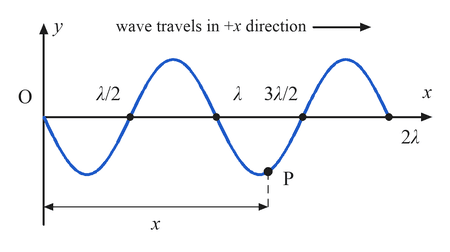
Step 4 — Explain double periodicity. At a fixed point the phase changes by ; this change reaches after a time . At a fixed instant the phase changes by along the wave; this change reaches over a distance . So the wave motion repeats itself after every period at a particular point, and after every wavelength along the wave at a particular instant. Being periodic in time and in space is called double periodicity.
Therefore, the propagation constant is ; since , a phase change of corresponds to a path difference of ; and "double periodicity" means the wave repeats after every period at a point and after every wavelength at an instant.