
Question 483 marksMedium
Explain the graphical representation of (i) transverse wave and (ii) longitudinal wave with suitable diagrams. Derive the equation of a progressive harmonic wave.
Confirming your payment
Sign up now and get 250 free tokens.
Waves: Wave Motion · Question 48 of 52
Explain the graphical representation of (i) transverse wave and (ii) longitudinal wave with suitable diagrams. Derive the equation of a progressive harmonic wave.
Solution:
Concept: A wave is represented graphically by plotting the displacement of the particles from their mean positions (along the -axis) against their equilibrium positions along the line of travel (along the -axis), at one instant.
Step 1 — Represent a transverse wave. In a transverse wave the particles are displaced at right angles to the line of travel, so the graph of displacement against distance has the same shape as the wave itself, with crests and troughs. The distance between two successive crests is the wavelength , and the greatest displacement is the amplitude .

Step 2 — Represent a longitudinal wave. In a longitudinal wave the particles are displaced along the line of travel. We take a displacement towards the right as positive and plot it upward. The graph is again a sine curve, though the displacements are really along the line. Points where the curve falls most steeply are compressions C, and points where it rises most steeply are rarefactions R.

Step 3 — Write the vibration of the particle at the origin. Let a harmonic wave travel along the direction from the origin O, with amplitude , period and speed . The particle at O performs simple harmonic motion:
Here is the angular frequency of the particle.
Step 4 — Find the lag of a particle at distance . The disturbance takes a time to reach a particle P at distance from O, as the figure shows. So P repeats the motion of O after this delay.
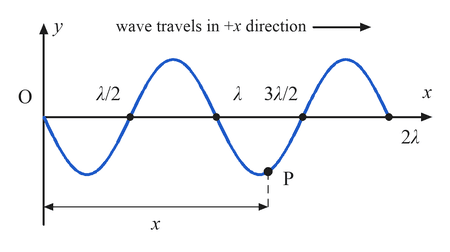
The displacement of P at time is the displacement O had at time :
Step 5 — Write the equation in standard forms. We use and to rewrite it:
With this becomes:
If the particle at O has an initial phase , the equation is ; for a wave in the direction, is replaced by .
Therefore, both waves are represented by sine-shaped displacement–distance graphs (for a longitudinal wave, displacement along the line is plotted upward), and the equation of a progressive harmonic wave travelling in the direction is , or .