
Question 463 marksEasy
What is a wave? What is (i) a longitudinal and (ii) a transverse wave? Give examples.
Confirming your payment
Sign up now and get 250 free tokens.
Waves: Wave Motion · Question 46 of 52
What is a wave? What is (i) a longitudinal and (ii) a transverse wave? Give examples.
Solution:
Concept: A wave carries energy from place to place without carrying matter; the two main kinds of mechanical wave differ in the direction in which the particles vibrate.
Step 1 — Define a wave. A wave is a disturbance produced in a medium by the repeated periodic vibrations of the particles of the medium about their equilibrium positions. The vibration is handed over from one particle to the next, so energy and information are transferred from one point to another, but the medium does not flow as a whole.
Step 2 — Define a longitudinal wave. A wave in which the particles of the medium vibrate along the direction in which the wave travels is called a longitudinal wave. It travels as alternate compressions and rarefactions, shown in the lower part of the figure.
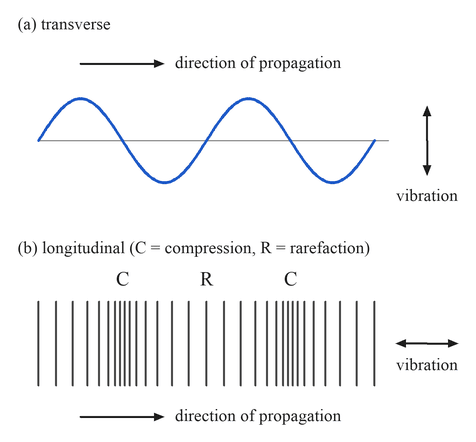
Examples: sound waves in air; a wave of compressions sent along a long helical spring (slinky) by pushing and pulling one end.
Step 3 — Define a transverse wave. A wave in which the particles of the medium vibrate at right angles to the direction in which the wave travels is called a transverse wave. It travels as crests and troughs, shown in the upper part of the figure.
Examples: a wave on a stretched string, such as a violin string or a rope jerked up and down; electromagnetic waves such as light, radio waves and X-rays (which need no medium).
Therefore, a wave is a disturbance passed on by the vibrations of the particles of a medium, carrying energy without matter; in a longitudinal wave (e.g. sound in air) the particles vibrate along the direction of propagation, and in a transverse wave (e.g. a wave on a string, light) they vibrate at right angles to it.