
Question 201 markEasy
When a wave propagates through a medium, what is the direction of vibrations of the particles, if the wave is (i) transverse and (ii) longitudinal?
Confirming your payment
Sign up now and get 250 free tokens.
Waves: Wave Motion · Question 20 of 52
When a wave propagates through a medium, what is the direction of vibrations of the particles, if the wave is (i) transverse and (ii) longitudinal?
Solution:
Concept: Waves are classified by comparing the direction in which the particles vibrate with the direction in which the wave travels, as the figure shows.
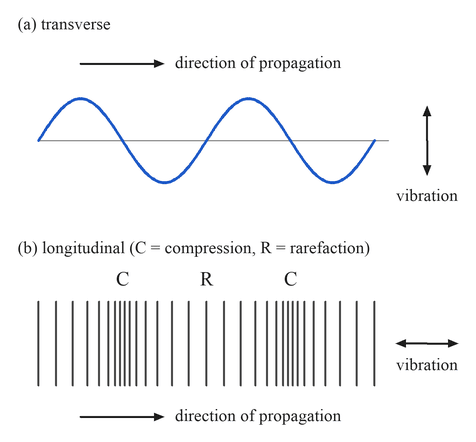
Step 1 — Transverse wave. In a transverse wave, such as a wave on a string, the particles vibrate at right angles to the direction in which the wave travels.
Step 2 — Longitudinal wave. In a longitudinal wave, such as sound in air, the particles vibrate back and forth along the direction in which the wave travels, forming compressions and rarefactions.
Therefore, (i) in a transverse wave the particles vibrate perpendicular to the direction of propagation, and (ii) in a longitudinal wave they vibrate parallel to it.