
Opening your dashboard
Class 11 Physics Chapter 23 Waves: Wave Motion: Competency-Based Questions (CBQ)
40 questions on Chapter 23, each worked through on its own page with the AI tutor. Class 11 Physics, ICSE 2026-27.
40 questions
1–4 marks · Mixed difficulty
- 13 marks
Question 1
Competency: Application
At a cricket stadium, the spectators make a "Mexican wave": each spectator stands up, raises both arms and sits down again a moment after the person beside them, so that a hump of standing people runs round the stand. Along one row the seats are apart, and each spectator stands up after the neighbour on one side. Each spectator stays up, out of the seat, for . The row runs all the way round the stadium, a distance of . (Hypothetical data.)
(a) Is the Mexican wave more like a transverse wave or a longitudinal wave? Explain what moves, and in which direction.
(b) Find the speed of the Mexican wave and the time it takes to go once round the stadium.
(c) Find the width of the hump, that is, the length of the row in which people are standing at any instant. Does any spectator travel round the stadium with the wave? Explain.
- 21 mark
Question 2
Competency: Analysis & Evaluation
A hotel near a busy road fits vacuum-insulated windows. In each window, two glass panes are held a fraction of a millimetre apart by a grid of tiny solid pillars, the narrow gap between them is pumped almost empty of air, and the edges of the two panes are sealed together.
Assertion (A): Some traffic noise still reaches the rooms through these windows.
Reason (R): Sound can pass from the outer pane to the inner pane through the tiny pillars and the sealed edges, which are solid.
- 31 mark
Question 3
Competency: Analysis & Evaluation
On a school science day, students stand 500 dominoes in a long line. When the first one is pushed, the dominoes topple one after another, and the toppling runs along the line at about . (Hypothetical data.) A student calls this a mechanical wave, like a pulse on a rope, but the teacher explains that it is not a mechanical wave of the kind studied in this chapter. Which observation best supports the teacher?
- 43 marks
Question 4
Competency: Application
In a demonstration, 25 identical trolleys stand in a straight line on a long, level track, each joined to the next by a light spring. The trolleys can roll only along the track. In equilibrium their centres are apart. The first five trolleys are shown in the figure.
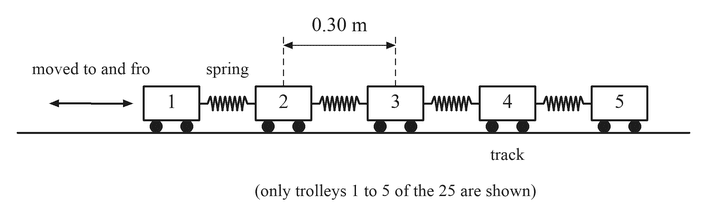
The teacher gives trolley 1 a quick push along the track, and the disturbance reaches trolley 25 after . The teacher then moves trolley 1 steadily to and fro along the track, making one complete oscillation every . (Hypothetical data.)
(a) What kind of wave travels along the line of trolleys? Explain.
(b) Find the speed of the wave, and the wavelength of the wave set up by the steady to-and-fro motion. How many spring gaps make up one wavelength?
(c) A student suggests sending a transverse wave along the same line by pushing trolley 1 sideways, across the track. Explain why this cannot work here.
- 51 mark
Question 5
Competency: Analysis & Evaluation
A loudspeaker sends a steady sound wave through the air in a long tube, in the direction. At one instant a student considers the layer of air at the centre of a compression.
Assertion (A): The layer of air at the centre of a compression is moving in the direction, the direction in which the wave travels.
Reason (R): At the centre of a compression the layers of air are crowded together more closely than anywhere else.
- 61 mark
Question 6
Competency: Analysis & Evaluation
A long steel rod is clamped at its middle. Tapping one end along the length of the rod makes it ring, and striking the end from the side makes the rod shake from side to side.
Assertion (A): A steel rod can carry both longitudinal waves and transverse waves.
Reason (R): Only solids can carry longitudinal waves.
- 73 marks
Question 7
Competency: Application
An angler standing on a pier in Kerala notices a long, smooth swell rolling in from the open sea, although the local weather is calm. The angler times the crests passing one of the pier's posts: from the moment one crest passes the post until the eighth crest after it passes, go by. A coastguard drone photographs the swell far out at sea, where its crests are apart. (Hypothetical data.)
(a) Find the time period and the frequency of the swell.
(b) Find the speed of the swell far out at sea, in and in .
(c) The angler's grandchild says that, since the swell travels so fast, the water of the open sea must be rushing towards the shore at that speed. Explain why the grandchild is wrong, and say what does travel towards the shore at this speed.
- 84 marks
Question 8
Competency: Application
To measure the speed of sound, a student connects a signal generator set at to a loudspeaker, and places two small microphones A and B in line with it on a bench, as shown. The signals from A and B are displayed one above the other on a double-beam oscilloscope.
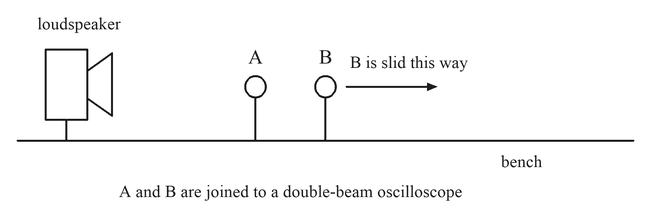
With B beside A, the two traces are in step (their crests are one above the other). The student then slides B slowly away from the loudspeaker, keeping A fixed. The traces drift out of step and come back into step again and again; when they have come back into step for the fifth time, B has moved . (Hypothetical data.)
(a) Explain why the traces come back into step each time B has moved a further wavelength from A.
(b) Find the wavelength and the speed of the sound.
(c) The generator is now set at . Starting from a position where the traces are in step, how far must B be moved to the nearest position where the traces are exactly out of step (a crest above a trough)?
- 91 mark
Question 9
Competency: Application
A student removes the turntable from a microwave oven, puts in a flat bar of chocolate, and runs the oven for a few seconds. The chocolate melts only in small spots. In this oven the microwaves set up a fixed pattern in which the hottest places are half a wavelength apart. The centres of neighbouring melted spots are apart, and the label on the oven gives the frequency of the microwaves as . (Hypothetical data.) The speed of the microwaves found from this experiment is about
- 104 marks
Question 10
Competency: Application
A vibrator at one end of a long stretched rope sends a steady transverse wave along it. A small felt pen is fixed to a point P of the rope, with its tip resting lightly on a long paper strip held upright beside the rope. A motor pulls the strip sideways, at right angles to the rope, at a steady , so as P moves up and down the pen draws the trace shown. The distance along the strip is measured from where the pen was at the start, and is the displacement of the pen from its mean position. (Hypothetical data.)

(a) Explain why this trace is a displacement–time graph of P, and find the time period and the frequency of the wave.
(b) State the amplitude of the wave.
(c) The wave travels along the rope at . Find its wavelength.
(d) The frequency of the vibrator is now doubled, with the same amplitude and the same paper speed. Describe how the new trace differs from the first one, giving the distance between its crests.
- 111 mark
Question 11
Competency: Analysis & Evaluation
A data logger joined to a motion sensor records the displacement of one marked point of a long stretched string, as a wave passes along the string, and plots it against time. The plot is a smooth sine curve.
Assertion (A): From this displacement–time graph alone, it is not possible to tell in which direction along the string the wave is travelling.
Reason (R): The particles of the string oscillate about their mean positions and do not travel along with the wave.
- 121 mark
Question 12
Competency: Analysis & Evaluation
Meera photographs a long stretched rope carrying a harmonic transverse wave and draws its shape at that instant as a displacement–distance graph. She marks four points on the curve: K and N are neighbouring crests, M is the trough between them, and L is where the rope crosses its undisturbed line between K and M.

Which one of her claims is correct?
- 134 marks
Question 13
Competency: Analysis & Evaluation
For Diwali, a long straight row of LED lamps is hung along a balcony, with the lamps apart. A controller sets the brightness of the lamp at distance from the first lamp as
Here is the full brightness of a lamp, is in metres and is in seconds. (Hypothetical data.)
(a) Show that the bright parts of this pattern move along the row. Find the direction in which they move, the wavelength of the pattern (and how many lamps it spans), and the speed of the pattern.
(b) The controller is reprogrammed so that the pattern moves twice as fast in the opposite direction, while each lamp goes through its bright–dark cycle as often as before. Write the new expression for .
(c) Is the moving pattern a mechanical wave? Does anything travel along the row from one lamp to the next? Explain.
- 144 marks
Question 14
Competency: Application
In a laboratory, a light string is joined at a knot K to a heavier string, whose far end is tied to a post, and the whole is kept taut, as shown. A vibrator at the free end of the light string, where , sends a wave along it towards K, which is from the vibrator. On the light string the wave is
Here and are in metres and is in seconds. Beyond K the wave goes on into the heavy string, where it travels at half the speed and has an amplitude of , and it is in step with the wave arriving at K. Part of the wave is also reflected at K; leave the reflected wave out of this question. (Hypothetical data.)
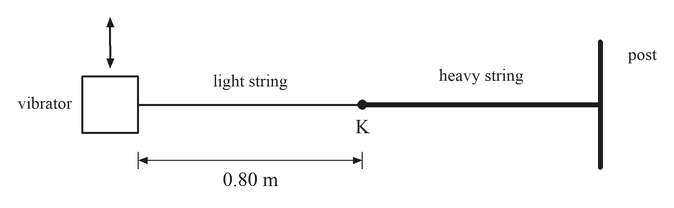
(a) Find the frequency, the wavelength and the speed of the wave on the light string.
(b) Explain why the wave on the heavy string has the same frequency. Taking as the distance from K along the heavy string, write the equation of the wave on the heavy string.
(c) Compare the greatest speeds of the particles of the two strings.
- 151 mark
Question 15
Competency: Analysis & Evaluation
A wave on a rope is described by , where and are in metres and is in seconds. (Hypothetical data.)
Assertion (A): In this equation the number 12 has the unit and the number 3.0 has the unit .
Reason (R): The phase of the wave is an angle, so each term in it must be an angle.
- 161 mark
Question 16
Competency: Application
Arjun makes a computer animation of a wave on a string using , with and in metres and in seconds. (Hypothetical data.) He wants the wave to travel twice as fast, while every point of the string still completes one oscillation in with the same amplitude. Which single change to the equation does this?
- 174 marks
Question 17
Competency: Analysis & Evaluation
Far out in the Bay of Bengal, where the sea is deep, a tsunami has a wavelength of and an amplitude of only . For such long waves the wave speed is , where is the depth of the sea; take . Treat the wave as harmonic, with the sea surface moving up and down as . (In such a wave the water also moves to and fro horizontally; here consider only the rise and fall of the surface.) (Hypothetical data.)
(a) Find the speed of the tsunami, in and in , and its time period.
(b) Find the greatest speed with which the sea surface rises or falls as the wave passes, and compare it with the wave speed.
(c) Find the greatest slope of the sea surface. Hence explain why the crew of a ship out at sea would hardly notice the tsunami passing beneath them, although it travels almost as fast as a jet airliner.
- 181 mark
Question 18
Competency: Analysis & Evaluation
A vibrator sends a harmonic wave along a long stretched string. Without changing its frequency, the vibrator is adjusted so that the amplitude of the wave is doubled; the amplitude stays small compared with the wavelength. The string and its tension are not changed.
Assertion (A): The wave now travels along the string twice as fast.
Reason (R): Each particle of the string now reaches twice the greatest speed it had before.
- 191 mark
Question 19
Competency: Analysis & Evaluation
A photograph of a long string carrying a harmonic transverse wave, travelling in the direction, shows that at some points the string is momentarily horizontal (its slope is zero).
Assertion (A): The particles of the string at these points are momentarily at rest.
Reason (R): The string is horizontal only at points that are at their mean positions.
- 201 mark
Question 20
Competency: Application
In the wave pool of a water park, a machine sends a steady train of waves across the pool, one every . A floating rubber ring rises and falls as the waves pass, and a phone strapped to it shows that its greatest upward speed is . Treat the motion of the ring as the simple harmonic up-and-down motion of the water surface. (Hypothetical data.) The height from a trough of these waves to the next crest is about
- 213 marks
Question 21
Competency: Application
In a gym, an athlete trains with a heavy "battle rope" of mass per unit length , whose far end is tied to a post. The athlete moves the free end up and down 2.5 times a second, sending waves of amplitude along the rope at . The power carried by a harmonic wave along a rope is , where is the frequency, the amplitude, the mass per unit length and the wave speed; this is the rope form of the intensity formula, with in place of the density. Ignore any loss of energy along the rope. (Hypothetical data.)
(a) Find the wavelength of the waves on the rope.
(b) Find the power carried along the rope, and the energy it carries in a burst of exercise.
(c) Keeping the frequency the same, the athlete wants to send twice the power along the rope. By what factor must the athlete change the amplitude, and what is the new amplitude?
- 223 marks
Question 22
Competency: Application
Above the Earth's atmosphere, sunlight falling normally on a surface brings energy at a rate of about . The average distance of the Earth from the Sun is , and that of Mars is . Treat the Sun as a small source sending out light equally in all directions, with nothing absorbed on the way.
(a) Find the total power given out by the Sun.
(b) Find the intensity of sunlight at the average distance of Mars.
(c) A solar panel of area , facing the Sun just above the Earth's atmosphere, collects a certain power. What area of the same kind of panel, facing the Sun at the distance of Mars, collects the same power?
- 231 mark
Question 23
Competency: Analysis & Evaluation
A student is revising the terms used for the energy carried by a sound wave.
Assertion (A): The intensity of a sound wave is the sound energy contained in each unit volume of the air through which it passes.
Reason (R): The intensity of a wave is equal to its energy density multiplied by the speed of the wave.
- 241 mark
Question 24
Competency: Analysis & Evaluation
A laser pointer gives out a beam of power with a cross-section of area , and the beam hardly spreads. A filament bulb radiates , mostly as infrared, equally in all directions; treat it as a point source. (Hypothetical data.) The intensity of the laser beam is about how many times the intensity of the bulb's radiation at from the bulb?
- 251 mark
Question 25
Competency: Analysis & Evaluation
A doctor hears a patient's heartbeat clearly through a stethoscope, but hardly at all with the doctor's ear held from the chest. (Hypothetical data.) The sound inside the stethoscope's tube travels through air, just as it does in the room. The main reason the stethoscope helps is that
- 263 marks
Question 26
What is the amplitude, the wavelength and velocity of the wave represented by , and are in metre?
- 273 marks
Question 27
The equation of a transverse wave travelling along -axis is given by where and are represented in centimetres and in seconds. Find the amplitude, frequency, velocity and wavelength of the wave.
- 283 marks
Question 28
A plane progressive wave is given by
Find the wavelength and the phase difference between two points at m and m. Also find the maximum particle velocity.
- 293 marks
Question 29
The phase velocity of a wave of frequency 500 Hz is 400 m/s. (i) How far apart are two points out of phase? (ii) Calculate the phase difference between two displacements at a certain point at times s apart.
- 303 marks
Question 30
A wave has an amplitude of 0.02 m, frequency 660 Hz and velocity 330 m/s. If the wave propagates along the negative -direction, what is equation for the wave?
- 313 marks
Question 31
Given metre. Calculate the wavelength and velocity of the wave represented by this equation.
- 323 marks
Question 32
The equation for the transverse wave travelling along a string is with lengths expressed in cm and time period in s. Calculate the wave velocity and maximum particle velocity.
- 333 marks
Question 33
Obtain the equation of a harmonic wave travelling in the negative -direction with the characteristics given below. Amplitude is 4.5 cm, wavelength is 20 cm and wave velocity is 40 m s.
- 343 marks
Question 34
A plane progressive wave propagating through air has an amplitude of m and a frequency of 480 Hz. Calculate the energy density and intensity of wave. Given velocity of wave m s and density of air kg m.
- 353 marks
Question 35
The intensity of a wave propagating through air is 0.22 W m. If the frequency of the wave is 500 Hz, calculate the displacement amplitude. [Density of air kg/m and speed of sound in air m/s]
- 363 marks
Question 36
For a plane harmonic sound wave of frequency 1000 Hz in air, the pressure amplitude is 1 N/m. What is the displacement amplitude? Atmospheric pressure is N/m, . Velocity of sound in air is 340 m s.
- 373 marks
Question 37
A wave travelling along the length of a string is shown in the given figure. Using the scale on the given axis, find
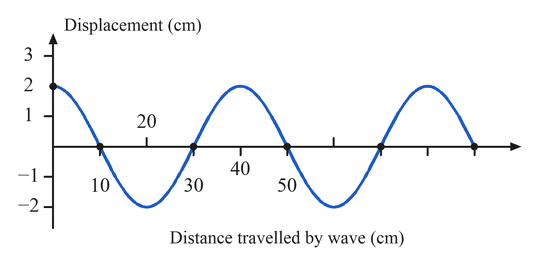
(i) The amplitude of the wave
(ii) The wavelength of the wave
(iii) If the frequency of the wave is 10 Hz, what is the speed of the wave?
(iv) What is the initial phase of the wave?
- 381 mark
Question 38
Competency: Analysis & Evaluation
In a darkened laboratory, a ripple tank is lit by a lamp that gives very short flashes of light. A straight dipper vibrating times a second sends straight ripples across the water, and in steady light the crests are seen apart. The lamp is now set to flash times a second. At each flash the eye sees a still view of the crests and, since all the crests look alike, it links each crest with the nearest crest in the view before. (Hypothetical data.)
How do the crests appear to move under the flashing lamp?
- 392 marks
Question 39
Competency: Application
Two astronauts, Kavya and Rohan, are working on the surface of the Moon, which has practically no atmosphere. Each wears a helmet filled with air, and they normally talk to each other by radio. One day the microphone in Kavya's helmet stops working. Standing from Rohan, she shouts as loudly as she can inside her helmet, but Rohan hears nothing, although his radio still picks up signals from the lunar base far away. Rohan then presses the front of his helmet firmly against the front of Kavya's helmet, and now he hears her voice faintly.
(a) Explain why Rohan heard nothing when he stood away, although radio signals reached him from much farther away.
(b) Explain how Kavya's voice reaches Rohan's ears when the two helmets are pressed together.
- 404 marks
Question 40
Competency: Analysis & Evaluation
In a school laboratory, a small ball-ended dipper vibrates steadily up and down at the centre of a large, shallow ripple tank. It sends circular ripples outwards over the water surface, so the energy of the ripples spreads out in two dimensions only. A student measures the amplitude of the ripples at different distances from the dipper, as given in the table. Assume that the ripples lose no energy to the water, and that the energy carried by a ripple is proportional to the square of its amplitude, as for any harmonic wave. (Hypothetical data.)
Distance from the dipper, (cm) 5.0 10.0 20.0 40.0 Amplitude, (mm) 2.0 1.4 1.0 0.70 (a) Explain why the amplitude of the ripples becomes smaller as they move outwards, even though no energy is lost.
(b) Riya claims that is inversely proportional to , as it is for the sound from a small source in open air. Ravi claims that is inversely proportional to . Use the data to decide who is right.
(c) Using the rule that fits the data, predict how far from the dipper the ripples must travel for their amplitude to fall to one-quarter of its value at . For a small sound source in open air, how many times farther must a listener go for the amplitude to fall to one-quarter? Explain the difference.