
Competency: Application
To measure the speed of sound, a student connects a signal generator set at to a loudspeaker, and places two small microphones A and B in line with it on a bench, as shown. The signals from A and B are displayed one above the other on a double-beam oscilloscope.
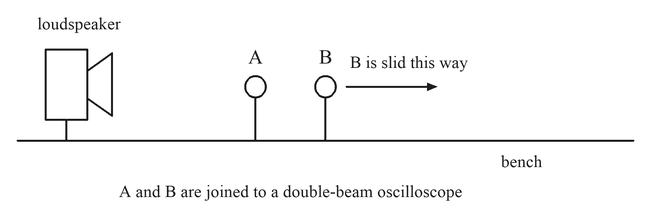
With B beside A, the two traces are in step (their crests are one above the other). The student then slides B slowly away from the loudspeaker, keeping A fixed. The traces drift out of step and come back into step again and again; when they have come back into step for the fifth time, B has moved . (Hypothetical data.)
(a) Explain why the traces come back into step each time B has moved a further wavelength from A.
(b) Find the wavelength and the speed of the sound.
(c) The generator is now set at . Starting from a position where the traces are in step, how far must B be moved to the nearest position where the traces are exactly out of step (a crest above a trough)?