
Question 412 marksMedium
For a wave propagating in the positive -direction, the instantaneous displacement of the particle is
What is the significance of the negative sign? If positive sign is used, what does it represent?
Confirming your payment
Sign up now and get 250 free tokens.
Waves: Wave Motion · Question 41 of 52
For a wave propagating in the positive -direction, the instantaneous displacement of the particle is
What is the significance of the negative sign? If positive sign is used, what does it represent?
Solution:
Concept: The particle at the origin O vibrates as . The disturbance takes a time to travel from O to a particle P at distance , as the figure shows.
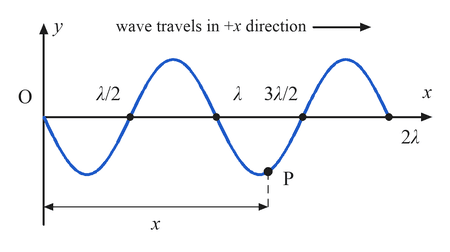
Step 1 — Explain the negative sign. The equation says that the displacement of P at time equals the displacement that O had at the earlier time . So whatever vibration P makes at an instant was made by the particle at O seconds earlier: P lags behind O. The lag in phase works out as follows, using :
This lag grows with distance from O. This is what happens when the wave moves from O towards P, in the positive -direction.
Step 2 — Explain a positive sign. With a positive sign, , the particle at repeats now what O will do seconds later. So particles at larger are ahead in phase, which means the disturbance reaches them first: the wave travels in the negative -direction.
Therefore, the negative sign shows that the particle at distance lags behind the particle at the origin by a time , so the wave moves in the positive -direction; a positive sign represents the same wave travelling in the negative -direction.