
Opening your dashboard
Class 11 Biology Chapter 14: Enzymes Solutions
59 textbook questions with step-by-step answers, free to read, for ISC 2026-27.
Get talked through Ch 14, not just shown the answer
Reading a finished solution is not the same as being able to do it. The AI tutor takes one question at a time and works it with you, in your own words, until you can.
- Ask it out loud, in your own words
- It gives you the next step, not the answer
- Stuck on part (ii)? Start there
59 questions with solutions
1–5 marks · Mixed difficulty
- 11 mark
Question 1
What is the chemical nature of enzymes?
Solve with AIWritten solution
Solution:
Concept: Enzymes are biological catalysts made by living cells.
Step 1 — What is asked: We must recall the fact the question asks for.
Step 2 — The fact: Almost every enzyme is made of one or more polypeptide chains, so enzymes are proteins (proteinaceous); many also carry a non-protein co-factor.
Step 3 — Answer: So enzymes are proteins.
Watch out: Almost all enzymes are proteins, but a few RNA molecules (ribozymes) also act as enzymes; for example, the peptidyl transferase that joins amino acids in the ribosome is part of its rRNA.
Therefore, enzymes are proteins.
- 21 mark
Question 2
What do the enzymes do, lower or increase the activation energy?
Solve with AIWritten solution
Solution:
Concept: Activation energy is the energy reactants must gain before they can react.
Step 1 — What is asked: We must recall the fact the question asks for.
Step 2 — The fact: By forming an enzyme–substrate complex, an enzyme provides an easier path for the reaction, so it lowers the activation energy.
Step 3 — Answer: So enzymes lower the activation energy.
Therefore, enzymes lower the activation energy.
- 31 mark
Question 3
State two important differences between catalysts and enzymes.
Solve with AIWritten solution
Solution:
Concept: Enzymes are biological catalysts, but they differ from inorganic catalysts in several ways.
Step 1 — What is asked: We must recall the fact the question asks for.
Step 2 — The fact: Two differences stand out. (a) Enzymes are extremely sensitive to changes in pH and temperature, while inorganic catalysts are much less sensitive. (b) The activity of enzymes can be regulated by specific molecules (activators and inhibitors), while inorganic catalysts have no such control (their activity is changed only by promoters and catalyst poisons).
Step 3 — Answer: So enzymes are highly sensitive to pH and temperature and can be regulated, while inorganic catalysts are much less sensitive and have no such control.
Note: If the intended word is “similarities”, two answers are: both remain unchanged at the end of the reaction, and both are needed only in small amounts.
Therefore, enzymes are highly sensitive to pH and temperature and can be regulated, while inorganic catalysts are much less sensitive and have no such control.
- 41 mark
Question 4
State two important differences between catalysts and enzymes
Solve with AIWritten solution
Solution:
Concept: Enzymes and inorganic catalysts (such as platinum, iron, nickel or manganese dioxide) differ in chemical nature and in specificity.
Step 1 — What is asked: We must recall the fact the question asks for.
Step 2 — The fact: Two differences stand out. (a) Enzymes are (almost always) proteins with a complex 3-D structure, while inorganic catalysts are simple inorganic substances such as metals, metal oxides or metal ions. (b) Enzymes are very specific to their substrate, while an inorganic catalyst can often speed up many different reactions.
Step 3 — Answer: So enzymes are specific proteins, while inorganic catalysts are simple, much less specific substances such as metals, metal oxides or ions.
Therefore, enzymes are specific proteins, while inorganic catalysts are simple, much less specific substances such as metals, metal oxides or ions.
- 51 mark
Question 5
What is an active site?
Solve with AIWritten solution
Solution:
Concept: Only a small part of a large enzyme molecule touches the substrate.
Step 1 — What is asked: We must recall the fact the question asks for.
Step 2 — The fact: The active site is the small region (pocket) of the enzyme, formed by a few (about 3–12) amino acids, that comes into direct contact with the substrate; the substrate binds there and is converted into products.
Step 3 — Answer: So the active site is the region of the enzyme where the substrate binds and reacts.
Therefore, the active site is the region of the enzyme where the substrate binds and reacts.
- 61 mark
Question 6
At which temperature do the enzymes work the best?
Solve with AIWritten solution
Solution:
Concept: Each enzyme has an optimum temperature at which its rate is highest.
Step 1 — What is asked: We must recall the fact the question asks for.
Step 2 — The fact: For the enzymes of the human body the optimum is close to normal body temperature, about 37 °C (98.6 °F); most work best between about 37 °C and 40 °C.
Step 3 — Answer: So our enzymes work best at about body temperature, 37 °C.
Note: A temperature of 37 °C converts to 98.6 °F. A body temperature of 38.6 °C would be a fever. Normal body temperature varies a little between people and through the day, so a value such as 98.4 °F (about 36.9 °C) is also normal.
Therefore, our enzymes work best at about body temperature, 37 °C.
- 71 mark
Question 7
What happens to enzymes if the temperature is increased?
Solve with AIWritten solution
Solution:
Concept: Temperature affects both the speed of molecules and the shape of the enzyme.
Step 1 — What is asked: We must recall the fact the question asks for.
Step 2 — The fact: Up to the optimum, a rise in temperature makes molecules collide more often, so the rate rises. Above the optimum, heat breaks the bonds that hold the enzyme's shape, and the enzyme is denatured.
Step 3 — Answer: So above the optimum temperature the enzyme is denatured and stops working.
Therefore, above the optimum temperature the enzyme is denatured and stops working.
- 81 mark
Question 8
What is the meaning of the term enzymes get 'denatured' at huge temperature?
Solve with AIWritten solution
Solution:
Concept: An enzyme works only while it keeps its folded 3-D shape.
Step 1 — What is asked: We must recall the fact the question asks for.
Step 2 — The fact: At a very high temperature the weak bonds that hold the folded shape break, so the enzyme loses its 3-D structure and the shape of its active site. The substrate can no longer fit, and the change is usually permanent.
Step 3 — Answer: So denatured means the enzyme has lost its 3-D shape (and active site) and can no longer catalyse the reaction.
Note: It is the folded (tertiary) shape, and in many-chain enzymes also the quaternary shape, that is lost; enzymes made of a single chain have no quaternary structure.
Therefore, denatured means the enzyme has lost its 3-D shape (and active site) and can no longer catalyse the reaction.
- 91 mark
Question 9
What happens to an enzyme at low temperature?
Solve with AIWritten solution
Solution:
Concept: Low temperature slows molecules down but does not destroy the enzyme.
Step 1 — What is asked: We must recall the fact the question asks for.
Step 2 — The fact: At a low temperature the enzyme works only slowly, and near freezing it is almost inactive: molecules move slowly and collide less often, so the rate is very low. The enzyme is not denatured, so it works again when warmed.
Step 3 — Answer: So at low temperature an enzyme is temporarily inactivated, not destroyed.
Therefore, at low temperature an enzyme is temporarily inactivated, not destroyed.
- 101 mark
Question 10
What is lock and key hypothesis?
Solve with AIWritten solution
Solution:
Concept: The lock and key hypothesis was put forward by Emil Fischer in 1894.
Step 1 — What is asked: We must recall the fact the question asks for.
Step 2 — The fact: It states that the active site of an enzyme has a definite, rigid shape that exactly fits the shape of its substrate, as a key fits a lock; the two form an enzyme–substrate complex.
Step 3 — Answer: So in the lock and key hypothesis a substrate of matching shape fits the rigid active site like a key in a lock.
Therefore, in the lock and key hypothesis a substrate of matching shape fits the rigid active site like a key in a lock.
- 111 mark
Question 11
What is induced fit hypothesis?
Solve with AIWritten solution
Solution:
Concept: The induced fit hypothesis was put forward by Koshland in 1958.
Step 1 — What is asked: We must recall the fact the question asks for.
Step 2 — The fact: It states that the active site does not at first have the exact shape of the substrate; when the substrate binds, it induces a change in the shape of the active site so that the two fit closely.
Step 3 — Answer: So in induced fit the substrate makes the active site change shape to fit it.
Therefore, in induced fit the substrate makes the active site change shape to fit it.
- 121 mark
Question 12
If pH and temperature are kept constant, does the rate of reaction keep increasing with increase in substrate concentration?
Solve with AIWritten solution
Solution:
Concept: Each enzyme molecule has a limited number of active sites.
Step 1 — What is asked: We must recall the fact the question asks for.
Step 2 — The fact: No. The rate rises at first, but once all active sites are occupied (the enzyme is saturated), extra substrate has nowhere to bind and the rate stays constant at its maximum.
Step 3 — Answer: So no; the rate rises up to a maximum and then stays constant.
Therefore, no; the rate rises up to a maximum and then stays constant.
- 131 mark
Question 13
What is the reason for the rate of reaction to stable at a point?
Solve with AIWritten solution
Solution:
Concept: An enzyme can process only as many substrate molecules as it has free active sites.
Step 1 — What is asked: We must recall the fact the question asks for.
Step 2 — The fact: At high substrate concentration, all the active sites of the enzyme are occupied at every moment; the enzyme is saturated, so adding more substrate cannot raise the rate.
Step 3 — Answer: So the rate becomes stable because all active sites are saturated with substrate.
Therefore, the rate becomes stable because all active sites are saturated with substrate.
- 141 mark
Question 14
Does pH have any effect on enzymes?
Solve with AIWritten solution
Solution:
Concept: A change in pH affects the charges on the amino acids of the enzyme.
Step 1 — What is asked: We must recall the fact the question asks for.
Step 2 — The fact: Yes. Each enzyme works best at its own optimum pH (pepsin about 2, trypsin about 8). A change in pH alters the active site, and an extreme pH can denature the enzyme.
Step 3 — Answer: So yes; each enzyme works best at its optimum pH and its activity falls on either side.
Therefore, yes; each enzyme works best at its optimum pH and its activity falls on either side.
- 151 mark
Question 15
What does an inhibitor do in active site competitive inhibition?
Solve with AIWritten solution
Solution:
Concept: A competitive inhibitor resembles the substrate.
Step 1 — What is asked: We must recall the fact the question asks for.
Step 2 — The fact: The inhibitor binds to the active site in place of the substrate, so the substrate cannot bind and no product is formed from that enzyme molecule while the inhibitor is there.
Step 3 — Answer: So the competitive inhibitor occupies the active site and blocks the substrate.
Therefore, the competitive inhibitor occupies the active site and blocks the substrate.
- 161 mark
Question 16
Does inhibitor alter the structure of enzyme?
Solve with AIWritten solution
Solution:
Concept: Inhibitors act in two main ways: by blocking the active site or by changing the enzyme's shape.
Step 1 — What is asked: We must recall the fact the question asks for.
Step 2 — The fact: A competitive inhibitor only occupies the active site, so it does not alter the structure of the enzyme. A non-competitive inhibitor binds elsewhere and does change the enzyme's structure.
Step 3 — Answer: So no for a competitive inhibitor; a non-competitive inhibitor does alter the enzyme's structure.
Therefore, no for a competitive inhibitor; a non-competitive inhibitor does alter the enzyme's structure.
- 171 mark
Question 17
What happens to the action site of the enzyme in non-competitive inhibition?
Solve with AIWritten solution
Solution:
Concept: A non-competitive inhibitor binds the enzyme at a site other than the active site.
Step 1 — What is asked: We must recall the fact the question asks for.
Step 2 — The fact: The inhibitor changes the shape of the enzyme, so the active site is altered; even if the substrate attaches, it is not converted into product.
Step 3 — Answer: So the active site is altered and the enzyme cannot form the product.
Note: The words “action site” in the question mean the active site.
Therefore, the active site is altered and the enzyme cannot form the product.
- 181 mark
Question 18
How does cyanide affect the enzymes at active sites?
Solve with AIWritten solution
Solution:
Concept: Cyanide is a non-competitive inhibitor of the respiratory enzyme cytochrome oxidase.
Step 1 — What is asked: We must recall the fact the question asks for.
Step 2 — The fact: Cyanide combines with the iron of the haem prosthetic group of cytochrome oxidase, so the enzyme can no longer pass electrons to oxygen, and in animal cells the electron transport chain stops.
Step 3 — Answer: So cyanide binds the prosthetic group of cytochrome oxidase and stops its activity (non-competitive inhibition).
Note: Cyanide is the usual textbook example of a non-competitive inhibitor because adding more substrate does not reverse it. Strictly, it binds the iron of haem a in the oxidised (Fe) form of cytochrome oxidase, at the centre where oxygen is reduced, rather than at a separate site; heavy-metal ions fit the 'binds elsewhere' description better.
Therefore, cyanide binds the prosthetic group of cytochrome oxidase and stops its activity (non-competitive inhibition).
- 191 mark
Question 19
Which kind of inhibition reaction is reversible?
Solve with AIWritten solution
Solution:
Concept: Some inhibitors can be removed from the enzyme easily.
Step 1 — What is asked: We must recall the fact the question asks for.
Step 2 — The fact: Competitive inhibition is reversible: because the inhibitor and substrate compete for the same site, raising the substrate concentration pushes the inhibitor out.
Step 3 — Answer: So competitive inhibition is reversible (by increasing substrate concentration).
Note: Competitive inhibition is not the only reversible kind. Non-competitive and allosteric inhibitors that bind loosely (without covalent bonds) are also reversible, because removing the inhibitor restores activity. Competitive inhibition is the kind that can also be reversed simply by adding more substrate. Inhibitors that bind permanently by covalent bonds cause irreversible inhibition.
Therefore, competitive inhibition is reversible (by increasing substrate concentration).
- 201 mark
Question 20
Which suffix (at the end) of the name signifies an enzyme?
Solve with AIWritten solution
Solution:
Concept: Most enzyme names are made by adding a suffix to the name of the substrate (sucrase) or of the kind of reaction (oxidase), or to both (succinate dehydrogenase).
Step 1 — What is asked: We must recall the fact the question asks for.
Step 2 — The fact: The suffix -ase marks an enzyme, e.g. hexokinase, sucrase, lipase.
Step 3 — Answer: So the suffix -ase signifies an enzyme.
Watch out: A few enzymes keep older names without this suffix, such as pepsin, trypsin and rennin.
Therefore, the suffix -ase signifies an enzyme.
- 211 mark
Question 21
What do hydrolases do?
Solve with AIWritten solution
Solution:
Concept: Enzyme classes are named after the reaction they catalyse.
Step 1 — What is asked: We must recall the fact the question asks for.
Step 2 — The fact: Hydrolases break a complex molecule into two products by adding water (hydrolysis), e.g. sucrase splits sucrose into glucose and fructose.
Step 3 — Answer: So hydrolases split molecules into two products by hydrolysis.
Therefore, hydrolases split molecules into two products by hydrolysis.
- 221 mark
Question 22
Which kind of enzymes join two molecules together?
Solve with AIWritten solution
Solution:
Concept: Enzyme classes are named after the reaction they catalyse.
Step 1 — What is asked: We must recall the fact the question asks for.
Step 2 — The fact: Ligases (synthetases) join two molecules by forming new covalent bonds, using energy from ATP.
Step 3 — Answer: So ligases join two molecules together.
Therefore, ligases join two molecules together.
- 231 mark
Question 23
What do isomerases do?
Solve with AIWritten solution
Solution:
Concept: An isomer has the same atoms as another molecule, arranged differently.
Step 1 — What is asked: We must recall the fact the question asks for.
Step 2 — The fact: Isomerases rearrange the structure of a molecule to form its isomer (optical, geometric or positional), e.g. glucose-6-phosphate into fructose-6-phosphate.
Step 3 — Answer: So isomerases convert a molecule into its isomer.
Therefore, isomerases convert a molecule into its isomer.
- 241 mark
Question 24
Which enzymes break the bonds without hydrolysis?
Solve with AIWritten solution
Solution:
Concept: Enzyme classes are named after the reaction they catalyse.
Step 1 — What is asked: We must recall the fact the question asks for.
Step 2 — The fact: Lyases break covalent bonds and remove groups without adding water, often leaving a double bond, e.g. decarboxylases.
Step 3 — Answer: So lyases break bonds without hydrolysis.
Note: The class is called lyases; “lysis” is not the name of an enzyme class.
Therefore, lyases break bonds without hydrolysis.
- 251 mark
Question 25
Give one example of a transferase.
Solve with AIWritten solution
Solution:
Concept: A transferase moves a group from one molecule to another.
Step 1 — What is asked: We must recall the fact the question asks for.
Step 2 — The fact: Hexokinase transfers a phosphate group from ATP to glucose: glucose + ATP gives glucose-6-phosphate + ADP.
Step 3 — Answer: So hexokinase is an example of a transferase.
Therefore, hexokinase is an example of a transferase.
- 261 mark
Question 26
Name the enzyme involved in the following reaction
Solve with AIWritten solution
Solution:
Concept: Joining two molecules by a new covalent bond is the work of a ligase.
Step 1 — What is asked: We must recall the fact the question asks for.
Step 2 — The fact: The enzyme named on the arrow is pyruvate carboxylase. It joins CO to pyruvate (using ATP) to form oxaloacetate, so it belongs to the class ligases.
Step 3 — Answer: So the enzyme is pyruvate carboxylase, a ligase.
Therefore, the enzyme is pyruvate carboxylase, a ligase.
- 271 mark
Question 27
What is a coenzyme?
Solve with AIWritten solution
Solution:
Concept: Co-factors are non-protein parts of enzymes.
Step 1 — What is asked: We must recall the fact the question asks for.
Step 2 — The fact: A coenzyme is an organic co-factor that is only loosely and briefly bound to the apoenzyme during catalysis, e.g. NAD, NADP, ATP, coenzyme A.
Step 3 — Answer: So a coenzyme is an organic, loosely bound co-factor of an enzyme.
Therefore, a coenzyme is an organic, loosely bound co-factor of an enzyme.
- 281 mark
Question 28
What is an apoenzyme?
Solve with AIWritten solution
Solution:
Concept: A conjugated enzyme has a protein part and a non-protein part.
Step 1 — What is asked: We must recall the fact the question asks for.
Step 2 — The fact: The apoenzyme is the protein part of such an enzyme, without its co-factor; on its own it is inactive.
Step 3 — Answer: So an apoenzyme is the protein part of an enzyme without its co-factor.
Therefore, an apoenzyme is the protein part of an enzyme without its co-factor.
- 291 mark
Question 29
Which Co-factor brings about the change at the active site of enzyme?
Solve with AIWritten solution
Solution:
Concept: Co-factors differ in how firmly they are bound to the enzyme.
Step 1 — What is asked: We must recall the fact the question asks for.
Step 2 — The fact: The prosthetic group, an organic co-factor tightly bound to the enzyme, forms part of the active site, e.g. haem in catalase and peroxidase.
Step 3 — Answer: So the prosthetic group is the co-factor that forms part of the active site.
Therefore, the prosthetic group is the co-factor that forms part of the active site.
- 301 mark
Question 30
What is a holoenzyme?
Solve with AIWritten solution
Solution:
Concept: Many enzymes need a non-protein part to be active.
Step 1 — What is asked: We must recall the fact the question asks for.
Step 2 — The fact: A holoenzyme is the complete, active enzyme: the protein part (apoenzyme) together with its non-protein part (co-factor).
Step 3 — Answer: So holoenzyme = apoenzyme + co-factor.
Note: The co-factor may be a coenzyme, a prosthetic group or a metal ion, not only a coenzyme.
Therefore, holoenzyme = apoenzyme + co-factor.
- 312 marks
Question 31
Give various parts of an enzyme.
Solve with AIWritten solution
Solution:
Concept: Many enzymes are conjugated: they have a protein part and a non-protein part.
Step 1 — What is asked: We need to answer the question point by point.
Step 2 — Protein part: The apoenzyme is the protein part of the enzyme; it carries the active site but is inactive on its own.
Step 3 — Non-protein part: The co-factor is the non-protein part. It is of three types: coenzymes (organic, loosely bound, e.g. NAD, NADP), prosthetic groups (organic, tightly bound, e.g. haem, FAD) and inorganic metal ions (e.g. Zn in carboxypeptidase).
Step 4 — Whole enzyme: Together they form the active holoenzyme: holoenzyme = apoenzyme + co-factor.
Therefore, an enzyme consists of an apoenzyme (protein) and a co-factor (coenzyme, prosthetic group or metal ion), which together form the holoenzyme.
- 322 marks
Question 32
Define 'lock and key' hypothesis in a few lines.
Solve with AIWritten solution
Solution:
Concept: The lock and key hypothesis was proposed by Emil Fischer in 1894.
Step 1 — What is asked: We need to answer the question point by point.
Step 2 — The idea: The active site of an enzyme has a definite, rigid shape. Only a substrate whose shape is complementary to it can fit, just as only the right key fits a lock.
Step 3 — What follows: The substrate fits the active site and forms an enzyme–substrate complex; this lowers the activation energy, the substrate is changed into products, and the products leave the enzyme unchanged.
Step 4 — Figure: The model is shown in part (a) of the figure below.
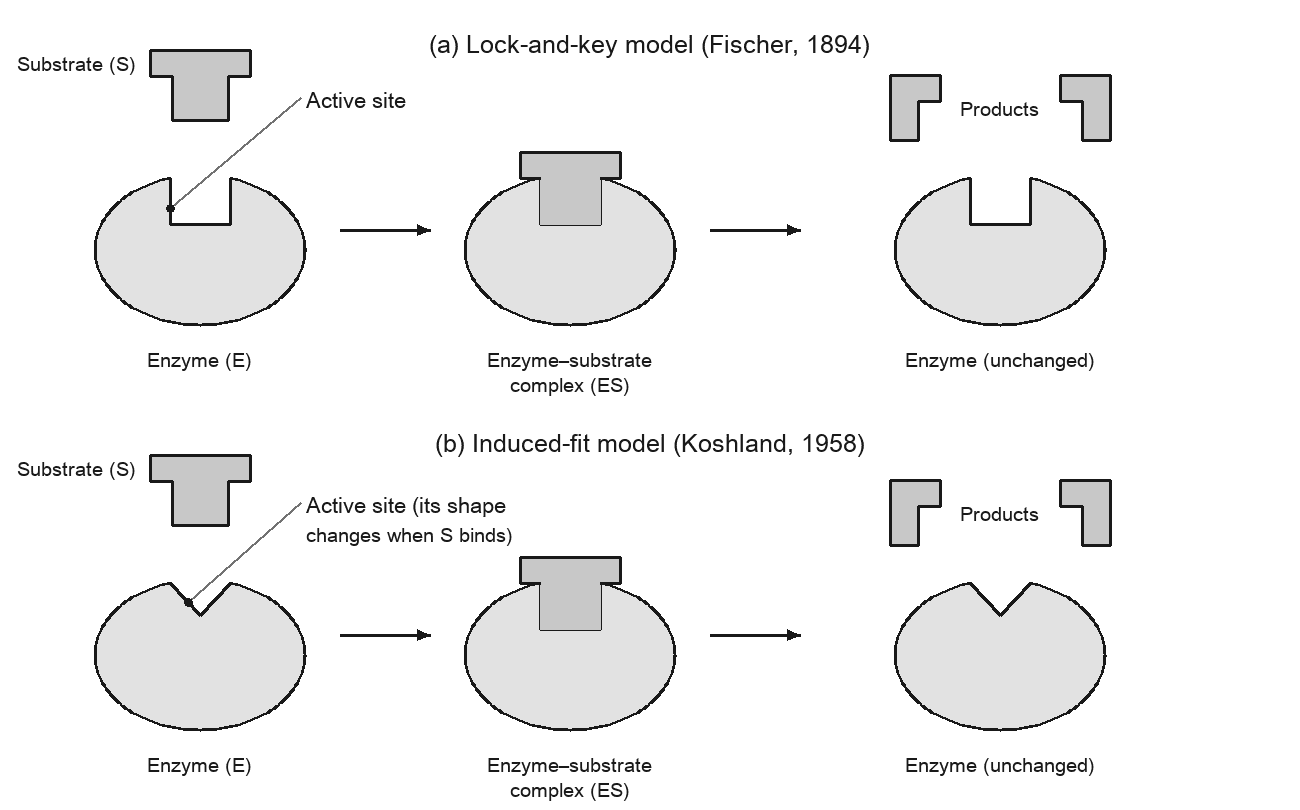
Therefore, the lock and key hypothesis says the substrate fits a rigid, complementary active site like a key in a lock, forming an ES complex.
- 332 marks
Question 33
Give an example to explain that the rate of enzymatic reaction is much faster.
Solve with AIWritten solution
Solution:
Concept: Enzymes speed up reactions enormously by lowering the activation energy.
Step 1 — What is asked: We need to answer the question point by point.
Step 2 — The reaction: Carbon dioxide combines with water to form carbonic acid: CO + HO gives HCO.
Step 3 — Without the enzyme: Only about 200 molecules of carbonic acid are formed in an hour.
Step 4 — With the enzyme: With carbonic anhydrase, present in the cytoplasm (for example of red blood cells), about 600,000 molecules are formed every second.
Step 5 — Compare: We first find how many molecules the enzyme gives in one hour (3600 seconds):
Then we divide by the 200 molecules formed in an hour without the enzyme:
So the enzyme makes the reaction about ten million times faster.
Therefore, carbonic anhydrase makes the CO + HO reaction about ten million times faster.
- 342 marks
Question 34
Explain the 'trivial' name of enzyme glucose 6 phosphatase.
Solve with AIWritten solution
Solution:
Concept: A full trivial enzyme name has three parts: the substrate, the kind of reaction, and the suffix -ase; many names are shorter, adding -ase to the substrate alone (sucrase) or to the reaction alone (oxidase).
Step 1 — What is asked: We need to answer the question point by point.
Step 2 — First part: “Glucose 6” names the substrate, glucose-6-phosphate, on which the enzyme acts.
Step 3 — Second part: “Phosphat” names the kind of reaction: removal of the phosphate group.
Step 4 — Suffix: “-ase” shows that the substance is an enzyme.
Step 5 — Its class: The enzyme removes phosphate by adding water (glucose-6-phosphate + HO gives glucose + phosphate), so it is a hydrolase.
Note: The enzyme that turns glucose-6-phosphate into fructose-6-phosphate is a different enzyme, glucose-6-phosphate isomerase; glucose-6-phosphatase is a hydrolase.
Therefore, glucose-6-phosphatase is the enzyme (-ase) that removes phosphate (phosphat-) from glucose-6-phosphate (substrate).
- 352 marks
Question 35
What is activation energy? Why are enzymes called biocatalysts?
Solve with AIWritten solution
Solution:
Concept: Molecules must collide with enough energy for a chemical reaction to take place.
Step 1 — What is asked: We need to answer the question point by point.
Step 2 — Activation energy: Activation energy is the minimum energy that reacting molecules must gain to collide powerfully enough to react.
Step 3 — Biocatalysts: Enzymes are catalysts because they speed up reactions by lowering the activation energy and are recovered unchanged; they are bio-catalysts because they are made by living cells and work inside living organisms.
Therefore, activation energy is the energy needed to start a reaction, and enzymes are biocatalysts because they are catalysts made by living cells.
- 362 marks
Question 36
How do enzymes increase a reaction rate?
Solve with AIWritten solution
Solution:
Concept: The rate of a reaction depends on how many molecules can cross the activation-energy barrier.
Step 1 — What is asked: We need to answer the question point by point.
Step 2 — Bind the substrate: The substrate binds the active site and forms an enzyme–substrate complex; the enzyme holds the reacting groups close together in the right position.
Step 3 — Lower the barrier: In this complex the bonds of the substrate are strained and easier to break, so the activation energy is lowered; many more molecules can react each second at the ordinary temperature of the cell.

Step 4 — Release: The products leave and the enzyme, unchanged, binds another substrate molecule.
Therefore, enzymes increase the reaction rate by forming an enzyme–substrate complex that lowers the activation energy.
- 372 marks
Question 37
What is the effect of increase of temperature on the activity of enzymes?
Solve with AIWritten solution
Solution:
Concept: Temperature changes both the speed of molecules and the shape of the enzyme.
Step 1 — What is asked: We need to answer the question point by point.
Step 2 — Below the optimum: As temperature rises, molecules move faster and collide more often, so the rate rises; it roughly doubles for every 10 °C rise.
Step 3 — At the optimum: The rate is highest at the optimum temperature, generally between 37 °C and 40 °C for body enzymes.
Step 4 — Above the optimum: Heat breaks the bonds holding the enzyme's shape, the enzyme is denatured, and the rate falls sharply, as the graph shows.
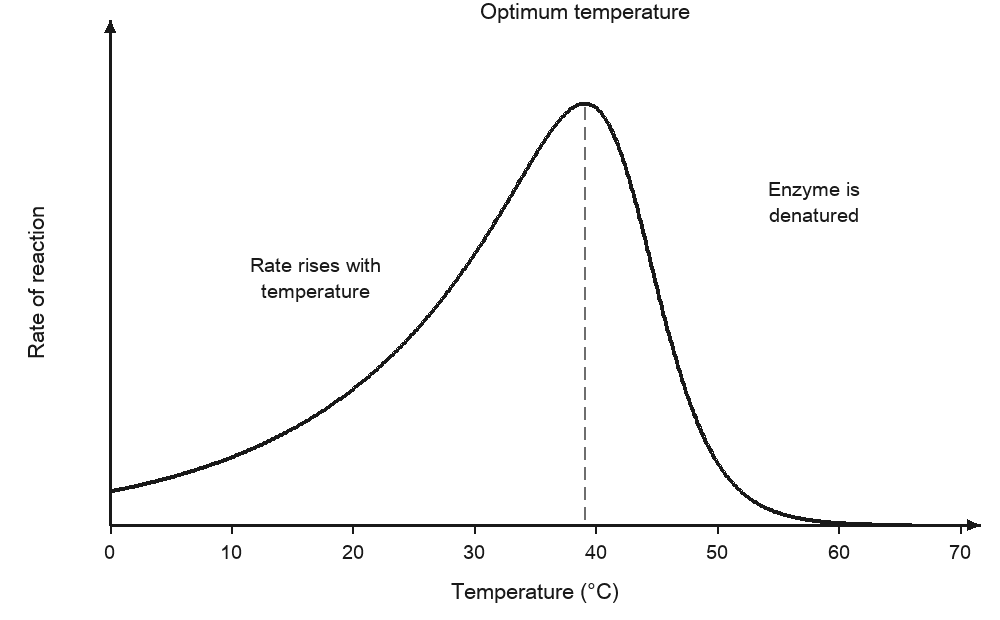
Therefore, enzyme activity rises with temperature up to the optimum and then falls as the enzyme is denatured.
- 382 marks
Question 38
How is induced-fit hypothesis, different from lock-key hypothesis?
Solve with AIWritten solution
Solution:
Concept: Both hypotheses explain how a substrate binds the active site.
Step 1 — What is asked: We need to answer the question point by point.
Step 2 — Lock-key: In the lock and key hypothesis (Fischer, 1894) the active site is rigid and already has the exact shape of the substrate.
Step 3 — Induced fit: In the induced-fit hypothesis (Koshland, 1958) the active site is flexible: it does not at first match the substrate exactly, and binding of the substrate induces a change of shape so that it fits closely.
Therefore, the lock-key model has a rigid, pre-shaped active site, while in induced fit the substrate makes the flexible active site change shape.
- 392 marks
Question 39
How does the enzymatic reactions change with substrate concentration?
Solve with AIWritten solution
Solution:
Concept: An enzyme has a limited number of active sites.
Step 1 — What is asked: We need to answer the question point by point.
Step 2 — Low concentration: At low substrate concentration many active sites are free, so the rate rises steeply as more substrate is added.
Step 3 — High concentration: At high substrate concentration all active sites are occupied; the enzyme is saturated, and the rate levels off at its maximum value, . The substrate concentration that gives half of is called .
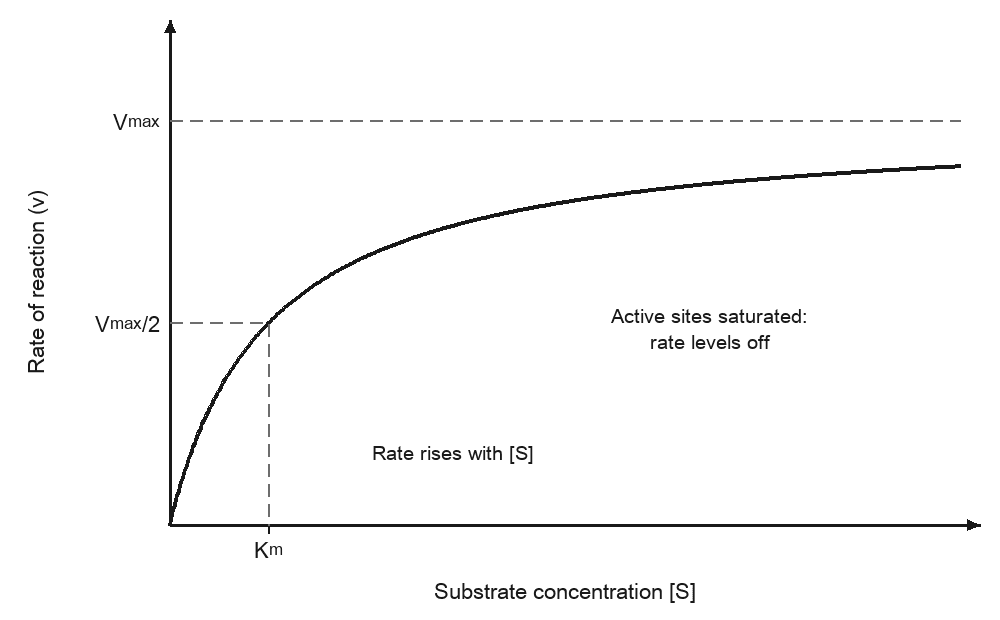
Therefore, the rate rises with substrate concentration at first and then becomes constant when the enzyme is saturated.
- 402 marks
Question 40
How do sulfa drugs control bacterial multiplication?
Solve with AIWritten solution
Solution:
Concept: A competitive inhibitor resembles the substrate and competes with it for the active site.
Step 1 — What is asked: We need to answer the question point by point.
Step 2 — The bacterial pathway: Bacteria make folic acid from p-aminobenzoic acid (PABA); they need folic acid to make DNA and multiply.
Step 3 — The drug: Sulfa drugs resemble PABA, so they occupy the active site of the bacterial enzyme in place of PABA (competitive inhibition). Folic acid is not made, so the bacteria cannot multiply.
Note: Human cells are not harmed in this way because we take in folic acid from food instead of making it from PABA.
Therefore, sulfa drugs competitively inhibit folic acid synthesis from PABA, so bacteria cannot multiply.
- 412 marks
Question 41
How are lyases different from ligases? Give an example.
Solve with AIWritten solution
Solution:
Concept: Enzyme classes are defined by the kind of reaction they catalyse.
Step 1 — What is asked: We need to answer the question point by point.
Step 2 — Lyases: Lyases break covalent bonds and remove groups from a substrate without hydrolysis, often leaving a double bond; e.g. histidine decarboxylase removes CO from histidine to give histamine.
Step 3 — Ligases: Ligases join two molecules by forming new covalent bonds, using energy from ATP; e.g. pyruvate carboxylase joins CO to pyruvate to give oxaloacetate.
Therefore, lyases break bonds without water (e.g. decarboxylase), while ligases join molecules using ATP (e.g. pyruvate carboxylase).
- 422 marks
Question 42
Name various types of Co-factors.
Solve with AIWritten solution
Solution:
Concept: A co-factor is the non-protein part that some enzymes need for activity.
Step 1 — What is asked: We need to answer the question point by point.
Step 2 — Coenzymes: Organic molecules loosely bound to the apoenzyme, e.g. NAD, NADP, ATP, coenzyme A.
Step 3 — Prosthetic groups: Organic molecules tightly bound, forming part of the active site, e.g. haem in catalase and peroxidase, FMN, FAD, biotin.
Step 4 — Metal ions: Inorganic ions (activators) that bind the active site and the substrate, e.g. Zn in carboxypeptidase.
Therefore, the three types of co-factors are coenzymes, prosthetic groups and inorganic metal ions.
- 432 marks
Question 43
Give an example to explain 'Enzymes have specific pH'.
Solve with AIWritten solution
Solution:
Concept: Each enzyme works best at its own optimum pH, which suits the place where it acts.
Step 1 — What is asked: We need to answer the question point by point.
Step 2 — Pepsin: Pepsin digests proteins in the stomach, where HCl makes the contents strongly acidic; it works best at about pH 2 and hardly works at pH 7.
Step 3 — Trypsin: Trypsin digests proteins in the small intestine, where bicarbonate from pancreatic juice neutralises the stomach acid; it works best at about pH 8 and does not work at pH 2. The two curves are shown below.
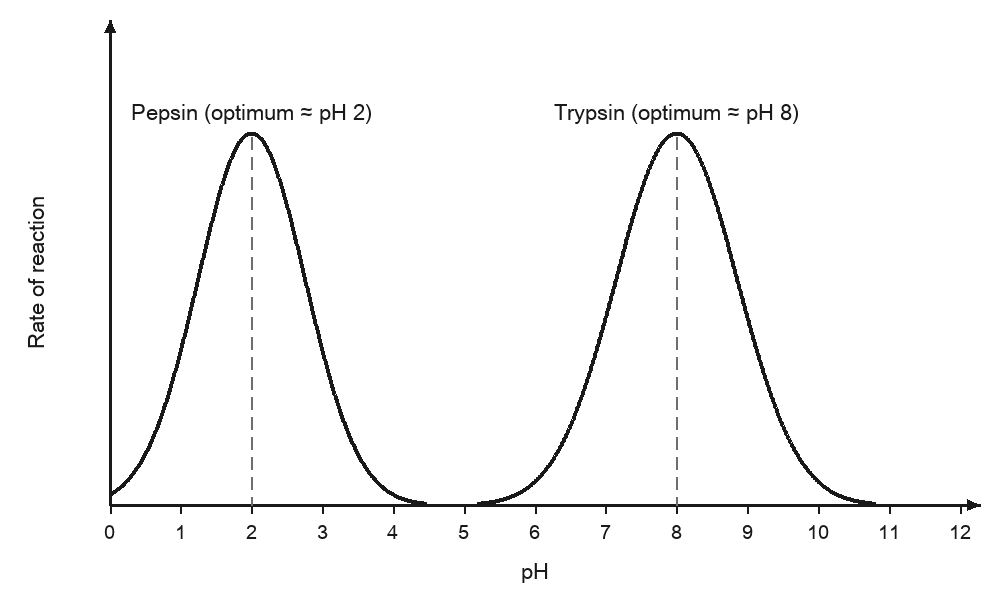
Therefore, pepsin (optimum about pH 2) and trypsin (optimum about pH 8) show that each enzyme has a specific pH.
- 443 marks
Question 44
Why are enzymes called biocatalysts? What is the effect of increase of temperature and substrate concentration on the activity of enzymes?
Solve with AIWritten solution
Solution:
Concept: Enzymes are catalysts made by living cells; their rate depends on temperature and substrate concentration.
Step 1 — What is asked: We must answer each part of the question in turn.
Step 2 — Biocatalysts: Enzymes speed up reactions by lowering the activation energy and remain unchanged at the end, so they are catalysts; they are made by living cells and work in them, so they are called biocatalysts.
Step 3 — Temperature: The rate rises with temperature (roughly doubling per 10 °C) up to the optimum (about 37–40 °C for body enzymes); above it the enzyme is denatured and the rate falls sharply.
Step 4 — Substrate concentration: At constant enzyme concentration, the rate rises as substrate is added, then levels off at when all active sites are saturated.
Therefore, enzymes are biological catalysts; their activity rises with temperature up to an optimum and then falls, and rises with substrate concentration until saturation.
- 453 marks
Question 45
What is allosteric modulation? Give a schematic diagram to explain it. How do sulpha drugs help in a bacterial disease?
Solve with AIWritten solution
Solution:
Concept: An enzyme's activity can be controlled through a site other than its active site, called the allosteric site.
Step 1 — What is asked: We must answer each part of the question in turn.
Step 2 — Allosteric modulation: A modulator (often a metabolite of the same pathway, such as its end product, or an energy signal such as ATP or AMP) binds the allosteric site, far from the active site. This changes the shape of the enzyme and of its active site, so the rate increases (activator) or decreases (inhibitor). The change is reversible.
Step 3 — Schematic diagram: In the diagram, the allosteric inhibitor binds the allosteric site; the active site changes shape, so the substrate cannot fit.
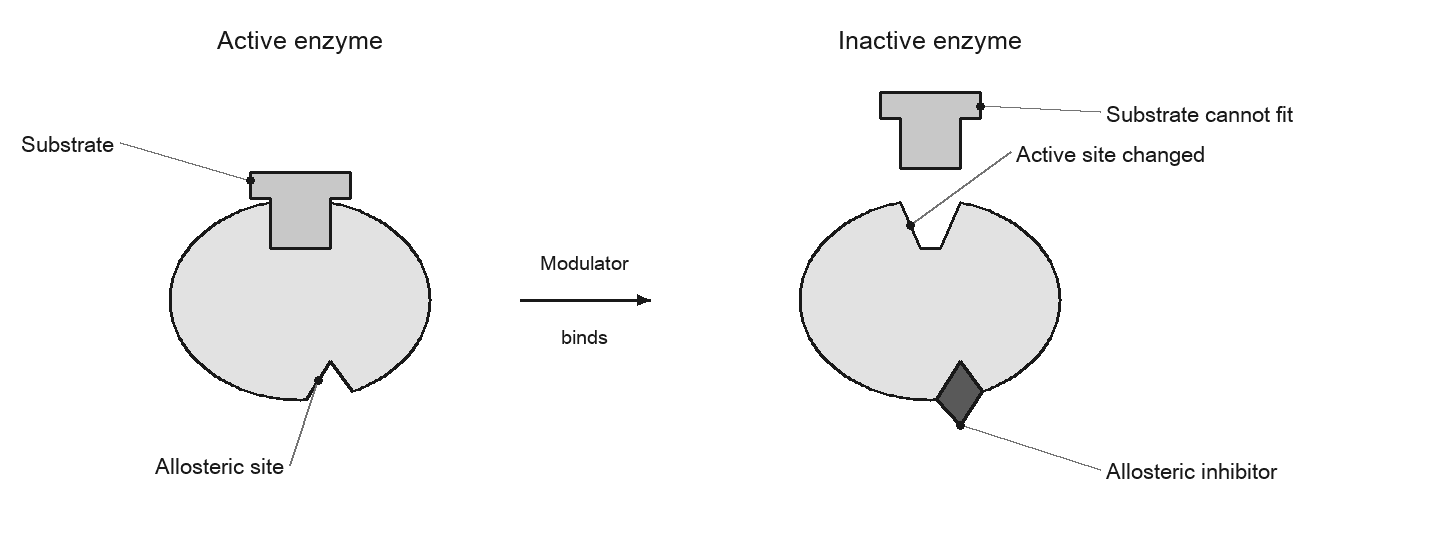
Step 4 — Sulpha drugs: Bacteria make folic acid from PABA. Sulpha drugs resemble PABA and block the active site of the bacterial enzyme (competitive inhibition), so no folic acid is made and the bacteria cannot multiply; the infection is controlled.
Therefore, allosteric modulation is the change in an enzyme's activity by a modulator bound at the allosteric site, and sulpha drugs cure bacterial infections by competitively inhibiting folic acid synthesis.
- 463 marks
Question 46
Differentiate between hydrolases and lyases and give an example of each.
Solve with AIWritten solution
Solution:
Concept: Hydrolases and lyases both break bonds, but in different ways.
Step 1 — What is asked: We must answer each part of the question in turn.
Step 2 — Compare: The two classes differ as follows.
Feature Hydrolases Lyases How bonds are broken By adding water (hydrolysis) Without adding water Result A molecule is split into two products A group is removed, often leaving a double bond Bonds acted on Ester, peptide, glycosidic and similar bonds C–C, C–O, C–N bonds Example Lipase, sucrase (sucrose to glucose + fructose) Histidine decarboxylase (histidine to histamine + CO), fumarase Step 3 — Example of a hydrolase: Sucrase adds water to sucrose and splits it into glucose and fructose.
Step 4 — Example of a lyase: Histidine decarboxylase removes CO from histidine without adding water.
Therefore, hydrolases split molecules by adding water (e.g. sucrase), while lyases remove groups without water (e.g. decarboxylase).
- 473 marks
Question 47
What happens in an enzyme catalysed reaction when all other factors are kept constant in the following situation
(i) if the temperature is increased from 10°C to 60°C.
(ii) if substrate concentration is continuously increased?
Solve with AIWritten solution
Solution:
Concept: The rate of an enzyme reaction depends on temperature (with an optimum) and on substrate concentration (with saturation).
Step 1 — What is asked: We must answer each part of the question in turn.
Step 2 — Part (i), 10 °C to about 40 °C: As the temperature rises from 10 °C, molecules move faster and collide more often, so the rate rises (roughly doubling per 10 °C) until the optimum, about 37–40 °C.
Step 3 — Part (i), above the optimum to 60 °C: Beyond the optimum the enzyme starts to be denatured; by about 50–60 °C most body enzymes have lost their shape and the rate falls almost to zero.
Step 4 — Part (ii): As substrate concentration rises, the rate rises at first because more active sites are filled; when all active sites are occupied the enzyme is saturated and the rate stays constant at .
Therefore: (i) the rate rises up to the optimum (about 37–40 °C) and then falls almost to zero by 60 °C; (ii) the rate rises and then levels off at .
- 483 marks
Question 48
How does malonic acid inhibit the enzyme action of substrate succinic acid? Draw a schematic diagram explaining it as well.
Solve with AIWritten solution
Solution:
Concept: A competitive inhibitor resembles the substrate and competes with it for the active site.
Step 1 — What is asked: We must answer each part of the question in turn.
Step 2 — Similar structure: Succinic acid (HOOC–CH–CH–COOH) is the substrate of succinic dehydrogenase, which converts it into fumaric acid. Malonic acid (HOOC–CH–COOH) has the same two –COOH groups and differs by only one CH group.
Step 3 — Competition: Because of this resemblance, malonic acid binds the active site. It cannot be dehydrogenated, so the enzyme–inhibitor complex gives no product and the succinic acid is kept out.
Step 4 — Reversible: Raising the succinic acid concentration displaces malonic acid, so this competitive inhibition is reversible. The schematic diagram shows both cases.
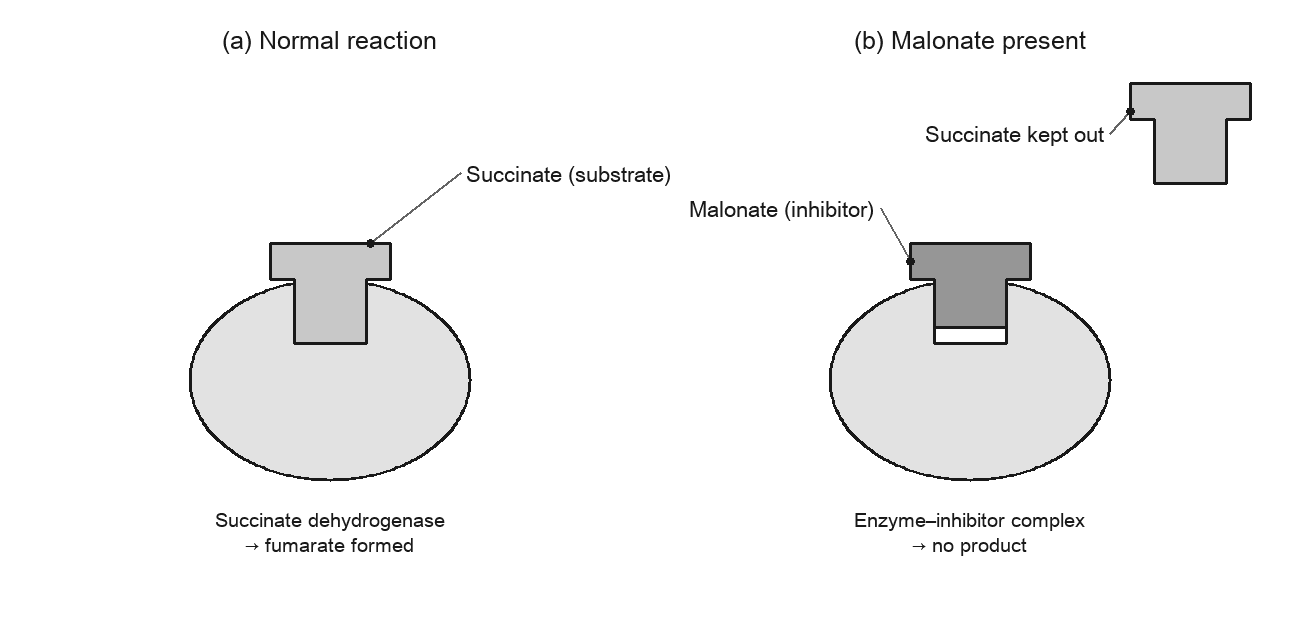
Therefore, malonic acid, which resembles succinic acid, occupies the active site of succinic dehydrogenase and competitively inhibits it.
- 492 marks
Question 49
Enzymes and Catalysts
Solve with AIWritten solution
Solution:
Concept: Enzymes are biological catalysts, so they share features with catalysts but also differ from them.
Step 1 — What is asked: We must state the differences between enzymes and catalysts.
Step 2 — Compare: The main differences are set out in the table.
Feature Enzymes Catalysts Nature Proteins (almost all; a few are RNA ribozymes) with a large, complex 3-D structure Usually simple inorganic substances: metals (Pt, Ni, Fe), metal oxides or ions such as H Specificity Act only on specific substrates Can catalyse many different reactions Regulation Activity is regulated by specific molecules of the cell (activators, allosteric and feedback inhibitors) No such control; activity changes only through promoters and catalyst poisons Sensitivity Extremely sensitive to pH and temperature Less sensitive to pH and temperature Therefore, enzymes are specific, regulated, sensitive proteins, while inorganic catalysts are simple, less specific substances without such regulation.
- 502 marks
Question 50
Competitive and Non-competitive inhibition of enzymes
Solve with AIWritten solution
Solution:
Concept: Inhibitors differ in where they bind and whether the substrate can out-compete them.
Step 1 — What is asked: We must state the differences between competitive inhibition and non-competitive inhibition.
Step 2 — Compare: The main differences are set out in the table.
Feature Competitive inhibition Non-competitive inhibition Structure of inhibitor Similar to the substrate Different from the substrate Site of binding Active site A site other than the active site Effect on enzyme Shape of enzyme not changed Shape of enzyme (and active site) changed Extra substrate Overcomes the inhibition Does not overcome the inhibition Example Malonate on succinic dehydrogenase Heavy-metal ions (Hg, Ag) combining with –SH groups; cyanide on cytochrome oxidase Note: Cyanide is the usual textbook example of a non-competitive inhibitor because adding more substrate does not reverse it. Strictly, it binds the iron of haem a in the oxidised (Fe) form of cytochrome oxidase, at the centre where oxygen is reduced, rather than at a separate site; heavy-metal ions fit the 'binds elsewhere' description better.
Therefore, a competitive inhibitor resembles the substrate and blocks the active site in a way that extra substrate can overcome, while a non-competitive inhibitor binds elsewhere and changes the enzyme's shape.
- 512 marks
Question 51
Lyases and Ligases
Solve with AIWritten solution
Solution:
Concept: Enzyme classes are defined by the kind of reaction they catalyse.
Step 1 — What is asked: We must state the differences between lyases and ligases.
Step 2 — Compare: The main differences are set out in the table.
Feature Lyases Ligases Reaction Break bonds and remove groups Join two molecules Water / energy No hydrolysis; no ATP needed Use energy from ATP Bond change Often leave a double bond Form new C–O, C–S, C–N or C–C bonds Example Histidine decarboxylase, fumarase Pyruvate carboxylase, synthetases Therefore, lyases break bonds without water, while ligases join molecules using ATP.
- 522 marks
Question 52
Transferases and Hydrolases
Solve with AIWritten solution
Solution:
Concept: Enzyme classes are defined by the kind of reaction they catalyse.
Step 1 — What is asked: We must state the differences between transferases and hydrolases.
Step 2 — Compare: The main differences are set out in the table.
Feature Transferases Hydrolases Reaction Transfer a group from one substrate to another Split a molecule into two by adding water Substrates Two substrates exchange a group One substrate and water General reaction S–G + S′ gives S + S′–G A–B + HO gives A–H + B–OH Example Hexokinase, transaminase Lipase, amylase, sucrase Therefore, transferases move groups between molecules, while hydrolases split molecules with water.
- 532 marks
Question 53
Holoenzyme and Apoenzyme
Solve with AIWritten solution
Solution:
Concept: A conjugated enzyme has a protein part and a non-protein part.
Step 1 — What is asked: We must state the differences between holoenzyme and apoenzyme.
Step 2 — Compare: The main differences are set out in the table.
Feature Holoenzyme Apoenzyme Meaning The complete conjugated enzyme The protein part of the enzyme Make-up Apoenzyme + co-factor Protein only, without the co-factor Activity Catalytically active Inactive on its own Example Catalase with its haem group The protein of catalase without haem Therefore, holoenzyme = apoenzyme + co-factor and is active, while the apoenzyme alone is the inactive protein part.
- 545 marks
Question 54
Explain the mechanism of action of enzyme.
Solve with AIWritten solution
Solution:
Concept: An enzyme works by binding its substrate at the active site to form an enzyme–substrate (ES) complex, which lowers the activation energy.
Step 1 — What is asked: We need to explain the topic fully, point by point.
Step 2 — Active site: Only a small part of the enzyme, the active site (about 3–12 amino acids), touches the substrate. Its shape and chemical groups suit one substrate.
Step 3 — Catalytic cycle: The substrate binds the active site; binding makes the enzyme fit more tightly around it and form the ES complex; the active site breaks or forms the bonds of the substrate, giving an enzyme–product complex; the products are released and the free enzyme binds a new substrate molecule.
Step 4 — Lowered activation energy: In the ES complex the substrate reaches the transition state more easily, so the activation energy is lowered and the reaction goes much faster; the overall energy change of the reaction is not altered.
Step 5 — Lock and key hypothesis: Emil Fischer (1894) proposed that the active site is rigid and complementary to the substrate, which fits it like a key in a lock.
Step 6 — Induced-fit hypothesis: Koshland (1958) proposed that the active site is flexible; the substrate induces a change in its shape so that the two fit closely, and the enzyme regains its shape after the products leave. The two models are shown below.
Step 7 — Summary in symbols: The whole process can be written as E + S gives ES, which gives EP, which gives E + P; the enzyme E comes out unchanged.
Therefore, an enzyme binds its substrate at the active site (lock and key or induced fit), forms an ES complex that lowers the activation energy, releases the products and is left unchanged.
- 555 marks
Question 55
Differentiate between competitive and non-competitive inhibition.
Solve with AIWritten solution
Solution:
Concept: Enzyme inhibitors reduce the rate of enzyme reactions; they are grouped by where they bind and how they act.
Step 1 — What is asked: We need to explain the topic fully, point by point.
Step 2 — Compare: The two types differ as follows.
Feature Competitive inhibition Non-competitive inhibition Structure of inhibitor Similar to the substrate Entirely different from the substrate Site of binding The active site A site other than the active site Competition Substrate and inhibitor compete for the active site No competition Effect on enzyme Enzyme structure not altered Enzyme structure altered; product not formed even if substrate binds Effect of more substrate Inhibition overcome Inhibition not overcome (removing the inhibitor may still reverse it) Effect on and unchanged; rises lowered; unchanged Examples Malonate on succinic dehydrogenase; sulpha drugs on folic acid synthesis Heavy-metal ions (Hg, Ag) combining with –SH groups; cyanide on cytochrome oxidase Step 3 — Show it on a graph: With a competitive inhibitor the curve still reaches the same at high substrate concentration, but more substrate is needed to reach half of it ( rises). With a non-competitive inhibitor the maximum rate itself is lower.

Step 4 — Show the binding: In competitive inhibition the inhibitor sits in the active site, as malonate does in the diagram below; a non-competitive inhibitor binds elsewhere and changes the shape of the active site.
Note: Cyanide is the usual textbook example of a non-competitive inhibitor because adding more substrate does not reverse it. Strictly, it binds the iron of haem a in the oxidised (Fe) form of cytochrome oxidase, at the centre where oxygen is reduced, rather than at a separate site; heavy-metal ions fit the 'binds elsewhere' description better.
Therefore, a competitive inhibitor resembles the substrate, blocks the active site and is overcome by more substrate, while a non-competitive inhibitor binds elsewhere, changes the enzyme and lowers the maximum rate.
- 565 marks
Question 56
Discuss various factors that affect the rate of enzymatic reaction.
Solve with AIWritten solution
Solution:
Concept: The rate of an enzyme reaction depends on the conditions in which the enzyme works.
Step 1 — What is asked: We need to explain the topic fully, point by point.
Step 2 — Temperature: The rate rises with temperature (roughly doubling per 10 °C) up to the optimum, generally 37–40 °C for body enzymes. At low temperature the enzyme works only slowly; near freezing it is almost inactive but is not damaged, and it works again when warmed. Above the optimum it is denatured and the rate falls.
Step 3 — Enzyme concentration: With substrate in excess and pH and temperature constant, the rate rises in proportion to the enzyme concentration, because more active sites are available.

Step 4 — Substrate concentration: At a fixed enzyme concentration the rate rises with substrate concentration and then levels off at when all active sites are saturated; is the substrate concentration at which the rate is half of .
Step 5 — pH: Each enzyme works over a narrow pH range with an optimum pH: pepsin about pH 2, trypsin about pH 8. A change in pH alters the active site, and extreme pH denatures the enzyme.
Step 6 — Inhibitors and modulators: Inhibitors lower the rate (competitive, non-competitive, allosteric and end-product inhibition), while allosteric activators can raise it.
Therefore, the rate of an enzyme reaction is affected by temperature, enzyme concentration, substrate concentration, pH and the presence of inhibitors or activators.
- 575 marks
Question 57
Classify the enzymes according to the kind of reactions they bring about, giving a diagrammatic representation.
Solve with AIWritten solution
Solution:
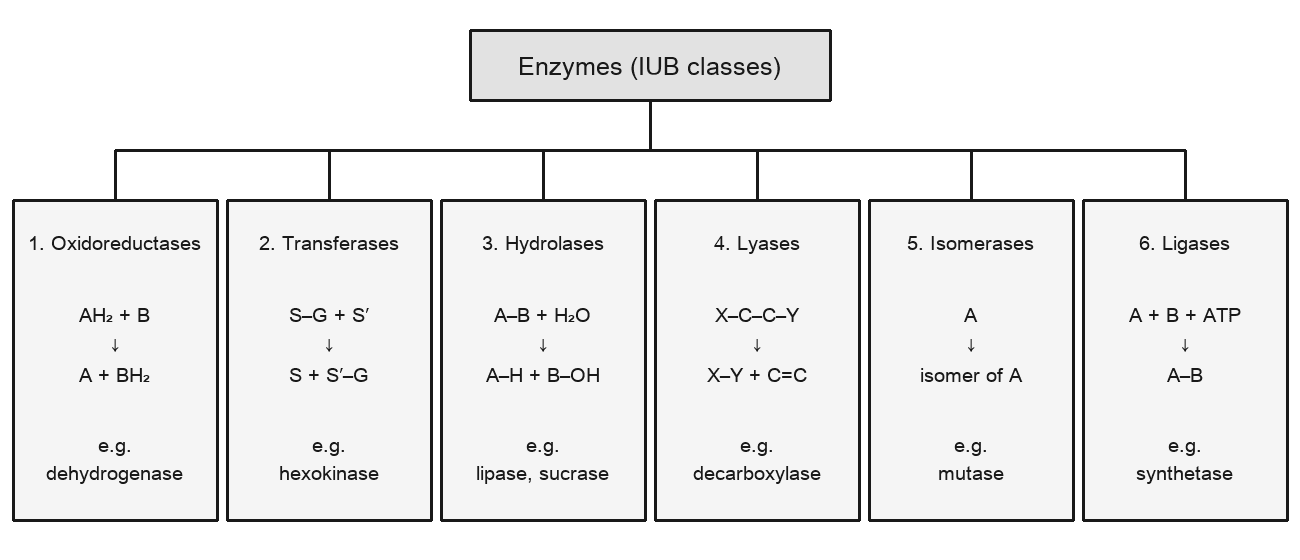
Concept: According to the IUB system, enzymes are grouped into six classes by the kind of reaction they catalyse.
Step 1 — What is asked: We need to explain the topic fully, point by point.
Step 2 — Oxidoreductases: Catalyse oxidation–reduction between two substrates (removing or adding hydrogen or electrons), e.g. dehydrogenases, oxidases.
Step 3 — Transferases: Transfer a group (other than hydrogen) from one substrate to another, e.g. hexokinase moves phosphate from ATP to glucose; transaminases.
Step 4 — Hydrolases: Split a molecule into two products by adding water, e.g. lipase, amylase, sucrase.
Step 5 — Lyases: Remove groups from substrates without hydrolysis, often leaving a double bond, e.g. decarboxylases, fumarase.
Step 6 — Isomerases: Convert a molecule into its isomer (optical, geometric or positional), e.g. glucose-6-phosphate isomerase (glucose-6-phosphate to fructose-6-phosphate) and mutases such as phosphoglucomutase (glucose-1-phosphate to glucose-6-phosphate).
Step 7 — Ligases: Join two molecules by new covalent bonds using energy from ATP, e.g. synthetases, pyruvate carboxylase.
Step 8 — Diagram: The classes, their general reactions and examples are shown below.
Note: The IUB list of six classes is the one used in the syllabus; since 2018 the official Enzyme Commission list has a seventh class, translocases, which move ions or molecules across membranes.
Therefore, enzymes are classified into oxidoreductases, transferases, hydrolases, lyases, isomerases and ligases.
- 585 marks
Question 58
Discuss the various molecules that inhibit the enzymatic reactions.
Solve with AIWritten solution
Solution:
Concept: Molecules that lower the rate of an enzyme reaction are called enzyme inhibitors; the inhibition may be reversible or irreversible.
Step 1 — What is asked: We need to explain the topic fully, point by point.
Step 2 — Competitive inhibitors: They resemble the substrate and compete for the active site, e.g. malonate inhibits succinic dehydrogenase; sulpha drugs compete with PABA and stop folic acid synthesis in bacteria. More substrate overcomes them.
Step 3 — Non-competitive inhibitors: They do not resemble the substrate, and more substrate does not displace them. Most bind a site other than the active site and change the enzyme's structure, so no product forms even if the substrate binds, e.g. heavy-metal ions such as Hg and Ag combine with –SH groups of the enzyme. Cyanide, the usual textbook example, blocks cytochrome oxidase, so the flow of electrons to oxygen through this enzyme stops (see the Note).
Step 4 — Allosteric modulators: Modulators, often metabolites of the same pathway (such as its end product) or energy signals such as ATP and AMP, bind the allosteric site, change the shape of the active site and so lower (or raise) the rate; the effect is reversible.
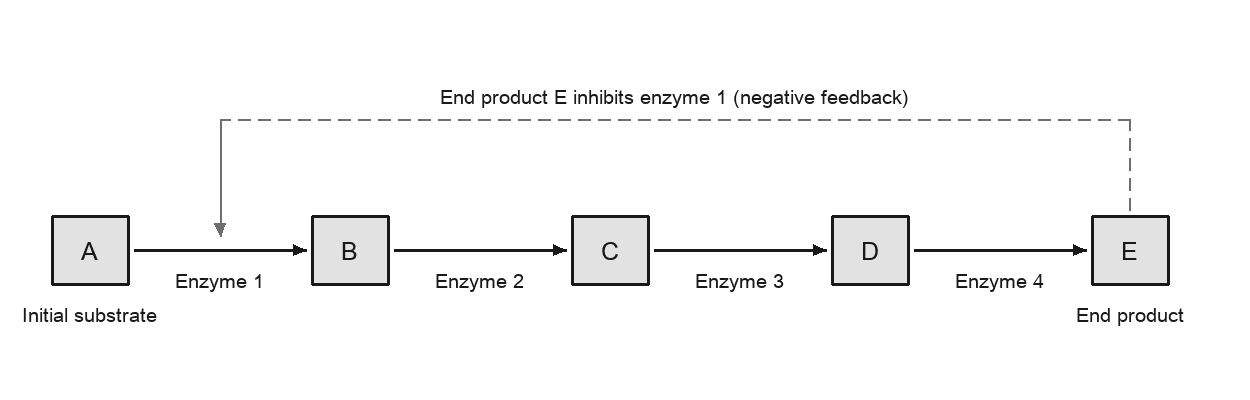
Step 5 — End-product (feedback) inhibitors: When the end product of a pathway accumulates, it acts like an allosteric inhibitor of the first enzyme of the pathway and slows the whole pathway; this is negative feedback inhibition.
Note: Cyanide is the usual textbook example of a non-competitive inhibitor because adding more substrate does not reverse it. Strictly, it binds the iron of haem a in the oxidised (Fe) form of cytochrome oxidase, at the centre where oxygen is reduced, rather than at a separate site; heavy-metal ions fit the 'binds elsewhere' description better.
Therefore, enzyme reactions are inhibited by competitive inhibitors, non-competitive inhibitors, allosteric inhibitors and end products (feedback inhibition).
- 595 marks
Question 59
Discuss 'Enzymes lower the activation energy'.
Solve with AIWritten solution
Solution:
Concept: Activation energy is the energy that reacting molecules must gain before they can react; it is an energy barrier between reactants and products.
Step 1 — What is asked: We need to explain the topic fully, point by point.
Step 2 — Why a barrier matters: Molecules react only when they collide with enough energy. Outside the cell a spark or strong heat can supply this, e.g. hydrogen and oxygen react only after a spark, but a cell cannot use high temperatures.
Step 3 — What the enzyme does: The enzyme binds the substrate as an enzyme–substrate complex. In this complex the substrate's bonds are strained and the reacting groups are held close in the right position, so the transition state is reached with less energy.
Step 4 — Energy diagram: On the energy profile, the peak with the enzyme is much lower than the peak without it, while the energy of the substrate and of the product, and so the overall energy change ΔG, stay the same.
Step 5 — What does not change: Because ΔG is unchanged, an enzyme does not alter the equilibrium of a reaction; it only helps the reaction reach equilibrium sooner, and it is not used up.
Step 6 — Example: Carbonic anhydrase speeds up CO + HO giving HCO from about 200 molecules per hour to about 600,000 molecules per second, about ten million times faster.
Therefore, enzymes speed up reactions by lowering the activation energy through the ES complex, without changing ΔG or the equilibrium.
What Class 11 Biology Ch 14 covers
The sections of the chapter, in the order the book takes them. Every question above comes from one of these.
- 01Enzymes and Activation Energy
- 02Enzymes and Co-factors
- 03Mechanism of Enzyme Action
- 04Nomenclature and Classification of Enzymes
- 05Properties of Enzymes and Factors Affecting Their Activity
More ways to study this chapter
The same chapter asked three other ways. Practise it, revise it, and see what the board has set on Ch 14 before.
Class 11 Biology Ch 14 questions students ask
How many questions are there in Class 11 Biology Ch 14?
59 questions. Every one is solved step by step on this page.
Are these Class 11 Biology solutions free?
Yes. Every question and its full working is free to read, with no account needed.
Can I download the Class 11 Biology Ch 14 solutions as a PDF?
There is no PDF to download. Every solution is on this page instead, which means it is searchable, always the current syllabus, and readable on a phone. Use your browser's print option if you want it on paper.