
Question 453 marksMedium
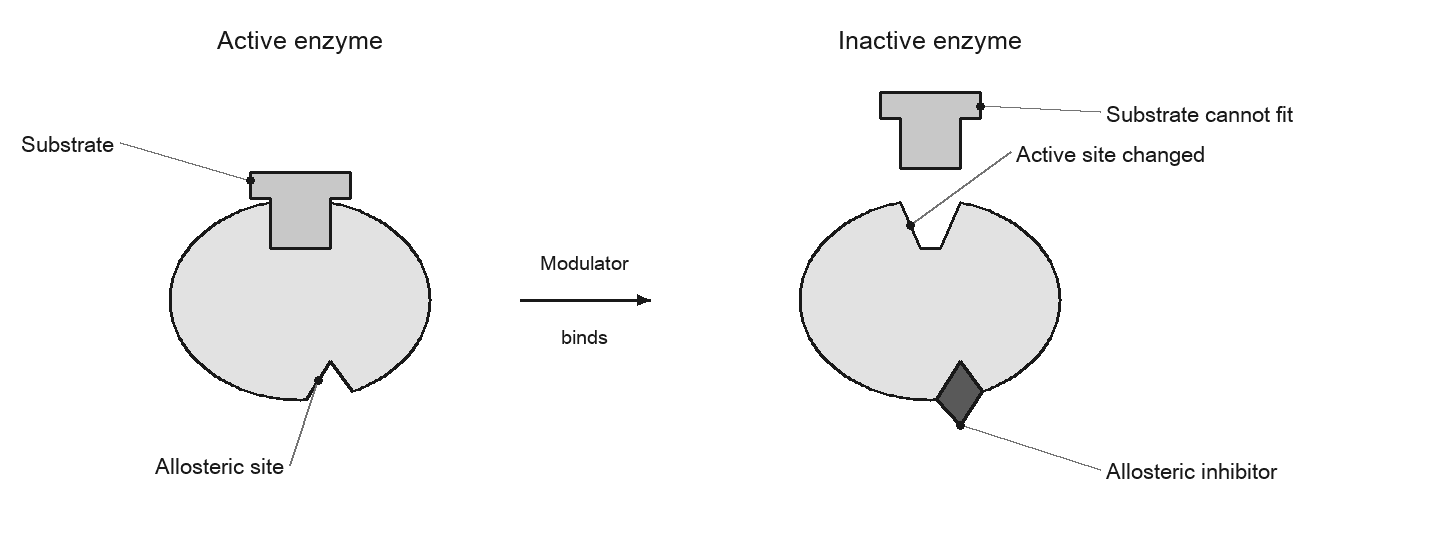
What is allosteric modulation? Give a schematic diagram to explain it. How do sulpha drugs help in a bacterial disease?
Confirming your payment
Sign up now and get 250 free tokens.
Enzymes · Question 45 of 59
What is allosteric modulation? Give a schematic diagram to explain it. How do sulpha drugs help in a bacterial disease?
Solution:
Concept: An enzyme's activity can be controlled through a site other than its active site, called the allosteric site.
Step 1 — What is asked: We must answer each part of the question in turn.
Step 2 — Allosteric modulation: A modulator (often a metabolite of the same pathway, such as its end product, or an energy signal such as ATP or AMP) binds the allosteric site, far from the active site. This changes the shape of the enzyme and of its active site, so the rate increases (activator) or decreases (inhibitor). The change is reversible.
Step 3 — Schematic diagram: In the diagram, the allosteric inhibitor binds the allosteric site; the active site changes shape, so the substrate cannot fit.
Step 4 — Sulpha drugs: Bacteria make folic acid from PABA. Sulpha drugs resemble PABA and block the active site of the bacterial enzyme (competitive inhibition), so no folic acid is made and the bacteria cannot multiply; the infection is controlled.
Therefore, allosteric modulation is the change in an enzyme's activity by a modulator bound at the allosteric site, and sulpha drugs cure bacterial infections by competitively inhibiting folic acid synthesis.