
Question 545 marksMedium
Explain the mechanism of action of enzyme.
Confirming your payment
Sign up now and get 250 free tokens.
Enzymes · Question 54 of 59
Explain the mechanism of action of enzyme.
Solution:
Concept: An enzyme works by binding its substrate at the active site to form an enzyme–substrate (ES) complex, which lowers the activation energy.
Step 1 — What is asked: We need to explain the topic fully, point by point.
Step 2 — Active site: Only a small part of the enzyme, the active site (about 3–12 amino acids), touches the substrate. Its shape and chemical groups suit one substrate.
Step 3 — Catalytic cycle: The substrate binds the active site; binding makes the enzyme fit more tightly around it and form the ES complex; the active site breaks or forms the bonds of the substrate, giving an enzyme–product complex; the products are released and the free enzyme binds a new substrate molecule.
Step 4 — Lowered activation energy: In the ES complex the substrate reaches the transition state more easily, so the activation energy is lowered and the reaction goes much faster; the overall energy change of the reaction is not altered.

Step 5 — Lock and key hypothesis: Emil Fischer (1894) proposed that the active site is rigid and complementary to the substrate, which fits it like a key in a lock.
Step 6 — Induced-fit hypothesis: Koshland (1958) proposed that the active site is flexible; the substrate induces a change in its shape so that the two fit closely, and the enzyme regains its shape after the products leave. The two models are shown below.
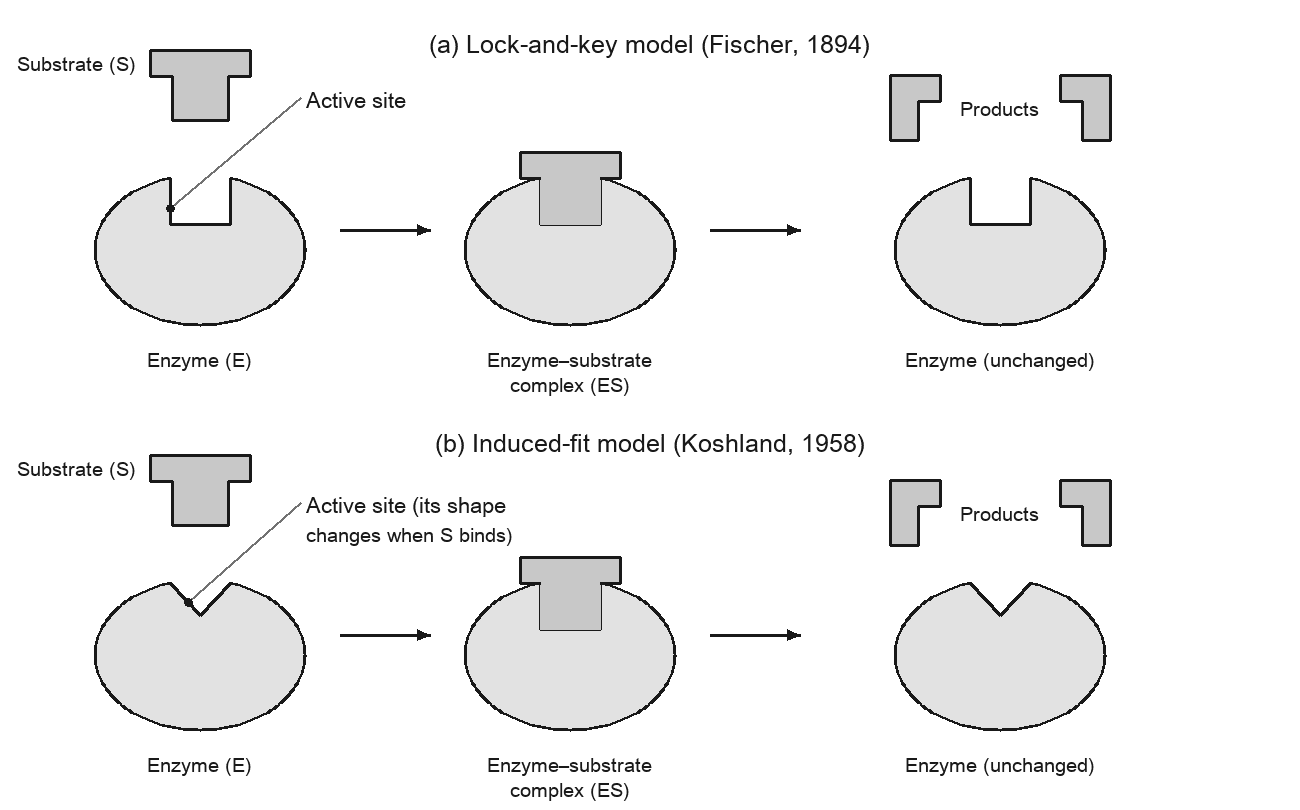
Step 7 — Summary in symbols: The whole process can be written as E + S gives ES, which gives EP, which gives E + P; the enzyme E comes out unchanged.
Therefore, an enzyme binds its substrate at the active site (lock and key or induced fit), forms an ES complex that lowers the activation energy, releases the products and is left unchanged.