
Question 555 marksMedium
Differentiate between competitive and non-competitive inhibition.
Confirming your payment
Sign up now and get 250 free tokens.
Enzymes · Question 55 of 59
Differentiate between competitive and non-competitive inhibition.
Solution:
Concept: Enzyme inhibitors reduce the rate of enzyme reactions; they are grouped by where they bind and how they act.
Step 1 — What is asked: We need to explain the topic fully, point by point.
Step 2 — Compare: The two types differ as follows.
| Feature | Competitive inhibition | Non-competitive inhibition |
|---|---|---|
| Structure of inhibitor | Similar to the substrate | Entirely different from the substrate |
| Site of binding | The active site | A site other than the active site |
| Competition | Substrate and inhibitor compete for the active site | No competition |
| Effect on enzyme | Enzyme structure not altered | Enzyme structure altered; product not formed even if substrate binds |
| Effect of more substrate | Inhibition overcome | Inhibition not overcome (removing the inhibitor may still reverse it) |
| Effect on and | unchanged; rises | lowered; unchanged |
| Examples | Malonate on succinic dehydrogenase; sulpha drugs on folic acid synthesis | Heavy-metal ions (Hg, Ag) combining with –SH groups; cyanide on cytochrome oxidase |
Step 3 — Show it on a graph: With a competitive inhibitor the curve still reaches the same at high substrate concentration, but more substrate is needed to reach half of it ( rises). With a non-competitive inhibitor the maximum rate itself is lower.

Step 4 — Show the binding: In competitive inhibition the inhibitor sits in the active site, as malonate does in the diagram below; a non-competitive inhibitor binds elsewhere and changes the shape of the active site.
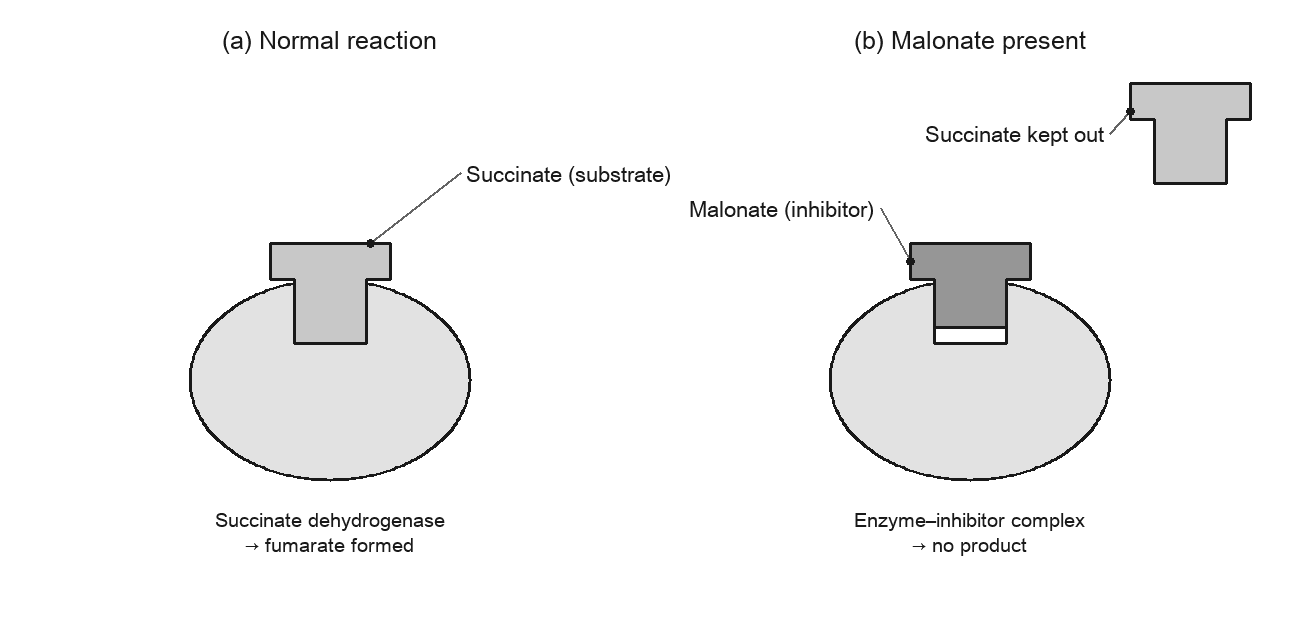
Note: Cyanide is the usual textbook example of a non-competitive inhibitor because adding more substrate does not reverse it. Strictly, it binds the iron of haem a in the oxidised (Fe) form of cytochrome oxidase, at the centre where oxygen is reduced, rather than at a separate site; heavy-metal ions fit the 'binds elsewhere' description better.
Therefore, a competitive inhibitor resembles the substrate, blocks the active site and is overcome by more substrate, while a non-competitive inhibitor binds elsewhere, changes the enzyme and lowers the maximum rate.