
Opening your dashboard
Class 11 Biology Chapter 14 Enzymes: Competency-Based Questions (CBQ)
40 questions on Chapter 14, each worked through on its own page with the AI tutor. Class 11 Biology, ICSE 2026-27.
40 questions
1–6 marks · Mixed difficulty
- 14 marks
Question 1
In a Class 11 practical at a school in Bhopal, five conical flasks each received 10 mL of the same hydrogen peroxide solution at 30 °C. Hydrogen peroxide slowly breaks down into water and oxygen. Different additions were made, and the oxygen given off was collected. (Hypothetical data.)
Flask Added to the hydrogen peroxide Oxygen in the first 2 minutes (mL) Total oxygen when bubbling stopped (mL) 1 Nothing 0 Not reached in the lesson 2 0.5 g manganese dioxide powder 18 54 3 1 mL fresh liver extract (contains the enzyme catalase) 40 54 4 1 mL liver extract that was boiled, then cooled 0 Not reached in the lesson 5 0.5 g manganese dioxide that was boiled in water, then cooled 18 54 (a) Using the idea of activation energy, explain why flasks 2 and 3 gave off oxygen quickly while flask 1 did not. (1 mark)
(b) Compare the results of flasks 4 and 5 and explain the difference between them. (2 marks)
(c) Flasks 2 and 3 worked at very different speeds, yet both finally gave 54 mL of oxygen. Explain why. (1 mark)
- 21 mark
Question 2
A sweet shop in Varanasi stores sugar syrup for months.
Assertion (A): A bottle of sugar syrup (sucrose dissolved in water), kept sealed and free of microbes at room temperature, stays almost unchanged for months, although the breakdown of sucrose into glucose and fructose releases energy.
Reason (R): At room temperature very few sucrose molecules have enough energy to cross the activation-energy barrier of this breakdown.
- 31 mark
Question 3
Vanaspati is made by adding hydrogen to vegetable oil at about 180 °C, using finely divided nickel as the catalyst. An engineer suggests replacing the nickel with a suitable enzyme while keeping the same temperature. Why would this plan fail?
- 44 marks
Question 4
A hospital laboratory in Kolkata measures the activity of the enzyme lactate dehydrogenase (LDH) in blood serum. LDH catalyses this reaction:
NADH absorbs ultraviolet light of wavelength 340 nm, but NAD⁺ does not, so the absorbance at 340 nm shows how much NADH is left. Four tubes were read every minute. (Hypothetical data.)
Tube Contents 0 min 1 min 2 min 3 min 4 min A Serum + pyruvate + NADH 1.20 1.08 0.96 0.84 0.72 B Pyruvate + NADH (no serum) 1.20 1.20 1.20 1.20 1.20 C Serum + pyruvate + NAD⁺ (in place of NADH) 0.00 0.00 0.00 0.00 0.00 D Serum heated to 70 °C for 10 min and cooled + pyruvate + NADH 1.20 1.20 1.20 1.20 1.20 (a) NADH is a co-factor of LDH. Name the type of co-factor it is, and state why it is placed in this group rather than with the prosthetic groups. (1 mark)
(b) Calculate the fall in absorbance per minute in tube A, and state what is happening to the NADH. (1 mark)
(c) Explain why the absorbance does not change in tube C and in tube D. (2 marks)
- 51 mark
Question 5
A biochemistry student studies an enzyme of the mitochondria.
Assertion (A): In the enzyme succinate dehydrogenase, the co-factor FAD separates from the enzyme after every reaction and moves off to work with another enzyme.
Reason (R): FAD acts as a prosthetic group, an organic molecule tightly bound to the apoenzyme.
- 61 mark
Question 6
In a school health check-up, children whose diet lacks vitamin B₂ (riboflavin) show low activity of several enzymes that need FAD or FMN, two molecules the body makes from riboflavin. Which statement correctly describes FAD and FMN in these enzymes?
- 74 marks
Question 7
A dairy in Anand makes lactose-free milk for people who cannot digest milk sugar. Milk is passed slowly through a column packed with beads that carry the enzyme lactase, fixed so that it cannot wash out. Lactase splits lactose (a disaccharide) into glucose and galactose. The same column was used every day for 30 days. On test days, a sucrose solution (sucrose is a disaccharide of the same size, made of glucose and fructose) was also passed through it. (Hypothetical data.)
Day of use Lactose in milk split by the column (%) Sucrose split by the column (%) 1 98 0 10 97 0 20 97 0 30 96 0 (a) Using the lock and key idea, explain why the column splits lactose but not sucrose, although both are disaccharides of the same size. (2 marks)
(b) Using the steps of the catalytic cycle, explain how the same enzyme molecules could keep working for 30 days. (1 mark)
(c) A worker suggests heating the milk to 90 °C just before it enters the column, to kill microbes. Predict the effect on the lactose-free milk and give a reason. (1 mark)
- 81 mark
Question 8
In a class debate on how enzymes bind their substrates, two statements are written on the board.
Assertion (A): According to the induced-fit hypothesis, the active site of an enzyme already has exactly the shape of its substrate before the substrate arrives.
Reason (R): The binding of the substrate makes the enzyme change its shape so that the active site fits more tightly around the substrate.
- 91 mark
Question 9
A medicine factory has a mixture of the two mirror-image forms (L and D) of an amino-acid compound. Both forms contain exactly the same atoms joined by the same bonds, but only the L form is wanted. The factory adds an enzyme that changes only the L form, and leaves the D form untouched. Which statement best explains why the enzyme can tell the two forms apart?
- 104 marks
Question 10
A food factory in Tamil Nadu makes a sweet syrup from maize starch in two enzyme steps:
Step I: Enzymes break starch into glucose; a water molecule is added across each bond that is broken.
Step II: The glucose solution is passed through a column of the enzyme glucose isomerase at about 60 °C. It changes part of the glucose into fructose, which is sweeter. Glucose and fructose have the same formula, C₆H₁₂O₆, but their atoms are arranged differently.
The glucose isomerase is taken from a bacterium that lives in warm soil and compost. In a test, the bacterial enzyme lost 5 % of its activity after one hour at 60 °C, while a similar enzyme from a human cell lost all its activity within ten minutes at 60 °C. (Hypothetical data.)
(a) Name the class of enzyme used in Step I and in Step II, giving a reason for each. (2 marks)
(b) Explain why the factory uses the bacterial enzyme and not a human enzyme for Step II. (1 mark)
(c) Using the rules for trivial names, state what the name "glucose isomerase" tells us about the enzyme. (1 mark)
- 111 mark
Question 11
Histamine is released in allergic reactions. A pharmacology student reads about the enzyme that makes it.
Assertion (A): The enzyme histidine decarboxylase, which removes carbon dioxide from the amino acid histidine to form histamine, is placed in the class lyases.
Reason (R): Histidine decarboxylase joins a molecule of carbon dioxide to histidine, using energy from ATP.
- 121 mark
Question 12
Urea fertiliser spread on a farm in Haryana is broken down in the soil by the enzyme urease made by soil microbes.
Assertion (A): From the name "urease" alone, a student can tell that this enzyme acts on urea.
Reason (R): Urease breaks urea into ammonia and carbon dioxide by adding water to it.
- 131 mark
Question 13
The strips used in a home blood-glucose meter contain the enzyme glucose oxidase. It catalyses the reaction: glucose + oxygen → gluconolactone + hydrogen peroxide, in which hydrogen is removed from glucose and passed to oxygen. To which class does glucose oxidase belong?
- 141 mark
Question 14
In a biotechnology laboratory in Bengaluru, a gene is cut out of DNA by a restriction enzyme, which breaks P–O bonds in the DNA backbone by adding water across them. The gene is then sealed into a plasmid by DNA ligase, which forms new P–O bonds using energy from ATP. Which option classifies the two enzymes correctly?
- 154 marks
Question 15
At an agricultural university in Ludhiana, wheat grains were soaked and allowed to germinate. Each day, five grains were crushed in water, and a drop of the extract was placed in a small well cut in a plate of starch–agar (agar jelly containing starch). After one hour at 30 °C the plate was flooded with iodine solution, which turns starch blue-black. A colourless ring appeared around some wells. On day 4, part of the extract was also boiled, cooled and tested. (Hypothetical data.)
Day of germination 0 1 2 3 4 5 Day 4, boiled extract Width of colourless ring (mm) 0 4 9 15 18 18 0 (a) Explain why a colourless ring forms around a well, naming the kind of enzyme responsible. (1 mark)
(b) Describe how the amount of this enzyme activity changes from day 0 to day 5, and suggest why a germinating grain needs this enzyme. (1 mark)
(c) Explain the result with the boiled extract, and why this test is needed in the experiment. (2 marks)
- 164 marks
Question 16
A detergent company in Mumbai tests a biological washing powder that contains a protease (a protein-digesting enzyme) and a lipase (a fat-digesting enzyme). Cloth strips stained with egg yolk, which contains both protein and fat, were washed for 30 minutes at different temperatures, either in the powder or in the same powder whose enzymes had been destroyed by boiling. (Hypothetical data.)
Wash temperature (°C) 20 30 40 50 60 70 Stain removed, enzyme powder (%) 32 55 80 90 58 30 Stain removed, boiled-enzyme powder (%) 18 21 25 27 29 30 (a) Work out the extra stain removal due to the enzymes at each temperature, and state the best wash temperature for this powder. (1 mark)
(b) Explain why the enzymes remove less stain at 20 °C than at 50 °C, and why they remove none at 70 °C. (2 marks)
(c) The packet warns: "Do not use for silk or wool." Silk and wool fibres are made of protein. Explain the warning. (1 mark)
- 174 marks
Question 17
Most fish are cold-blooded (ectothermic): their body temperature follows the temperature of the water. A biology team from Dehradun compared the same muscle enzyme from two fish: enzyme P from a fish of a cold Himalayan stream (water 8–15 °C), and enzyme Q from a fish of a warm pond in the plains. The rate of reaction was measured at different temperatures, all other conditions being kept the same. (Hypothetical data.)
Temperature (°C) 5 10 15 20 25 30 35 40 45 Rate with enzyme P (units) 34 48 67 80 54 16 3 1 0 Rate with enzyme Q (units) 15 21 30 43 60 83 100 67 19 The data are plotted below.
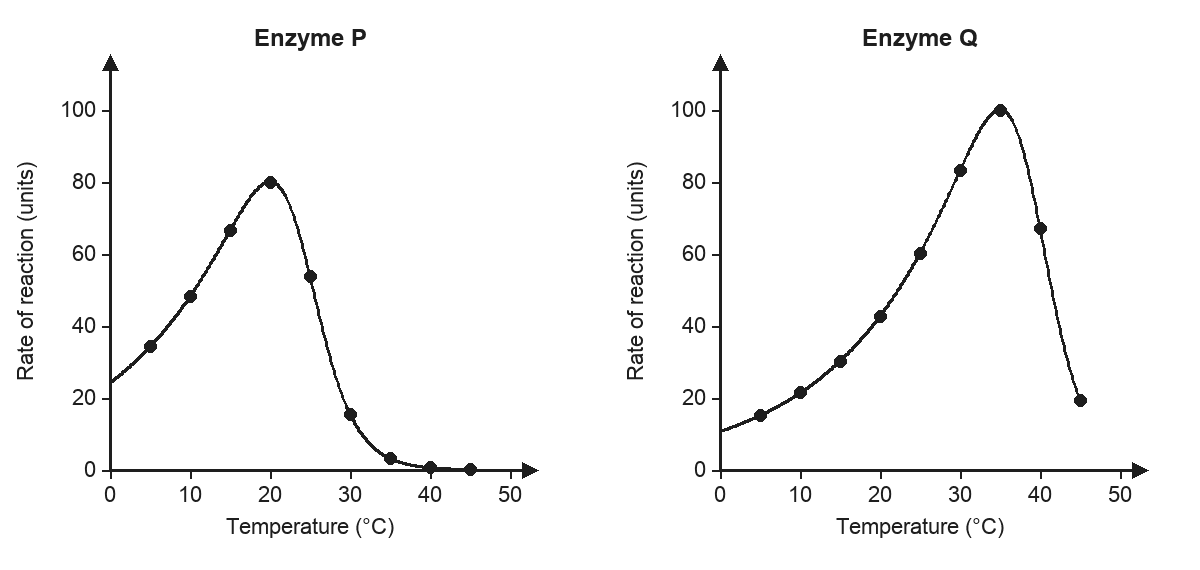
(a) State the optimum temperature of enzyme P and of enzyme Q. (1 mark)
(b) At 40 °C enzyme Q is still very active, but enzyme P has almost no activity. Explain why. (1 mark)
(c) In winter the pond water cools to 15 °C and the pond fish become sluggish. Use the data to explain this, and state whether enzyme Q is damaged by the cold. (2 marks)
- 184 marks
Question 18
Cut apple slices turn brown in air. In the cells, an enzyme called polyphenol oxidase, which contains copper at its active site, uses oxygen to oxidise phenolic compounds (released when cells are cut) into substances that form brown pigments. A food-technology class in Shimla treated freshly cut slices as follows and scored the browning after 30 minutes at 25 °C, on a scale from 0 (none) to 5 (dark brown). (Hypothetical data.)
Slice Treatment Browning score A Left in air 5 B Dipped in lemon juice (pH about 2.5), then left in air 1 C Dipped in boiling water for 2 minutes, cooled, then left in air 0 D Kept completely under water (no air) 1 (a) Name the class to which polyphenol oxidase belongs, and the type of co-factor that copper is. (1 mark)
(b) Explain the results for slices B and C. (2 marks)
(c) Explain why slice D hardly browned although its enzyme was not harmed. (1 mark)
- 191 mark
Question 19
A frozen-food plant near Pune prepares green peas for sale.
Assertion (A): Fresh green peas are dipped briefly in boiling water (blanched) before being frozen, so that they keep their colour and flavour for many months in a freezer.
Reason (R): Brief heating denatures the enzymes of the peas, which would otherwise keep acting slowly and spoil the peas even in frozen storage.
- 201 mark
Question 20
A dietician in Hyderabad explains how fats in an Indian meal are digested.
Assertion (A): Pancreatic lipase can digest many different fats, such as those in ghee, groundnut oil and butter.
Reason (R): Pancreatic lipase is made in the pancreas and poured into the small intestine.
- 211 mark
Question 21
People whose pancreas makes too little of its enzymes take capsules of pancreatic enzymes (lipase, trypsin and amylase) with their meals. The capsule holds tiny beads with a coating that does not dissolve in strong acid but dissolves at the higher pH of the small intestine. Why is this coating used?
- 224 marks
Question 22
A patient at a district hospital has drunk spurious liquor containing methanol. In the liver, the enzyme alcohol dehydrogenase oxidises methanol to formaldehyde, which is then changed into formic acid; these products damage the nerves of the eye and can cause blindness. The same enzyme also oxidises ethanol (ordinary alcohol), whose molecule is very similar to methanol (CH₃OH and C₂H₅OH). Where the specific antidote is not available, doctors give ethanol by drip to keep a high level in the blood.
In a laboratory test, liver enzyme was given 10 mM methanol with different amounts of ethanol. (Hypothetical data.)
Ethanol added (mM) 0 10 50 Rate of formaldehyde formation (units) 100 40 12 (a) Name the type of inhibition that ethanol causes to the breakdown of methanol, and give the reason from the information above. (1 mark)
(b) Use the table to explain why the blood level of ethanol must be kept high. (2 marks)
(c) Predict what will happen if the ethanol drip is stopped while much methanol is still in the blood, and give a reason. (1 mark)
- 234 marks
Question 23
A fermentation factory uses a bacterium to make an amino acid, Z, which is the end product of a chain of enzyme reactions in the bacterium. The normal strain makes very little Z, so the factory uses a mutant strain. The amount of Z in the culture medium was measured, and the first enzyme of the chain was extracted from each strain and tested with and without 5 mM Z added. (Hypothetical data.)
Time (h) 0 12 24 36 48 Z in medium, normal strain (g/L) 0 0.4 0.5 0.5 0.5 Z in medium, mutant strain (g/L) 0 6 15 24 33 First enzyme from Activity without Z (units) Activity with 5 mM Z (units) Normal strain 100 10 Mutant strain 96 94 (a) Explain why Z stops building up in the normal strain at about 0.5 g/L. (1 mark)
(b) Use the enzyme test to explain what has changed in the first enzyme of the mutant strain, and why its active site is probably unchanged. (2 marks)
(c) Calculate the average rate at which the mutant strain added Z to the medium between 12 h and 48 h. (1 mark)
- 241 mark
Question 24
Fisheries scientists in Kerala study fish from a river polluted by factory waste containing mercury.
Assertion (A): Mercury ions in polluted river water slow down many different enzymes in the fish living there, not just one enzyme.
Reason (R): Mercury ions have a structure similar to the substrates of all these enzymes, and so compete with them for the active site.
- 251 mark
Question 25
Gout is a painful joint disease caused by too much uric acid in the blood. The enzyme xanthine oxidase forms uric acid from a substance called hypoxanthine (by way of xanthine). The drug allopurinol, given to gout patients, has a structure very similar to hypoxanthine. Which statement best explains how allopurinol lowers the formation of uric acid?
- 266 marks
Question 26
Match the following:
Column A Column B 1. Oxidoreductase (a) Lipase 2. Transferase (b) Dehydrogenase 3. Hydrolase (c) Hexokinase 4. Lyase (d) Mutase 5. Ligase (e) Decarboxylase 6. Isomerase (f) Pyruvate (g) Synthetase - 275 marks
Question 27
Read the sources given and answer any four from the questions given below.
The striking characteristics of enzymes are their catalytic power and specificity. Catalysis takes place at a particular site on the enzyme called the active site. The enzymes are proteinaceous in nature and get denatured at high temperature because their chemical structure gets altered. A substrate binds to the active site of an enzyme and is converted into products. Enzymes only speed up or catalyse the chemical reactions but remain unchanged at the end of the reaction. Enzymes speed up the chemical reactions by lowering the activation energy. Enzymes are specific about the pH range. Enzymes in the intestines work best at about pH 8, whereas in the stomach they work best at about pH 2.
(1) The enzymes increase a chemical reaction by
(a) increasing the activation energy
(b) decreasing the activation energy
(c) increasing the products
(d) increasing the substrates
(2) The active site is present on the
(a) substrate
(b) product
(c) enzyme
(d) both (a) and (b)
(3) Enzymes in the stomach work best at
(a) acidic pH
(b) alkaline pH
(c) neutral pH
(d) extreme pH
(4) Which of the following statement is true for enzymes?
(a) Specific about substrate but not temperature
(b) Get denatured at high temperature
(c) Specific about both substrate and product
(d) Can be minerals or proteins
(5) At the end of a catalytic reaction, the enzymes
(a) become part of the product
(b) disintegrate and reduce in number
(c) increase in number and become more active
(d) do not undergo any change
- 281 mark
Question 28
A student in Nagpur is making revision cards on the parts of an enzyme. On one card she writes two statements.
Assertion (A): NADP and coenzyme A are placed among the coenzymes, not among the prosthetic groups.
Reason (R): NADP and coenzyme A are organic (carbon-containing) molecules.
- 291 mark
Question 29
After a marathon in Mumbai, a sports doctor finds a raised level of the enzyme creatine kinase in the blood of several runners; the enzyme leaks out of muscle cells that were strained during the race. Inside muscle, creatine kinase catalyses this reaction, in which a phosphate group moves from ATP to creatine:
To which class of enzymes does creatine kinase belong?
- 301 mark
Question 30
In a hospital laboratory in Chennai, the amount of the enzyme amylase in blood serum is checked for a patient suspected to have an inflamed pancreas. A fixed volume of serum is mixed with a large excess of starch at 37 °C and pH 7, and the starch broken down per minute is measured. Serum from a healthy person breaks down 0.8 mg of starch per minute, while the patient's serum breaks down 3.2 mg per minute under the same conditions. (Hypothetical data.) Which statement correctly explains the method and the result?
- 311 mark
Question 31
In a bacterium, two amino acids, C and E, are made from the same starting substance A. The steps, each catalysed by its own enzyme, are:
- A is changed into B by enzyme e1.
- B is changed into C by enzyme e2.
- B is also changed into D by enzyme e3, and D is changed into E by enzyme e4.
When the cell already has plenty of E, it should stop making E but go on making C. (Hypothetical data.) Which enzyme should E inhibit by end-product (feedback) inhibition to do this best?
- 321 mark
Question 32
A doctor in Jaipur prescribes a sulpha drug for a patient's bacterial urinary infection.
Assertion (A): The sulpha drug stops the bacteria from multiplying, but it does not stop the supply of folic acid to the patient's own cells.
Reason (R): Human cells do not make folic acid from p-aminobenzoic acid; humans get the folic acid they need from their food.
- 332 marks
Question 33
The graph below shows how the energy changes during one reaction catalysed by an enzyme E, which changes substrate S into product P. Points K and M are the tops of two humps, and L is the dip between them.

(a) What is present at point L? Explain why the curve dips there.
(b) The same reaction without the enzyme has a single hump that rises much higher than K. Which point, K, L or M, sets the activation energy of the enzyme-catalysed reaction? Use it to explain why the enzyme makes the reaction faster.
- 342 marks
Question 34
A research student tests one purified enzyme with three related substrates under the same conditions. Substrate S1 is its usual substrate. S2 has the same shape as S1 but carries one extra small group at one end. S3 has the same reacting bond as S1 but two large ring groups attached to it. (Hypothetical data.)
Substrate S1 S2 S3 Rate of reaction (units) 100 70 0 Student A says: "These results support the lock and key hypothesis." Student B says: "The induced-fit hypothesis explains these results better." Evaluate the two claims.
- 352 marks
Question 35
An enzyme from the small intestine works best at pH 8. In a laboratory, samples of it were kept for 10 minutes at different pH values and then tested with plenty of substrate at the same temperature. (Hypothetical data.)
Treatment of the enzyme sample Activity measured at Activity (% of best) Kept at pH 8 pH 8 100 Kept at pH 5 pH 5 20 Kept at pH 5, then brought back to pH 8 pH 8 96 Kept at pH 1, then brought back to pH 8 pH 8 5 From the second row, a technician concludes: "pH 5 destroys this enzyme." Evaluate this conclusion, and explain the result of the last row.
- 363 marks
Question 36
A petrol car has a catalytic converter in its exhaust pipe. It contains small amounts of the metals platinum, palladium and rhodium spread over a honeycomb, and it starts working only after it has become hot, at a few hundred degrees Celsius. It speeds up the change of three different harmful gases, carbon monoxide, unburnt petrol vapour and oxides of nitrogen, into less harmful ones, and the metals are not used up.
A student says: "The converter and the enzymes in our liver work in exactly the same way, because both lower the activation energy." Evaluate the student's statement, giving at least one similarity and two differences.
- 373 marks
Question 37
Enzyme E1 removes hydrogen from a substance S and passes it to the coenzyme NAD⁺, forming the product X and NADH. Enzyme E2 takes the hydrogen from NADH and passes it to another substance Y, turning NADH back into NAD⁺. A student set up two tubes, each with 10 mM of S, enzyme E1 and only 0.2 mM of NAD⁺. Tube 2 also had enzyme E2 and plenty of Y. The amount of X formed was measured. (Hypothetical data.)
Time (min) 0 5 10 20 40 X in tube 1 (mM) 0 0.15 0.2 0.2 0.2 X in tube 2 (mM) 0 3 6 9.5 10 (a) Explain why X stops forming in tube 1 at 0.2 mM, although most of S is still left.
(b) Explain the result in tube 2, and calculate how many times, on average, each NAD molecule was used.
(c) Predict how much X would form in a third tube like tube 2 but with no Y, and give a reason.
- 383 marks
Question 38
For a science exhibition in Guwahati, Class 11 students must build a simple model from everyday materials to show how an enzyme works according to the induced-fit hypothesis.
Design such a model. Name what each part stands for, describe how the model shows the steps of the catalytic cycle, and state one way in which your model is unlike a real enzyme.
- 395 marks
Question 39
Read the passage and answer the questions that follow.
A home-science teacher in Shillong wanted to make a pineapple jelly for a school fair. Jelly made with gelatin, a protein obtained from animal collagen, sets because the gelatin chains form a network as the mixture cools. Jelly made with agar, a carbohydrate obtained from seaweed, sets in the same way. Her students made six small bowls of jelly and kept them in a refrigerator for 4 hours. Fresh pineapple contains a group of enzymes called bromelain. (Hypothetical data.)
Bowl Jelly mixture After 4 hours 1 Gelatin + water Set firm 2 Gelatin + juice of fresh pineapple Still liquid 3 Gelatin + juice from canned pineapple (heat-treated in the factory) Set firm 4 Gelatin + fresh pineapple juice that was boiled for 5 minutes and cooled Set firm 5 Agar + juice of fresh pineapple Set firm 6 Gelatin + fresh pineapple juice that had been kept in a refrigerator at 4 °C for 2 days Still liquid (a) Compare bowls 1 and 2, and state what kind of enzyme bromelain must be.
(b) Explain the results of bowls 3, 4 and 6.
(c) What property of enzymes does bowl 5 show? Using the data, suggest two different ways in which the teacher can make a jelly that sets while still adding fresh pineapple juice.
- 404 marks
Question 40
Read the passage and answer the questions that follow.
Platelets are small cell fragments in blood that clump together to stop bleeding. To clump, they need the enzyme cyclooxygenase (COX). A low dose of aspirin is given to some heart patients to reduce unwanted clotting. Aspirin attaches a small chemical group permanently to the COX enzyme near its active site, so that the substrate can no longer reach the site. Platelets have no nucleus, so they cannot make new enzyme molecules; each platelet lives about 8 to 10 days, and new platelets are released from the bone marrow every day. Another painkiller, ibuprofen, also binds at the active site of COX, but it binds loosely and comes off again. A laboratory measured platelet clumping after a single tablet of each drug. (Hypothetical data.)
Days after one aspirin tablet 1 2 4 6 8 10 Platelet clumping (% of normal) 10 20 40 60 80 100 Hours after one ibuprofen tablet 2 12 24 Platelet clumping (% of normal) 15 85 100 (a) Name the type of inhibition (reversible or irreversible) caused by aspirin and by ibuprofen, giving a reason for each.
(b) Use the data to work out how fast clumping recovers after aspirin, and explain why it takes about ten days.
(c) A patient says: "Aspirin leaves the blood within a few hours of a tablet, so its effect on my platelets must also end within a few hours." Evaluate this statement.