
Most fish are cold-blooded (ectothermic): their body temperature follows the temperature of the water. A biology team from Dehradun compared the same muscle enzyme from two fish: enzyme P from a fish of a cold Himalayan stream (water 8–15 °C), and enzyme Q from a fish of a warm pond in the plains. The rate of reaction was measured at different temperatures, all other conditions being kept the same. (Hypothetical data.)
| Temperature (°C) | 5 | 10 | 15 | 20 | 25 | 30 | 35 | 40 | 45 |
|---|---|---|---|---|---|---|---|---|---|
| Rate with enzyme P (units) | 34 | 48 | 67 | 80 | 54 | 16 | 3 | 1 | 0 |
| Rate with enzyme Q (units) | 15 | 21 | 30 | 43 | 60 | 83 | 100 | 67 | 19 |
The data are plotted below.
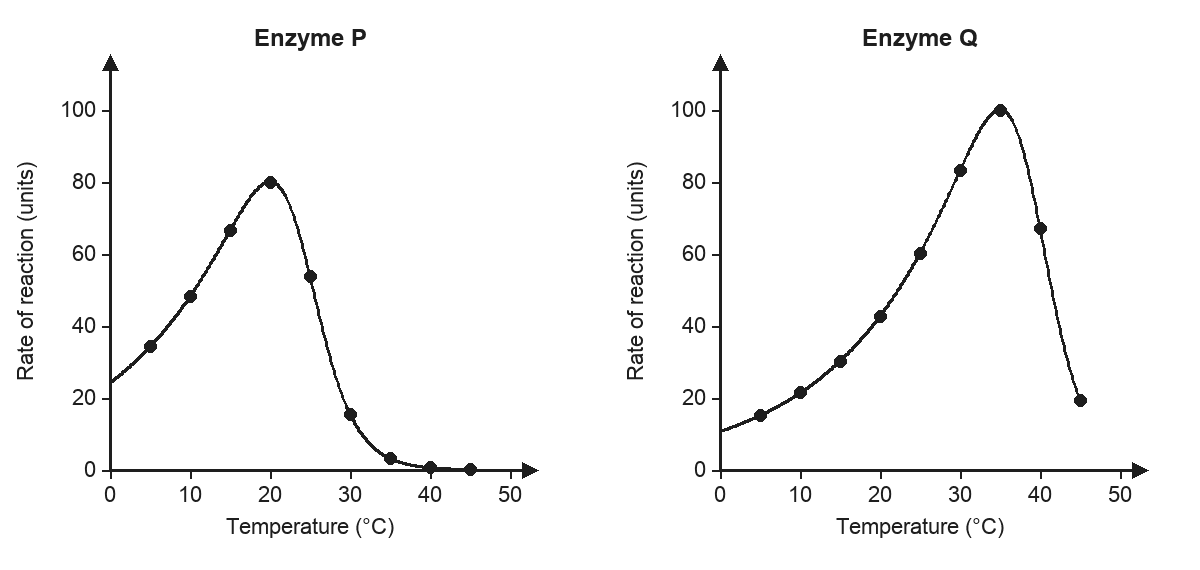
(a) State the optimum temperature of enzyme P and of enzyme Q. (1 mark)
(b) At 40 °C enzyme Q is still very active, but enzyme P has almost no activity. Explain why. (1 mark)
(c) In winter the pond water cools to 15 °C and the pond fish become sluggish. Use the data to explain this, and state whether enzyme Q is damaged by the cold. (2 marks)