
Question 585 marksMedium
Discuss the various molecules that inhibit the enzymatic reactions.
Confirming your payment
Sign up now and get 250 free tokens.
Enzymes · Question 58 of 59
Discuss the various molecules that inhibit the enzymatic reactions.
Solution:
Concept: Molecules that lower the rate of an enzyme reaction are called enzyme inhibitors; the inhibition may be reversible or irreversible.
Step 1 — What is asked: We need to explain the topic fully, point by point.
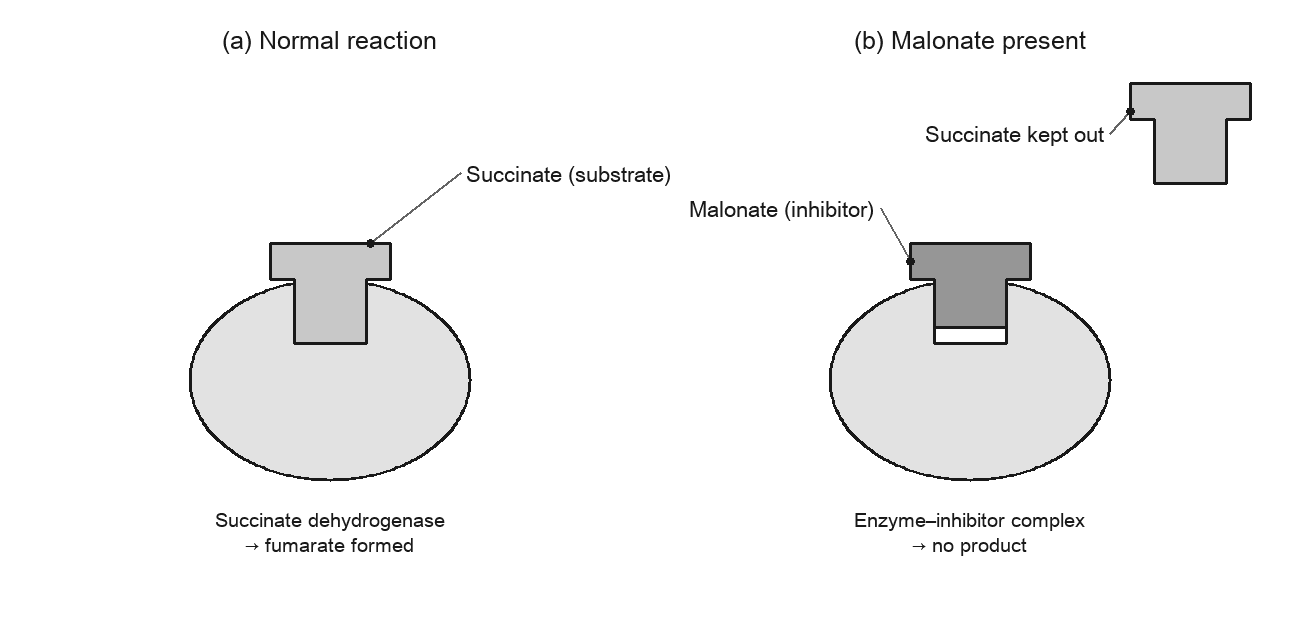
Step 2 — Competitive inhibitors: They resemble the substrate and compete for the active site, e.g. malonate inhibits succinic dehydrogenase; sulpha drugs compete with PABA and stop folic acid synthesis in bacteria. More substrate overcomes them.
Step 3 — Non-competitive inhibitors: They do not resemble the substrate, and more substrate does not displace them. Most bind a site other than the active site and change the enzyme's structure, so no product forms even if the substrate binds, e.g. heavy-metal ions such as Hg and Ag combine with –SH groups of the enzyme. Cyanide, the usual textbook example, blocks cytochrome oxidase, so the flow of electrons to oxygen through this enzyme stops (see the Note).
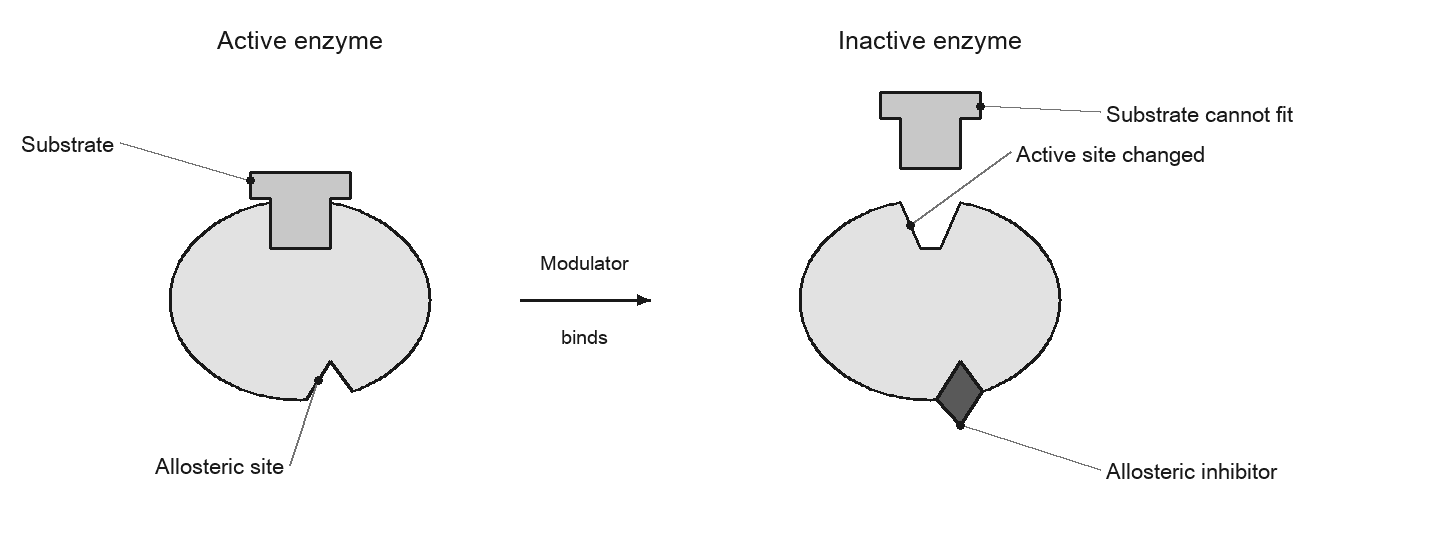
Step 4 — Allosteric modulators: Modulators, often metabolites of the same pathway (such as its end product) or energy signals such as ATP and AMP, bind the allosteric site, change the shape of the active site and so lower (or raise) the rate; the effect is reversible.
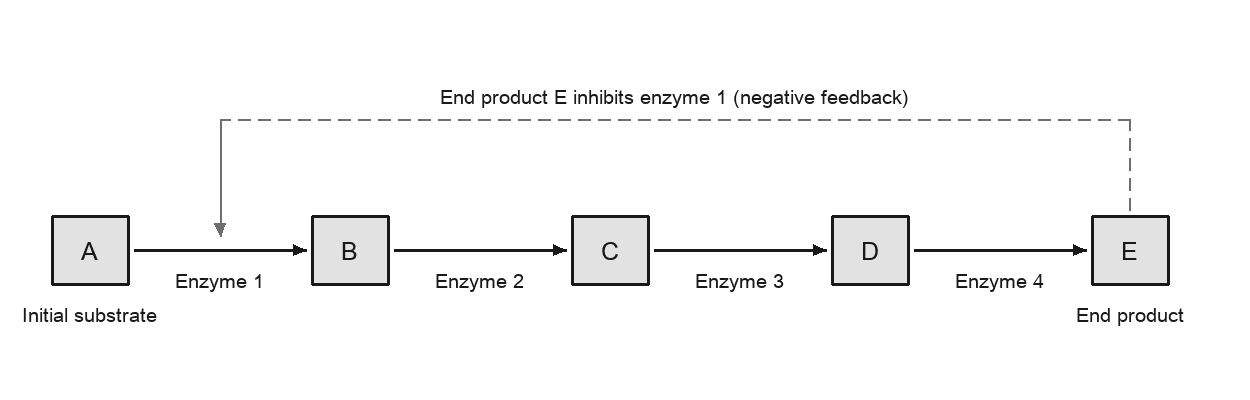
Step 5 — End-product (feedback) inhibitors: When the end product of a pathway accumulates, it acts like an allosteric inhibitor of the first enzyme of the pathway and slows the whole pathway; this is negative feedback inhibition.
Note: Cyanide is the usual textbook example of a non-competitive inhibitor because adding more substrate does not reverse it. Strictly, it binds the iron of haem a in the oxidised (Fe) form of cytochrome oxidase, at the centre where oxygen is reduced, rather than at a separate site; heavy-metal ions fit the 'binds elsewhere' description better.
Therefore, enzyme reactions are inhibited by competitive inhibitors, non-competitive inhibitors, allosteric inhibitors and end products (feedback inhibition).