
Question 575 marksMedium
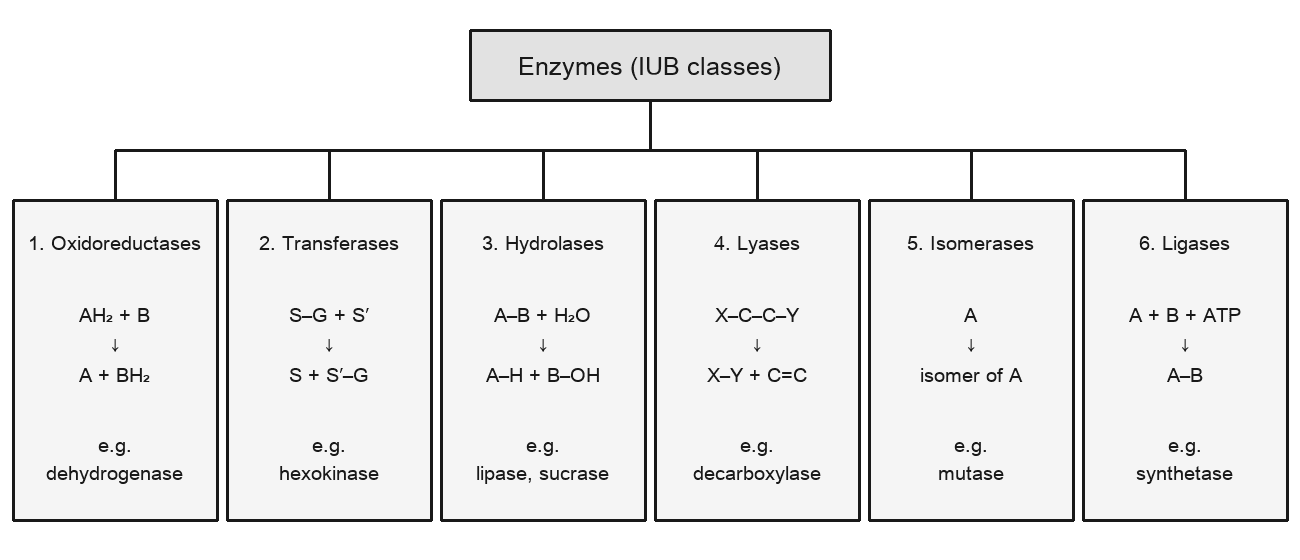
Classify the enzymes according to the kind of reactions they bring about, giving a diagrammatic representation.
Confirming your payment
Sign up now and get 250 free tokens.
Enzymes · Question 57 of 59
Classify the enzymes according to the kind of reactions they bring about, giving a diagrammatic representation.
Solution:
Concept: According to the IUB system, enzymes are grouped into six classes by the kind of reaction they catalyse.
Step 1 — What is asked: We need to explain the topic fully, point by point.
Step 2 — Oxidoreductases: Catalyse oxidation–reduction between two substrates (removing or adding hydrogen or electrons), e.g. dehydrogenases, oxidases.
Step 3 — Transferases: Transfer a group (other than hydrogen) from one substrate to another, e.g. hexokinase moves phosphate from ATP to glucose; transaminases.
Step 4 — Hydrolases: Split a molecule into two products by adding water, e.g. lipase, amylase, sucrase.
Step 5 — Lyases: Remove groups from substrates without hydrolysis, often leaving a double bond, e.g. decarboxylases, fumarase.
Step 6 — Isomerases: Convert a molecule into its isomer (optical, geometric or positional), e.g. glucose-6-phosphate isomerase (glucose-6-phosphate to fructose-6-phosphate) and mutases such as phosphoglucomutase (glucose-1-phosphate to glucose-6-phosphate).
Step 7 — Ligases: Join two molecules by new covalent bonds using energy from ATP, e.g. synthetases, pyruvate carboxylase.
Step 8 — Diagram: The classes, their general reactions and examples are shown below.
Note: The IUB list of six classes is the one used in the syllabus; since 2018 the official Enzyme Commission list has a seventh class, translocases, which move ions or molecules across membranes.
Therefore, enzymes are classified into oxidoreductases, transferases, hydrolases, lyases, isomerases and ligases.