
Question 322 marksEasy
Define 'lock and key' hypothesis in a few lines.
Confirming your payment
Sign up now and get 250 free tokens.
Enzymes · Question 32 of 59
Define 'lock and key' hypothesis in a few lines.
Solution:
Concept: The lock and key hypothesis was proposed by Emil Fischer in 1894.
Step 1 — What is asked: We need to answer the question point by point.
Step 2 — The idea: The active site of an enzyme has a definite, rigid shape. Only a substrate whose shape is complementary to it can fit, just as only the right key fits a lock.
Step 3 — What follows: The substrate fits the active site and forms an enzyme–substrate complex; this lowers the activation energy, the substrate is changed into products, and the products leave the enzyme unchanged.
Step 4 — Figure: The model is shown in part (a) of the figure below.
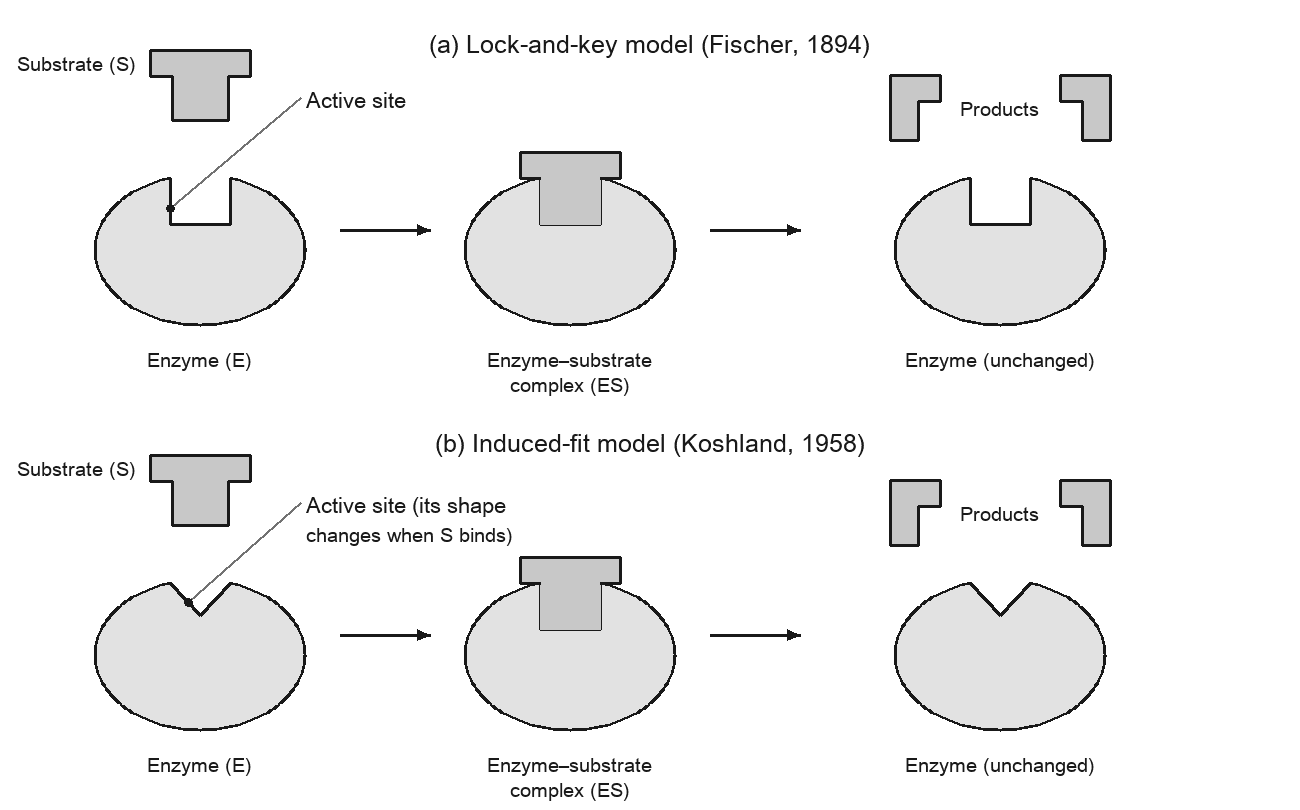
Therefore, the lock and key hypothesis says the substrate fits a rigid, complementary active site like a key in a lock, forming an ES complex.