
Opening your dashboard
Class 11 Biology Chapter 14 Enzymes: Practice Questions
99 questions on Chapter 14, each worked through on its own page with the AI tutor. Class 11 Biology, ICSE 2026-27.
99 questions
1–4 marks · Mixed difficulty
- 11 mark
Question 1
A reversible reaction A ⇌ B is left without any enzyme. It reaches equilibrium after about 10 hours, when the ratio of B to A is 4 : 1. The experiment is repeated at the same temperature with a suitable enzyme added. (Hypothetical data.) What will be observed?
- 23 marks
Question 2
The figure shows the energy profiles of the same reaction under two conditions, drawn on the same energy scale. In one condition an enzyme is present; in the other there is no enzyme.
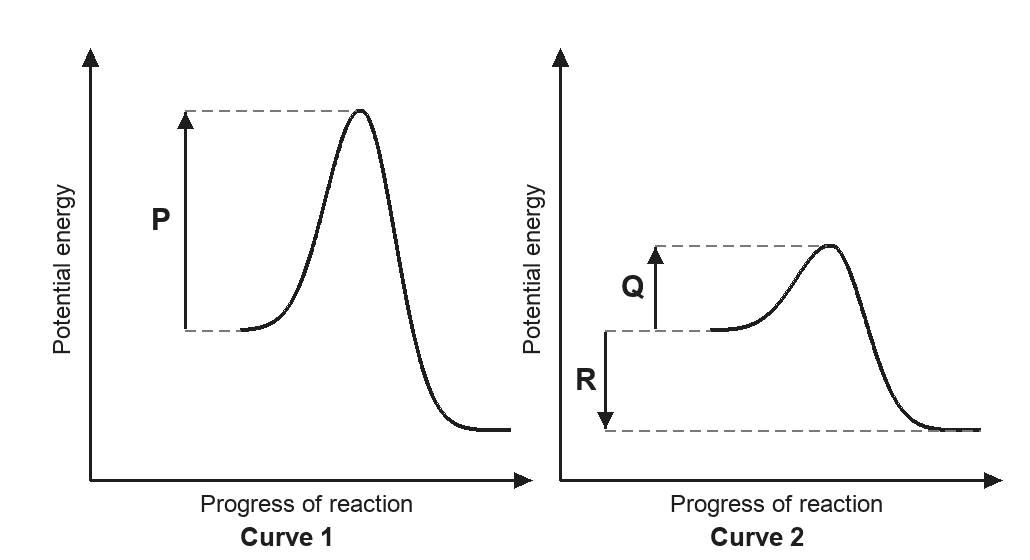
(a) Which curve shows the enzyme-catalysed reaction? Give a reason.
(b) Which arrow shows the activation energy of the enzyme-catalysed reaction?
(c) What does arrow R show, and is it changed by the enzyme?
- 31 mark
Question 3
Warming a reaction mixture and adding an enzyme to it can both speed up the same reaction. Which statement correctly compares how the two act?
- 42 marks
Question 4
Heating could supply the activation energy for the reactions of a living cell. Give two reasons why cells depend on enzymes instead of high temperature.
- 51 mark
Question 5
Without an enzyme, a reaction forms 180 molecules of product per hour. With its enzyme, the same reaction goes 10⁶ (one million) times faster. (Hypothetical data.) About how many molecules of product does the enzyme-catalysed reaction form per second?
- 63 marks
Question 6
The table gives the potential energy at three points of a reaction, with and without its enzyme. (Hypothetical data.)
Point on the energy profile Potential energy (kJ mol⁻¹) Substrate (start) 50 Top of the hump without enzyme 130 Top of the hump with enzyme 80 Product (end) 20 (a) Calculate the activation energy without and with the enzyme.
(b) By how much does the enzyme lower the activation energy?
(c) Calculate the energy released by the reaction, and say whether the enzyme changes it.
- 71 mark
Question 7
In the ribosome, the joining of amino acids by peptide bonds is catalysed by a molecule of ribosomal RNA, not by a protein. The RNA is unchanged at the end of the reaction. What does this observation show?
- 82 marks
Question 8
A mixture of hydrogen and oxygen gases can be kept at room temperature for years without forming water, yet a single spark makes the whole mixture react.
(a) Why does the mixture not react on its own at room temperature?
(b) Why does one spark make the whole mixture react, not just the gas near the spark?
- 91 mark
Question 9
An enzyme preparation loses all activity when EDTA, a chemical that grips metal ions tightly and removes them, is added. Activity returns when zinc ions (Zn²⁺) are added back in excess. Which is the best conclusion?
- 103 marks
Question 10
Three enzymes X, Y and Z each need a non-protein part. Read the descriptions and classify the non-protein part of each as a prosthetic group, a coenzyme or an inorganic metal ion. Give a reason for each. (Hypothetical descriptions.)
Enzyme Description of its non-protein part X An organic ring containing iron; it stays firmly attached to the protein even after the enzyme is purified, and it lies in the active site. Y An organic molecule that joins the protein only during the reaction, is changed in the reaction and then leaves. Z Magnesium ions (Mg²⁺), which form coordination bonds with the active site and with the substrate. - 111 mark
Question 11
In the enzyme pyruvate carboxylase, the vitamin biotin is held by a covalent bond to the protein and remains attached after every reaction. In this enzyme biotin is best described as
- 122 marks
Question 12
Niacin is a vitamin. A diet badly short of niacin slows down many different enzyme reactions in the body, not just one. Explain why.
- 132 marks
Question 13
Catalase breaks down hydrogen peroxide into water and oxygen, and its haem group is a prosthetic group. Suppose the haem could be removed while leaving the protein part folded and intact. Predict what would happen to the activity of catalase, and explain your prediction.
- 142 marks
Question 14
A metal-ion co-factor is sometimes said to act as a bridge between an enzyme and its substrate. Explain this description.
- 154 marks
Question 15
A purified enzyme extract was placed in a bag of a membrane through which only small molecules can pass, and the bag was kept in water. This separated the extract into fraction A (large molecules, left inside the bag) and fraction B (small molecules, which passed out). Five tubes were set up with the same substrate and the product formed was measured. (Hypothetical data.)
Tube Contents added to substrate Product formed (µmol) 1 Fraction A only 0 2 Fraction B only 0 3 Fractions A and B 100 4 Boiled fraction A + fraction B 0 5 Fraction A + boiled fraction B 100 (a) Explain the results of tubes 1, 2 and 3.
(b) Name the part of a holoenzyme that fraction A and fraction B each represent.
(c) Explain the results of tubes 4 and 5.
- 161 mark
Question 16
The coenzyme NAD is changed (reduced to NADH) every time it takes part in a reaction, yet a cell needs only a small amount of it. Why?
- 171 mark
Question 17
An enzyme is a single chain of 500 amino acids. If, as is typical, 3 to 12 of its amino acids come into direct contact with the substrate, what fraction of its amino acids forms this contact region?
- 183 marks
Question 18
In chymotrypsin, a protein-digesting enzyme, three amino acids that are essential in its active site lie at positions 57, 102 and 195 of the polypeptide chain.
(a) Explain how amino acids so far apart in the chain can sit side by side in one active site.
(b) Explain why strong heating destroys the activity of this enzyme.
- 191 mark
Question 19
X-ray pictures of the enzyme hexokinase show that when glucose binds, the two lobes of the enzyme swing towards each other and close around the glucose molecule. This observation best supports
- 204 marks
Question 20
The four events of one catalytic cycle of an enzyme are given below in the wrong order.
P: The enzyme releases the products and is free to bind another substrate molecule.
Q: The substrate binds to the active site of the enzyme.
R: The active site breaks bonds in the substrate, and an enzyme–product complex is formed.
S: Binding makes the enzyme change shape so that it fits tightly round the substrate, forming the enzyme–substrate complex.
(a) Arrange P, Q, R and S in the correct order.
(b) Explain why the enzyme can run through this cycle again and again.
- 211 mark
Question 21
One molecule of an enzyme converts 600 substrate molecules into product every second. A cell contains 2,000 molecules of this enzyme, and substrate is plentiful. (Hypothetical data.) How many substrate molecules are converted in 5 seconds?
- 222 marks
Question 22
The active site of an enzyme has binding groups, which hold the substrate, and catalytic groups, which act on the bond to be broken. A molecule M fits the binding groups well, but it has no bond in the position where the catalytic groups act. Predict what happens when M meets the enzyme, and explain.
- 232 marks
Question 23
Some enzymes join two different substrate molecules together. Explain how holding both substrates in the active site helps the reaction to go faster.
- 243 marks
Question 24
At the end of a catalytic cycle an enzyme must release its product.
(a) Why must the product be released quickly for the reaction to keep going at a high rate?
(b) Predict what would happen to the rate if one product stayed tightly bound to the active site for a long time after it was formed.
(c) Explain why the enzyme is said to remain unchanged at the end of the reaction.
- 252 marks
Question 25
Two mutant forms of an enzyme each have one amino acid changed. Predict and explain the likely effect on the enzyme's activity when the changed amino acid is
(a) one of the amino acids lining the active site, replaced by an amino acid of a very different shape and charge;
(b) an amino acid on the outer surface, far from the active site, whose change does not alter how the chain folds.
- 261 mark
Question 26
The enzyme glucose-6-phosphatase catalyses this reaction:
To which class of enzymes does it belong?
- 271 mark
Question 27
The enzyme fumarase catalyses this reaction:
The enzyme belongs to the class
- 281 mark
Question 28
An enzyme catalyses this reaction, in which an amino group (–NH₂) moves from one molecule to the other:
The enzyme is
- 293 marks
Question 29
Name the class of enzyme that catalyses each reaction, and give a reason.
(a) Dihydroxyacetone phosphate ⇌ glyceraldehyde-3-phosphate (both C₃H₇O₆P)
(b) Lactate + NAD⁺ → pyruvate + NADH + H⁺
(c) Glutamate + NH₃ + ATP → glutamine + ADP + phosphate
- 302 marks
Question 30
Using the rules for trivial names of enzymes, state the substrate and the kind of reaction indicated by each name, and the class to which each enzyme belongs.
(a) Succinate dehydrogenase
(b) Histidine decarboxylase
- 311 mark
Question 31
Which of the following reactions would be catalysed by an isomerase?
- 322 marks
Question 32
An enzyme catalyses a reaction of the type
where C is not water. A student says the enzyme is a hydrolase because the A–B bond is broken. Is the student right? Explain.
- 333 marks
Question 33
The enzyme alcohol dehydrogenase catalyses this reaction:
(a) Which substrate is oxidised and which is reduced?
(b) To which class does the enzyme belong?
(c) What role does NAD⁺ play in this reaction?
- 344 marks
Question 34
The rate of a reaction catalysed by a human enzyme was measured at different temperatures, with all other conditions kept the same. (Hypothetical data.)
Temperature (°C) 10 20 30 37 40 45 50 60 Rate (units) 2.0 4.0 8.0 13.0 12.0 7.0 3.0 0 (a) Show from the data that between 10 °C and 30 °C the rate roughly doubles for every 10 °C rise.
(b) State the optimum temperature shown by the data.
(c) Explain why the rate falls above 40 °C, and why it does not recover when the 60 °C mixture is cooled back to 37 °C.
- 351 mark
Question 35
Two samples of the same human enzyme are kept for one hour, sample 1 at 0 °C and sample 2 at 80 °C. Both are then brought to 37 °C and tested with substrate. What result is expected?
- 361 mark
Question 36
In an experiment the substrate is kept in large excess, and the pH and temperature are kept constant. The rate is measured with different amounts of enzyme. (Hypothetical data.)
Enzyme (units) 1 2 3 4 Rate (µmol per min) 5 10 15 20 What rate is expected with 6 units of enzyme under the same conditions?
- 374 marks
Question 37
The rate of an enzyme reaction was measured at different substrate concentrations, with enzyme concentration, pH and temperature kept constant. The maximum rate (Vmax) for this enzyme under these conditions is 60 units. (Hypothetical data.)
[S] (mM) 1 2 4 6 10 18 38 Rate (units) 20 30 40 45 50 54 57 (a) Find Km, the substrate concentration at which the rate is half of Vmax.
(b) Explain why the rise in rate becomes smaller and smaller as [S] increases.
(c) The experiment is repeated at 38 mM substrate with twice the amount of enzyme. Predict the rate, given that this enzyme follows the rule .
- 381 mark
Question 38
Pepsin digests proteins in the stomach, where the pH is about 2. When the partly digested food passes into the small intestine, the pH there rises to about 7 to 8. What happens to the activity of the pepsin that passes along with the food?
- 392 marks
Question 39
The activity of two protein-digesting enzymes, X and Y, was measured at different pH values. (Hypothetical data.)
pH 1 2 3 5 7 8 9 11 Activity of X (%) 60 100 70 5 0 0 0 0 Activity of Y (%) 0 0 0 10 70 100 75 5 Which enzyme could be pepsin and which could be trypsin? Give a reason for each.
- 403 marks
Question 40
Two enzymes, P and Q, were each tested on several possible substrates under the same conditions. (Hypothetical data.)
Enzyme Substrates tested (rate of reaction, units) P maltose (100); sucrose (0); lactose (0); starch (0) Q fat 1 (80); fat 2 (95); fat 3 (70); a protein (0) (a) Which enzyme is more specific? Give a reason from the data.
(b) Explain, in terms of the active site, why each enzyme acts only on the substrates shown.
(c) Which enzyme could be a lipase?
- 412 marks
Question 41
Explain how a change of pH away from the optimum can lower the activity of an enzyme, even before the enzyme is denatured.
- 424 marks
Question 42
The rate of an enzyme reaction was measured at different substrate concentrations with no inhibitor, with inhibitor X and with inhibitor Y. Each inhibitor was used at one fixed concentration. (Hypothetical data.)
[S] (mM) 1 2 4 9 19 99 No inhibitor 50.0 66.7 80.0 90.0 95.0 99.0 With X 33.3 50.0 66.7 81.8 90.5 98.0 With Y 25.0 33.3 40.0 45.0 47.5 49.5 The values up to 19 mM are plotted below.
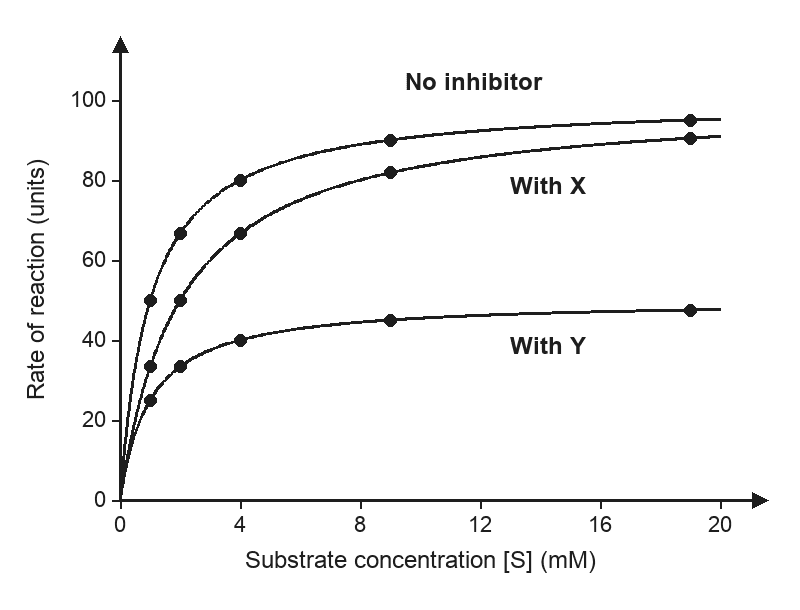
The maximum rate (Vmax) is 100 units without an inhibitor.
(a) Identify the type of inhibition caused by X. Give a reason from the data.
(b) Identify the type of inhibition caused by Y. Give a reason from the data.
(c) Find the value of Km (the [S] giving half the maximum rate) without inhibitor, with X and with Y.
- 431 mark
Question 43
An inhibitor lowers the rate of an enzyme reaction. When the substrate concentration is raised tenfold, with the same amount of inhibitor present, the rate becomes almost the same as without the inhibitor. The inhibitor most probably
- 441 mark
Question 44
Without an inhibitor, an enzyme has Vmax = 80 units and Km = 4 mM. A non-competitive inhibitor is added at a concentration that puts half of the enzyme molecules out of action. (Hypothetical data.) What are the new values of Vmax and Km?
- 453 marks
Question 45
In a bacterium, substance E is made from substance A by a chain of four enzymes, e1 to e4:
When a large amount of E is added to the culture, the amounts of B, C and D in the cells fall to almost zero, while A builds up. When E is used up, B, C and D appear again.
(a) Which enzyme does E inhibit? Explain how the data show this.
(b) Name this kind of inhibition and state how E acts on the enzyme.
(c) Why do B, C and D reappear when E is used up?
- 461 mark
Question 46
A molecule made by another pathway of the cell binds to an enzyme at a site far away from its active site, and the enzyme then works faster. This is an example of
- 472 marks
Question 47
An enzyme was mixed with inhibitor I₁ in one tube and with inhibitor I₂ in another. Each mixture was then placed in a bag of a membrane that lets small molecules such as the inhibitors pass out into a large volume of water, but keeps the enzyme in. Activity was measured before and after this treatment. (Hypothetical data.)
Inhibitor Activity before (% of normal) Activity after (% of normal) I₁ 10 95 I₂ 10 10 Classify each inhibition as reversible or irreversible, and explain.
- 482 marks
Question 48
A drug company wants to design a competitive inhibitor for an enzyme that a disease-causing bacterium needs. State two properties the drug molecule must have, and explain why each is needed.
- 492 marks
Question 49
In end-product inhibition, the final product of a pathway usually inhibits the first enzyme of the pathway rather than the last one. Give two advantages of this to the cell.
- 504 marks
Question 50
A new substance Z lowers the activity of an enzyme. Describe an experiment to find out whether Z is a competitive or a non-competitive inhibitor, and state how you would interpret the results.
- 511 mark
Question 51
An enzyme acts by
- 521 mark
Question 52
Enzyme differs from the catalyst by
- 531 mark
Question 53
Enzyme is similar to catalyst because it is
- 541 mark
Question 54
According to IUB, the first part of 'trivial' name of enzyme refers to the kind of
- 551 mark
Question 55
In an enzyme catalysed reaction, addition of a substance to the reaction mixture decreases the reaction. The substance added must be
- 561 mark
Question 56
A co-enzyme can be
- 571 mark
Question 57
The enzymes that break a complex molecule into two products by hydrolysis belong to class
- 581 mark
Question 58
The enzymes that break the covalent bonds without hydrolysis are
- 591 mark
Question 59
Enzymes generally have
- 601 mark
Question 60
The enzymes that join together two molecules by forming new covalent bonds are
- 611 mark
Question 61
The enzymes that catalyse rearrangement of molecular structure with any addition or deletion of a molecule are
- 621 mark
Question 62
An enzyme sucrase is an example of
- 631 mark
Question 63
Hexokinase is an example of
- 641 mark
Question 64
An enzyme could be
- 651 mark
Question 65
Which of the following will be an enzyme?
- 661 mark
Question 66
The organic molecule tightly bound to the enzyme and required for the activity of enzyme is grouped as
- 671 mark
Question 67
The feedback mechanism means the inhibition by the
- 681 mark
Question 68
In an enzyme catalysed reaction, rate of reaction will keep on increasing with the increase in
- 691 mark
Question 69
The rate of enzyme catalysed reaction becomes stable after some time due to
- 701 mark
Question 70
The rate of reaction will be maximum when the temperature is increased from
- 711 mark
Question 71
Pepsin acts best at pH
- 721 mark
Question 72
The sulpha drugs act on the principle of
- 731 mark
Question 73
A cyanide molecule changes the rate of reaction then due to
- 741 mark
Question 74
If a molecule which is an intermediate product of the chain decreases the rate of reaction, then it does so by
- 751 mark
Question 75
Most of the vitamins are
- 761 mark
Question 76
Enzymes do not ________ a reaction but lower the ________.
- 771 mark
Question 77
In a chemical reaction, the organic molecules loosely bound to an enzyme are called ________ while the inorganic metal ions like zinc are called ________.
- 781 mark
Question 78
________ enzymes catalyse the removal of groups from substrates by mechanisms other than hydrolysis leaving double bonds.
- 791 mark
Question 79
Enzyme pepsin works best at ________ pH while trypsin works best at ________ pH.
- 801 mark
Question 80
The molecule that binds at a specific site far away from the active site and brings a change in the shape of an enzyme is called ________.
- 811 mark
Question 81
Only some enzymes are proteinaceous.
- 821 mark
Question 82
A catalyst increases the rate of reaction but does not participate.
- 831 mark
Question 83
All enzymes work best at the same optimum temperature and same pH.
- 841 mark
Question 84
A co-enzyme is always non-protein in nature.
- 851 mark
Question 85
All enzymes get denatured at high temperature.
- 861 mark
Question 86
Allosteric inhibitor molecule is structurally similar to the substrate.
- 871 mark
Question 87
Competitive inhibitors alter the shape of the enzyme.
- 881 mark
Question 88
The enzymes remain unchanged at the end of the reaction.
- 891 mark
Question 89
With the increase of substrate the rate of reaction will go on increasing.
- 901 mark
Question 90
If the final product of the reaction is made to accumulate, enzyme decreases the rate of reaction.
- 911 mark
Question 91
Part of an enzyme which is an organic compound, tightly bound to an apoenzyme.
- 921 mark
Question 92
Class of enzymes that bring about linking together of the two compounds.
- 931 mark
Question 93
The part of an enzyme at which a substrate binds to the enzyme.
- 941 mark
Question 94
The kind of inhibition in which an inhibitor binds to an enzyme other than the active site of an enzyme.
- 951 mark
Question 95
The chemical nature of enzymes.
- 961 mark
Question 96
Assertion (A): Allosteric enzymes show feedback inhibition.
Reason (R): The inhibitor substance is competitive to substrate.
- 971 mark
Question 97
Assertion (A): The inhibition of succinic dehydrogenase by malonate is an example of competitive inhibition.
Reason (R): Competitive inhibition is the inhibition of enzyme activity when inhibitor closely resembles the substrate in its molecular structure.
- 981 mark
Question 98
Assertion (A): Co-enzyme nicotinamide adenine dinucleotide (NAD) and NADP contain a vitamin niacin.
Reason (R): The association of co-enzyme with apoenzyme is strong and lasting.
- 991 mark
Question 99
Assertion (A): Sucrase is a hydrolase that breaks sucrose into glucose and fructose.
Reason (R): Hydrolases break a complex molecule into two products by hydrolysis.