
Opening your dashboard
Class 10 Biology Chapter 6: Photosynthesis Solutions
63 textbook questions with step-by-step answers, free to read, for ICSE 2026-27.
Get talked through Ch 6, not just shown the answer
Reading a finished solution is not the same as being able to do it. The AI tutor takes one question at a time and works it with you, in your own words, until you can.
- Ask it out loud, in your own words
- It gives you the next step, not the answer
- Stuck on part (ii)? Start there
63 questions with solutions
1–16 marks · Mixed difficulty
- 17 marks
Question 1
Answer the following in "Yes" or "No"
(i) All parts of a green plant carry out photosynthesis. Yes/No
(ii) All green parts of a plant carry out photosynthesis. Yes/No
(iii) Photosynthesis is the only biological process that releases oxygen into the air. Yes/No
(iv) Out of nine types of chlorophylls, chlorophyll a and b are the most abundant. Yes/No
(v) Too much light destroys chlorophyll. Yes/No
(vi) No transpiration occurs during photosynthesis. Yes/No
(vii) During sunlight, the guard cells turn flaccid to open the stomata. Yes/No
Solve with AIWritten solution
Solution:
Concept: Photosynthesis needs chlorophyll, so only green cells can carry it out. A stoma opens when its two guard cells become turgid and closes when they become flaccid.
Step 1 — Parts (i) and (ii): which parts photosynthesise.
Only cells that contain chlorophyll can trap light energy and make food.
(i) No. Non-green parts, such as the roots and the woody stem, have no chlorophyll, so they cannot photosynthesise.
(ii) Yes. Every green part has chloroplasts: the mesophyll cells of the leaves, the guard cells of the stomata and the outer layers of young green stems.
Step 2 — Parts (iii) to (v): oxygen and chlorophyll.
(iii) Yes. Photosynthesis is the only biological process that releases oxygen into the atmosphere; respiration uses oxygen up.
(iv) Yes. Of the nine types of chlorophyll, chlorophyll-a and chlorophyll-b are the most abundant.
(v) Yes. Chlorophyll is sensitive to light, so very strong light can destroy it.
Step 3 — Part (vi): transpiration during photosynthesis.
In light the stomata are open to let carbon dioxide in. Water vapour escapes through the same open stomata, so transpiration goes on along with photosynthesis.
(vi) No.
Step 4 — Part (vii): what opens the stoma.
In sunlight water enters the guard cells, so they become turgid. Their thin outer walls stretch more than their thick inner walls, so the guard cells bow outwards and the pore between them opens. When they lose water they become flaccid and the pore closes.
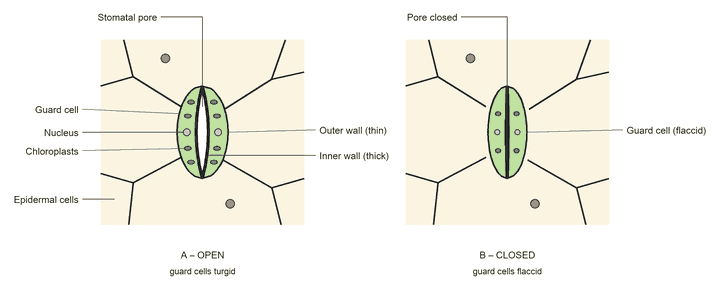
(vii) No. The guard cells turn turgid, not flaccid, to open the stomata.
Watch out: "all parts" and "all green parts" are different statements: roots belong to the plant but are not green.
Therefore, (i) No, (ii) Yes, (iii) Yes, (iv) Yes, (v) Yes, (vi) No, (vii) No.
- 21 mark
Question 2
Write the overall summary of the chemical equation of photosynthesis.
Solve with AIWritten solution
Solution:
Concept: In photosynthesis, carbon dioxide and water combine in the presence of light energy and chlorophyll to form glucose; water and oxygen are also given out.
Step 1 — Write the raw materials and the products.
The raw materials are carbon dioxide and water; the products are glucose, water and oxygen. Light energy and chlorophyll are written on the arrow because they are needed but are not used up as raw materials.
Step 2 — Write the balanced equation.
Six molecules of carbon dioxide and twelve of water give one molecule of glucose, six of water and six of oxygen:
Step 3 — Check the balance.
Each side has 6 carbon atoms, 24 hydrogen atoms and 24 oxygen atoms, so the equation is balanced.

Watch out: Write 12 molecules of water on the left and 6 on the right; the shorter form with 6 water on the left and none on the right hides the fact that the oxygen comes from water.
Therefore, 6CO₂ + 12H₂O → (light energy, chlorophyll) → C₆H₁₂O₆ + 6H₂O + 6O₂.
- 31 mark
Question 3
Which single substance in the above equation is repeated in raw material as well as reproduced as an end product?
Solve with AIWritten solution
Solution:
Concept: A substance that is both a raw material and an end-product appears on both sides of the equation.
Step 1 — Look at both sides of the equation.
We write the equation of photosynthesis and compare the two sides:
Step 2 — Find the common formula.
Only appears on both sides: 12 molecules are used as a raw material and 6 molecules appear among the end-products.
Step 3 — Why it reappears.
The 6 water molecules on the right are not left-over water. They are formed again during the chain of reactions of photosynthesis.
Therefore, the substance is water (H₂O).
- 41 mark
Question 4
What is the source of oxygen released in photosynthesis — or ?
Solve with AIWritten solution
Solution:
Concept: The oxygen given out in photosynthesis is set free when water is split by light (photolysis) in the light-dependent phase.
Step 1 — Find where oxygen is released.
Light energy absorbed by chlorophyll splits water molecules in the grana. The oxygen of the water is given out as molecular oxygen:
Step 2 — See what happens to carbon dioxide.
Carbon dioxide is used later, in the light-independent phase, where hydrogen is added to it to form glucose. Its oxygen stays in the glucose (and the water formed), so it is not the source of the oxygen released.
Watch out: The oxygen is not taken from , even though contains oxygen.
Therefore, the oxygen released comes from water (H₂O), not from CO₂.
- 52 marks
Question 5
What happens in photolysis?
Solve with AIWritten solution
Solution:
Concept: photolysis means splitting by light (photo = light, lysis = breaking). It is the splitting of water molecules in the grana of the chloroplast, using light energy.
Step 1 — Chlorophyll is activated.
Chlorophyll absorbs photons (the smallest units of light energy) and becomes activated.
Step 2 — Water is split.
The energy passed on by the activated chlorophyll splits water molecules into hydrogen ions, electrons and oxygen:
Step 3 — The products are used or released.
Each product has its own fate:
- the hydrogen ions are picked up by NADP to form NADPH;
- the oxygen is given out as molecular oxygen ();
- the electrons help to convert ADP into energy-rich ATP by adding a phosphate group (photophosphorylation).
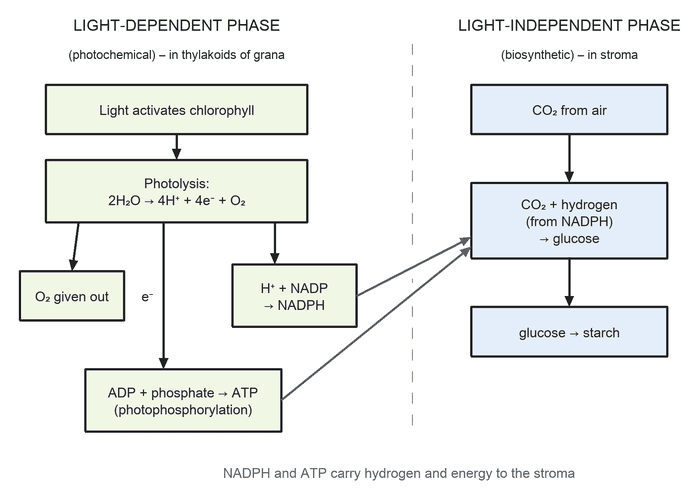
Watch out: Photolysis splits water, not carbon dioxide.
Therefore, in photolysis light energy splits water into hydrogen ions, electrons and oxygen; oxygen is given out, the hydrogen goes to NADP (NADPH) and the electrons help to form ATP.
- 62 marks
Question 6
Dark reaction involves utilisation of in producing (glucose). Why is this phase called dark reaction?
Solve with AIWritten solution
Solution:
Concept: In the name "dark reaction", dark means not needing light. It does not mean "happening at night".
Step 1 — See what this phase uses.
This phase uses the NADPH and ATP made in the light reaction: hydrogen from NADPH is added to , using energy from ATP, to form glucose.
Step 2 — See what it does not need.
None of these reactions needs light energy directly. Because they do not depend on light, the phase was named the dark reaction.
Step 3 — When it actually happens.
It goes on in the daytime, at the same time as the light reaction, because it needs a constant supply of NADPH and ATP from it.
Watch out: Do not write that the dark reaction takes place at night.
Therefore, it is called the dark reaction because its reactions do not require light; they only use the products (NADPH and ATP) of the light reaction.
- 71 mark
Question 7
Glucose produced during photosynthesis is soon polymerised into starch. What does polymerisation mean?
Solve with AIWritten solution
Solution:
Concept: In polymerisation, many small, simple molecules (units) join to form one large, complex molecule.
Step 1 — Define the term.
Polymerisation is the conversion of many simpler and smaller molecules into a complex, bigger molecule.
Step 2 — Apply it to photosynthesis.
Many glucose molecules join to form one molecule of starch. Glucose is soluble in water, but starch is insoluble, so starch can be stored in the leaf without disturbing its cells.
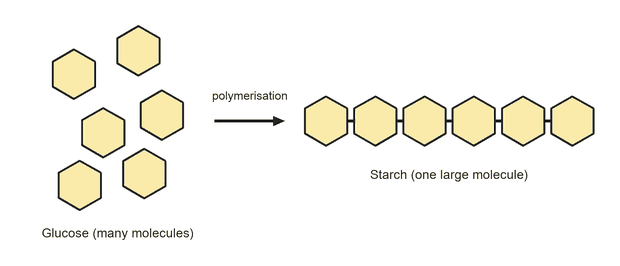
Therefore, polymerisation means joining many small molecules (here glucose) into one large molecule (here starch).
- 82 marks
Question 8
Why is it better to call the dark phase of photosynthesis as "light-independent phase"?
Solve with AIWritten solution
Solution:
Concept: The old name "dark phase" suggests that the phase happens only in darkness, which is not true.
Step 1 — What the old name meant.
"Dark phase" never meant that it occurs at night. It only meant that its reactions are not dependent on light.
Step 2 — When it really occurs.
It occurs simultaneously with the light reaction; the time gap between the two is less than one-thousandth of a second. It needs the NADPH and ATP that the light reaction keeps supplying.
Step 3 — Why the new name is better.
"Light-independent" states exactly what is true, that the reactions do not need light, and so it avoids the wrong idea of night-time.
Therefore, "light-independent phase" is the better name because the phase does not need light but does not happen only in the dark; it runs at the same time as the light phase.
- 96 marks
Question 9
How do the following favour increased photosynthesis?
(i) Large surface area of the leaf.
(ii) Thinness of the leaf.
(iii) More numerous stomata.
Solve with AIWritten solution
Solution:
Concept: A leaf is built to catch as much light as possible, to take in quickly and to move materials quickly.
Step 1 — Large surface area.
A large surface exposes more chlorophyll to the light (cause), so the maximum amount of light is absorbed (effect). More light energy trapped means more food made.
Step 2 — Thinness of the leaf.
A thin leaf reduces the distance between the surface and the inner cells (cause). So and water reach every mesophyll cell quickly, and the food made is carried away quickly (effect).
Step 3 — More numerous stomata.
Many stomata give many openings for gases (cause). So more diffuses in for photosynthesis and the oxygen formed diffuses out quickly (rapid exchange of gases) (effect).
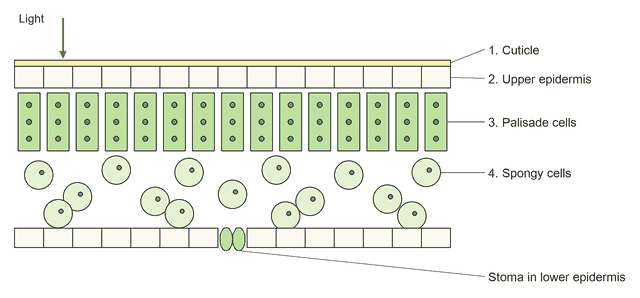
Therefore, a large surface absorbs more light, thinness shortens the path for gases and food, and many stomata speed up the exchange of CO₂ and O₂; all three increase photosynthesis.
- 103 marks
Question 10
Name the three end-products of photosynthesis and mention the fate of each of them in the plant.
Solve with AIWritten solution
Solution:
Concept: The three end-products of photosynthesis are glucose, water and oxygen.
Step 1 — Glucose.
Glucose () is used in four ways, as the plant needs:
- it is used at once by the plant cells (in respiration);
- it is stored as insoluble starch;
- it is converted into sucrose for transport;
- it is used to make fats, proteins, etc.
Step 2 — Water.
The water formed may be re-used for further photosynthesis.
Step 3 — Oxygen.
Some oxygen may be used in respiration by the leaf cells, but most of it diffuses out into the atmosphere through the stomata.
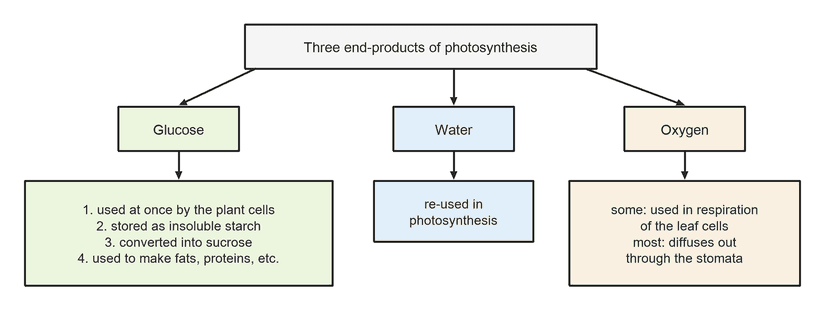
Therefore, glucose is used, stored as starch, changed to sucrose or used to make fats and proteins; water is re-used; oxygen is partly used in respiration and mostly released through the stomata.
- 112 marks
Question 11
If we keep on increasing concentration in the air, will the rate of photosynthesis also keep on increasing in direct proportion? Yes/No. Explain.
Solve with AIWritten solution
Solution:
Concept: A factor can raise the rate of photosynthesis only up to a limit. After that, another factor that is in short supply (a limiting factor) holds the rate back.
Step 1 — What happens at first.
When the concentration is raised, the rate of photosynthesis does increase, but only up to a certain limit.
Step 2 — Read the graph.
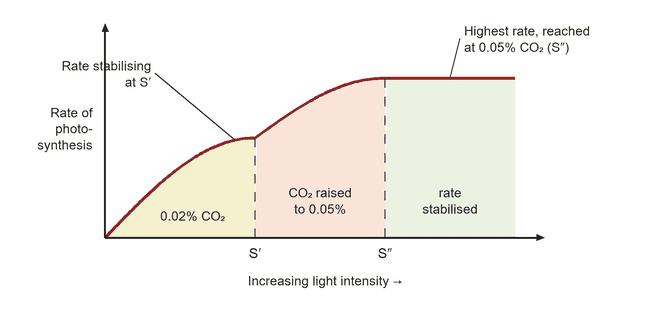
At 0.02% , the rate rises with light intensity and then stabilises at S′. When is raised to 0.05%, the rate rises further and then stabilises again at S″.
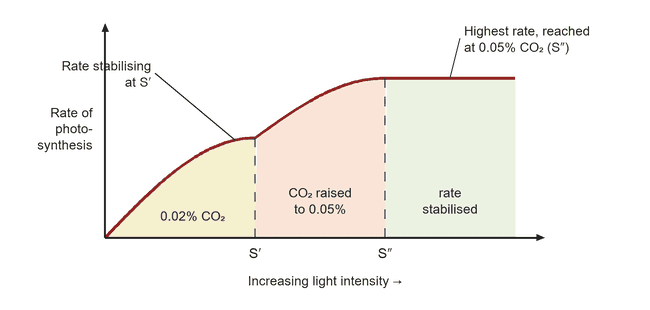
Step 3 — Why the rate stops rising.
Beyond this point, other factors such as light intensity and temperature become limiting, so adding more does not raise the rate.
Watch out: "increases" is not the same as "increases in direct proportion"; the graph flattens.
Therefore, No: the rate rises with CO₂ only up to a limit, after which light intensity or temperature limits it.
- 122 marks
Question 12
Why is it necessary to destarch the leaves of a plant before performing an experiment on photosynthesis?
Solve with AIWritten solution
Solution:
Concept: Experiments on photosynthesis use starch as the sign that photosynthesis took place, so the leaf must start with no starch.
Step 1 — The problem with old starch.
A leaf that has been in light already contains starch made earlier. If it stayed, even a part where no photosynthesis took place during the experiment would give a positive iodine test, and the result would be false.
Step 2 — What destarching does.
Destarching removes this old starch, so any starch found at the end must have been made during the experiment.
Step 3 — How it is done.
The plant is kept in the dark for 24 to 48 hours. No new starch is made, and the starch already present is changed to sugar and carried away from the leaves.
Therefore, leaves are destarched so that any starch found afterwards can only have been formed during the experiment.
- 132 marks
Question 13
Why do we perform the iodine test?
Solve with AIWritten solution
Solution:
Concept: The glucose made in photosynthesis is quickly changed to starch, and starch is easy to detect with iodine solution.
Step 1 — State the purpose.
The iodine test is performed to detect starch in a leaf, and so to show whether photosynthesis has taken place.
Step 2 — Read the result.
The two possible colours mean:
- blue-black: starch is present, so photosynthesis has taken place there;
- brown (the colour of iodine): no starch, so no photosynthesis took place there.
Step 3 — Prepare the leaf first.
The leaf is boiled in water, decolourised in methylated spirit and softened in warm water, so the colour change can be seen clearly.

Therefore, we perform the iodine test to detect starch in a leaf: a blue-black colour shows starch, and so shows that photosynthesis has occurred.
- 141 mark
Question 14
What chemical do you use to remove from inside a flask in certain experiments on photosynthesis?
Solve with AIWritten solution
Solution:
Concept: To show that is needed, part of a leaf must be kept in air from which the has been removed.
Step 1 — Name the chemical.
Potassium hydroxide (KOH) solution is used, because it absorbs carbon dioxide from the air around it.
Step 2 — See how it is used.
Part of a destarched leaf is passed through a split cork into a bottle containing KOH solution. That part gets no , so it forms no starch, while the part outside does.
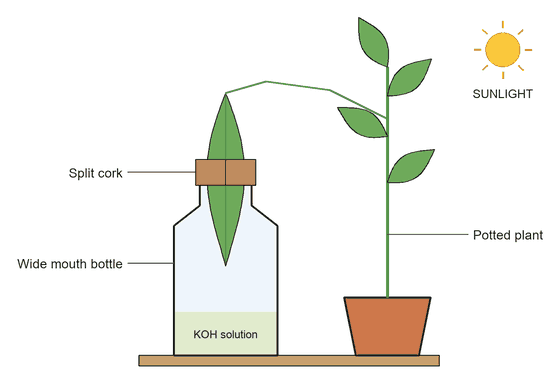
Therefore, potassium hydroxide (KOH) is used to remove CO₂.
- 152 marks
Question 15
All food chains start with a plant. Why is this so?
Solve with AIWritten solution
Solution:
Concept: Only green plants can make food from simple raw materials; every other organism gets its food from plants, directly or indirectly.
Step 1 — Plants are producers.
Green plants trap light energy and make their own food by photosynthesis, so they are the producers.
Step 2 — Animals depend on them.
A herbivore eats plant parts directly. A carnivore eats an animal that itself fed on plants. So all animals depend on plants for food.
Step 3 — So the chain starts with a plant.
However many stages a food chain has, its first link must be the organism that first makes the food: a plant.
Example: grass → rabbit → tiger. The tiger does not eat grass, but its food (the rabbit) was built from grass.

Therefore, all food chains start with a plant because only green plants make food by photosynthesis; all animals get their food from plants, directly or indirectly.
- 161 mark
Question 16
The honey bee produces honey. In terms of the food chain, is the honey bee a producer or a consumer?
Solve with AIWritten solution
Solution:
Concept: A producer makes its own food by photosynthesis; a consumer gets its food from other organisms.
Step 1 — Can the bee make food?
The honey bee has no chlorophyll and cannot photosynthesise.
Step 2 — Where its food comes from.
It collects nectar from flowers, which is food already made by the plant, and changes it into honey. Making honey from nectar is not making food from raw materials.
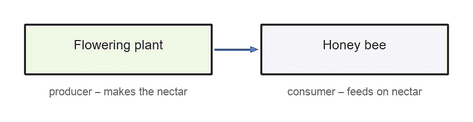
Watch out: Making honey does not make the bee a producer; producers make food from carbon dioxide and water.
Therefore, the honey bee is a consumer (a primary consumer, feeding on the plant's nectar).
- 171 mark
Question 17
Chlorophyll is located in :
Solve with AIAnswer
(A) Stroma
- Correct
(B) Thylakoid
(C) Stoma
(D) Fret
Answer: (B) Thylakoid
Concept: Inside a chloroplast, closely packed flattened sacs called thylakoids are piled into grana; the pigment chlorophyll is in the walls of the thylakoids.
Step 1 — Recall the parts of a chloroplast.
A chloroplast has a double membrane outside, grana (piles of thylakoids) inside, and a colourless ground substance, the stroma, around them.
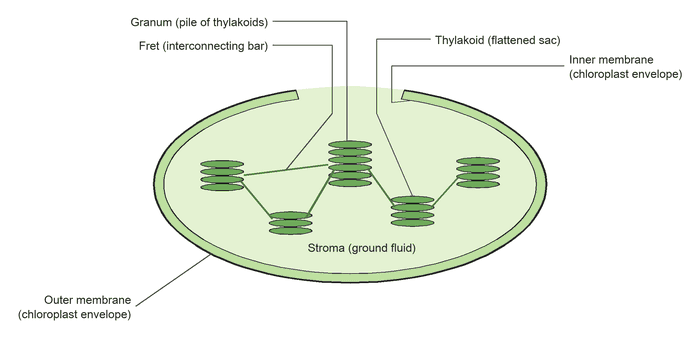
Step 2 — Locate the chlorophyll.
Chlorophyll lies in the thylakoid walls, which is why the light reaction takes place there.
Watch out: Stoma (a leaf pore) and stroma (inside the chloroplast) look alike but are different.
Why the other options are wrong:
- (A) Stroma: the stroma is the colourless ground substance of the chloroplast; it has no chlorophyll.
- (C) Stoma: a stoma is a minute opening in the leaf epidermis, not a part of the chloroplast.
- (D) Fret: a fret is a bar connecting one granum with another; chlorophyll is in the thylakoids.
Therefore, chlorophyll is located in the thylakoids, option (B).
- 181 mark
Question 18
Which of the following is not applicable to the process of photosynthesis ?
Solve with AIAnswer
(A) Oxygen is evolved
(B) Carbon dioxide is absorbed
- Correct
(C) Carbon dioxide is evolved
(D) Water is utilized
Answer: (C) Carbon dioxide is evolved
Concept: In photosynthesis, carbon dioxide and water are the raw materials and oxygen is given out. Carbon dioxide is given out in respiration, not in photosynthesis.
Step 1 — Write the process in words.
Carbon dioxide + water → glucose + water + oxygen, in the presence of light energy and chlorophyll.

Step 2 — Test each option.
Carbon dioxide is on the raw-material side, so in photosynthesis it is absorbed, never evolved. Option (C) does not apply.
Watch out: The question asks for the statement that does not apply.
Why the other options are wrong:
- (A) Oxygen is evolved: oxygen is evolved: true, it is released as a by-product.
- (B) Carbon dioxide is absorbed: carbon dioxide is absorbed: true, it enters through the stomata as a raw material.
- (D) Water is utilized: water is utilised: true, it is a raw material and is split in photolysis.
Therefore, the statement not applicable to photosynthesis is "carbon dioxide is evolved", option (C).
- 191 mark
Question 19
The colour of VIBGYOR spectrum which is reflected by chlorophyll is :
Solve with AIAnswer
(A) Blue
- Correct
(B) Green
(C) Red
(D) Yellow
Answer: (B) Green
Concept: Chlorophyll absorbs blue and red light (the two ends of the visible spectrum) and reflects green light, so it looks green.
Step 1 — Link colour to reflection.
The colour we see is the colour that is reflected, not the colour that is absorbed.
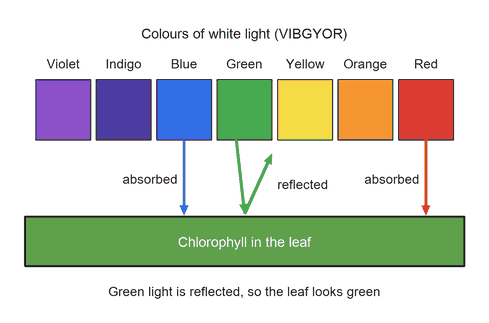
Step 2 — Apply it to chlorophyll.
Chlorophyll looks green, so green is the reflected colour.
Why the other options are wrong:
- (A) Blue: blue light is absorbed by chlorophyll and is very effective for photosynthesis.
- (C) Red: red light is also absorbed by chlorophyll and is effective for photosynthesis.
- (D) Yellow: yellow is not the colour chlorophyll reflects; leaves look green, not yellow.
Therefore, chlorophyll reflects green light, option (B).
- 201 mark
Question 20
The basic functional unit of solar energy which is absorbed by the pigment chlorophyll is :
Solve with AIAnswer
(A) Proton
(B) Phytochrome
(C) Phyton
- Correct
(D) Photon
Answer: (D) Photon
Concept: A photon is the smallest unit (packet) of light energy; chlorophyll is activated by absorbing photons.
Step 1 — How solar energy arrives.
Solar energy reaches the leaf as light, and light energy comes in small packets called photons.
Step 2 — What chlorophyll absorbs.
Chlorophyll absorbs these photons; the energy of 4 photons is used to split 2 molecules of water.
Watch out: Proton (a particle of an atom) and photon (a unit of light) sound alike.
Why the other options are wrong:
- (A) Proton: a proton is a positively charged particle of an atom, not a unit of light energy.
- (B) Phytochrome: phytochrome is a plant pigment, not a unit of energy.
- (C) Phyton: "phyton" is not a unit of energy; the word just refers to a plant.
Therefore, the basic unit of solar energy absorbed by chlorophyll is the photon, option (D).
- 211 mark
Question 21
The molecules of water split during :
Solve with AIAnswer
(A) Photorespiration
(B) Phosphorylation
- Correct
(C) Photolysis
(D) Photophosphorylation
Answer: (C) Photolysis
Concept: photolysis (photo = light, lysis = breaking) is the splitting of water molecules by light energy in the grana.
Step 1 — Activated chlorophyll passes on energy.
Chlorophyll absorbs light and passes the energy on.
Step 2 — This energy splits water.
The water molecules are split into hydrogen ions, electrons and oxygen:
Watch out: Photophosphorylation also happens in light, but it makes ATP; it does not split water.
Why the other options are wrong:
- (A) Photorespiration: photorespiration is a respiration-like use of oxygen in light; water is not split in it.
- (B) Phosphorylation: phosphorylation is the addition of a phosphate group to ADP to form ATP.
- (D) Photophosphorylation: photophosphorylation is phosphorylation using light energy; it makes ATP and does not split water.
Therefore, water molecules split during photolysis, option (C).
- 221 mark
Question 22
The granum is a pile of many :
Solve with AIAnswer
(A) Frets
(B) Stoma
(C) Stroma
- Correct
(D) Thylakoids
Answer: (D) Thylakoids
Concept: The flattened sacs inside a chloroplast are thylakoids; a pile of them is a granum (plural grana).
Step 1 — Picture a granum.
A granum looks like a stack of coins.

Step 2 — Name each coin.
Each "coin" of the stack is one thylakoid, so a granum is a pile of many thylakoids.
Why the other options are wrong:
- (A) Frets: frets are the bars that connect one granum to another.
- (B) Stoma: a stoma is a minute opening in the leaf epidermis, guarded by two guard cells.
- (C) Stroma: the stroma is the colourless ground substance in which the grana lie.
Therefore, the granum is a pile of many thylakoids, option (D).
- 231 mark
Question 23
Which of the following is used to remove chlorophyll from the leaves :
Solve with AIAnswer
(A) Iodine solution
- Correct
(B) Methylated spirit
(C) Potassium hydroxide
(D) Soda lime
Answer: (B) Methylated spirit
Concept: In the starch test the leaf is boiled in methylated spirit over a water bath until it turns pale white; the spirit dissolves out the chlorophyll, so the iodine colour can be seen clearly.
Step 1 — Kill the cells first.
The leaf is first dipped in boiling water for about a minute to kill the cells.
Step 2 — Then remove the chlorophyll.
It is then heated in methylated spirit in a test tube placed in boiling water; the green colour passes into the spirit and the leaf turns pale white.
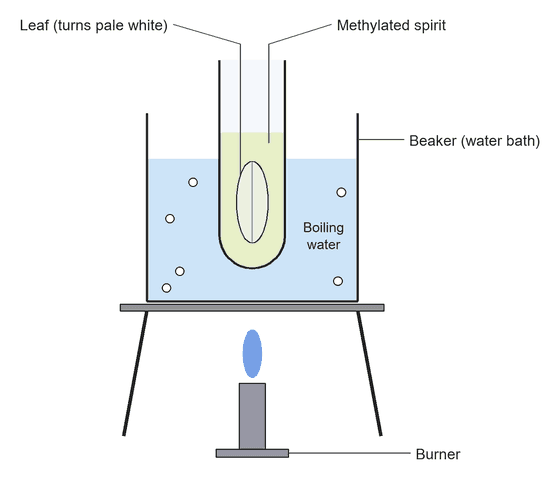
Watch out: Methylated spirit catches fire easily, so it is heated over a water bath, never directly on a flame.
Why the other options are wrong:
- (A) Iodine solution: iodine solution is used to test for starch, which it turns blue-black.
- (C) Potassium hydroxide: potassium hydroxide absorbs carbon dioxide in the experiment on the need for CO₂.
- (D) Soda lime: soda lime also absorbs carbon dioxide; it does not remove chlorophyll.
Therefore, chlorophyll is removed from leaves with methylated spirit, option (B).
- 241 mark
Question 24
The raw material which is reduced during photosynthesis is :
Solve with AIAnswer
- Correct
(A) Carbon dioxide
(B) Glucose
(C) Water
(D) Oxygen
Answer: (A) Carbon dioxide
Concept: reduction is the addition of hydrogen. In the light-independent phase, hydrogen from NADPH is added to carbon dioxide to form glucose.
Step 1 — List the raw materials.
The raw materials of photosynthesis are carbon dioxide and water.
Step 2 — Follow the hydrogen.
Water is split in the light reaction, and its hydrogen is picked up by NADP to form NADPH.
Step 3 — See which substance gains hydrogen.
This hydrogen is added to carbon dioxide to make glucose (). The substance that gains hydrogen, and so is reduced, is carbon dioxide.
Watch out: Water is also a raw material, but it loses hydrogen (it is oxidised), so it is not the one reduced.
Why the other options are wrong:
- (B) Glucose: glucose is a product of photosynthesis, not a raw material.
- (C) Water: water is a raw material, but it is split and loses its hydrogen; it is not reduced.
- (D) Oxygen: oxygen is a by-product given out, not a raw material.
Therefore, the raw material reduced in photosynthesis is carbon dioxide, option (A).
- 251 mark
Question 25
The optimum temperature for the process of photosynthesis is :
Solve with AIAnswer
(A) 53°C
(B) 45°C
(C) 25°C
- Correct
(D) 35°C
Answer: (D) 35°C
Concept: The rate of photosynthesis rises with temperature up to the optimum of 35 °C; above it the rate falls, and a little above 40 °C photosynthesis stops because the enzymes are destroyed.
Step 1 — Meaning of optimum.
The optimum temperature is the temperature at which photosynthesis goes on best (fastest).
Step 2 — Read the temperature effect.
Up to the optimum, a 10 °C rise roughly doubles the rate, so the rate at 25 °C is about half the rate at 35 °C. The highest rate is reached at 35 °C.
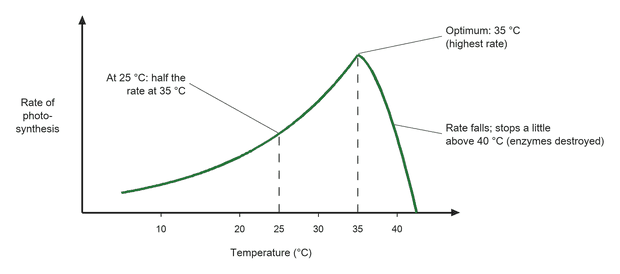
Watch out: Photosynthesis still occurs at 25 °C; it is simply not the temperature of the highest rate.
Why the other options are wrong:
- (A) 53°C: 53 °C is far above 40 °C; the enzymes are destroyed and photosynthesis has stopped.
- (B) 45°C: 45 °C is also above 40 °C, so photosynthesis has stopped.
- (C) 25°C: photosynthesis occurs at 25 °C, but at only about half the rate reached at 35 °C.
Therefore, the optimum temperature for photosynthesis is 35 °C, option (D).
- 261 mark
Question 26
Conversion of several glucose molecules into starch is termed as :
Solve with AIAnswer
(A) Photolysis
(B) Phosphorylation
- Correct
(C) Polymerisation
(D) Photorespiration
Answer: (C) Polymerisation
Concept: polymerisation is the joining of many small, simple molecules into one large, complex molecule; many glucose molecules join to form one starch molecule.
Step 1 — Glucose forms quickly.
Glucose is formed rapidly during photosynthesis.
Step 2 — It is joined into starch.
Most plants change it into insoluble starch as soon as it forms, by joining many glucose molecules together. This joining is polymerisation.

Why the other options are wrong:
- (A) Photolysis: photolysis is the splitting of water molecules by light energy.
- (B) Phosphorylation: phosphorylation is the addition of a phosphate group to ADP to form ATP.
- (D) Photorespiration: photorespiration is a respiration-like use of oxygen in light; it does not make starch.
Therefore, the conversion of several glucose molecules into starch is polymerisation, option (C).
- 271 mark
Question 27
Assertion (A): Photosynthesis occurs in all parts of a green plant.
Reason (R): Chlorophyll is the green pigment which traps solar energy during daytime.
Solve with AIAnswer
(A) (1) A is True and R is False
- Correct
(B) (2) A is False and R is True
(C) (3) Both A and R are True
(D) (4) Both A and R are False
Answer: (B) (2) A is False and R is True
Concept: In an assertion–reason item, judge the Assertion (A) and the Reason (R) separately as true or false; only when both are true do we ask whether R correctly explains A. Photosynthesis needs chlorophyll, so it occurs only in the green parts of a plant.
Step 1 — Judge the Assertion.
The non-green parts of a plant (roots, woody stem) have no chlorophyll and cannot photosynthesise. So A is false.
Step 2 — Judge the Reason.
Chlorophyll is the green pigment of plants, and it traps light energy in the daytime. So R is true.
Why the other options are wrong:
- (A) (1) A is True and R is False: it says A is true and R is false, the opposite of what we found.
- (C) (3) Both A and R are True: it says both are true, but A is false.
- (D) (4) Both A and R are False: it says both are false, but R is true.
Therefore, A is false and R is true, option (B).
- 281 mark
Question 28
Assertion (A): Guard cells regulate the opening and closing of the stomatal aperture.
Reason (R): Guard cells contain chloroplasts and are mostly located on the lower surface of the leaves. Other cells of the lower epidermis do not contain chloroplasts.
Solve with AIAnswer
(A) (1) A is True and R is False
(B) (2) A is False and R is True
- Correct
(C) (3) Both A and R are True
(D) (4) Both A and R are False
Answer: (C) (3) Both A and R are True
Concept: In an assertion–reason item, judge the Assertion (A) and the Reason (R) separately as true or false; only when both are true do we ask whether R correctly explains A. Each stoma is bounded by two guard cells: turgid guard cells open the stoma and flaccid ones close it.
Step 1 — Judge the Assertion.
Water moving into and out of the guard cells makes them turgid or flaccid, and this opens or closes the stomatal pore. So A is true.
Step 2 — Judge the Reason.
Guard cells contain chloroplasts, stomata are mostly on the lower surface of leaves, and the other cells of the lower epidermis have no chloroplasts. So R is true.
Step 3 — Pick the option.
Both statements are true, and the option that says so is (C).
Watch out: The options here only ask whether A and R are true or false, so (C) is the answer whether or not R explains A.
Why the other options are wrong:
- (A) (1) A is True and R is False: it says R is false, but R is true.
- (B) (2) A is False and R is True: it says A is false, but A is true.
- (D) (4) Both A and R are False: it says both are false, but both are true.
Therefore, both A and R are true, option (C).
- 291 mark
Question 29
Assertion (A): Palisade cells of mesophyll are loosely arranged towards the lower epidermis of a dorsiventral leaf.
Reason (R): Palisade cells contain the maximum amount of chlorophyll, trap solar energy and help in the process of photosynthesis.
Solve with AIAnswer
(A) (1) A is True and R is False
- Correct
(B) (2) A is False and R is True
(C) (3) Both A and R are True
(D) (4) Both A and R are False
Answer: (B) (2) A is False and R is True
Concept: In an assertion–reason item, judge the Assertion (A) and the Reason (R) separately as true or false; only when both are true do we ask whether R correctly explains A. In a dorsiventral leaf the palisade cells lie just below the upper epidermis and are compactly arranged; the loosely arranged cells near the lower epidermis are the spongy cells.
Step 1 — Judge the Assertion.
Palisade cells are neither loosely arranged nor near the lower epidermis; that description fits the spongy cells. So A is false.
Step 2 — Judge the Reason.
Palisade cells have the most chloroplasts, trap most of the light energy and so help in photosynthesis. So R is true.
Why the other options are wrong:
- (A) (1) A is True and R is False: it says A is true and R is false, the opposite of what we found.
- (C) (3) Both A and R are True: it says both are true, but A is false.
- (D) (4) Both A and R are False: it says both are false, but R is true.
Therefore, A is false and R is true, option (B).
- 301 mark
Question 30
Assertion (A): Phosphorylation occurs in all organisms only during the process of respiration.
Reason (R): Photophosphorylation is the process during which ADP combines with inorganic phosphate (iP) and produces ATP.
Solve with AIAnswer
(A) (1) A is True and R is False
- Correct
(B) (2) A is False and R is True
(C) (3) Both A and R are True
(D) (4) Both A and R are False
Answer: (B) (2) A is False and R is True
Concept: In an assertion–reason item, judge the Assertion (A) and the Reason (R) separately as true or false; only when both are true do we ask whether R correctly explains A. Phosphorylation (adding a phosphate group to ADP to form ATP) happens in respiration and also in the light reaction of photosynthesis, where it is called photophosphorylation.
Step 1 — Judge the Assertion.
Green plants also form ATP during photosynthesis, so phosphorylation is not limited to respiration. The word "only" makes A false.
Step 2 — Judge the Reason.
In photophosphorylation, ADP combines with inorganic phosphate to form ATP, using light energy. So R is true.
Watch out: One word such as "only" or "all" can make a statement false.
Why the other options are wrong:
- (A) (1) A is True and R is False: it says A is true and R is false, the opposite of what we found.
- (C) (3) Both A and R are True: it says both are true, but A is false.
- (D) (4) Both A and R are False: it says both are false, but R is true.
Therefore, A is false and R is true, option (B).
- 316 marks
Question 31
Name the following :
(a) The category of organisms that prepare their own food from basic raw materials.
(b) The kind of plastids found in the mesophyll cells of the leaf.
(c) The compound which stores energy in the cells.
(d) The first form of food substance produced during photosynthesis.
(e) The source of for aquatic plants.
(f) The part of chloroplast where the dark reaction of photosynthesis takes place.
Solve with AIWritten solution
Solution:
Concept: Each answer is one term from the chapter; know in one line why it fits.
Step 1 — Organisms and plastids: (a), (b).
(a) Autotrophs. Green plants make their own food from carbon dioxide and water, so they are autotrophs (self-feeding); in a food chain they are the producers.
(b) Chloroplasts. These green plastids contain chlorophyll; they are found mainly in the mesophyll (palisade and spongy) cells of the leaf.
Step 2 — Energy store and first food: (c), (d).
(c) ATP (adenosine triphosphate). It stores energy in its phosphate bonds and is formed from ADP by adding a phosphate group.
(d) Glucose (). This simple sugar is the first product; it is soon changed into starch for storage.
Step 3 — CO₂ source and site: (e), (f).
(e) Carbon dioxide dissolved in the water (partly as bicarbonates). Land plants take from the air; water plants take it from the water around them.
(f) Stroma. The dark (light-independent) reaction takes place in the stroma; the light reaction takes place in the thylakoids of the grana.
Therefore, (a) autotrophs (producers), (b) chloroplasts, (c) ATP, (d) glucose, (e) CO₂ dissolved in the water, (f) stroma.
- 325 marks
Question 32
Given below are groups of terms. In each group, the first pair indicates the relationship between the two terms. Complete the second pair accordingly.
(a) Chlorophyll : Magnesium :: Haemoglobin : ..........
(b) Light reaction : Granum :: Dark reaction : ..........
(c) Producers : Autotrophs :: Consumers : ..........
(d) Respiration : Carbon dioxide :: Photosynthesis : ..........
(e) Water and minerals : Xylem :: Prepared food : ..........
Solve with AIWritten solution
Solution:
Concept: First find how the two terms of the given pair are related, then pick the term that has the same relation to the first term of the second pair.
Step 1 — Pairs (a) and (b).
(a) Iron. Magnesium is the metal in chlorophyll; in the same way, iron is the metal in haemoglobin.
(b) Stroma. The light reaction takes place in the granum; the dark reaction takes place in the stroma.
Step 2 — Pair (c).
(c) Heterotrophs. Producers make their own food, so they are autotrophs; consumers take food from other organisms, so they are heterotrophs.
Step 3 — Pairs (d) and (e).
(d) Oxygen. Respiration gives out carbon dioxide; photosynthesis gives out oxygen.
(e) Phloem. Water and minerals travel up the xylem; prepared food travels in the phloem.
Therefore, (a) iron, (b) stroma, (c) heterotrophs, (d) oxygen, (e) phloem.
- 335 marks
Question 33
Given below is the internal structure of a chloroplast. Read the information given ahead and fill in the blanks :
The chloroplast is an important cellular structure located in the green parts of a plant. It is covered by a double layered membrane. The main function of chloroplast is to prepare food material for all the parts of a plant during daytime.

The chloroplast is a kind of (a) .........., suspended in the cytoplasm of the plant cells. It contains a vital pigment (b) .......... which traps solar energy for the process of (c) .......... . The photochemical phase of photosynthesis occurs in (d) .......... of granum and the biosynthetic phase occurs in the (e) .......... of chloroplast.
Solve with AIWritten solution
Solution:
Concept: A chloroplast has two working regions: the thylakoids of the grana hold chlorophyll and carry out the light (photochemical) phase; the stroma carries out the dark (biosynthetic) phase.
Step 1 — Blanks (a) to (c).
(a) plastid. A chloroplast is a green plastid, a small oval body bounded by a double membrane.
(b) chlorophyll. This green pigment in the thylakoid walls traps solar energy.
(c) photosynthesis. The trapped energy is used to make food from carbon dioxide and water.
Step 2 — Blanks (d) and (e).
(d) thylakoids. The photochemical phase needs chlorophyll, which is in the thylakoids of the granum.
(e) stroma. The biosynthetic phase, which builds glucose, takes place in the stroma, the ground substance of the chloroplast.
Step 3 — Read the completed passage.
The chloroplast is a kind of plastid, suspended in the cytoplasm of the plant cells. It contains a vital pigment chlorophyll which traps solar energy for the process of photosynthesis. The photochemical phase of photosynthesis occurs in thylakoids of granum and the biosynthetic phase occurs in the stroma of chloroplast.
Therefore, (a) plastid, (b) chlorophyll, (c) photosynthesis, (d) thylakoids, (e) stroma.
- 348 marks
Question 34
Identify the false statements and rewrite them correctly by changing the first or the last word only.
(a) Dark reaction of photosynthesis occurs during night time.
(b) Photosynthesis requires enzymes.
(c) Green plants are consumers.
(d) Photosynthesis results in loss of dry weight of the plants.
(e) Photosynthesis stops at a temperature of about 35°C.
(f) Photosynthesis occurs only in cells containing chloroplasts.
(g) Green plants perform photosynthesis.
(h) Algae are autotrophs.
Solve with AIWritten solution
Solution:
Concept: Test each statement against the facts of the chapter. A false statement is corrected by changing only its first or its last word.
Step 1 — Statement (a).
(a) False. The dark reaction does not need light, but it runs alongside the light reaction in the daytime. Corrected: Dark reaction of photosynthesis occurs during day time.
Step 2 — Statements (b), (c), (d).
(b) True. Photosynthesis is controlled by enzymes; that is why it stops when high temperature destroys them.
(c) False. Green plants make their own food. Corrected: Green plants are producers.
(d) False. Photosynthesis makes food, so it adds to the dry weight; respiration uses food up. Corrected: Respiration results in loss of dry weight of the plants.
Step 3 — Statement (e).
(e) False. 35 °C is the optimum temperature, where photosynthesis is fastest; it stops a little above 40 °C. Corrected: Photosynthesis stops at a temperature of about 40°C (just above it).
Step 4 — Statements (f), (g), (h).
(f) True. Chlorophyll is in the chloroplasts, so only cells with chloroplasts photosynthesise.
(g) True. Green plants have chlorophyll and make food from carbon dioxide and water using light.
(h) True. Algae contain chlorophyll and make their own food, so they are autotrophs.
Watch out: In (d) the first word is changed (Photosynthesis → Respiration); the last word cannot be changed to make the sentence both true and sensible.
Therefore, (a), (c), (d) and (e) are false: (a) day time, (c) producers, (d) Respiration results in loss of dry weight, (e) about 40°C; (b), (f), (g) and (h) are true.
- 355 marks
Question 35
Fill in the blanks with the appropriate answer from the choices given in the brackets.
(a) The site of light reaction in the cells of a leaf is .......... (cytoplasm, stroma, grana).
(b) The chemical substance used to test the presence of starch in the cell of a leaf is .......... (, iodine solution, Benedict solution).
(c) Stroma is the ground substance in .......... (cytoplasm, chloroplast, ribosomes).
(d) The dark reaction of photosynthesis is known as .......... (Hill reaction, cyclic phosphorylation, Calvin cycle).
(e) In the flowering plants, food is transported in the form of .......... (sucrose, glucose, starch).
Solve with AIWritten solution
Solution:
Concept: The light reaction takes place in the grana and the dark reaction (the Calvin cycle) in the stroma of the chloroplast; starch is detected with iodine solution.
Step 1 — Blanks (a) to (c).
(a) grana. The light reaction needs chlorophyll, which is in the thylakoids of the grana.
(b) iodine solution. Starch turns blue-black with iodine solution.
(c) chloroplast. Stroma is the colourless ground substance of the chloroplast.
Step 2 — Blank (d).
(d) Calvin cycle. This is the name of the dark (light-independent) reaction, in which carbon dioxide is built into glucose. The Hill reaction and cyclic phosphorylation are parts of the light reaction.
Step 3 — Blank (e).
(e) sucrose. Glucose made in the leaf is changed into sucrose, a soluble sugar, and carried through the phloem.
Watch out: Food is transported as sucrose, not glucose, and is stored as starch.
Therefore, (a) grana, (b) iodine solution, (c) chloroplast, (d) Calvin cycle, (e) sucrose.
- 366 marks
Question 36
Are the following statements true or false? Give reason in support of your answer.
(a) The rate of photosynthesis continues to rise as long as the intensity of light rises.
(b) The outside atmospheric temperature has no effect on the rate of photosynthesis.
(c) If you immerse a leaf intact on the plant in ice cold water, it will continue to photosynthesise in bright sunshine.
(d) Destarching of the leaves of a potted plant can occur only at night.
(e) If a plant is kept in bright light all the 24 hours for a few days, the dark reaction (biosynthetic phase) will fail to occur.
(f) Photosynthesis is considered as a process supporting all life on earth.
Solve with AIWritten solution
Solution:
Concept: The rate of photosynthesis depends on light intensity, carbon dioxide concentration and temperature; each helps only up to a limit, after which another factor limits the rate.
Step 1 — Statement (a): light intensity.
(a) False. As light intensity rises, the rate rises only up to a limit and then stabilises, because carbon dioxide becomes the limiting factor. It rises again only if more is given.
Step 2 — Statements (b) and (c): temperature.
(b) False. Temperature has a clear effect: the rate rises up to the optimum of 35 °C, then falls, and photosynthesis stops a little above 40 °C.
(c) False. Ice-cold water makes the enzymes of photosynthesis inactive (cause), so photosynthesis stops or almost stops even in bright sunshine (effect).
Step 3 — Statements (d) and (e): light and the dark phase.
(d) False. Destarching needs only the absence of light. A plant kept in a dark room for 24 to 48 hours is destarched whether it is day or night outside.
(e) False. The dark reaction does not need darkness; it only does not depend on light. In continuous light it goes on, using the NADPH and ATP of the light reaction.
Step 4 — Statement (f): importance.
(f) True. Photosynthesis is the ultimate source of food for all living beings and the only biological process that releases oxygen into the air.
Watch out: "dark reaction" means "light-independent", not "needs darkness".
Therefore, (a) to (e) are false and (f) is true.
- 372 marks
Question 37
Given below are five terms. Rewrite the terms in the correct order so as to be in a logical sequence with regard to photosynthesis: (i) water molecules, (ii) oxygen, (iii) grana, (iv) hydrogen and hydroxyl ions, (v) photons.
Solve with AIWritten solution
Solution:
Concept: Follow the light reaction in order: light is trapped in the grana, the trapped energy splits water, and oxygen is given out.
Step 1 — Start with the energy.
Photons (v) of light fall on the leaf and are absorbed by the chlorophyll in the grana (iii).
Step 2 — Split the water.
The absorbed energy splits water molecules (i) into hydrogen and hydroxyl ions (iv).
Step 3 — Release the gas.
The hydroxyl ions finally give oxygen (ii), which is released.
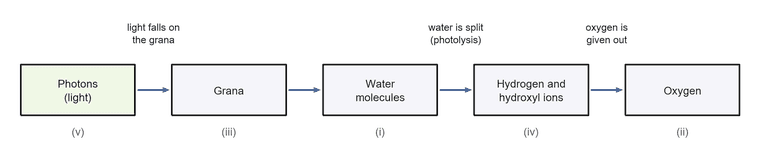
Therefore, the order is photons → grana → water molecules → hydrogen and hydroxyl ions → oxygen, that is (v), (iii), (i), (iv), (ii).
- 382 marks
Question 38
State any four differences between photosynthesis and respiration.
Solve with AIWritten solution
Solution:
Concept: Photosynthesis builds up food and stores energy in it; respiration breaks down food and releases the energy. The raw materials of one are the products of the other.
Step 1 — Compare the two processes.
The four differences are:
Photosynthesis Respiration Occurs only in green cells, which contain chlorophyll. Occurs in all living cells. Takes place only in light. Takes place all the time, day and night. Carbon dioxide and water are used; oxygen is given out. Oxygen is used; carbon dioxide and water are given out. Food is made and energy is stored (anabolic). Food is broken down and energy is released (catabolic). Step 2 — See it in the equations.
Photosynthesis:
Respiration:
Therefore, photosynthesis occurs only in green cells and in light, uses CO₂ and water, gives out O₂ and stores energy; respiration occurs in all cells at all times, uses O₂, gives out CO₂ and water and releases energy.
- 392 marks
Question 39
Complete the following food chains by writing the names of appropriate organisms in the blanks.
(i) Grass → .......... → Snake → ..........
(ii) .......... → Mouse .......... → Peacock
Solve with AIWritten solution
Solution:
Concept: A food chain starts with a producer (a green plant), which is eaten by a herbivore, which is eaten by a carnivore.
Step 1 — Chain (i).
The first blank must be a herbivore that eats grass and is eaten by a snake, such as a rat. The last blank must be a carnivore that eats snakes, such as a hawk (or an eagle).
Grass → Rat → Snake → Hawk
Step 2 — Chain (ii).
The first blank must be a plant that a mouse eats, such as wheat (the producer). The second blank must be an animal that eats mice and is eaten by a peacock, such as a snake.
Wheat → Mouse → Snake → Peacock

Watch out: Other suitable organisms are also correct, as long as each one eats the one before it.
Therefore, (i) Grass → Rat → Snake → Hawk; (ii) Wheat → Mouse → Snake → Peacock.
- 405 marks
Question 40
Name these :
(a) Two aquatic plants which can be used for the experiment of photosynthesis.
(b) Two plants having variegated leaves.
(c) Two raw materials for photosynthesis
(d) Four essentials for photosynthesis.
(e) Two main phases of photosynthesis.
Solve with AIWritten solution
Solution:
Concept: All five answers are lists from the chapter; give exactly the number of items asked for.
Step 1 — Plants for experiments: (a), (b).
(a) Hydrilla and Elodea. These water plants give out visible bubbles of oxygen under water, which can be collected.
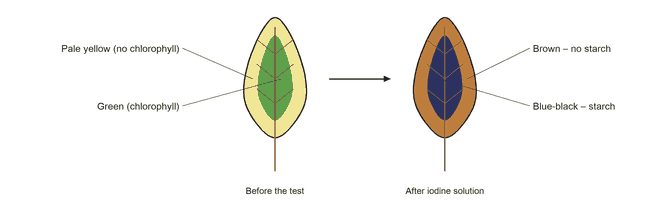
(b) Croton and Coleus (Geranium is another). A variegated leaf has green parts and non-green parts, so it can show that chlorophyll is needed.
Step 2 — Raw materials and essentials: (c), (d).
(c) Carbon dioxide and water.
(d) Light, chlorophyll, carbon dioxide and water.
Step 3 — Phases: (e).
(e) The light-dependent phase (photochemical) and the light-independent phase (dark or biosynthetic).
Watch out: Raw materials are only carbon dioxide and water; light and chlorophyll are essentials but not raw materials.
Therefore, (a) Hydrilla, Elodea; (b) Croton, Coleus; (c) CO₂, water; (d) light, chlorophyll, CO₂, water; (e) light-dependent and light-independent phases.
- 415 marks
Question 41
Match the terms given in column A with column B :
Column A Column B (a) Chlorophyll (i) Removes/absorbs (c) Methylated spirit (ii) Tests presence of starch (c) Potassium hydroxide (iii) Traps solar energy (d) Iodine solution (iv) Produces oxygen (e) Water (v) Bleaches chlorophyll Solve with AIWritten solution
Solution:
Concept: Recall the part each substance plays in photosynthesis or in the experiments on it.
Step 1 — Match each term.
The matched pairs are:
Column A Column B (a) Chlorophyll (iii) Traps solar energy (b) Methylated spirit (v) Bleaches chlorophyll (c) Potassium hydroxide (i) Removes/absorbs (d) Iodine solution (ii) Tests presence of starch (e) Water (iv) Produces oxygen Step 2 — Give the reasons.
Each pair follows from the job of the substance:
- chlorophyll is the green pigment that absorbs light energy;
- methylated spirit dissolves out the chlorophyll, leaving the leaf pale white;
- potassium hydroxide absorbs carbon dioxide from the air in a flask;
- iodine solution turns starch blue-black;
- water is split in photolysis, and its oxygen is given out.
Therefore, (a)–(iii), (b)–(v), (c)–(i), (d)–(ii), (e)–(iv).
- 425 marks
Question 42
Complete the following by filling the blanks 1 to 5 with appropriate words/terms/phrases:
To test the leaf for starch, the leaf is boiled in water to (1) .......... . It is next boiled in methylated spirit to (2) .......... . The leaf is placed in warm water to soften it. It is then placed in a dish and (3) .......... solution is added. The region, which contains starch, turns (4) .......... and the region, which does not contain starch, turns (5) .......... .
Solve with AIWritten solution
Solution:
Concept: In the iodine test the leaf is first killed, then decolourised, then softened, and only then tested with iodine solution.
Step 1 — Blanks (1) and (2).
(1) kill the cells. The leaf is dipped in boiling water for about a minute.
(2) remove the chlorophyll. The leaf is heated in methylated spirit over a water bath until it turns pale white; it also becomes hard and brittle, which is why it is softened in warm water next.
Step 2 — Blank (3).
(3) iodine. Iodine solution is poured over the leaf spread in a dish.

Step 3 — Blanks (4) and (5).
(4) blue-black. Starch gives a blue-black colour with iodine.
(5) brown. A region without starch shows only the brown colour of the iodine solution.
Therefore, (1) kill the cells, (2) remove the chlorophyll, (3) iodine, (4) blue-black, (5) brown.
- 435 marks
Question 43
Write the exact location of each :
(a) Chlorophyll
(b) Chloroplast in the parts of a plant
(c) Stroma
(d) Guard cells
(e) Palisade cells
Solve with AIWritten solution
Solution:
Concept: "exact location" means the precise part of the cell or of the leaf, not just "in the leaf".
Step 1 — Inside the chloroplast: (a), (c).
(a) Chlorophyll: in the walls of the thylakoids of the grana, inside the chloroplasts.
(c) Stroma: inside the chloroplast, as the colourless ground substance around the grana.
Step 2 — Chloroplasts in the plant: (b).
(b) Chloroplasts: mainly in the mesophyll cells (palisade and spongy) of the leaf, between the upper and lower epidermis; also in the guard cells of the stomata and the outer layers of young green stems.
Step 3 — Cells of the leaf: (d), (e).
(d) Guard cells: in the epidermis of the leaf, mostly the lower epidermis, one on each side of every stoma.
(e) Palisade cells: in the mesophyll just below the upper epidermis.
Therefore, (a) thylakoid walls of the grana, (b) mesophyll cells (also guard cells and young green stems), (c) inside the chloroplast around the grana, (d) the leaf epidermis, mostly lower, around each stoma, (e) the mesophyll just below the upper epidermis.
- 4410 marks
Question 44
Define the following terms :
(a) Photosynthesis
(b) Thylakoids
(c) Chloroplast
(d) Photolysis of water
(e) Polymerisation
Solve with AIWritten solution
Solution:
Concept: A good definition names the process or structure and gives its essential feature, adding where it occurs when that is part of the meaning.
Step 1 — Processes: (a), (d), (e).
(a) Photosynthesis: the process by which living plant cells containing chlorophyll make food (glucose, then starch) from carbon dioxide and water using light energy, releasing oxygen as a by-product.
(d) Photolysis of water: the splitting of water molecules into hydrogen ions, electrons and oxygen by light energy, in the grana of the chloroplast.
(e) Polymerisation: the conversion of many small, simple molecules into one large, complex molecule, e.g. many glucose molecules into one starch molecule.
Step 2 — Structures: (b), (c).
(b) Thylakoids: the closely packed flattened sacs inside a chloroplast, piled into grana; their walls contain chlorophyll and carry out the light reaction.
(c) Chloroplast: a small oval green plastid bounded by a double membrane, with grana lying in a colourless stroma; it contains chlorophyll and is the site of photosynthesis.
Therefore, each term is defined above: photosynthesis (food from CO₂ and water using light), thylakoids (flattened chlorophyll sacs), chloroplast (green plastid, site of photosynthesis), photolysis (splitting of water by light) and polymerisation (small molecules joined into a large one).
- 4516 marks
Question 45
Given below is the figure of an experimental set-up, showing a physiological act of the plants. Study and answer the following questions.

(a) What is the objective of this experiment ?
(b) Name and define the process shown here.
(c) Why do we destarch the leaves before performing the experiment ?
(d) How do we destarch the leaves ?
(e) What will be the observation when we pour iodine solution over the bleached experimental leaf.
(f) Write a well-balanced equation of the above process.
Solve with AIWritten solution
Solution:
Concept: A strip of black paper keeps light off one part of a leaf. After a few hours in sunlight, only the parts that received light contain starch.
Step 1 — Objective and process: (a), (b).
(a) The objective is to show that light is necessary for photosynthesis.
(b) The process is photosynthesis: the process by which living plant cells containing chlorophyll make food (glucose and starch) from carbon dioxide and water using light energy, releasing oxygen as a by-product.
Step 2 — Destarching: (c), (d).
(c) The leaves already contain starch made earlier. If it stayed, even the covered part would test positive and the result would be false. After destarching, any starch found must have been made during the experiment.
(d) The potted plant is kept in a dark room for 24 to 48 hours; the starch already in the leaves is changed to sugar and carried away.
Step 3 — Observation: (e).
When iodine solution is poured on the decolourised leaf:
- the part covered by the black strip shows only a brown colour: no starch, because no light reached it;
- the uncovered parts turn blue-black: starch was made there.

Step 4 — Equation: (f).
The balanced equation of photosynthesis is:
Watch out: The covered part must stay attached to the plant and receive air; only light is kept away.
Therefore, (a) to show that light is necessary; (b) photosynthesis; (c) so that any starch found is new; (d) by keeping the plant in the dark for 24–48 hours; (e) covered part brown, uncovered parts blue-black; (f) 6CO₂ + 12H₂O → C₆H₁₂O₆ + 6H₂O + 6O₂ (light energy, chlorophyll).
- 4610 marks
Question 46
Give reasons/explain :
(a) It is necessary to place a plant in the dark before starting an experiment on photosynthesis.
(b) It is not possible to demonstrate respiration in a green plant kept in sunlight.
(c) Most leaves have the upper surface more green and shiny than the lower surface.
(d) During the starch test the leaf is —
(1) boiled in water.
(2) boiled in methylated spirit.
Solve with AIWritten solution
Solution:
Concept: Each reason links a step or an observation with what happens inside the leaf (cause → effect).
Step 1 — Part (a): placing the plant in the dark first.
Cause: in the dark for 24 to 48 hours no new starch is made, and the old starch is removed from the leaves (destarching).
Effect: any starch found at the end must have been made during the experiment, so the result can be trusted.
Step 2 — Part (b): respiration in sunlight.
Cause: in light the plant photosynthesises and respires at the same time, and the carbon dioxide given out in respiration is used at once in photosynthesis.
Effect: there is a net output of oxygen and no carbon dioxide can be detected, so respiration is masked by photosynthesis.
Step 3 — Part (c): the upper surface is greener and shinier.
Cause: the chloroplast-rich palisade cells lie just below the upper epidermis, and the upper surface has a thicker waxy cuticle.
Effect: more chlorophyll makes the upper surface greener, and the cuticle makes it shiny.
Step 4 — Part (d): the two boiling steps.
(1) Boiling in water kills the cells, so all reactions stop and the cells let the chemicals in.
(2) Boiling in methylated spirit (over a water bath) removes the chlorophyll; the leaf turns pale white and the blue-black colour of starch with iodine can be seen clearly.
Therefore, (a) to destarch the leaves; (b) the CO₂ of respiration is used up in photosynthesis; (c) palisade cells and a thick cuticle lie on the upper side; (d) water kills the cells and methylated spirit removes the chlorophyll.
- 478 marks
Question 47
Distinguish between the following pairs on the basis of words indicated in the brackets ( ).
(a) Light reaction and Dark reaction (end products)
(b) Producers and Consumers (organisms)
(c) Grass and Grasshopper (mode of nutrition)
(d) Stoma and Stroma (structure)
Solve with AIWritten solution
Solution:
Concept: Compare each pair only on the basis given in the brackets.
Step 1 — Tabulate the differences.
The differences are:
Basis First term Second term (a) End products Light reaction: ATP, NADPH and oxygen Dark reaction: glucose (then changed to starch) (b) Organisms Producers: green plants, e.g. grass Consumers: animals, e.g. rabbit, tiger (c) Mode of nutrition Grass: autotrophic, makes its own food by photosynthesis Grasshopper: heterotrophic, eats plants (herbivore) (d) Structure Stoma: a minute pore in the leaf epidermis, bounded by two guard cells Stroma: the colourless ground substance of the chloroplast, around the grana Step 2 — Picture the stoma.
The two words in (d) look alike, but a stoma is a pore in the leaf surface, while the stroma is inside a chloroplast.
Therefore, (a) light reaction: ATP, NADPH, O₂ / dark reaction: glucose; (b) producers: green plants / consumers: animals; (c) grass autotrophic / grasshopper heterotrophic; (d) stoma: a pore with guard cells / stroma: ground substance of the chloroplast.
- 483 marks
Question 48
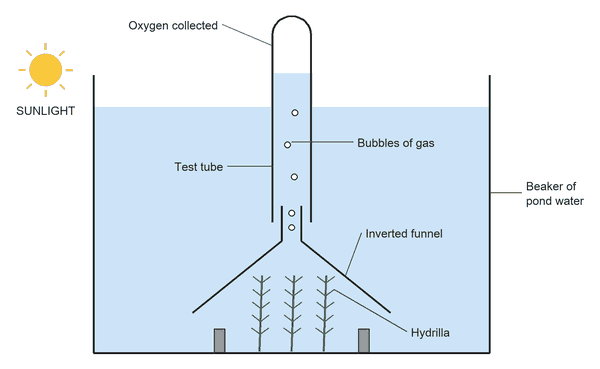
How would you demonstrate that green plants release oxygen when exposed to light ?
Solve with AIWritten solution
Solution:
Concept: A water plant kept in sunlight gives off bubbles of a gas; the gas is collected and tested with a glowing splinter.
Step 1 — Set up the apparatus.
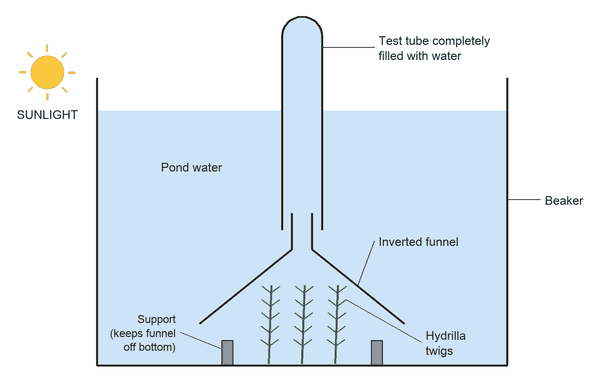
Place a few twigs of Hydrilla (or Elodea) in a beaker of pond water and cover them with a short-stemmed inverted funnel resting on small supports, so that it stays off the bottom. Invert a test tube full of water over the stem of the funnel; the water level must be above the funnel stem.
Step 2 — Expose it to sunlight.
Keep the apparatus in sunlight for a few hours. The plant photosynthesises (cause), so bubbles of gas rise from it and collect at the top of the test tube, pushing the water down (effect).
Step 3 — Test the gas.
Remove the test tube carefully and put a glowing splinter into the gas. It bursts into flame, so the gas is oxygen.
Watch out: The test tube must be completely full of water at the start, so that the gas collected can only have come from the plant.
Therefore, Hydrilla under an inverted funnel in sunlight gives bubbles that collect in the test tube and rekindle a glowing splinter, showing that green plants release oxygen in light.
- 496 marks
Question 49
Describe the main chemical changes which occur during photosynthesis in
(i) Light reaction
(ii) Dark reaction
Solve with AIWritten solution
Solution:
Concept: The light reaction uses light energy to make ATP, NADPH and oxygen; the dark reaction uses the ATP and NADPH to change carbon dioxide into glucose.
Step 1 — Light reaction: chlorophyll is activated.
In the thylakoids of the grana, chlorophyll absorbs photons and becomes activated.
Step 2 — Light reaction: photolysis and its products.
The energy splits water molecules:
- oxygen is given out as ;
- hydrogen ions are picked up by NADP to form NADPH;
- the electrons help to convert ADP into ATP (photophosphorylation).
Step 3 — Dark reaction in the stroma.
Hydrogen from NADPH is combined with carbon dioxide, using energy from ATP, to form glucose (). Most plants soon join the glucose into starch (polymerisation).
Watch out: The dark reaction needs the products of the light reaction, so the two run at the same time in the day.
Therefore, (i) in the light reaction water is split by light, oxygen is released and NADPH and ATP are formed; (ii) in the dark reaction CO₂ is reduced by hydrogen from NADPH, using ATP, to glucose (then starch).
- 505 marks
Question 50
Given below is a schematic diagram to illustrate some aspects of photosynthesis.
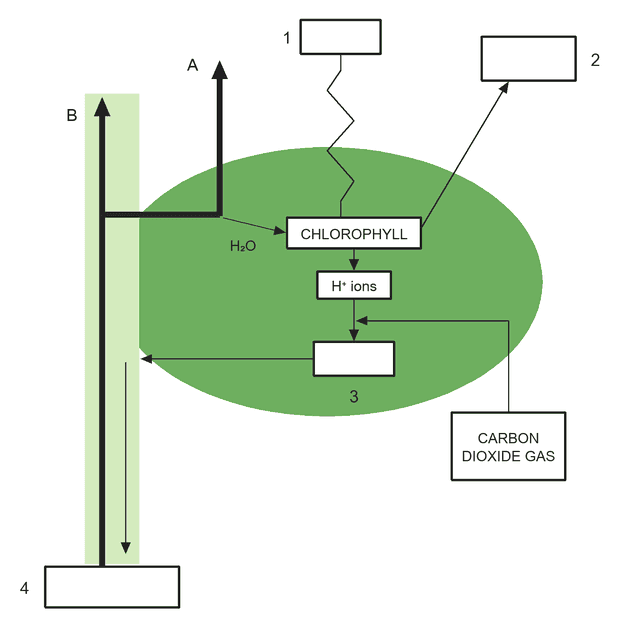
(a) Fill up the gaps, in blank spaces (1-4), by writing the names of the correct items.
(b) What phenomenon do the thick arrows A and B indicate ?
Solve with AIWritten solution
Solution:
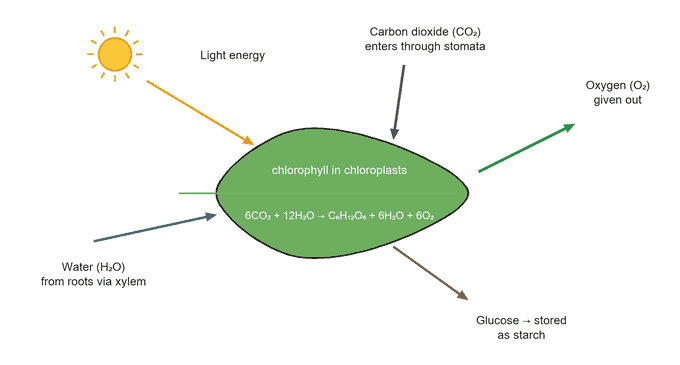
Concept: The diagram summarises photosynthesis in a leaf: light falls on the chlorophyll, water comes up the stem, carbon dioxide enters the leaf, oxygen leaves it, and the food made is sent out of the leaf.
Step 1 — Blanks 1 and 2.
1 — Sunlight (light energy). It falls on the chlorophyll, which traps it.
2 — Oxygen. It comes from the water split by light energy, and it is given out of the leaf.
Step 2 — Blanks 3 and 4.
3 — Glucose (sugar, later stored as starch). It is formed when hydrogen (shown as ions) combines with the carbon dioxide gas.
4 — Water. It is absorbed from the soil by the roots and sent up the stem to the leaf.
Step 3 — The thick arrows.
Both thick arrows follow water through the plant:
- A — Transpiration: loss of water, as water vapour, from the leaf;
- B — Ascent of sap: upward movement of water (with minerals) through the stem.
Therefore, (a) 1 sunlight, 2 oxygen, 3 glucose, 4 water; (b) A transpiration, B ascent of sap.
- 514 marks
Question 51
Given below is the representation of a certain phenomenon in nature. with four organisms 1-4.

(a) Name the phenomenon represented.
(b) Name any one organism that could be shown at No. 5.
(c) Name the biological process which was the starting point of the whole chain.
(d) Name one natural element which all the organisms 2-4 and even 5 are getting from No. 1 for their survival.
Solve with AIWritten solution
Solution:
Concept: A green plant is eaten by a grasshopper, the grasshopper by a frog and the frog by a snake; such a chain of feeding is a food chain.
Step 1 — Name the phenomenon: (a).
(a) Food chain. Organism 1 is a green plant (producer), 2 a grasshopper (herbivore), 3 a frog and 4 a snake (carnivores).

Step 2 — Organism 5: (b).
(b) Hawk (an eagle or a peacock is also correct): No. 5 must be an animal that eats snakes.
Step 3 — Starting process: (c).
(c) Photosynthesis. The plant at No. 1 makes the food by photosynthesis, and this food passes along the whole chain.
Step 4 — What all of them get from No. 1: (d).
(d) Carbon. The plant takes in carbon dioxide and builds its carbon into food. This food passes from No. 1 to organisms 2, 3, 4 and 5, so all of them get their carbon, the element of all body tissues, from the plant.
Therefore, (a) food chain, (b) hawk, (c) photosynthesis, (d) carbon.
- 529 marks
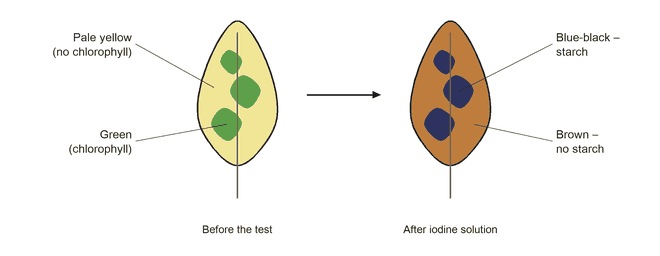
Question 52
A potted plant with variegated leaves was taken in order to prove a factor necessary for photosynthesis. The potted plant was kept in the dark for 24 hours and then placed in bright sunlight for a few hours. Observe the diagram and answer the question :

(a) What aspect of photosynthesis is being tested in the above diagram ?
(b) Why was the plant placed in the dark before beginning the experiment ?
(c) Write a balanced chemical equation to represent the process of photosynthesis.
(d) What will be the result of starch test when performed on leaf A shown in the diagram ?
(e) Draw a neat and labelled diagram of a chloroplast.
Solve with AIWritten solution
Solution:
Concept: A variegated leaf has green parts (with chlorophyll) and pale yellow parts (without chlorophyll), so it can show whether chlorophyll is needed for photosynthesis.
Step 1 — Aspect tested: (a).
(a) The experiment tests whether chlorophyll is necessary for photosynthesis.
Step 2 — Dark treatment: (b).
(b) The plant was kept in the dark to destarch its leaves, so that any starch found at the end must have been made during the experiment.
Step 3 — Equation: (c).
(c) The balanced equation is:
Step 4 — Starch test on leaf A: (d).
(d) Only the green parts turn blue-black, because chlorophyll there made starch. The pale yellow parts stay brown (no starch), because they have no chlorophyll.
Step 5 — Chloroplast diagram: (e).
(e) A labelled diagram of a chloroplast:
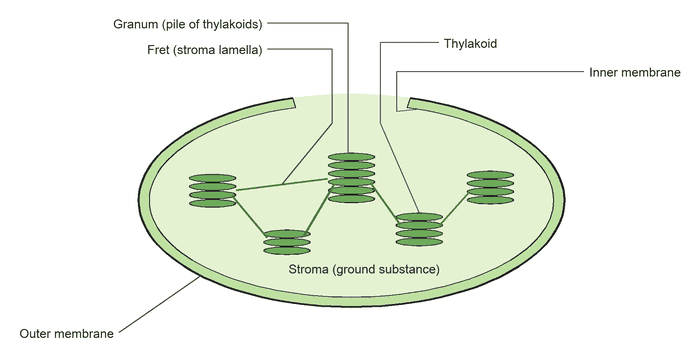
Watch out: Both parts of the leaf got the same light and air, so chlorophyll is the only difference between them.
Therefore, (a) the need for chlorophyll; (b) to destarch the leaves; (c) 6CO₂ + 12H₂O → C₆H₁₂O₆ + 6H₂O + 6O₂ (light energy, chlorophyll); (d) green parts blue-black, pale yellow parts brown; (e) as drawn.
- 537 marks
Question 53
Given below is the diagram of an experimental set-up :
(a) What is the objective of this experiment ?
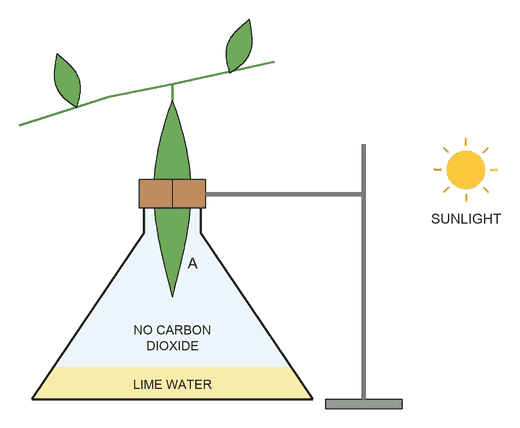
(b) Will it work satisfactorily? Give reason.
(c) What alteration(s) will you make in it for obtaining expected result?
(d) Would you take any step before starting the experiment? Describe this step and explain its necessity.
Solve with AIWritten solution
Solution:
Concept: To prove that carbon dioxide is needed, the part of the leaf inside the flask must get no carbon dioxide at all, so the chemical in the flask must absorb all of it.
Step 1 — Objective: (a).
(a) To show that carbon dioxide is necessary for photosynthesis.
Step 2 — Will it work? (b).
(b) No.
Cause: lime water absorbs carbon dioxide only weakly (calcium hydroxide is only slightly soluble), so some remains in the flask.
Effect: part A can still photosynthesise a little and form some starch, so the two parts of the leaf may not show a clear difference.
Step 3 — Alterations: (c).
(c) Replace the lime water with potassium hydroxide (KOH) solution, which absorbs carbon dioxide strongly, and make the split cork airtight (for example with vaseline) so that no air leaks in.
Step 4 — Step before starting: (d).
(d) Yes: destarch the plant by keeping it in the dark for 24 to 48 hours. This removes the starch already in the leaves, so starch found later in the part outside the flask is new, and its absence in part A can be trusted.
Expected result after these changes:
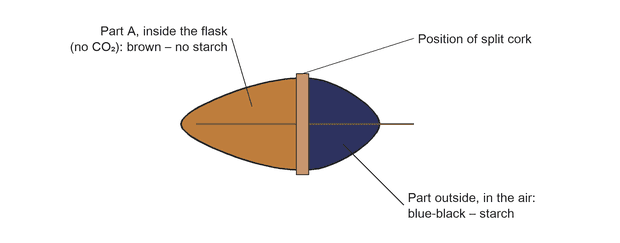
Therefore, (a) to show CO₂ is needed; (b) no, lime water does not absorb all the CO₂; (c) use KOH solution and an airtight cork; (d) yes, destarch the plant first so that the result can be trusted.
- 542 marks
Question 54
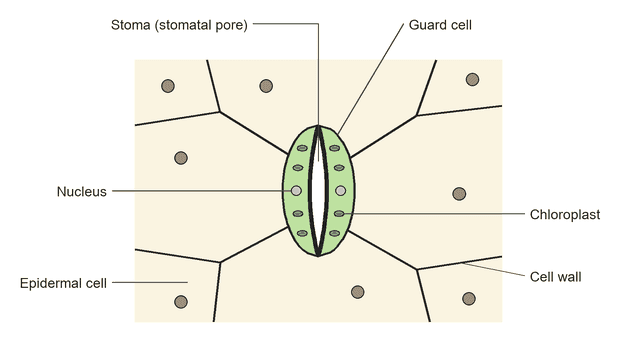
Draw a neat diagram of the stomatal apparatus found in the epidermis of leaves and label the Stoma, Guard cells, Chloroplast, Epidermal cells, Cell wall and Nucleus.
Solve with AIWritten solution
Solution:
Concept: A stoma is a minute pore bounded by two bean-shaped guard cells, which have chloroplasts, a nucleus, a thick inner wall and a thin outer wall; ordinary epidermal cells lie around them.
Step 1 — Draw the guard cells and the pore.
Draw two bean-shaped guard cells facing each other, joined at their ends, with a gap between them: the stoma (stomatal pore). Make the inner wall (facing the pore) thick and the outer wall thin.
Step 2 — Add the contents.
Put several small chloroplasts and one nucleus in each guard cell.
Step 3 — Add the epidermal cells and label.
Draw the epidermal cells around the guard cells, mark a cell wall, and label all six parts.
Watch out: Ordinary epidermal cells have no chloroplasts; draw chloroplasts only in the guard cells.
Therefore, the diagram shows the stoma between two guard cells (each with chloroplasts and a nucleus), the epidermal cells around them and a cell wall, all labelled.
- 557 marks
Question 55
Given below is the diagram of an experimental set-up (final stage). Study the same and answer the following questions :
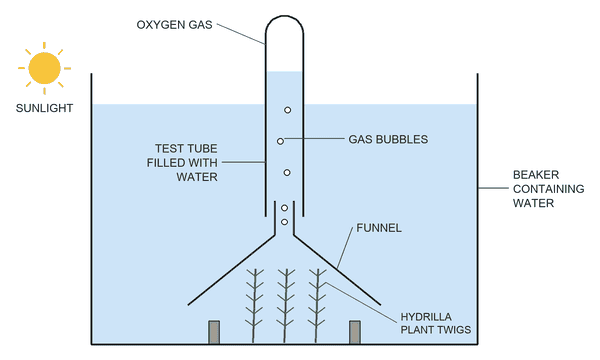
(a) What is the main aim of the experiment ?
(b) Oxygen gas shown in the experiment is released from which of the raw materials ?
(c) How would you confirm the presence of oxygen gas?
(d) Name the chemical substance which can be added in water to enhance the process/rate of release of oxygen gas.
(e) Draw a neat and labelled diagram of the same experiment for its initial stage.
Solve with AIWritten solution
Solution:
Concept: Hydrilla, a water plant, gives off bubbles of oxygen when it photosynthesises in sunlight; the gas collects at the top of the test tube.
Step 1 — Aim: (a).
(a) To show that oxygen is given out during photosynthesis.
Step 2 — Source of the oxygen: (b).
(b) Water. Light energy splits water molecules (photolysis), and their oxygen is given out.
Step 3 — Test for oxygen: (c).
(c) Put a glowing splinter into the gas collected; it bursts into flame, which confirms oxygen.
Step 4 — Speeding it up: (d).
(d) Sodium bicarbonate (). It adds more carbon dioxide to the water (cause), so photosynthesis speeds up and more oxygen is released (effect).
Step 5 — Initial stage: (e).
(e) At the start, the test tube is completely filled with water and no gas has collected; the rest of the set-up is the same.
Watch out: The oxygen comes from water, not from the carbon dioxide or the sodium bicarbonate.
Therefore, (a) to show oxygen is released in photosynthesis; (b) water; (c) a glowing splinter bursts into flame; (d) sodium bicarbonate; (e) the same set-up with the test tube full of water.
- 561 mark
Question 56
Answer the following simply in "Yes" or "No" :
Chloroplast and chlorophyll are one and the same thing.
Solve with AIWritten solution
Solution:
Concept: A chloroplast is a cell organelle; chlorophyll is a pigment inside it.
Step 1 — Compare the two.
A chloroplast is the organelle in which photosynthesis takes place. Chlorophyll is the green pigment present in the thylakoids of the chloroplast.
Step 2 — Decide.
One is a structure and the other is a substance inside that structure, so they are not the same.
Therefore, No.
- 571 mark
Question 57
Answer the following simply in "Yes" or "No" :
Oxygen given out in photosynthesis comes from the atmosphere.
Solve with AIWritten solution
Solution:
Concept: The oxygen of photosynthesis is set free when water is split in the light-dependent phase.
Step 1 — Find the source.
Light energy splits water molecules (photolysis of water), and their oxygen is given out through the stomata.
Step 2 — Decide.
The oxygen comes from the water absorbed by the plant, not from the air.
Therefore, No: the oxygen comes from water.
- 581 mark
Question 58
Answer the following simply in "Yes" or "No" :
Photosynthesis can also occur in artificial light such as that of a 100 Watt electric lamp.
Solve with AIWritten solution
Solution:
Concept: Chlorophyll needs light energy; the light need not be sunlight.
Step 1 — What chlorophyll needs.
Chlorophyll can trap any light of suitable intensity and wavelength.
Step 2 — Decide.
A 100 W electric lamp gives such light, so a plant near it can photosynthesise.
Therefore, Yes.
- 591 mark
Question 59
Answer the following simply in "Yes" or "No" :
All the starch produced in a leaf remains stored in it for 2-3 weeks before it is used by other parts of the plant.
Solve with AIWritten solution
Solution:
Concept: Starch made in a leaf is stored there only for a short time.
Step 1 — What happens to the starch.
At night the starch is changed into soluble sugar and carried away through the phloem to other parts of the plant.
Step 2 — Decide.
It does not stay in the leaf for 2–3 weeks; this is also why a plant kept in the dark for 24–48 hours is destarched.
Therefore, No.
- 601 mark
Question 60
Answer the following simply in "Yes" or "No" :
Photosynthesis requires involvement of enzymes.
Solve with AIWritten solution
Solution:
Concept: Photosynthesis is a series of chemical reactions inside living cells, and such reactions are controlled by enzymes.
Step 1 — Look for enzymes.
Each step, especially the building of glucose from carbon dioxide in the light-independent phase, is controlled by enzymes.
Step 2 — Supporting fact.
This is why photosynthesis stops above about 40 °C, when the enzymes are destroyed.
Therefore, Yes.
- 611 mark
Question 61
Answer the following simply in "Yes" or "No" :
Plants require several nutrients such as nitrogen, sulphur and iron.
Solve with AIWritten solution
Solution:
Concept: Glucose contains only carbon, hydrogen and oxygen, but a plant is made of many other elements too.
Step 1 — What else plants need.
To make proteins, chlorophyll and other compounds, plants need mineral nutrients such as nitrogen, sulphur and iron.
Step 2 — Decide.
The roots absorb these minerals from the soil, so the statement is true.
Therefore, Yes.
- 621 mark
Question 62
Answer the following simply in "Yes" or "No" :
Every green plant produces glucose as well as proteins and many other compounds.
Solve with AIWritten solution
Solution:
Concept: Glucose is the first product of photosynthesis, not the only compound a plant makes.
Step 1 — What the plant does with glucose.
The plant uses glucose, together with minerals from the soil, to make starch, cellulose, fats, proteins and many other compounds.
Step 2 — Decide.
So every green plant produces glucose as well as proteins and other compounds.
Therefore, Yes.
- 631 mark
Question 63
Answer the following simply in "Yes" or "No" :
All green plants are categorised as consumers.
Solve with AIWritten solution
Solution:
Concept: Organisms are grouped by how they get their food: producers make it, consumers take it from others.
Step 1 — How green plants get food.
Green plants make their own food by photosynthesis.
Step 2 — Decide.
So they are producers (autotrophs), not consumers; consumers are organisms, such as animals, that depend on plants for food.
Therefore, No: green plants are producers.
What Class 10 Biology Ch 6 covers
The sections of the chapter, in the order the book takes them. Every question above comes from one of these.
- 01Plants – Self Food Producers
- 02What Is Photosynthesis
- 03Chlorophyll – The Vital Plant Pigment
- 04Regulation of Stomatal Opening for Letting in Carbon Dioxide
- 05Process of Photosynthesis
- 06Two Main Phases of Photosynthesis
More ways to study this chapter
The same chapter asked three other ways. Practise it, revise it, and see what the board has set on Ch 6 before.
- Competency-Based Questions (CBQ)Case study questions: a situation, and the part of the chapter that answers it.40questionsOpen
- Previous Year QuestionsQuestions that have actually appeared in board papers, each tagged with its year.49questionsOpen
- Practice QuestionsExtra questions per chapter, for when one attempt at a method is not enough.44questionsOpen
Ch 6 in past ICSE papers
The same chapter as the board has actually asked it. These are worded differently from the textbook exercise, which is the point of reading them.
- 11 mark
Board paper question 1
Choose the correct answer from the four options given below:
The individual flattened stacks of membranous structures inside the chloroplasts are known as:
Solve with AIAnswer
- Correct
(A) Grana
(B) Stroma
(C) Thylakoids
(D) Cristae
Answer: (A) Grana
Concept: A chloroplast is bounded by a double membrane (the chloroplast envelope). Inside, flattened sacs called thylakoids are piled into stacks called grana (singular granum), joined by frets, and lie in a colourless ground substance, the stroma. Chlorophyll is held in the thylakoid membranes.
Step 1 — Read what is asked.
The question asks for the flattened stacks of membranes, that is, the piles, not the single sacs that make up a pile.
Step 2 — Name the stacks.
One pile of thylakoids is a granum, so the stacks are the grana.
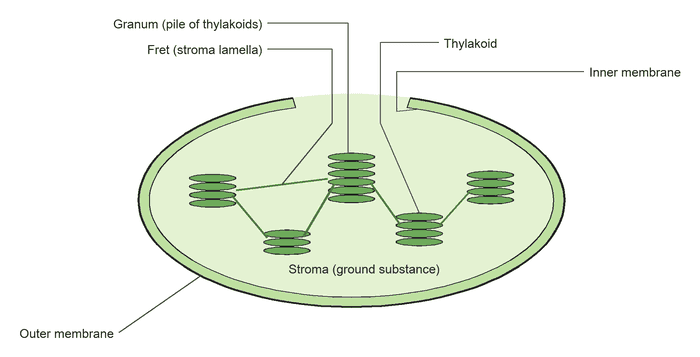
Watch out: A single flattened sac is a thylakoid; a STACK of them is a granum.
Note: The words 'individual … structures' could suggest the single sacs (thylakoids), but 'stacks' points to grana, which is the printed key; we keep it.
Why the other options are wrong:
- (B) Stroma: the stroma is the colourless ground substance in which the grana lie; it is not made of stacks.
- (C) Thylakoids: thylakoids are the single flattened sacs; many of them piled together form one granum.
- (D) Cristae: cristae are the folds of the inner membrane of a mitochondrion, not part of a chloroplast.
Therefore, the flattened stacks inside the chloroplast are the grana, option (A).
- 25 marks
Board paper question 2
The following diagram demonstrates a physiological process taking place in green plants. The whole set up was placed in bright sunlight for several hours. Study the diagram and answer the questions that follow:
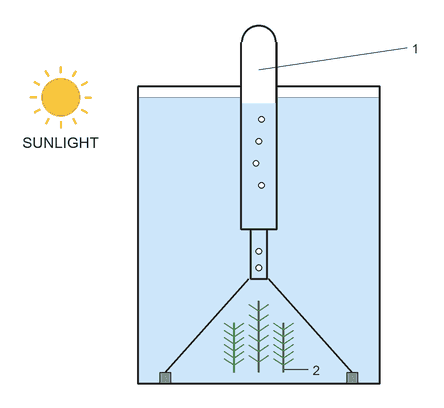
(i) What aspect of the physiological process is being examined?
(ii) Explain the physiological process mentioned in (i) above.
(iii) Label the parts numbered 1 and 2 in the diagram.
(iv) Write a well-balanced chemical equation for the physiological process explained in (ii) above.
(v) What would happen to the rate of bubbling of the gas if a pinch of sodium bicarbonate is added to the water in the beaker? Explain your answer.
Solve with AIWritten solution
Solution:
Concept: A green water plant kept in sunlight gives off bubbles of gas; collecting that gas and testing it shows which gas photosynthesis releases.
Step 1 — (i) Aspect being examined.
The water plant gives off bubbles of gas in sunlight and the gas collects in the test tube, so the experiment shows that oxygen is given out (evolved) during photosynthesis.
Step 2 — (ii) The process explained.
In this set-up the Hydrilla uses carbon dioxide dissolved in the water and light energy from the sun. Photosynthesis is the process by which living plant cells containing chlorophyll make food (glucose, stored as starch) from carbon dioxide and water, using light energy; oxygen is given out as a by-product.
Chlorophyll in the thylakoids absorbs light energy and becomes activated. This energy splits water into hydrogen ions, electrons and oxygen (photolysis); the oxygen is given out. The hydrogen is picked up by NADP to form NADPH, and energy is stored by turning ADP into ATP (photophosphorylation).
Using the energy of ATP, the hydrogen carried by NADPH is combined with carbon dioxide to form glucose.
The oxygen rises as bubbles through the funnel stem and collects at the top of the test tube, pushing the water down. A glowing splinter held in this gas bursts into flame, which shows that the gas is oxygen.
Step 3 — (iii) Labels 1 and 2.
Part 1 is the gas at the top of the test tube and part 2 is the plant under the funnel.
- 1 — Oxygen gas (collected at the top of the test tube)
- 2 — Hydrilla (an aquatic plant, under the inverted funnel)

Step 4 — (iv) Balanced chemical equation.
The overall equation, with chlorophyll and light energy written over the arrow, is:
Each side has 6 carbon, 24 hydrogen and 24 oxygen atoms, so it is balanced.
Step 5 — (v) Adding a pinch of sodium bicarbonate.
The rate of bubbling increases. Sodium bicarbonate adds carbon dioxide to the water; carbon dioxide is a raw material of photosynthesis, so the plant photosynthesises faster and gives off more oxygen.
Watch out: The gas collected is oxygen (it relights a glowing splinter), not carbon dioxide.
Therefore, the experiment shows that oxygen is evolved in photosynthesis; 1 = oxygen, 2 = Hydrilla; the rate of bubbling rises when sodium bicarbonate supplies more carbon dioxide.
- 31 mark
Board paper question 3
Briefly explain the following terms :
Photophosphorylation
Solve with AIWritten solution
Solution:
Concept: 'Photo' means light and 'phosphorylation' means adding a phosphate group.
Step 1 — Define the term.
Photophosphorylation is the formation of energy-rich ATP from ADP by adding an inorganic phosphate group, using the energy of light.
Step 2 — Say where and why it happens.
It takes place in the thylakoids of the grana during the light-dependent phase. The ATP formed supplies the energy used in the stroma to make glucose.
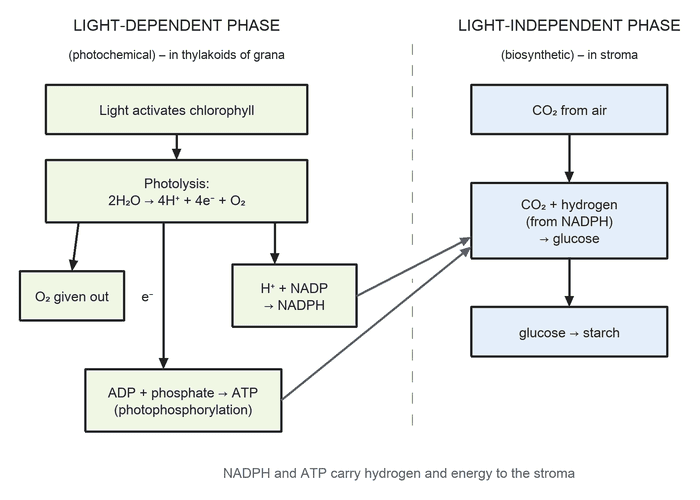
Watch out: Photophosphorylation makes ATP; photolysis splits water. Do not mix the two.
Therefore, photophosphorylation is the making of ATP from ADP and phosphate using light energy.
- 41 mark
Board paper question 4
The statements given below are incorrect. Rewrite the correct statement by changing the underlined words of the statements.
The solvent used to dissolve the chlorophyll pigments while testing a leaf for starch is Soda lime.
Solve with AIWritten solution
Solution:
Concept: In the starch test a leaf is boiled in water (to kill it), warmed in methylated spirit over a water bath (to remove chlorophyll), softened in warm water and then covered with iodine solution: parts with starch turn blue-black, parts without starch stay brown (the colour of iodine).
Step 1 — Check the underlined words.
Soda lime absorbs carbon dioxide; it does not dissolve chlorophyll, so the statement is wrong as written.
Step 2 — Name the right solvent.
Chlorophyll dissolves in alcohol, so the leaf is warmed in methylated spirit (alcohol). It is heated over a water bath, never a direct flame, because the spirit catches fire easily. The leaf turns pale white.
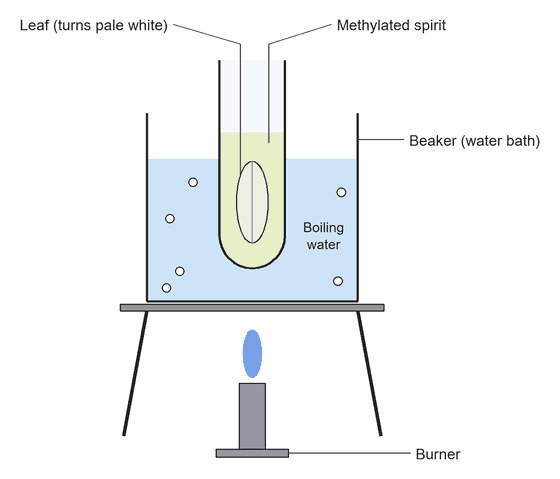
Watch out: Soda lime and potassium hydroxide are used to REMOVE carbon dioxide in other experiments, not to remove chlorophyll.
Therefore, the correct statement is: The solvent used to dissolve the chlorophyll pigments while testing a leaf for starch is methylated spirit (alcohol).
- 51 mark
Board paper question 5
Given below are sets of five terms each. Rewrite the terms in correct order in a logical sequence.
Example: Large intestine, Stomach, Mouth, Small intestine, Oesophagus.
Answer: Mouth → Oesophagus → Stomach → Small intestine → Large intestine.
Caterpillar, Snake, Owl, Frog, Green leaves.
Solve with AIWritten solution
Solution:
Concept: A food chain always starts with a producer (a green plant or alga, which makes food by photosynthesis), then a herbivore that eats it, then carnivores, each eaten by the next.
Step 1 — Find the producer.
Green leaves make food by photosynthesis, so the chain starts with them.
Step 2 — Add the eaters in order.
The caterpillar eats leaves (herbivore), the frog eats the caterpillar, the snake eats the frog and the owl eats the snake.

Therefore, the sequence is Green leaves → Caterpillar → Frog → Snake → Owl.
- 61 mark
Board paper question 6
Differentiate between the following pairs on the basis of what is mentioned in brackets:
NADP and ATP [Expand the abbreviation]
Solve with AIWritten solution
Solution:
Concept: Both compounds take part in the light-dependent phase: NADP carries hydrogen and ATP stores energy.
Step 1 — Expand each abbreviation.
Write the full name of each.
NADP ATP Nicotinamide adenine dinucleotide phosphate Adenosine triphosphate Step 2 — Recall their roles.
NADP picks up hydrogen from the splitting of water and becomes NADPH; ATP is formed from ADP during photophosphorylation.
Therefore, NADP is nicotinamide adenine dinucleotide phosphate and ATP is adenosine triphosphate.
All 49 board paper questions for this chapter, solved the same way.
Class 10 Biology Ch 6 questions students ask
How many questions are there in Class 10 Biology Ch 6?
63 questions. Every one is solved step by step on this page.
Are these Class 10 Biology solutions free?
Yes. Every question and its full working is free to read, with no account needed.
Can I download the Class 10 Biology Ch 6 solutions as a PDF?
There is no PDF to download. Every solution is on this page instead, which means it is searchable, always the current syllabus, and readable on a phone. Use your browser's print option if you want it on paper.