
Opening your dashboard
Class 10 Biology Chapter 6 Photosynthesis: Previous Year Questions
49 questions on Chapter 6, each solved step by step. Class 10 Biology, ICSE 2026-27.
49 questions with solutions
1–5 marks · Mixed difficulty
- 11 mark
Question 1
Choose the correct answer from the four options given below:
The individual flattened stacks of membranous structures inside the chloroplasts are known as:
Solve with AIAnswer
- Correct
(A) Grana
(B) Stroma
(C) Thylakoids
(D) Cristae
Answer: (A) Grana
Concept: A chloroplast is bounded by a double membrane (the chloroplast envelope). Inside, flattened sacs called thylakoids are piled into stacks called grana (singular granum), joined by frets, and lie in a colourless ground substance, the stroma. Chlorophyll is held in the thylakoid membranes.
Step 1 — Read what is asked.
The question asks for the flattened stacks of membranes, that is, the piles, not the single sacs that make up a pile.
Step 2 — Name the stacks.
One pile of thylakoids is a granum, so the stacks are the grana.
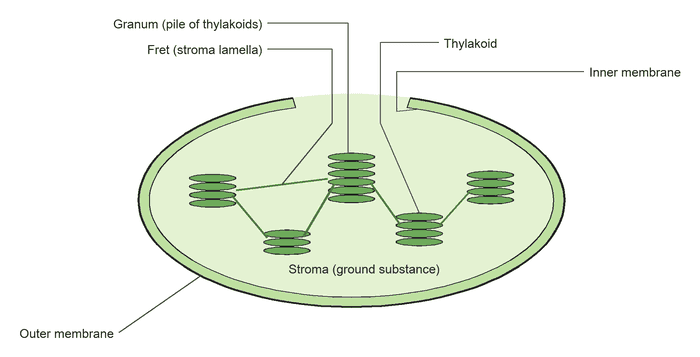
Watch out: A single flattened sac is a thylakoid; a STACK of them is a granum.
Note: The words 'individual … structures' could suggest the single sacs (thylakoids), but 'stacks' points to grana, which is the printed key; we keep it.
Why the other options are wrong:
- (B) Stroma: the stroma is the colourless ground substance in which the grana lie; it is not made of stacks.
- (C) Thylakoids: thylakoids are the single flattened sacs; many of them piled together form one granum.
- (D) Cristae: cristae are the folds of the inner membrane of a mitochondrion, not part of a chloroplast.
Therefore, the flattened stacks inside the chloroplast are the grana, option (A).
- 25 marks
Question 2
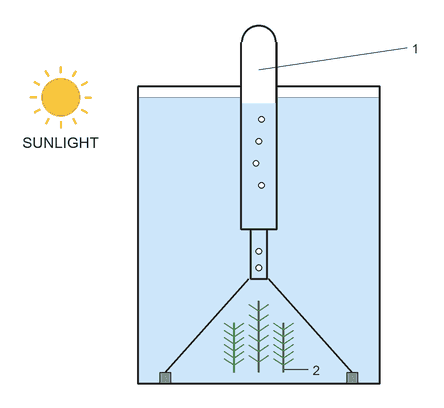
The following diagram demonstrates a physiological process taking place in green plants. The whole set up was placed in bright sunlight for several hours. Study the diagram and answer the questions that follow:
(i) What aspect of the physiological process is being examined?
(ii) Explain the physiological process mentioned in (i) above.
(iii) Label the parts numbered 1 and 2 in the diagram.
(iv) Write a well-balanced chemical equation for the physiological process explained in (ii) above.
(v) What would happen to the rate of bubbling of the gas if a pinch of sodium bicarbonate is added to the water in the beaker? Explain your answer.
Solve with AIWritten solution
Solution:
Concept: A green water plant kept in sunlight gives off bubbles of gas; collecting that gas and testing it shows which gas photosynthesis releases.
Step 1 — (i) Aspect being examined.
The water plant gives off bubbles of gas in sunlight and the gas collects in the test tube, so the experiment shows that oxygen is given out (evolved) during photosynthesis.
Step 2 — (ii) The process explained.
In this set-up the Hydrilla uses carbon dioxide dissolved in the water and light energy from the sun. Photosynthesis is the process by which living plant cells containing chlorophyll make food (glucose, stored as starch) from carbon dioxide and water, using light energy; oxygen is given out as a by-product.
Chlorophyll in the thylakoids absorbs light energy and becomes activated. This energy splits water into hydrogen ions, electrons and oxygen (photolysis); the oxygen is given out. The hydrogen is picked up by NADP to form NADPH, and energy is stored by turning ADP into ATP (photophosphorylation).
Using the energy of ATP, the hydrogen carried by NADPH is combined with carbon dioxide to form glucose.
The oxygen rises as bubbles through the funnel stem and collects at the top of the test tube, pushing the water down. A glowing splinter held in this gas bursts into flame, which shows that the gas is oxygen.
Step 3 — (iii) Labels 1 and 2.
Part 1 is the gas at the top of the test tube and part 2 is the plant under the funnel.
- 1 — Oxygen gas (collected at the top of the test tube)
- 2 — Hydrilla (an aquatic plant, under the inverted funnel)

Step 4 — (iv) Balanced chemical equation.
The overall equation, with chlorophyll and light energy written over the arrow, is:
Each side has 6 carbon, 24 hydrogen and 24 oxygen atoms, so it is balanced.
Step 5 — (v) Adding a pinch of sodium bicarbonate.
The rate of bubbling increases. Sodium bicarbonate adds carbon dioxide to the water; carbon dioxide is a raw material of photosynthesis, so the plant photosynthesises faster and gives off more oxygen.
Watch out: The gas collected is oxygen (it relights a glowing splinter), not carbon dioxide.
Therefore, the experiment shows that oxygen is evolved in photosynthesis; 1 = oxygen, 2 = Hydrilla; the rate of bubbling rises when sodium bicarbonate supplies more carbon dioxide.
- 31 mark
Question 3
Briefly explain the following terms :
Photophosphorylation
Solve with AIWritten solution
Solution:
Concept: 'Photo' means light and 'phosphorylation' means adding a phosphate group.
Step 1 — Define the term.
Photophosphorylation is the formation of energy-rich ATP from ADP by adding an inorganic phosphate group, using the energy of light.
Step 2 — Say where and why it happens.
It takes place in the thylakoids of the grana during the light-dependent phase. The ATP formed supplies the energy used in the stroma to make glucose.
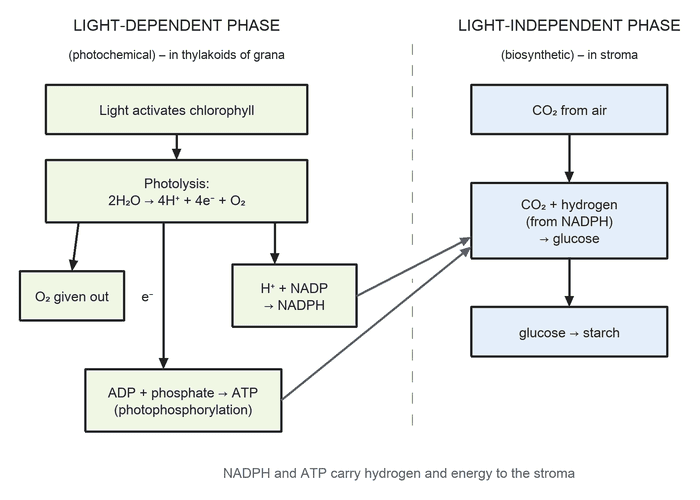
Watch out: Photophosphorylation makes ATP; photolysis splits water. Do not mix the two.
Therefore, photophosphorylation is the making of ATP from ADP and phosphate using light energy.
- 41 mark
Question 4
The statements given below are incorrect. Rewrite the correct statement by changing the underlined words of the statements.
The solvent used to dissolve the chlorophyll pigments while testing a leaf for starch is Soda lime.
Solve with AIWritten solution
Solution:
Concept: In the starch test a leaf is boiled in water (to kill it), warmed in methylated spirit over a water bath (to remove chlorophyll), softened in warm water and then covered with iodine solution: parts with starch turn blue-black, parts without starch stay brown (the colour of iodine).
Step 1 — Check the underlined words.
Soda lime absorbs carbon dioxide; it does not dissolve chlorophyll, so the statement is wrong as written.
Step 2 — Name the right solvent.
Chlorophyll dissolves in alcohol, so the leaf is warmed in methylated spirit (alcohol). It is heated over a water bath, never a direct flame, because the spirit catches fire easily. The leaf turns pale white.
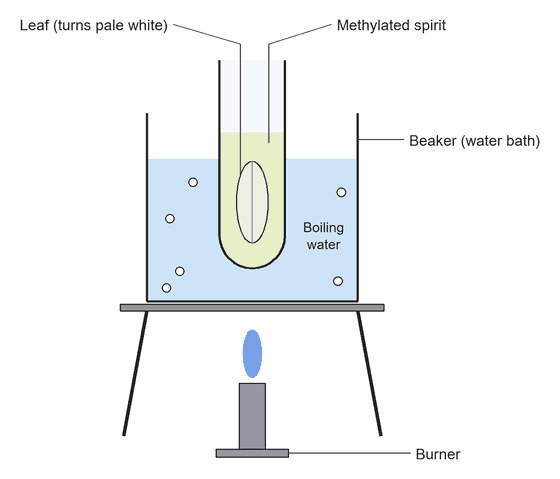
Watch out: Soda lime and potassium hydroxide are used to REMOVE carbon dioxide in other experiments, not to remove chlorophyll.
Therefore, the correct statement is: The solvent used to dissolve the chlorophyll pigments while testing a leaf for starch is methylated spirit (alcohol).
- 51 mark
Question 5
Given below are sets of five terms each. Rewrite the terms in correct order in a logical sequence.
Example: Large intestine, Stomach, Mouth, Small intestine, Oesophagus.
Answer: Mouth → Oesophagus → Stomach → Small intestine → Large intestine.
Caterpillar, Snake, Owl, Frog, Green leaves.
Solve with AIWritten solution
Solution:
Concept: A food chain always starts with a producer (a green plant or alga, which makes food by photosynthesis), then a herbivore that eats it, then carnivores, each eaten by the next.
Step 1 — Find the producer.
Green leaves make food by photosynthesis, so the chain starts with them.
Step 2 — Add the eaters in order.
The caterpillar eats leaves (herbivore), the frog eats the caterpillar, the snake eats the frog and the owl eats the snake.

Therefore, the sequence is Green leaves → Caterpillar → Frog → Snake → Owl.
- 61 mark
Question 6
Differentiate between the following pairs on the basis of what is mentioned in brackets:
NADP and ATP [Expand the abbreviation]
Solve with AIWritten solution
Solution:
Concept: Both compounds take part in the light-dependent phase: NADP carries hydrogen and ATP stores energy.
Step 1 — Expand each abbreviation.
Write the full name of each.
NADP ATP Nicotinamide adenine dinucleotide phosphate Adenosine triphosphate Step 2 — Recall their roles.
NADP picks up hydrogen from the splitting of water and becomes NADPH; ATP is formed from ADP during photophosphorylation.
Therefore, NADP is nicotinamide adenine dinucleotide phosphate and ATP is adenosine triphosphate.
- 75 marks
Question 7
The diagrams given below represent the relationship between a mouse and a physiological process that occurs in green plants. Study the diagrams and answer the questions that follow:
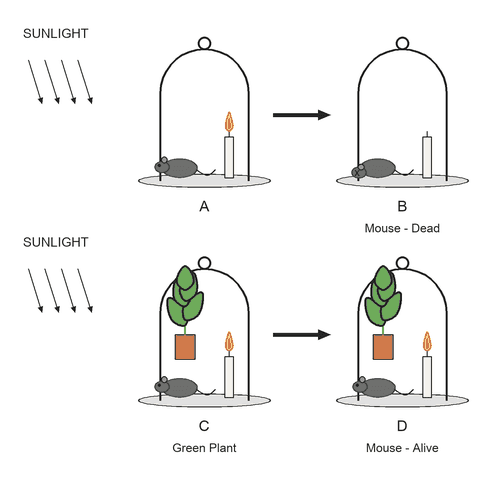
(i) Name the physiological process occurring in the green plant that has kept the mouse alive.
(ii) Explain the physiological process mentioned above.
(iii) Why did the mouse die in bell jar B?
(iv) What is the significance of the process as stated in (i) for life on earth.
(v) Represent the above mentioned physiological process in the form of a chemical equation.
Solve with AIWritten solution
Solution:
Concept: In sunlight a green plant takes in carbon dioxide and gives out oxygen by photosynthesis, while a mouse (and a burning candle) uses up oxygen and gives out carbon dioxide.
Step 1 — (i) Name the process.
The process in the green plant that kept the mouse alive is photosynthesis.
Step 2 — (ii) Explain the process.
Photosynthesis is the process by which living plant cells containing chlorophyll make food (glucose, stored as starch) from carbon dioxide and water, using light energy; oxygen is given out as a by-product.
Carbon dioxide from the air diffuses into the leaf through the stomata, and water absorbed by the roots rises through the xylem to the mesophyll cells.
Chlorophyll in the thylakoids absorbs light energy and becomes activated. This energy splits water into hydrogen ions, electrons and oxygen (photolysis); the oxygen is given out. The hydrogen is picked up by NADP to form NADPH, and energy is stored by turning ADP into ATP (photophosphorylation).
Using the energy of ATP, the hydrogen carried by NADPH is combined with carbon dioxide to form glucose.
The glucose is soon changed into insoluble starch and stored, which is why a leaf that has been in light gives a positive starch test.
Step 3 — (iii) Why the mouse died in jar B.
In jar B the mouse used up the oxygen for respiration, and the burning candle used it up too, while both gave out carbon dioxide. There was no green plant to take in the carbon dioxide and release fresh oxygen, so the mouse died for want of oxygen.
Step 4 — (iv) Significance for life on earth.
Photosynthesis matters to every living being.
- Food: it is the source of food and energy for all living beings, directly for plants and indirectly for animals.
- Oxygen: it releases the oxygen that most organisms need for respiration.
- Balance of gases: it removes carbon dioxide from the air and keeps the levels of oxygen and carbon dioxide balanced.
Step 5 — (v) The chemical equation.
The overall equation is:
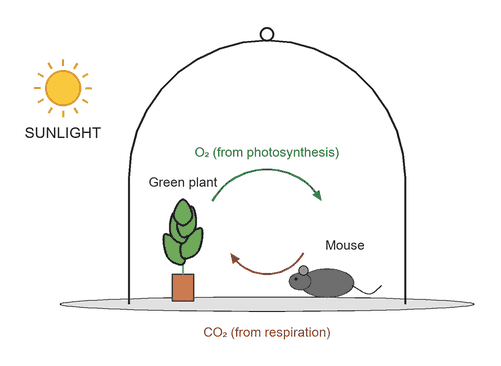
The figure shows the exchange inside the jar: the plant gives out oxygen used by the mouse, and the mouse gives out carbon dioxide used by the plant.
Watch out: The plant saves the mouse only in LIGHT; in the dark the plant also uses oxygen.
Therefore, photosynthesis kept the mouse alive; in jar B the mouse died because the oxygen was used up and nothing replaced it.
- 85 marks
Question 8
Complete the following paragraph by filling in the blanks (i) to (v) with appropriate words:
To test a leaf for starch, the leaf is boiled in water to (i) ............... It is then boiled in Methylated spirit to (ii) ............... The leaf is dipped in warm water to soften it. It is placed in a petri dish, and (iii) ............... solution is added. The region of the leaf which contains starch, turns (iv) ............... and the region which does not contain starch, turns (v) ...............
Solve with AIWritten solution
Solution:
Concept: In the starch test a leaf is boiled in water (to kill it), warmed in methylated spirit over a water bath (to remove chlorophyll), softened in warm water and then covered with iodine solution: parts with starch turn blue-black, parts without starch stay brown (the colour of iodine).
Step 1 — Blank (i): boiling in water.
Boiling in water kills the cells, so all chemical reactions stop and the cells let the next solutions in.
Step 2 — Blank (ii): boiling in methylated spirit.
The spirit removes the chlorophyll (decolourises the leaf), so that the green colour does not hide the colour change. It is warmed over a water bath because it catches fire easily.
Step 3 — Blank (iii): the reagent.
The test reagent is iodine solution. (The spirit makes the leaf hard and brittle, so it is first dipped in warm water to soften it.)

Step 4 — Blanks (iv) and (v): the colours.
Iodine turns starch blue-black; where there is no starch the leaf only takes the brown colour of the iodine solution.
Watch out: The brown colour is simply iodine's own colour; it means NO starch.
Therefore, (i) kill the cells, (ii) remove the chlorophyll, (iii) iodine, (iv) blue-black, (v) brown.
- 95 marks
Question 9
A potted plant with variegated leaves was taken in order to prove a factor necessary for photosynthesis. The potted plant was kept in the dark for 24 hours and then placed in bright sunlight for a few hours. Observe the diagrams and answer the questions.
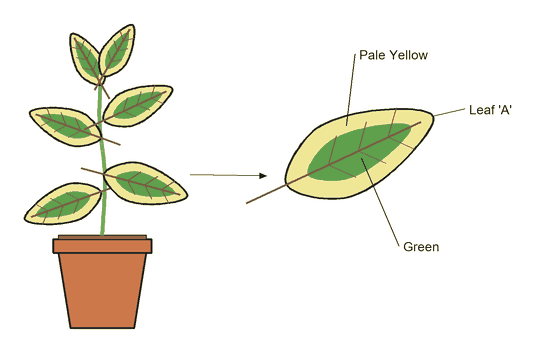
(i) What aspect of photosynthesis is being tested in the above diagram?
(ii) Represent the process of photosynthesis in the form of a balanced equation.
(iii) Why was the plant kept in the dark before beginning the experiment?
(iv) What will be the result of the starch test performed on leaf 'A' shown in the diagram? Give an example of a plant with variegated leaves.
(v) Draw a neat labelled diagram of a chloroplast.
Solve with AIWritten solution
Solution:
Concept: A variegated leaf has green parts (with chlorophyll) and pale yellow parts (without chlorophyll). After destarching and exposure to sunlight, only the green parts can make starch.
Step 1 — (i) Aspect being tested.
Only the parts with chlorophyll can make starch, so the experiment tests that chlorophyll is necessary for photosynthesis.
Step 2 — (ii) Balanced equation.
The overall equation is:
Step 3 — (iii) Why the plant was kept in the dark.
A plant is destarched by keeping it in the dark for 24 to 48 hours: with no light it cannot photosynthesise, so the starch already in its leaves is used up or moved away. Any starch found later must have been made during the experiment.
Step 4 — (iv) Result on leaf A, and an example.
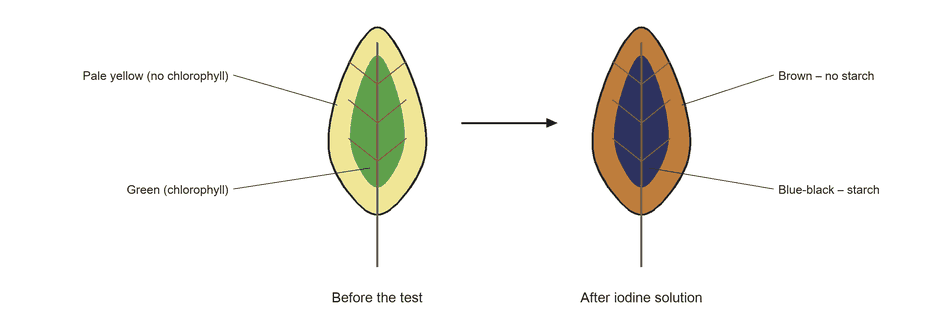
Iodine shows where starch was made.
- The green parts turn blue-black: they have chlorophyll, so they made starch.
- The pale yellow parts stay brown (the colour of iodine): with no chlorophyll, no starch was made.
- Example: Coleus (also croton).
Step 5 — (v) Labelled diagram of a chloroplast.
A chloroplast is bounded by a double membrane (the chloroplast envelope). Inside, flattened sacs called thylakoids are piled into stacks called grana (singular granum), joined by frets, and lie in a colourless ground substance, the stroma. Chlorophyll is held in the thylakoid membranes.
Watch out: Destarching comes BEFORE the light; otherwise old starch would give a false blue-black colour.
Therefore, the experiment shows that chlorophyll is necessary: the green parts of leaf A turn blue-black and the pale yellow parts stay brown.
- 101 mark
Question 10
Differentiate between the following pairs on the basis of what is indicated in the brackets.
Leaf and Liver [form in which glucose is stored]
Solve with AIWritten solution
Solution:
Concept: Extra glucose is stored as an insoluble polysaccharide: starch in plants, glycogen in animals.
Step 1 — State the form in each organ.
Set the two side by side.
Leaf Liver Glucose is stored as starch. Glucose is stored as glycogen. Step 2 — Explain why.
In the leaf, glucose made by photosynthesis is soon turned into starch for storage. In the liver, extra glucose from the blood is turned into glycogen.
Therefore, the leaf stores glucose as starch and the liver stores it as glycogen.
- 111 mark
Question 11
Differentiate between the following pairs on the basis of what is indicated in the brackets.
ATP and AIDS [expand the abbreviations]
Solve with AIWritten solution
Solution:
Concept: Each letter of an abbreviation stands for one word of the full name.
Step 1 — Expand each abbreviation.
Write the full names side by side.
ATP AIDS Adenosine triphosphate Acquired Immuno Deficiency Syndrome (Acquired Immunodeficiency Syndrome) Step 2 — Recall what each is.
ATP is the energy-rich compound formed in photosynthesis and respiration. AIDS is a disease caused by HIV (human immunodeficiency virus), which weakens the immune system.
Therefore, ATP is adenosine triphosphate and AIDS is acquired immuno deficiency syndrome.
- 121 mark
Question 12
Give biological explanations for the following:
All the food chains begin with green plants.
Solve with AIWritten solution
Solution:
Concept: Green plants are the producers: only they can make food from simple substances using sunlight.
Step 1 — See what green plants do.
Green plants make food (glucose and starch) from carbon dioxide and water by photosynthesis, trapping the sun's light energy with chlorophyll.
Step 2 — See why animals depend on them.
Animals cannot make their own food. Herbivores eat plants directly, and carnivores eat the herbivores, so the energy in every chain first enters through a green plant.

Therefore, all food chains begin with green plants because they alone make food by photosynthesis, and every animal depends on that food.
- 131 mark
Question 13
Give suitable biological reasons for the following statements :
All life on Earth is supported by Photosynthesis.
Solve with AIWritten solution
Solution:
Concept: Photosynthesis gives living beings the two things they cannot do without: food and oxygen.
Step 1 — Food.
Photosynthesis is the starting source of food and energy for all living beings: directly for plants and indirectly for animals that eat plants or plant-eaters.
Step 2 — Oxygen.
It is the main process that adds oxygen to the air, and most organisms need that oxygen for respiration.

Step 3 — Balance of gases.
It also removes carbon dioxide from the air, keeping the gases of the atmosphere in balance.
Therefore, all life is supported by photosynthesis because it supplies the food and the oxygen that living beings depend on.
- 141 mark
Question 14
Expand the following biological abbreviations :
ATP
Solve with AIWritten solution
Solution:
Concept: ATP is the energy-rich compound formed in the light-dependent phase of photosynthesis (and in respiration).
Step 1 — Expand the abbreviation.
ATP stands for Adenosine triphosphate.
Step 2 — Recall its role.
It is formed from ADP (adenosine diphosphate) by adding a phosphate group using light energy (photophosphorylation); its energy is used to make glucose in the stroma.
Therefore, ATP is adenosine triphosphate.
- 151 mark
Question 15
Mention the exact location of the following :
Thylakoids
Solve with AIWritten solution
Solution:
Concept: A chloroplast is bounded by a double membrane (the chloroplast envelope). Inside, flattened sacs called thylakoids are piled into stacks called grana (singular granum), joined by frets, and lie in a colourless ground substance, the stroma. Chlorophyll is held in the thylakoid membranes.
Step 1 — Locate the thylakoids.
Thylakoids are the flattened membrane sacs inside the chloroplast, piled one above another to form the grana, which lie in the stroma.
Step 2 — Locate the chloroplasts.
The chloroplasts themselves are mainly in the mesophyll cells (palisade and spongy cells) of the leaf, and also in the guard cells of the stomata.
Therefore, thylakoids are found inside the chloroplasts, stacked into grana in the stroma.
- 165 marks
Question 16
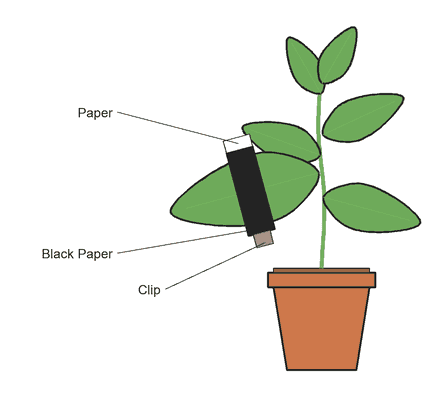
The diagram given below represents an experiment to prove the importance of a factor in photosynthesis. Answer the questions that follow :
(i) Name the factor studied in this experiment.
(ii) What will you observe in the experimental leaf after the starch test?
(iii) Explain the process of Photosynthesis.
(iv) Give a balanced chemical equation to represent the process of photosynthesis.
(v) Draw a neat, labelled diagram of an experimental setup to show that oxygen is released during photosynthesis.
Solve with AIWritten solution
Solution:
Concept: Part of a destarched leaf is covered with black paper so that light cannot reach it; after a few hours in sunlight the starch test shows where starch was made.
Step 1 — (i) Factor studied.
Only the light reaching the leaf is changed, so the factor is light (sunlight).
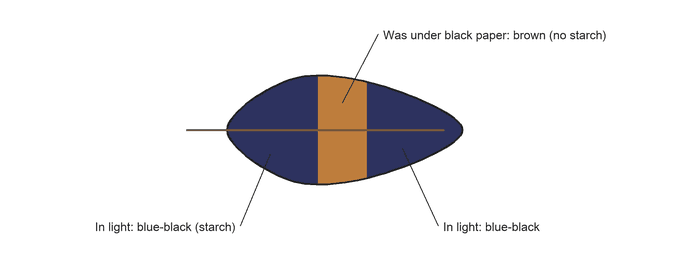
Step 2 — (ii) Observation after the starch test.
Iodine shows starch only where light fell.
- The part covered by the black paper stays brown: no starch was made there.
- The uncovered parts that got sunlight turn blue-black: starch is present.
Step 3 — (iii) The process of photosynthesis.
Photosynthesis is the process by which living plant cells containing chlorophyll make food (glucose, stored as starch) from carbon dioxide and water, using light energy; oxygen is given out as a by-product.
Carbon dioxide from the air diffuses into the leaf through the stomata, and water absorbed by the roots rises through the xylem to the mesophyll cells.
Chlorophyll in the thylakoids absorbs light energy and becomes activated. This energy splits water into hydrogen ions, electrons and oxygen (photolysis); the oxygen is given out. The hydrogen is picked up by NADP to form NADPH, and energy is stored by turning ADP into ATP (photophosphorylation).
Using the energy of ATP, the hydrogen carried by NADPH is combined with carbon dioxide to form glucose.
The glucose is soon changed into insoluble starch and stored, which is why a leaf that has been in light gives a positive starch test.
Step 4 — (iv) Balanced equation.
The overall equation is:
Step 5 — (v) Set-up to show that oxygen is released.
Hydrilla is placed in a beaker of pond water under a short-stemmed inverted funnel, kept off the bottom by small supports, and a test tube full of water is inverted over the funnel stem. In sunlight, bubbles of gas collect in the test tube; a glowing splinter bursts into flame in this gas, which shows that it is oxygen.
Watch out: The plant must be destarched first, or old starch would turn the covered part blue-black too.
Therefore, the factor is light: the covered part stays brown and the uncovered parts turn blue-black.
- 171 mark
Question 17
Name the following:
(i) The process of transformation of several glucose molecules into one molecule of starch.
Solve with AIWritten solution
Solution:
Concept: Many small glucose molecules can join together into one large starch molecule.
Step 1 — Name the process.
Joining many small, simple molecules into one large, complex molecule is polymerisation.
Step 2 — See where it happens.
In the leaf, the glucose formed by photosynthesis is soon turned into insoluble starch in this way, for storage.

Therefore, the process is polymerisation.
- 181 mark
Question 18
Explain the following terms:
(iii) Photolysis
Solve with AIWritten solution
Solution:
Concept: 'Photo' means light and 'lysis' means splitting.
Step 1 — Define the term.
Photolysis is the splitting of water molecules, using light energy absorbed by chlorophyll, into hydrogen ions, electrons and oxygen. It occurs in the grana during the light-dependent phase.
Both sides have 4 hydrogen and 2 oxygen atoms, and the charges (+4 and −4) cancel.
Step 2 — Say what happens to the products.
The oxygen is given out, and the hydrogen ions (with the electrons) are picked up by NADP to form NADPH.
Watch out: The oxygen given out in photosynthesis comes from WATER (by photolysis), not from carbon dioxide.
Therefore, photolysis is the light-driven splitting of water in the grana into hydrogen ions, electrons and oxygen.
- 191 mark
Question 19
Match the items given in column A with the most appropriate ones in Column B and REWRITE the correct matching pairs:
Column A: (iv) Stroma
Column B: Calcium; balance of the body; Light independent reaction; diffusion of gases; gonad; Peppered moth; Light dependent reaction; Chlorophyll
Solve with AIWritten solution
Solution:
Concept: The stroma is the colourless ground substance of the chloroplast, where the light-independent phase takes place.
Step 1 — Pick the matching item.
Of the items in Column B, only light independent reaction belongs to the stroma.
Step 2 — Say why.
In the stroma, carbon dioxide combines with the hydrogen carried by NADPH, using energy from ATP, to form glucose; these reactions do not need light directly.
Watch out: The light DEPENDENT reaction happens in the grana, not the stroma.
Therefore, the matching pair is Stroma — Light independent reaction.
- 205 marks
Question 20
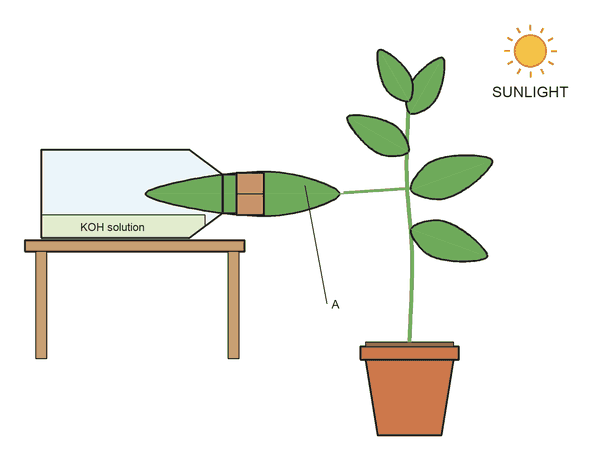
The diagram given below represents an experiment to prove the importance of a factor in photosynthesis. Answer the questions that follow:
(i) Which factor is being studied here?
(ii) What is the purpose of keeping KOH in the flask?
(iii) Explain the term Photosynthesis.
(iv) What will you observe when the leaf A is tested for starch?
(v) Write a well balanced chemical equation for the process of photosynthesis.
Solve with AIWritten solution
Solution:
Concept: Potassium hydroxide (KOH) absorbs carbon dioxide, so the part of leaf A inside the bottle gets no carbon dioxide, while the part outside, in the open air, gets it and acts as the control.
Step 1 — (i) Factor studied.
Only carbon dioxide is removed, so the factor is carbon dioxide.
Step 2 — (ii) Purpose of the KOH.
The KOH absorbs carbon dioxide from the air inside the bottle, so that part of the leaf gets none.
Step 3 — (iii) The term photosynthesis.
Photosynthesis is the process by which living plant cells containing chlorophyll make food (glucose, stored as starch) from carbon dioxide and water, using light energy; oxygen is given out as a by-product.
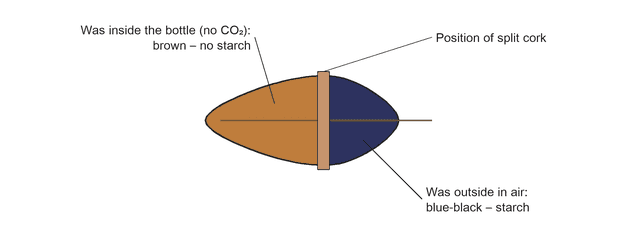
Step 4 — (iv) Observation when leaf A is tested for starch.
Iodine shows starch only where carbon dioxide reached the leaf.
- The part inside the bottle stays brown: no starch, because there was no carbon dioxide.
- The part outside the bottle turns blue-black: starch is present.
Step 5 — (v) Balanced equation.
The overall equation is:
Each side has 6 carbon, 24 hydrogen and 24 oxygen atoms, so it is balanced.
Watch out: The plant must be destarched first and the cork must be airtight, or the result means nothing.
Therefore, the factor is carbon dioxide: the part of leaf A inside the bottle stays brown and the part outside turns blue-black.
- 211 mark
Question 21
Give the biological reasons for the following statements:
(i) It is advisable to keep green plants in an aquarium.
Solve with AIWritten solution
Solution:
Concept: Water plants and fish help each other with gases: in light the plants give out oxygen, and the fish give out carbon dioxide.
Step 1 — What the plants give the fish.
Green water plants carry out photosynthesis in light and release oxygen into the water, which the fish use for respiration.
Step 2 — What the fish give the plants.
The carbon dioxide given out by the fish is used by the plants for photosynthesis.
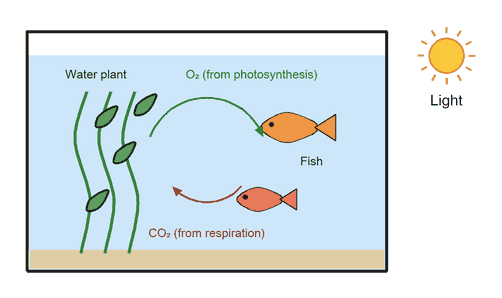
Watch out: The oxygen is released only in light; at night the plants also respire.
Therefore, green plants are kept in an aquarium because in light they add oxygen to the water for the fish and use up the carbon dioxide the fish give out.
- 221 mark
Question 22
The site of light reaction in the cells of a green leaf is:
Solve with AIAnswer
(A) Nucleus
- Correct
(B) Grana of chloroplast
(C) Cytoplasm
(D) Stroma of chloroplast
Answer: (B) Grana of chloroplast
Concept: The light reaction needs chlorophyll, which is held in the thylakoid membranes; the thylakoids are piled into grana.
Step 1 — Find where light is trapped.
Chlorophyll absorbs light energy only where it is present, in the thylakoids of the grana.
Step 2 — Follow the light reaction.
That energy splits water (photolysis) and forms ATP and NADPH, all in the grana of the chloroplast.
Why the other options are wrong:
- (A) Nucleus: the nucleus controls the cell's activities; it has no chlorophyll and does not trap light.
- (C) Cytoplasm: the cytoplasm has no chlorophyll outside the chloroplasts, so the light reaction cannot occur there.
- (D) Stroma of chloroplast: the stroma is the site of the light-independent reaction, where glucose is made.
Therefore, the light reaction takes place in the grana of the chloroplast, option (B).
- 231 mark
Question 23
Arrange and rewrite the terms in each group in correct order to be in a logical sequence beginning with the term that is underlined:
(a) Snake, Rabbit, Cabbage, Hawk.
Solve with AIWritten solution
Solution:
Concept: A food chain always starts with a producer (a green plant or alga, which makes food by photosynthesis), then a herbivore that eats it, then carnivores, each eaten by the next.
Step 1 — Start at the underlined producer.
Cabbage makes food by photosynthesis.
Step 2 — Add the eaters in order.
The rabbit eats the cabbage, the snake eats the rabbit and the hawk eats the snake.

Therefore, the sequence is Cabbage → Rabbit → Snake → Hawk.
- 241 mark
Question 24
Write the overall chemical equation for photosynthesis.
Solve with AIWritten solution
Solution:
Concept: Carbon dioxide and water combine, using light energy trapped by chlorophyll, to form glucose; oxygen and water are given out.
Step 1 — Write the equation.
Put the raw materials on the left, the conditions over the arrow and the products on the right.
Step 2 — Check that it balances.
Count the atoms on each side: 6 carbon, 24 hydrogen and 24 oxygen on both sides, so the equation is balanced. The 6 water molecules on the right are formed again during the reactions.
Watch out: Write 12 H₂O on the left and 6 H₂O on the right; all the oxygen given out comes from water.
Therefore, the overall equation is 6CO₂ + 12H₂O → C₆H₁₂O₆ + 6H₂O + 6O₂ (light energy, chlorophyll).
- 253 marks
Question 25
A potted plant with variegated leaves was kept in dark for 24 hours and then placed in bright sunlight. Answer the following questions.

(a) Which aspect of photosynthesis is being tested in the above diagram?
(b) Why was the plant kept in dark for 24 hours?
(c) After the starch test what will be the colour of the yellow and green parts of the leaf? Give reasons to support your answer.
Solve with AIWritten solution
Solution:
Concept: A variegated leaf has chlorophyll in its green parts and none in its pale yellow parts.
Step 1 — (a) Aspect being tested.
Only the chlorophyll differs between the two parts of the same leaf, so the experiment tests that chlorophyll is necessary for photosynthesis.
Step 2 — (b) Why the plant was kept in the dark.
A plant is destarched by keeping it in the dark for 24 to 48 hours: with no light it cannot photosynthesise, so the starch already in its leaves is used up or moved away. Any starch found later must have been made during the experiment.
Step 3 — (c) Colours after the starch test, with reasons.
Iodine turns starch blue-black and leaves other parts brown.
- Yellow part → brown (the colour of iodine): it has no chlorophyll, so it could not photosynthesise and no starch was formed.
- Green part → blue-black: it has chlorophyll, so it made glucose by photosynthesis, which was stored as starch.
Watch out: The yellow part is not 'yellow' after the test; it shows the brown colour of iodine.
Therefore, the experiment shows that chlorophyll is necessary: after destarching and light, the yellow part stays brown and the green part turns blue-black.
- 261 mark
Question 26
The process of conversion of ADP to ATP during photosynthesis is called:
Solve with AIAnswer
(A) Photolysis
(B) Phagocytosis
- Correct
(C) Photophosphorylation
(D) Polymerisation
Answer: (C) Photophosphorylation
Concept: Adding a phosphate group to ADP is phosphorylation; when the energy for it comes from light, it is photophosphorylation.
Step 1 — Find the energy source.
In the light-dependent phase, light energy absorbed by chlorophyll releases energised electrons.
Step 2 — Name the change.
Their energy is used to add a phosphate group to ADP, forming energy-rich ATP; this is photophosphorylation.
Why the other options are wrong:
- (A) Photolysis: photolysis is the splitting of water by light into hydrogen ions, electrons and oxygen.
- (B) Phagocytosis: phagocytosis is the engulfing of solid particles (such as germs) by a cell, as white blood cells do.
- (D) Polymerisation: polymerisation is the joining of many small molecules into a large one, such as glucose into starch.
Therefore, the conversion of ADP to ATP during photosynthesis is photophosphorylation, option (C).
- 275 marks
Question 27
Study the diagram given below and fill in the blanks with suitable words:
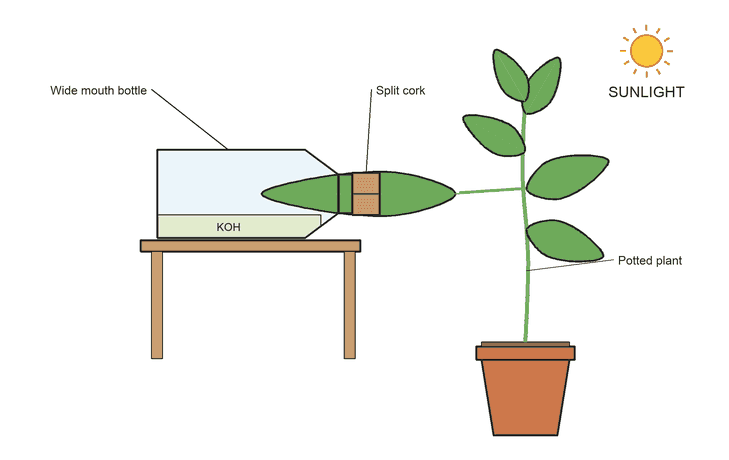
In order to prove that carbon dioxide is necessary for (a) ............... , a potted plant is placed in dark for 48 hours to (b) ............... the leaves. A part of a leaf is inserted into a conical flask containing potassium hydroxide solution. This is to absorb (c) ............... from the flask. The plant is then placed in sunlight for a few hours. The experimental leaf is tested for starch. The part of the leaf that was inside the conical flask turns (d) ............... , whereas the part of the leaf outside turns (e) ............... in colour.
Solve with AIWritten solution
Solution:
Concept: Potassium hydroxide absorbs carbon dioxide, so the part of the leaf inside the vessel gets no carbon dioxide, while the part outside gets it from the air.
Step 1 — Blanks (a) and (b): the aim and the preparation.
The experiment proves that carbon dioxide is necessary for (a) photosynthesis. The plant is kept in the dark for 48 hours to (b) destarch the leaves, so that any starch found later was made during the experiment.
Step 2 — Blank (c): the job of the potassium hydroxide.
The solution is there to absorb (c) carbon dioxide from the air inside the vessel.
Step 3 — Blanks (d) and (e): the colours.
The part inside had no carbon dioxide, made no starch and turns (d) brown (iodine's own colour); the part outside made starch and turns (e) blue-black.
Watch out: The part inside had no carbon dioxide, so it made no starch and stays brown; only the part outside turns blue-black.
Note: The paragraph says 'conical flask' while the figure shows a wide mouth bottle; either vessel works the same way, as long as it is closed by the split cork and holds potassium hydroxide.
Therefore, (a) photosynthesis, (b) destarch, (c) carbon dioxide, (d) brown, (e) blue-black.
- 281 mark
Question 28
Match the items given in Column I with most appropriate ones in Column II and rewrite the correct matching pairs:
Column I: (b) Stoma
Column II: Lack of thyroxine in children; 12 pairs; Testosterone; Diffusion of respiratory gases; Haploid cells; 31 Pairs; Diploid cells
Solve with AIWritten solution
Solution:
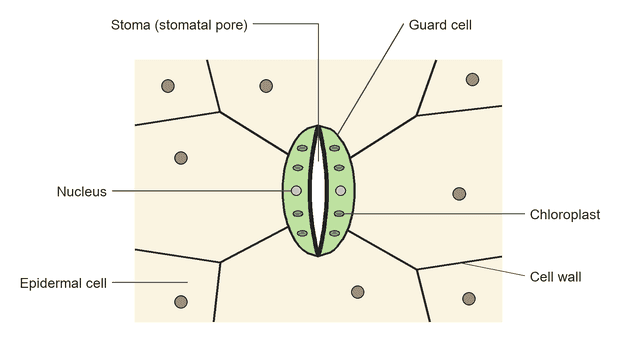
Concept: Stomata are minute pores in the epidermis of leaves through which gases pass in and out.
Step 1 — Pick the matching item.
Of the items in Column II, only diffusion of respiratory gases belongs to a stoma.
Step 2 — Say why.
Oxygen and carbon dioxide diffuse into and out of the leaf through the open stomata; in light they let in the carbon dioxide needed for photosynthesis.
Therefore, the matching pair is Stoma — Diffusion of respiratory gases.
- 291 mark
Question 29
Expand the abbreviation-NADP.
Solve with AIWritten solution
Solution:
Concept: NADP is the compound that picks up hydrogen in the light-dependent phase of photosynthesis.
Step 1 — Expand the abbreviation.
NADP stands for Nicotinamide adenine dinucleotide phosphate.
Step 2 — Recall its role.
It picks up hydrogen released by the splitting of water to form NADPH, which carries the hydrogen to the stroma to make glucose.
Therefore, NADP is nicotinamide adenine dinucleotide phosphate.
- 303 marks
Question 30
Draw a neat, labelled diagram of a chloroplast.
Solve with AIWritten solution
Solution:
Concept: A chloroplast is bounded by a double membrane (the chloroplast envelope). Inside, flattened sacs called thylakoids are piled into stacks called grana (singular granum), joined by frets, and lie in a colourless ground substance, the stroma. Chlorophyll is held in the thylakoid membranes.
Step 1 — Draw the outline.
Draw an oval body bounded by two membranes, the outer and the inner membrane of the chloroplast envelope.
Step 2 — Draw the inside.
Draw several piles of flattened sacs (grana) lying in the ground substance (stroma), joined by thin connecting bars (frets), and label every part.
Step 3 — Know what each part does.
Each label has a job.
- Thylakoids: flattened sacs whose membranes hold chlorophyll.
- Granum: a pile of thylakoids; the light reaction takes place here.
- Fret (stroma lamella): the bar joining one granum to another.
- Stroma: the ground substance in which the grana lie; the light-independent reaction takes place here.
Watch out: Label BOTH membranes of the envelope, and show the grana as piles of discs, not single lines.
Therefore, the labelled chloroplast shows the outer and inner membranes, grana made of thylakoids, frets and the stroma.
- 311 mark
Question 31
The optimum temperature for photosynthesis is:
Solve with AIAnswer
(A) 10 – 15°C
(B) 60 – 65°C
(C) 40 – 45°C
- Correct
(D) 25 – 35°C
Answer: (D) 25 – 35°C
Concept: The reactions of photosynthesis are controlled by enzymes, so the rate rises with temperature up to an optimum and then falls as heat damages the enzymes.
Step 1 — Follow the rise.
Between about 10 °C and 35 °C the rate keeps rising; a 10 °C rise roughly doubles it.
Step 2 — Find the best range.
The rate is highest at about 25 – 35 °C, so this is the optimum temperature range for most plants.

Step 3 — Follow the fall.
Above this range the rate falls, and well above 40 °C it drops sharply because the enzymes are damaged by heat.
Why the other options are wrong:
- (A) 10 – 15°C: 10 – 15 °C is too cold; the enzymes work slowly and the rate is low.
- (B) 60 – 65°C: 60 – 65 °C is far too hot; the enzymes are destroyed and photosynthesis stops.
- (C) 40 – 45°C: 40 – 45 °C is past the optimum; the enzymes are being damaged and the rate falls sharply.
Therefore, the optimum temperature for photosynthesis is 25 – 35 °C, option (D).
- 321 mark
Question 32
Name the following:
(d) The physiological process which is the starting point of all food chains.
Solve with AIWritten solution
Solution:
Concept: A food chain always starts with a producer (a green plant or alga, which makes food by photosynthesis), then a herbivore that eats it, then carnivores, each eaten by the next.
Step 1 — Find what every food chain starts with.
Every food chain starts with a green plant that makes its own food.
Step 2 — Name the process.
The plant makes that food by photosynthesis: food (glucose and starch) from carbon dioxide and water using light energy. Herbivores eat the plants and carnivores eat the herbivores, so the energy of every chain enters through photosynthesis.
Therefore, the physiological process is photosynthesis.
- 331 mark
Question 33
Arrange the terms in each group in the correct order. Write them in a logical sequence beginning with the term that is underlined.
(a) Palisade cells, , Upper epidermis, Spongy cells.
Solve with AIWritten solution
Solution:
Concept: Light passes down through a leaf from its upper surface, layer by layer.
Step 1 — Start at the underlined layer.
The cuticle is the thin, waxy, waterproof layer on top.
Step 2 — Go down through the leaf.
Below it lies the transparent upper epidermis, then the tall, closely packed palisade cells (the main site of photosynthesis), and then the loosely arranged spongy cells with air spaces.
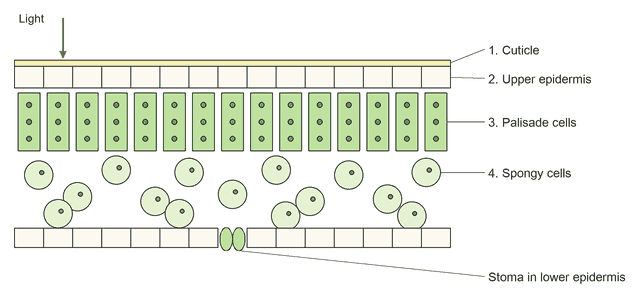
Therefore, the sequence is Cuticle → Upper epidermis → Palisade cells → Spongy cells.
- 341 mark
Question 34
Write the overall chemical equation for photosynthesis.
Solve with AIWritten solution
Solution:
Concept: Carbon dioxide and water combine, using light energy trapped by chlorophyll, to form glucose; oxygen and water are given out.
Step 1 — Write the equation.
Put the raw materials on the left, the conditions over the arrow and the products on the right.
Step 2 — Check that it balances.
Count the atoms: 6 carbon, 24 hydrogen and 24 oxygen on each side, so the equation is balanced.
Watch out: Write 12 H₂O on the left and 6 H₂O on the right; all the oxygen given out comes from water.
Therefore, the overall equation is 6CO₂ + 12H₂O → C₆H₁₂O₆ + 6H₂O + 6O₂ (light energy, chlorophyll).
- 352 marks
Question 35
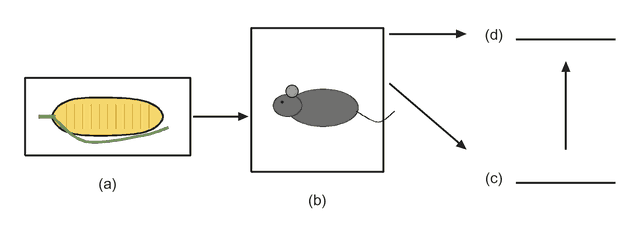
Complete the food chain by mentioning the names of the organisms in (c) and (d):
 Solve with AI
Written solution
Solution:
Concept: A food chain always starts with a producer (a green plant or alga, which makes food by photosynthesis), then a herbivore that eats it, then carnivores, each eaten by the next.
Step 1 — Read the figure.
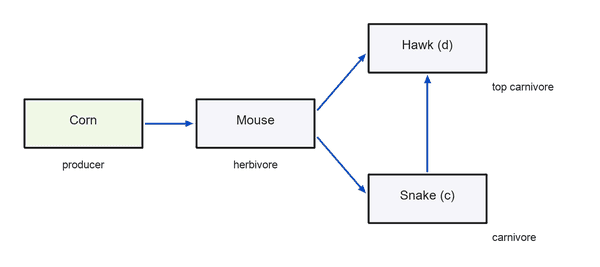
Corn (a) is the producer and the mouse (b) is the herbivore. The arrows show that (c) eats the mouse, and (d) eats both the mouse and (c), so (d) is the top carnivore.
Step 2 — Name the organisms.
A snake eats mice, and a hawk eats both snakes and mice, so (c) is the snake and (d) is the hawk (an eagle or owl also fits).
Watch out: (d) must eat BOTH the mouse and (c), so it is the top carnivore.
Therefore, (c) is a snake and (d) is a hawk: Corn → Mouse → Snake → Hawk.
- 363 marks
Question 36
Draw a neat, labelled diagram to show that oxygen is released during photosynthesis.
Solve with AIWritten solution
Solution:
Concept: A water plant such as Hydrilla gives off bubbles of oxygen in sunlight; collected in a test tube, the gas makes a glowing splinter burst into flame.
Step 1 — Set up the apparatus.
Place Hydrilla in a beaker of pond water and cover it with a short-stemmed inverted funnel, kept off the bottom by small supports so that water can circulate. Invert a test tube full of water over the funnel stem, with the stem below the water level.
Step 2 — Observe.
In sunlight, bubbles of gas rise and collect at the top of the test tube, pushing the water down.
Step 3 — Test the gas.
A glowing splinter brought to the gas bursts into flame, showing that the gas is oxygen.
Watch out: The test tube must be completely full of water at the start, so that only the gas from the plant collects in it.
Therefore, the labelled set-up shows Hydrilla under an inverted funnel in pond water, with the oxygen it releases collecting in the test tube.
- 371 mark
Question 37
Read the explanations given below and name the structures:
Example: A cord that connects the placenta with the foetus.
Answer: Umbilical cord
(c) The part of the chloroplast where the light independent phase occurs.
Solve with AIWritten solution
Solution:
Concept: Photosynthesis has two phases: the light-dependent (photochemical) phase in the thylakoids of the grana, where light splits water and ATP and NADPH are formed, and the light-independent (biosynthetic) phase in the stroma, where carbon dioxide is turned into glucose using that ATP and NADPH.
Step 1 — Recall what the light-independent phase does.
It uses carbon dioxide, ATP and NADPH to make glucose.
Step 2 — Name its site.
This takes place in the stroma, the colourless ground substance of the chloroplast in which the grana lie.
Therefore, the structure is the stroma.
- 382 marks
Question 38
Distinguish between stoma and stroma.
Solve with AIWritten solution
Solution:
Concept: The two words look alike but name very different things: a stoma is a pore in a leaf; the stroma is the ground substance inside a chloroplast.
Step 1 — Compare what and where.
Set the two side by side.
Stoma Stroma A minute pore in the epidermis of a leaf (mostly on the lower surface), surrounded by two guard cells. The colourless ground substance inside a chloroplast, in which the grana lie. Lets carbon dioxide and oxygen pass into and out of the leaf; water vapour is lost through it in transpiration. Site of the light-independent reaction of photosynthesis, where glucose is made. Step 2 — See them in the figures.
The first figure shows a stoma between its guard cells; the second shows the stroma inside a chloroplast.
Therefore, a stoma is a pore in the leaf epidermis for gas exchange, while the stroma is the ground substance of the chloroplast where glucose is made.
- 393 marks
Question 39
The Amazon rain forest is referred to as the ‘Lungs of the Earth’. It plays an important role in climate regulation through photosynthesis. However, this delicate ecosystem is facing threats from deforestation, climate change and human encroachment which can lead to irreversible environmental consequences.

(a) How does photosynthesis contribute to the Amazon rain forests’ reputation as the ‘Lungs of the Earth’?
(b) In what way is the environment affected by deforestation?
(c) Name the pigment that captures the light energy during photosynthesis.
Solve with AIWritten solution
Solution:
Concept: Green plants take in carbon dioxide and give out oxygen in photosynthesis; a vast forest does this on a huge scale.
Step 1 — (a) Why the forest is called the 'Lungs of the Earth'.
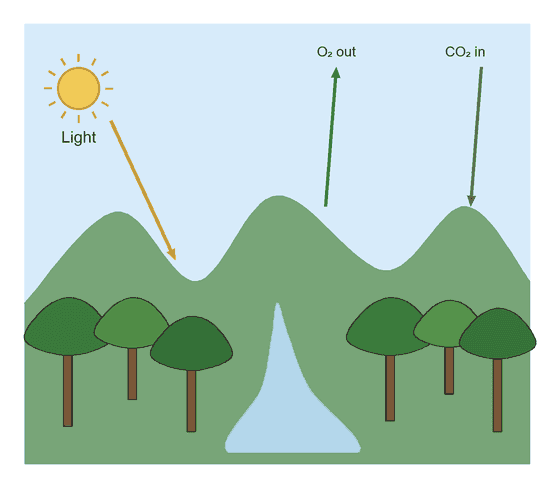
The dense vegetation of the Amazon carries out photosynthesis on a vast scale: it absorbs large amounts of carbon dioxide from the air and releases large amounts of oxygen, much as lungs exchange gases. This helps keep the balance of oxygen and carbon dioxide in the air and helps regulate the climate.
Step 2 — (b) Effect of deforestation.
Cutting the forest removes this exchange and the protection the trees give.
- More carbon dioxide stays in the air (and burning trees adds more), increasing global warming.
- Less oxygen is released by photosynthesis.
- Without roots to hold it, the soil is eroded, and floods become more likely.
- Less water vapour is given off by the trees, so rainfall decreases; plants and animals lose their habitat, reducing biodiversity.
Step 3 — (c) Pigment that captures light.
The green pigment chlorophyll in the chloroplasts captures the light energy; it absorbs mainly blue and red light.
Note: a mature forest also uses much of the oxygen it makes (in the respiration of its plants, animals and decomposers), so the nickname refers mainly to its huge photosynthesis and carbon uptake.
Therefore, (a) the forest takes in huge amounts of carbon dioxide and gives out oxygen by photosynthesis, (b) deforestation raises carbon dioxide, causes erosion and loss of habitat, and (c) the pigment is chlorophyll.
- 402 marks
Question 40
Divya performed an experiment on photosynthesis. At the end of the experiment, she tested the experimental leaf for the presence of starch. During the starch test she first boiled the leaf in water and then in methylated spirit.
(a) Why did she boil the leaf in water?
(b) Mention the reason why she then boiled the leaf in methylated spirit.
Solve with AIWritten solution
Solution:
Concept: In the starch test a leaf is boiled in water (to kill it), warmed in methylated spirit over a water bath (to remove chlorophyll), softened in warm water and then covered with iodine solution: parts with starch turn blue-black, parts without starch stay brown (the colour of iodine).
Step 1 — (a) Why boil the leaf in water.
Boiling in water kills the cells, so all chemical reactions stop (no starch is used up or made) and the cell membranes let the next solutions in.
Step 2 — (b) Why boil it in methylated spirit.
The spirit removes the chlorophyll (decolourises the leaf). The green colour would hide the colour change with iodine; once the leaf is pale white, the blue-black colour of starch shows clearly. The spirit is heated over a water bath, because it catches fire easily.
Therefore, boiling in water kills the leaf cells, and boiling in methylated spirit removes the chlorophyll so that the iodine result can be seen.
- 411 mark
Question 41
State the overall chemical equation for photosynthesis.
Solve with AIWritten solution
Solution:
Concept: Carbon dioxide and water combine, using light energy trapped by chlorophyll, to form glucose; oxygen and water are given out.
Step 1 — Write the equation.
Put the raw materials on the left, the conditions over the arrow and the products on the right.
Step 2 — Check that it balances.
Count the atoms: 6 carbon, 24 hydrogen and 24 oxygen on each side, so the equation is balanced.
Watch out: Write 12 H₂O on the left and 6 H₂O on the right; all the oxygen given out comes from water.
Therefore, the overall equation is 6CO₂ + 12H₂O → C₆H₁₂O₆ + 6H₂O + 6O₂ (light energy, chlorophyll).
- 422 marks
Question 42
Arrange the following food chains in a proper sequence.
(a) Small fish, Algae, Mosquito larvae, Kingfisher
(b) Frog, Snail, Crow, Green leaves
Solve with AIWritten solution
Solution:
Concept: A food chain always starts with a producer (a green plant or alga, which makes food by photosynthesis), then a herbivore that eats it, then carnivores, each eaten by the next.
Step 1 — Chain (a).
Algae make food by photosynthesis; mosquito larvae feed on algae; small fish eat the larvae; the kingfisher eats the small fish.
Step 2 — Chain (b).
Green leaves are the producer; the snail eats leaves; the frog eats the snail; the crow eats the frog.
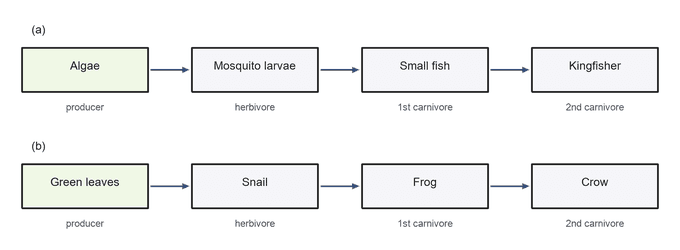
Therefore, (a) Algae → Mosquito larvae → Small fish → Kingfisher and (b) Green leaves → Snail → Frog → Crow.
- 432 marks
Question 43
Sara placed a healthy potted plant in a dark room for 48 hours to perform an experiment on photosynthesis. She plucked one of the leaves and tested it for starch. The leaf did not turn blue-black on adding Iodine solution.
(a) Why was the plant placed in the dark for 48 hours?
(b) What is the significance of boiling the leaf in alcohol during the starch test?
Solve with AIWritten solution
Solution:
Concept: A plant is destarched by keeping it in the dark for 24 to 48 hours: with no light it cannot photosynthesise, so the starch already in its leaves is used up or moved away. Any starch found later must have been made during the experiment.
Step 1 — (a) Why the plant was kept in the dark.
In the dark the plant cannot photosynthesise, so the starch already in its leaves is used up or moved away: the leaves are destarched. That is why Sara's leaf did not turn blue-black with iodine. Any starch found in a later experiment must then have been made during that experiment.
Step 2 — (b) Why the leaf is boiled in alcohol.
Boiling in alcohol (methylated spirit) removes the chlorophyll and makes the leaf pale white, so the blue-black colour of starch (or the brown colour of iodine) can be seen clearly. It is done over a water bath, because alcohol catches fire easily.
Therefore, the plant was kept in the dark to destarch its leaves, and alcohol removes the chlorophyll so that the iodine result is visible.
- 441 mark
Question 44
Write the overall chemical equation for photosynthesis.
Solve with AIWritten solution
Solution:
Concept: Carbon dioxide and water combine, using light energy trapped by chlorophyll, to form glucose; oxygen and water are given out.
Step 1 — Write the equation.
Put the raw materials on the left, the conditions over the arrow and the products on the right.
Step 2 — Check that it balances.
Count the atoms: 6 carbon, 24 hydrogen and 24 oxygen on each side, so the equation is balanced.
Watch out: Write 12 H₂O on the left and 6 H₂O on the right; all the oxygen given out comes from water.
Therefore, the overall equation is 6CO₂ + 12H₂O → C₆H₁₂O₆ + 6H₂O + 6O₂ (light energy, chlorophyll).
- 452 marks
Question 45
Expand the abbreviations:
(a) NADP
(b) ADP
Solve with AIWritten solution
Solution:
Concept: Both compounds take part in the light-dependent phase of photosynthesis.
Step 1 — (a) Expand NADP.
NADP stands for Nicotinamide adenine dinucleotide phosphate; it picks up hydrogen to form NADPH.
Step 2 — (b) Expand ADP.
ADP stands for Adenosine diphosphate; it gains a phosphate group, using light energy, to form ATP (adenosine triphosphate).
Therefore, NADP is nicotinamide adenine dinucleotide phosphate and ADP is adenosine diphosphate.
- 461 mark
Question 46
Which one of the following does NOT affect the rate of photosynthesis?
Solve with AIAnswer
- Correct
(A) Oxygen
(B) Carbon dioxide
(C) Water
(D) Temperature
Answer: (A) Oxygen
Concept: The factors the syllabus lists for the rate of photosynthesis are light intensity, carbon dioxide concentration, temperature and water; oxygen is a product of photosynthesis, not one of these factors.
Step 1 — Check the raw materials.
Carbon dioxide and water are the raw materials, so a shortage of either slows photosynthesis.
Step 2 — Check temperature.
Temperature controls the enzymes: the rate rises up to the optimum and falls above it.
Step 3 — Check oxygen.
Oxygen is given out as a by-product; it is not one of the listed factors, so it is the answer.
Note: Strictly, a very high oxygen concentration can slightly lower the rate (by photorespiration), but oxygen is not one of the factors studied at this level, so the printed key, oxygen, stands.
Why the other options are wrong:
- (B) Carbon dioxide: carbon dioxide is a raw material; raising its concentration (up to a limit) increases the rate.
- (C) Water: water is a raw material; a shortage also makes the stomata close and cuts the intake of carbon dioxide, so the rate drops.
- (D) Temperature: temperature affects the enzymes; the rate rises up to the optimum and falls at higher temperatures.
Therefore, oxygen is the option that does not affect the rate of photosynthesis, option (A).
- 471 mark
Question 47
Assertion (A): Plants growing in shade tend to have larger leaves.
Reason (R): This is because they need to capture more sunlight for photosynthesis.
Solve with AIAnswer
(A) (A) is true and (R) is false.
(B) (A) is false and (R) is true.
- Correct
(C) Both (A) and (R) are true and (R) is the correct explanation of (A).
(D) Both (A) and (R) are true, but (R) is not the correct explanation of (A).
Answer: (C) Both (A) and (R) are true and (R) is the correct explanation of (A).
Concept: In an assertion–reason item, judge the Assertion (A) and the Reason (R) separately as true or false; only when both are true do we ask whether R correctly explains A. A large leaf surface absorbs more light.
Step 1 — Judge the Assertion.
A is true. Plants (and leaves) growing in shade tend to have larger, broader and thinner leaves than those growing in full sun.
Step 2 — Judge the Reason.
R is true. In shade the light is dim, so a larger leaf surface catches more of the little light available for photosynthesis.
Step 3 — Decide whether R explains A.
The leaves are larger because the plant must capture more of the limited light, so R is the correct explanation of A: option (C).
Why the other options are wrong:
- (A) (A) is true and (R) is false: R is true: a larger leaf area does trap more light, so 'R is false' is wrong.
- (B) (A) is false and (R) is true: A is true: shade plants do tend to have larger leaves.
- (D) Both (A) and (R) are true, but (R) is not the correct explanation of (A): capturing more light is the very reason for the larger leaves, so R does explain A.
Therefore, both A and R are true and R is the correct explanation of A, option (C).
- 483 marks
Question 48
Draw a neat, labelled diagram of the cell organelle which is responsible for photosynthesis and label the following parts:
(a) Stroma
(b) Grana
Solve with AIWritten solution
Solution:
Concept: A chloroplast is bounded by a double membrane (the chloroplast envelope). Inside, flattened sacs called thylakoids are piled into stacks called grana (singular granum), joined by frets, and lie in a colourless ground substance, the stroma. Chlorophyll is held in the thylakoid membranes.
Step 1 — Name the organelle.
Photosynthesis takes place in the chloroplast.
Step 2 — Draw and label it.
Draw an oval body with a double membrane; inside, draw piles of discs (grana) lying in the ground substance (stroma), joined by frets.
Step 3 — Label the two parts asked for.
Write what each part is.
- (a) Stroma: the colourless ground substance of the chloroplast, in which the grana lie; the light-independent reaction takes place here, forming glucose.
- (b) Grana: piles of flattened sacs (thylakoids) whose membranes hold chlorophyll; the light reaction (photolysis of water, formation of ATP and NADPH) takes place here.
Therefore, the organelle is the chloroplast, with the grana (piles of thylakoids) lying in the stroma.
- 492 marks
Question 49
Arrange the following food chains in a proper sequence beginning with the term that is underlined:
(a) , Eagle, Fox, Rat
(b) , Crow, Bee, Lizard
Solve with AIWritten solution
Solution:
Concept: A food chain always starts with a producer (a green plant or alga, which makes food by photosynthesis), then a herbivore that eats it, then carnivores, each eaten by the next.
Step 1 — Chain (a).
Start at the underlined corn: the rat eats corn, the fox eats the rat and the eagle, a top predator, can prey on the fox.
Step 2 — Chain (b).
Start at the underlined nectar, made by flowers: the bee feeds on nectar, the lizard eats the bee and the crow eats the lizard.

Watch out: A fox does not prey on eagles, so the eagle comes last in chain (a).
Therefore, (a) Corn → Rat → Fox → Eagle and (b) Nectar → Bee → Lizard → Crow.