Solution:
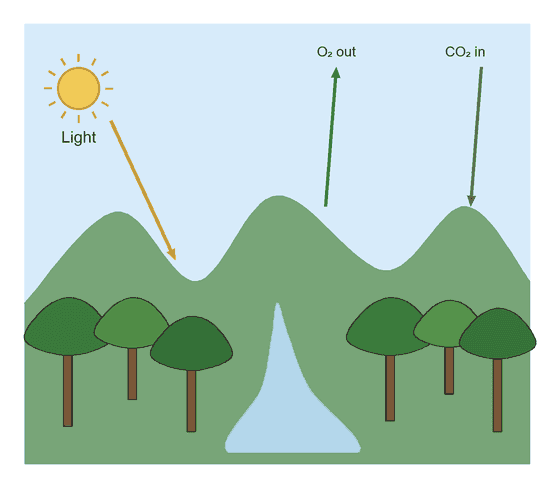
Concept: Green plants take in carbon dioxide and give out oxygen in photosynthesis; a vast forest does this on a huge scale.
Step 1 — (a) Why the forest is called the 'Lungs of the Earth'.
The dense vegetation of the Amazon carries out photosynthesis on a vast scale: it absorbs large amounts of carbon dioxide from the air and releases large amounts of oxygen, much as lungs exchange gases. This helps keep the balance of oxygen and carbon dioxide in the air and helps regulate the climate.
Step 2 — (b) Effect of deforestation.
Cutting the forest removes this exchange and the protection the trees give.
- More carbon dioxide stays in the air (and burning trees adds more), increasing global warming.
- Less oxygen is released by photosynthesis.
- Without roots to hold it, the soil is eroded, and floods become more likely.
- Less water vapour is given off by the trees, so rainfall decreases; plants and animals lose their habitat, reducing biodiversity.
Step 3 — (c) Pigment that captures light.
The green pigment chlorophyll in the chloroplasts captures the light energy; it absorbs mainly blue and red light.
Note: a mature forest also uses much of the oxygen it makes (in the respiration of its plants, animals and decomposers), so the nickname refers mainly to its huge photosynthesis and carbon uptake.
Therefore, (a) the forest takes in huge amounts of carbon dioxide and gives out oxygen by photosynthesis, (b) deforestation raises carbon dioxide, causes erosion and loss of habitat, and (c) the pigment is chlorophyll.

