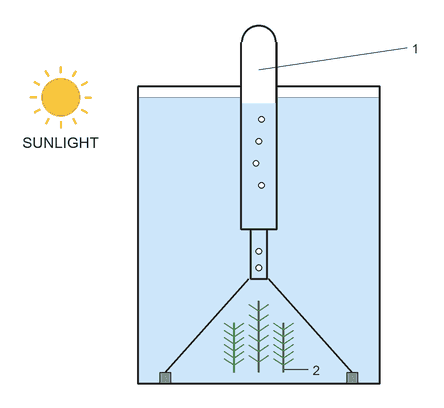
The following diagram demonstrates a physiological process taking place in green plants.
Question 25 marksAsked 2016Medium
The following diagram demonstrates a physiological process taking place in green plants. The whole set up was placed in bright sunlight for several hours. Study the diagram and answer the questions that follow:
(i) What aspect of the physiological process is being examined?
(ii) Explain the physiological process mentioned in (i) above.
(iii) Label the parts numbered 1 and 2 in the diagram.
(iv) Write a well-balanced chemical equation for the physiological process explained in (ii) above.
(v) What would happen to the rate of bubbling of the gas if a pinch of sodium bicarbonate is added to the water in the beaker? Explain your answer.
Solution:
Concept: A green water plant kept in sunlight gives off bubbles of gas; collecting that gas and testing it shows which gas photosynthesis releases.
Step 1 — (i) Aspect being examined.
The water plant gives off bubbles of gas in sunlight and the gas collects in the test tube, so the experiment shows that oxygen is given out (evolved) during photosynthesis.
Step 2 — (ii) The process explained.
In this set-up the Hydrilla uses carbon dioxide dissolved in the water and light energy from the sun. Photosynthesis is the process by which living plant cells containing chlorophyll make food (glucose, stored as starch) from carbon dioxide and water, using light energy; oxygen is given out as a by-product.
Chlorophyll in the thylakoids absorbs light energy and becomes activated. This energy splits water into hydrogen ions, electrons and oxygen (photolysis); the oxygen is given out. The hydrogen is picked up by NADP to form NADPH, and energy is stored by turning ADP into ATP (photophosphorylation).
Using the energy of ATP, the hydrogen carried by NADPH is combined with carbon dioxide to form glucose.
The oxygen rises as bubbles through the funnel stem and collects at the top of the test tube, pushing the water down. A glowing splinter held in this gas bursts into flame, which shows that the gas is oxygen.
Step 3 — (iii) Labels 1 and 2.
Part 1 is the gas at the top of the test tube and part 2 is the plant under the funnel.
1 — Oxygen gas (collected at the top of the test tube)
2 — Hydrilla (an aquatic plant, under the inverted funnel)
Step 4 — (iv) Balanced chemical equation.
The overall equation, with chlorophyll and light energy written over the arrow, is:
Each side has 6 carbon, 24 hydrogen and 24 oxygen atoms, so it is balanced.
Step 5 — (v) Adding a pinch of sodium bicarbonate.
The rate of bubbling increases. Sodium bicarbonate adds carbon dioxide to the water; carbon dioxide is a raw material of photosynthesis, so the plant photosynthesises faster and gives off more oxygen.
Watch out: The gas collected is oxygen (it relights a glowing splinter), not carbon dioxide.
Therefore, the experiment shows that oxygen is evolved in photosynthesis; 1 = oxygen, 2 = Hydrilla; the rate of bubbling rises when sodium bicarbonate supplies more carbon dioxide.