Solution:
Concept: The rate of photosynthesis depends on light intensity, carbon dioxide concentration and temperature; each helps only up to a limit, after which another factor limits the rate.
Step 1 — Statement (a): light intensity.
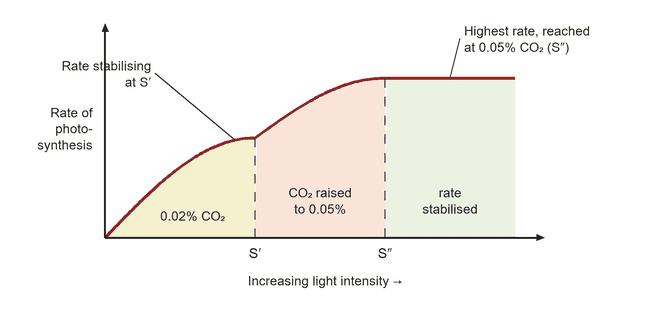
(a) False. As light intensity rises, the rate rises only up to a limit and then stabilises, because carbon dioxide becomes the limiting factor. It rises again only if more CO2 is given.
Step 2 — Statements (b) and (c): temperature.
(b) False. Temperature has a clear effect: the rate rises up to the optimum of 35 °C, then falls, and photosynthesis stops a little above 40 °C.
(c) False. Ice-cold water makes the enzymes of photosynthesis inactive (cause), so photosynthesis stops or almost stops even in bright sunshine (effect).
Step 3 — Statements (d) and (e): light and the dark phase.
(d) False. Destarching needs only the absence of light. A plant kept in a dark room for 24 to 48 hours is destarched whether it is day or night outside.
(e) False. The dark reaction does not need darkness; it only does not depend on light. In continuous light it goes on, using the NADPH and ATP of the light reaction.
Step 4 — Statement (f): importance.
(f) True. Photosynthesis is the ultimate source of food for all living beings and the only biological process that releases oxygen into the air.
Watch out: "dark reaction" means "light-independent", not "needs darkness".
Therefore, (a) to (e) are false and (f) is true.
