
Opening your dashboard
Class 10 Biology Chapter 6 Photosynthesis: Practice Questions
44 questions on Chapter 6, each worked through on its own page with the AI tutor. Class 10 Biology, ICSE 2026-27.
44 questions
1–5 marks · Mixed difficulty
- 11 mark
Question 1
Bloom's level: Remember
Photosynthesis is often called the most significant life process because it provides :
- 21 mark
Question 2
Bloom's level: Remember
In the light-dependent phase, the hydrogen ions released by the splitting of water are picked up by :
- 31 mark
Question 3
Bloom's level: Remember
Organisms that cannot make their own food and obtain it from plants, directly or by eating plant-eaters, are called :
- 41 mark
Question 4
Bloom's level: Remember
Apart from respiration, decay and the burning of fuels, carbon dioxide is also returned to the air in the carbon cycle by :
- 51 mark
Question 5
Bloom's level: Understand
According to the potassium ion theory, the guard cells become turgid in daylight because :
- 61 mark
Question 6
Bloom's level: Understand
Grass growing in the shade under a large stone turns yellowish. This is because :
- 71 mark
Question 7
Bloom's level: Understand
Pick the correct description of what a green leaf does with the sunlight it absorbs while making food :
- 81 mark
Question 8
Bloom's level: Apply
A crop is grown in soil that is short of magnesium and nitrogen, and its leaves turn pale yellow. Its rate of photosynthesis falls mainly because :
- 91 mark
Question 9
Bloom's level: Apply
The oxygen-collecting set-up with Hydrilla under a funnel and an inverted test tube is kept in a dark cupboard instead of in the sun.

After a few hours, the test tube will most likely have :
- 101 mark
Question 10
Bloom's level: Analyse
Assertion (A): The light-independent phase stops very soon after a plant is placed in darkness.
Reason (R): The light-independent phase uses the ATP and NADPH produced in the light-dependent phase.
- 111 mark
Question 11
Bloom's level: Evaluate
Assertion (A): A wilting plant photosynthesises less, even in bright light.
Reason (R): Only about 1% of the water absorbed by the roots is used in photosynthesis.
- 121 mark
Question 12
Bloom's level: Understand
Assertion (A): Oleander (Nerium) has narrow leaves.
Reason (R): Leaves usually have a large surface area for maximum absorption of light.
- 132 marks
Question 13
Bloom's level: Understand
The cells of a carrot root are living, yet they cannot photosynthesise, whereas the guard cells of a leaf can. Explain why.
- 142 marks
Question 14
Bloom's level: Understand
Explain why transpiration is said to be the price which the plant pays for photosynthesis.
- 152 marks
Question 15
Bloom's level: Understand
Explain why the palisade cells of a leaf trap more light energy than the spongy cells.
- 162 marks
Question 16
Bloom's level: Apply
Use the overall equation of photosynthesis :
If a leaf uses 132 g of carbon dioxide, find the mass of glucose formed and the mass of oxygen given out. (C = 12, H = 1, O = 16)
- 172 marks
Question 17
Bloom's level: Apply
A money plant is kept indoors near a window. After a few days, most of its leaves have turned so that their flat surfaces face the window. Which adaptation of leaves for photosynthesis does this show, and how does it help ?
- 182 marks
Question 18
Bloom's level: Apply
A healthy potted plant is kept for a week in a closed room lit only by a green lamp. Predict how well it will photosynthesise, and give the reason.
- 192 marks
Question 19
Bloom's level: Apply
Coal was formed millions of years ago from buried plants. When a power station burns coal, carbon dioxide goes into the air. Using the carbon cycle, explain how this carbon first got into the coal and how it returns to the air.
- 202 marks
Question 20
Bloom's level: Analyse
The rate of photosynthesis of a water plant was measured at different light intensities, at two carbon dioxide concentrations :
Light intensity (units) 1 2 3 4 5 Rate at 0.02% 10 20 28 30 30 Rate at 0.05% 10 20 30 40 45 Which factor limits the rate (a) at light intensity 1–2, and (b) at light intensity 4–5 with 0.02% carbon dioxide ? Give a reason from the data for each.
- 212 marks
Question 21
Bloom's level: Analyse
In a laboratory, the thylakoids of chloroplasts are separated from the stroma. The thylakoids are kept in water in bright light; the stroma is kept with carbon dioxide in bright light. Analyse which of the two will give out oxygen and whether either will form glucose.
- 222 marks
Question 22
Bloom's level: Evaluate
To show that carbon dioxide is necessary for photosynthesis, Neha placed one whole destarched plant under a bell jar containing potassium hydroxide, and kept a different plant in the open as the control.
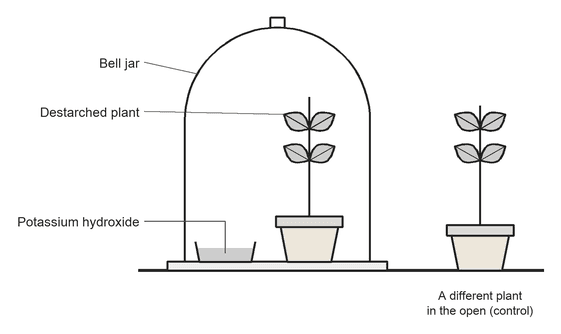
Evaluate her design and suggest a better one.
- 233 marks
Question 23
Bloom's level: Apply
A scientist can "tag" oxygen atoms so that they can be traced. A water plant is given water whose oxygen atoms are tagged, and ordinary carbon dioxide, and is kept in light.
(a) In which product of photosynthesis will the tagged oxygen appear ?
(b) If instead the carbon dioxide were tagged and the water ordinary, would the oxygen gas given out be tagged ? Explain.
(c) Write the equation for the step that explains your answer to (a), and name the step.
- 244 marks
Question 24
Bloom's level: Apply
Case: Simran grows lettuce in a glass greenhouse. On winter days the temperature inside is , the light is bright, and the plants photosynthesise at 6 units. She installs a heater.
(a) A rise of up to the optimum doubles the rate of photosynthesis. Predict the rate at and at .
(b) Her helper suggests heating the greenhouse to "to make the plants grow even faster". What will actually happen ? Why ?
(c) At and bright light, the rate stops rising. Suggest one more change that could raise it, with a reason.
- 253 marks
Question 25
Bloom's level: Apply
Glucose is made in the leaves of a potato plant, but food is stored in its underground tubers.
(a) Why is the glucose changed into starch in the leaf during the day ?
(b) In what form, and through which tissue, does the food travel to the tuber at night ?
(c) Name the process by which it is stored again in the tuber, and state two other ways in which the plant uses glucose.
- 264 marks
Question 26
Bloom's level: Analyse
Case: Kabir set up a sealed glass terrarium with mosses, ferns and two snails, and placed it near a window. A sensor recorded the carbon dioxide in its air :
Time 6 a.m. 10 a.m. 2 p.m. 6 p.m. 10 p.m. 2 a.m. 6 a.m. (%) 0.048 0.036 0.024 0.026 0.034 0.042 0.048 (a) By what fraction did the carbon dioxide fall between 6 a.m. and 2 p.m. ? Which process caused the fall ?
(b) Explain why the carbon dioxide rose steadily through the night.
(c) The level at 6 a.m. on the second day is the same as on the first. What does this show about the movement of carbon inside the terrarium ?
- 273 marks
Question 27
Bloom's level: Analyse
Cuscuta (amarbel) is a plant with yellow, thread-like stems and no green leaves. It winds around other plants and sends tiny suckers into their stems.
(a) Can Cuscuta carry out photosynthesis ? Give a reason.
(b) How must it obtain its food ?
(c) A student writes: "All plants are autotrophs." Using Cuscuta, analyse what is wrong with this statement and rewrite it correctly.
- 284 marks
Question 28
Bloom's level: Evaluate
Case: A team planning a long space mission suggests growing green algae in transparent tanks inside the sealed spacecraft, lit by lamps, to keep the astronauts alive.
(a) State two ways in which the algae would help the astronauts.
(b) State one way in which the astronauts would help the algae.
(c) An engineer says the lamps can be switched off to save power, since "the algae will keep working anyway". Evaluate this claim.
- 295 marks
Question 29
Bloom's level: Create
Design an experiment, using Hydrilla, to find out whether red light or green light is better for photosynthesis.
(a) List the materials and describe your set-up, including what you will keep the same.
(b) State what you will count, and draw up a table with the kind of results you expect.
(c) State your conclusion, explain it using the properties of chlorophyll, and give one precaution.
- 305 marks
Question 30
Bloom's level: Create
Construct a concept map (flow chart) that summarises photosynthesis. It must show :
(a) The raw materials and how each reaches the chloroplast.
(b) The two phases, with the site of each and its main products.
(c) The end products and what the plant does with each.
- 311 mark
Question 31
Which one of the following elements is not a constituent of chlorophyll ?
- 321 mark
Question 32
Photosynthesis is the only biological process that :
- 331 mark
Question 33
Assertion (A): The light-independent phase of photosynthesis takes place only at night.
Reason (R): The reactions of the light-independent phase do not require light energy.
- 342 marks
Question 34
Answer the following on the basis of the potassium ion concentration theory.
(i) What happens to the potassium ions of the guard cells at night ? State the effect this has on the guard cells and on the stomatal pore.
(ii) Why do the guard cells bulge outwards, and not inwards, when they become turgid ?
- 352 marks
Question 35
(i) Write the equation for the photolysis of water. In which part of the chloroplast does photolysis occur ?
(ii) How many molecules of water must be split to release 6 molecules of oxygen ? How many hydrogen ions are formed at the same time, and by which compound are they picked up ?
- 362 marks
Question 36
Give a reason for each of the following features of a green leaf.
(i) The cuticle and the upper epidermis are transparent, and the chloroplasts are concentrated in the upper layers of the leaf.
(ii) The leaf is thin and has an extensive system of veins.
- 372 marks
Question 37
(i) What is the carbon cycle ?
(ii) Name the process by which the carbon present in each of the following is returned to the air as carbon dioxide : the dead remains of plants and animals, and coal.
- 384 marks
Question 38
The figure shows the internal structure of a cell organelle found in the mesophyll cells of a green leaf, as revealed by the electron microscope.
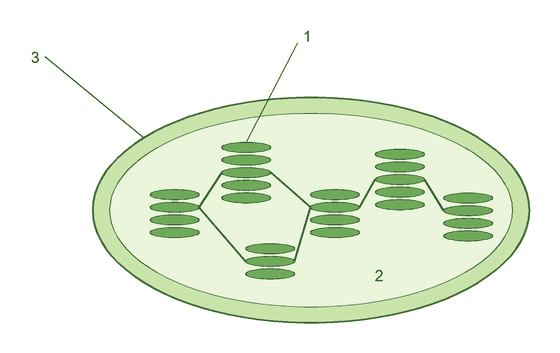
(i) Name the organelle and the parts numbered 1, 2 and 3.
(ii) Which of the numbered parts contains chlorophyll ? Name the phase of photosynthesis that takes place there, and any two substances produced in this phase.
(iii) Name the phase of photosynthesis that takes place in part 2. What happens to carbon dioxide in this phase ?
- 394 marks
Question 39
A potted plant with variegated leaves was kept in a dark room for 48 hours. A strip of black paper was then fixed across one of its leaves, covering both surfaces, as shown in the figure, and the plant was placed in the sun. After a few hours the leaf was plucked, the strip was removed and the leaf was tested for starch with iodine solution.
In the figure, 1 is the uncovered green part, 2 is the green part under the strip and 3 is the uncovered pale yellow part of the leaf.
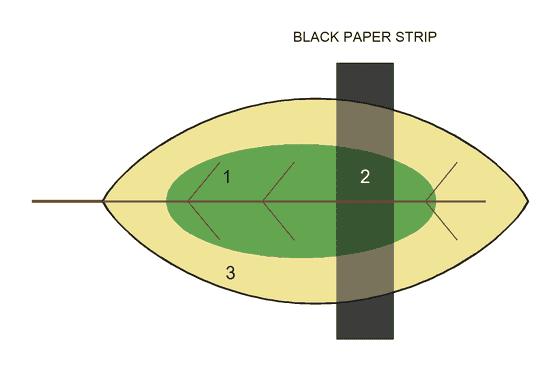
(i) Why was the plant first kept in a dark room ? What is a plant treated in this way called ?
(ii) State the colour of each of the parts 1, 2 and 3 after the iodine test.
(iii) Explain the results obtained in part 2 and in part 3.
- 403 marks
Question 40
A twig of Hydrilla kept in pond water in bright light gives off 8 bubbles of oxygen per minute when the water is at 15 °C. The number of bubbles given off per minute is taken as a measure of its rate of photosynthesis.
(i) If all the other factors remain favourable, how many bubbles per minute are expected at 25 °C and at 35 °C ? State the rule you have used.
(ii) What would happen to the rate if the water were warmed to 45 °C ? Give a reason.
(iii) At 35 °C, the rate stops rising at a certain point even when the light is made still brighter. Which other external factor should now be increased to raise the rate further ?
- 415 marks
Question 41
Class 10 Sample Paper 1 · Section B
Describe an experiment to test the presence of starch in a leaf.
- 421 mark
Question 42
Class 10 Sample Paper 2 · Section A
Name the following:
A mineral required for the synthesis of chlorophyll in plants.
- 431 mark
Question 43
Class 10 Sample Paper 2 · Section A
A destarched plant has
- 441 mark
Question 44
Class 10 Sample Paper 2 · Section A
Correct the following statement:
The light-dependent reactions of photosynthesis occur in the stroma of the chloroplast.