Solution:
Concept: Each reason links a step or an observation with what happens inside the leaf (cause → effect).
Step 1 — Part (a): placing the plant in the dark first.
Cause: in the dark for 24 to 48 hours no new starch is made, and the old starch is removed from the leaves (destarching).
Effect: any starch found at the end must have been made during the experiment, so the result can be trusted.
Step 2 — Part (b): respiration in sunlight.
Cause: in light the plant photosynthesises and respires at the same time, and the carbon dioxide given out in respiration is used at once in photosynthesis.
Effect: there is a net output of oxygen and no carbon dioxide can be detected, so respiration is masked by photosynthesis.
Step 3 — Part (c): the upper surface is greener and shinier.
Cause: the chloroplast-rich palisade cells lie just below the upper epidermis, and the upper surface has a thicker waxy cuticle.
Effect: more chlorophyll makes the upper surface greener, and the cuticle makes it shiny.
Step 4 — Part (d): the two boiling steps.
(1) Boiling in water kills the cells, so all reactions stop and the cells let the chemicals in.
(2) Boiling in methylated spirit (over a water bath) removes the chlorophyll; the leaf turns pale white and the blue-black colour of starch with iodine can be seen clearly.
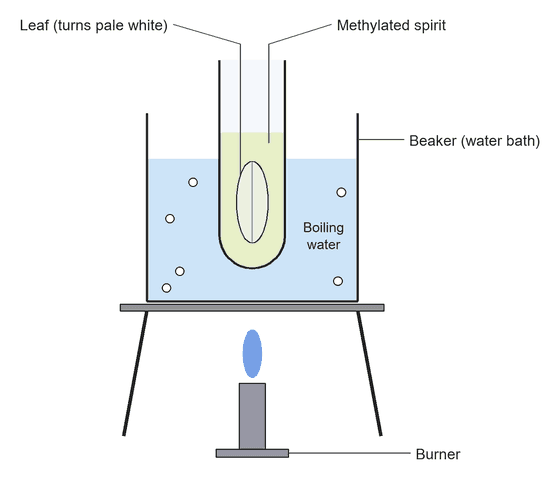
Therefore, (a) to destarch the leaves; (b) the CO₂ of respiration is used up in photosynthesis; (c) palisade cells and a thick cuticle lie on the upper side; (d) water kills the cells and methylated spirit removes the chlorophyll.
