Solution:
Concept: Photosynthesis needs chlorophyll, so only green cells can carry it out. A stoma opens when its two guard cells become turgid and closes when they become flaccid.
Step 1 — Parts (i) and (ii): which parts photosynthesise.
Only cells that contain chlorophyll can trap light energy and make food.
(i) No. Non-green parts, such as the roots and the woody stem, have no chlorophyll, so they cannot photosynthesise.
(ii) Yes. Every green part has chloroplasts: the mesophyll cells of the leaves, the guard cells of the stomata and the outer layers of young green stems.
Step 2 — Parts (iii) to (v): oxygen and chlorophyll.
(iii) Yes. Photosynthesis is the only biological process that releases oxygen into the atmosphere; respiration uses oxygen up.
(iv) Yes. Of the nine types of chlorophyll, chlorophyll-a and chlorophyll-b are the most abundant.
(v) Yes. Chlorophyll is sensitive to light, so very strong light can destroy it.
Step 3 — Part (vi): transpiration during photosynthesis.
In light the stomata are open to let carbon dioxide in. Water vapour escapes through the same open stomata, so transpiration goes on along with photosynthesis.
(vi) No.
Step 4 — Part (vii): what opens the stoma.
In sunlight water enters the guard cells, so they become turgid. Their thin outer walls stretch more than their thick inner walls, so the guard cells bow outwards and the pore between them opens. When they lose water they become flaccid and the pore closes.
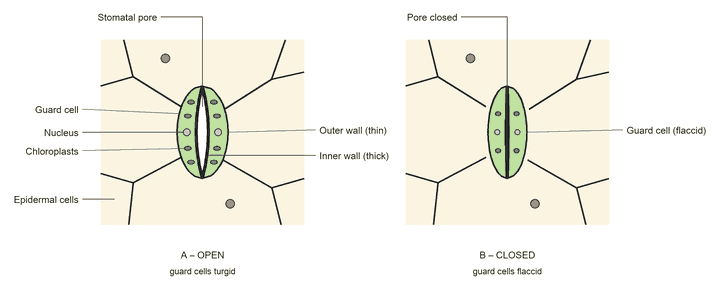
(vii) No. The guard cells turn turgid, not flaccid, to open the stomata.
Watch out: "all parts" and "all green parts" are different statements: roots belong to the plant but are not green.
Therefore, (i) No, (ii) Yes, (iii) Yes, (iv) Yes, (v) Yes, (vi) No, (vii) No.
