
Question 496 marksMedium
Describe the main chemical changes which occur during photosynthesis in
(i) Light reaction
(ii) Dark reaction
Confirming your payment
Sign up now and get 250 free tokens.
Photosynthesis · Question 49 of 63
Describe the main chemical changes which occur during photosynthesis in
(i) Light reaction
(ii) Dark reaction
Solution:
Concept: The light reaction uses light energy to make ATP, NADPH and oxygen; the dark reaction uses the ATP and NADPH to change carbon dioxide into glucose.
Step 1 — Light reaction: chlorophyll is activated.
In the thylakoids of the grana, chlorophyll absorbs photons and becomes activated.
Step 2 — Light reaction: photolysis and its products.
The energy splits water molecules:
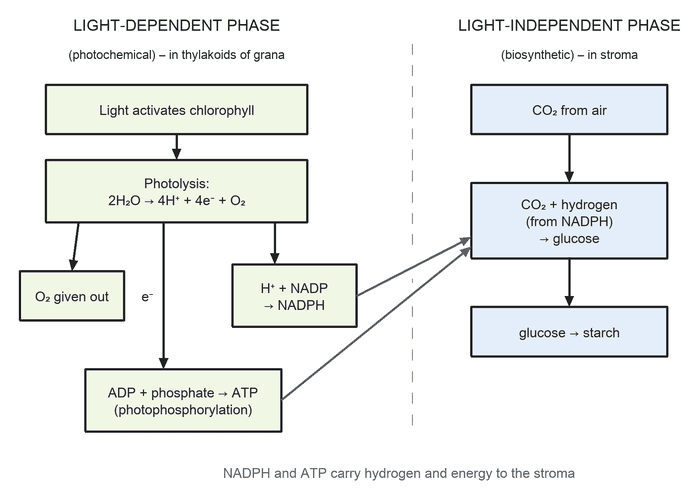
Step 3 — Dark reaction in the stroma.
Hydrogen from NADPH is combined with carbon dioxide, using energy from ATP, to form glucose (). Most plants soon join the glucose into starch (polymerisation).
Watch out: The dark reaction needs the products of the light reaction, so the two run at the same time in the day.
Therefore, (i) in the light reaction water is split by light, oxygen is released and NADPH and ATP are formed; (ii) in the dark reaction CO₂ is reduced by hydrogen from NADPH, using ATP, to glucose (then starch).