
Question 4410 marksEasy
Define the following terms :
(a) Photosynthesis
(b) Thylakoids
(c) Chloroplast
(d) Photolysis of water
(e) Polymerisation
Confirming your payment
Sign up now and get 250 free tokens.
Photosynthesis · Question 44 of 63
Define the following terms :
(a) Photosynthesis
(b) Thylakoids
(c) Chloroplast
(d) Photolysis of water
(e) Polymerisation
Solution:
Concept: A good definition names the process or structure and gives its essential feature, adding where it occurs when that is part of the meaning.
Step 1 — Processes: (a), (d), (e).
(a) Photosynthesis: the process by which living plant cells containing chlorophyll make food (glucose, then starch) from carbon dioxide and water using light energy, releasing oxygen as a by-product.
(d) Photolysis of water: the splitting of water molecules into hydrogen ions, electrons and oxygen by light energy, in the grana of the chloroplast.
(e) Polymerisation: the conversion of many small, simple molecules into one large, complex molecule, e.g. many glucose molecules into one starch molecule.
Step 2 — Structures: (b), (c).
(b) Thylakoids: the closely packed flattened sacs inside a chloroplast, piled into grana; their walls contain chlorophyll and carry out the light reaction.
(c) Chloroplast: a small oval green plastid bounded by a double membrane, with grana lying in a colourless stroma; it contains chlorophyll and is the site of photosynthesis.
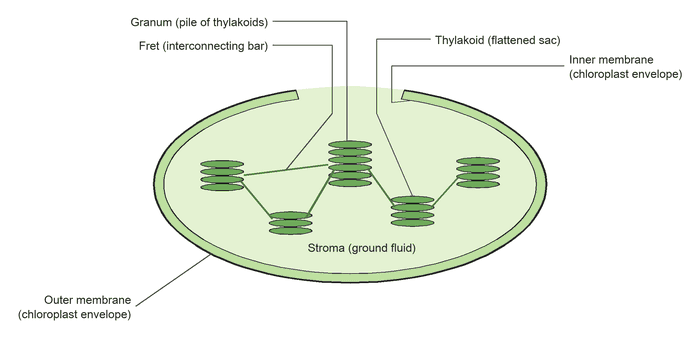
Therefore, each term is defined above: photosynthesis (food from CO₂ and water using light), thylakoids (flattened chlorophyll sacs), chloroplast (green plastid, site of photosynthesis), photolysis (splitting of water by light) and polymerisation (small molecules joined into a large one).