
Opening your dashboard
Class 10 Biology Chapter 6 Photosynthesis: Competency-Based Questions (CBQ)
40 questions on Chapter 6, each worked through on its own page with the AI tutor. Class 10 Biology, ICSE 2026-27.
40 questions
1–5 marks · Mixed difficulty
- 11 mark
Question 1
Cognitive domain: Application
The shrubs growing beside a cement godown are always coated with a layer of fine grey dust. They get the same sunlight, water and manure as shrubs of the same kind in a park nearby, yet they grow much more slowly. Which is the best explanation ?
- 21 mark
Question 2
Cognitive domain: Analysis
A potted plant with variegated leaves (green in the centre, white along the margin) was kept in the dark for two days. A strip of black paper was then clipped across one leaf, and the plant was placed in the sun for six hours. The strip was removed and the leaf was tested for starch. P, Q, R and S are four regions of this leaf.
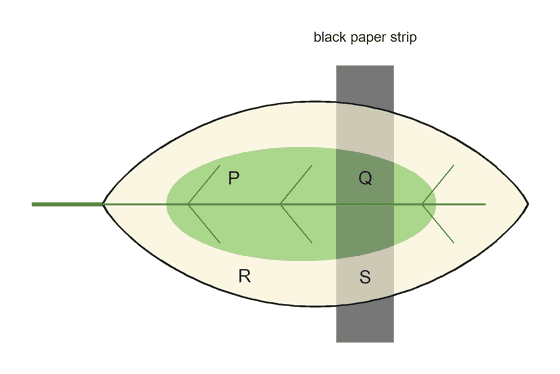
Which two regions must be compared to conclude that light is necessary for photosynthesis ?
- 31 mark
Question 3
Cognitive domain: Application
A fern had been growing well for months in a shaded verandah. In peak summer it was shifted to an open terrace, where it stood in harsh sunlight all day. It was watered regularly, yet within a week its most exposed fronds showed pale, bleached patches. What does this most probably show ?
- 41 mark
Question 4
Cognitive domain: Analysis
A certain weed-killer acts on the thylakoids of the chloroplasts and stops the photolysis of water. A leaf sprayed with it still receives light, water and carbon dioxide. Which set of changes will follow in its chloroplasts ?
- 51 mark
Question 5
Cognitive domain: Understanding
Assertion (A): The cuticle and the upper epidermis of a leaf do not cut off sunlight from the palisade cells lying below them.
Reason (R): The cuticle of a leaf is waterproof.
- 61 mark
Question 6
Cognitive domain: Understanding
Assertion (A): In a green leaf, the light-independent phase of photosynthesis is carried out at night, after the light-dependent phase of the day is over.
Reason (R): The reactions of the light-independent phase do not require light energy.
- 71 mark
Question 7
Cognitive domain: Understanding
Two similar leaves of a garden plant were tested for starch. The leaf plucked at 6 p.m. after a sunny day turned deep blue-black with iodine. The leaf plucked at 5 a.m. the next morning gave a much fainter colour.
During the night the starch of the leaf was reconverted into soluble ______, which was carried away through the ______ of the stem.
- 81 mark
Question 8
Cognitive domain: Application
After the wheat harvest, a farmer sets fire to the dry stubble left in his field. The carbon locked in the stubble at once goes back into the air as carbon dioxide.
If the stubble had been ploughed into the soil instead, the same carbon would have returned to the air slowly by the step of the carbon cycle called ______, carried out by the bacteria and fungi known as ______.
- 91 mark
Question 9
Cognitive domain: Application
Farah floats a strip of leaf epidermis on a dilute solution of a potassium salt and keeps it in bright light. After some time its stomata are wide open. A similar strip kept in the dark has closed stomata.
In the lighted strip, ATP made in the guard cells was used to pump potassium ions into them, so the guard cells became ______ to their neighbouring cells and took in water by ______.
- 102 marks
Question 10
Cognitive domain: Evaluation
To save time, Tanya took a potted plant straight from the sunny garden, covered a part of one leaf with black paper and kept the plant in the sun for three hours. On testing the leaf with iodine, both the covered part and the uncovered part turned blue-black. She concluded: "Leaves can make starch without light."
Is Tanya's conclusion valid ? Give a reason, and state what she should have done.
- 112 marks
Question 11
Cognitive domain: Application
Button mushrooms are grown in dark sheds on beds of rotting wheat straw. A grower says, "My crop is the one food that does not depend on photosynthesis at all."
Explain why the grower is mistaken.
- 122 marks
Question 12
Cognitive domain: Analysis
Two leaves of a destarched potted plant, still attached to it, were smeared with a thin layer of clear petroleum jelly, which lets light pass through. The plant was then kept in the sun for six hours and both leaves were tested with iodine.
Leaf Surface smeared with jelly Colour with iodine 1 Lower surface only Brown 2 Upper surface only Blue-black Account for the two results. What do they tell you about the leaf of this plant ?
- 134 marks
Question 13
Cognitive domain: Analysis
Case: A grower raises tomato plants in a polyhouse whose doors and ventilators are kept shut. On a bright, clear day and the following night, the carbon dioxide in the air inside was recorded.
Time in the air inside (%) 6 a.m. 0.045 9 a.m. 0.030 12 noon 0.020 3 p.m. 0.018 6 p.m. 0.022 12 midnight 0.035 6 a.m. (next day) 0.045 (a) Explain why the carbon dioxide inside fell steadily from 6 a.m. to 3 p.m.
(b) Explain the rise from 6 p.m. to 6 a.m. A worker says, "So plants respire only at night." Is he right ? Give a reason.
(c) Between 12 noon and 3 p.m. the sunlight was at its brightest, yet the plants were making food no faster than before. Use the table to explain why, and suggest what the grower should do during these hours.
- 145 marks
Question 14
Cognitive domain: Evaluation
Case: For a class exhibition, Nikhil drew the flow chart of the carbon cycle shown below and numbered its arrows 1 to 6. His teacher told him that two of the numbered arrows are wrong and that one step is missing.
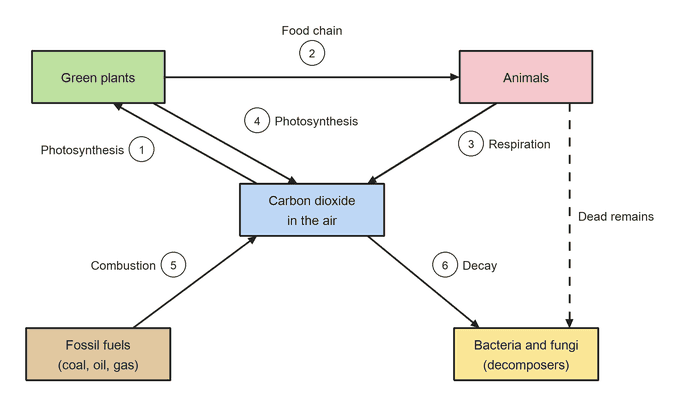
(a) Which two numbered arrows are wrong ? Say what is wrong with each and correct it.
(b) Name one step that returns carbon dioxide to the air but does not appear anywhere in the chart.
(c) Nikhil says, "Fossil fuels are dug out of the earth, so they have nothing to do with photosynthesis." Judge this statement.
(d) He also says, "If arrow 1 stopped, only the green plants would suffer." Do you agree ? Give two reasons.
- 155 marks
Question 15
Cognitive domain: Creativity
Case: For Science Day, a class wants to make the word ECO appear on a living leaf of a potted plant whose leaves are broad and fully green, using nothing but sunlight, and then show the "printed" leaf to visitors. They have black paper, scissors, paper clips and the materials for the iodine test. Their teacher will do all the heating.
(a) What must be done to the plant before the leaf is used, and why ?
(b) Design the stencil and describe how the leaf should be exposed. State which parts of the leaf will form starch.
(c) List, in order, the steps by which the leaf is treated to make the word visible. State the colour of the letters and of the rest of the leaf at the end.
(d) A classmate suggests using a leaf of variegated Coleus instead, because it looks prettier. Predict the problem with this choice.
- 162 marks
Question 16
CISCE Competency-Focused Practice Questions (2024) · Cognitive domain: Analysis
Differentiate in the rate of photosynthesis for the increase in temperature.
(a) 20°C to 30°C
(b) 40°C to 50°C
- 172 marks
Question 17
CISCE Competency-Focused Practice Questions (2024) · Cognitive domain: Analysis
Under which condition does a leaf take carbon dioxide from the atmosphere?
- 181 mark
Question 18
CISCE Competency-Focused Practice Questions (2024) · Cognitive domain: Analysis
Electrons released on splitting of water molecules in photosynthesis are used in producing:
- 191 mark
Question 19
Cognitive domain: Application
Two sets of bean seeds were put on moist cotton wool, and both sets were given the same amount of water every day. Set X was kept in a dark cupboard. Set Y was kept in the dark for four days and was then moved to a sunny window. The seedlings of set X grew thin and pale for about a week and then withered and died. The seedlings of set Y went on growing and turned green. Why did the seedlings of set X die ?
- 201 mark
Question 20
Cognitive domain: Analysis
The overall equation of photosynthesis is
In a leaf, 3 molecules of glucose are formed. How many molecules of water are taken in altogether, and how many molecules of water are formed anew, in making them ?
- 211 mark
Question 21
Cognitive domain: Understanding
Assertion (A): In the starch test, a leaf is boiled in methylated spirit by keeping the spirit in a test tube dipped in a beaker of boiling water, and not by heating the spirit directly over a flame.
Reason (R): Methylated spirit is highly inflammable and catches fire easily.
- 221 mark
Question 22
Cognitive domain: Application
A balsam plant with a young green stem was kept in the dark for 48 hours. All its leaves were then plucked, and one half of the green stem was wrapped in black paper. The plant was kept in the sun for six hours. A thin outer slice from each half of the stem was then tested with iodine solution. The exposed half turned blue-black and the wrapped half stayed brown. Which conclusion is justified ?
- 231 mark
Question 23
Cognitive domain: Application
A thin peel of the lower epidermis of a leaf, kept in bright light, shows stomata that are wide open under the microscope. A drop of a very strong sugar solution, much more concentrated than the cell sap of the guard cells, is then added to the peel. What will be seen after a few minutes ?
- 241 mark
Question 24
Cognitive domain: Analysis
A gardener removed a ring of bark, which includes the phloem, from the base of one branch of a guava sapling and left a second branch untouched. The phloem carries the food made in the leaves to other parts of the plant. After three weeks the leaves on both branches were equally fresh and green and had the same light, but those on the ringed branch contained much more starch and photosynthesised more slowly. Which statement best explains the slower photosynthesis on the ringed branch ?
- 251 mark
Question 25
Cognitive domain: Understanding
Assertion (A): Photosynthesis takes place only in the palisade cells of a leaf.
Reason (R): The palisade cells contain the largest number of chloroplasts in a leaf.
- 261 mark
Question 26
Cognitive domain: Application
The glucose made in leaves is changed into other substances for storage, and different plants store it in different forms. Which row correctly names the main stored form of the food in a sugarcane stem, a groundnut seed and a potato tuber ?
- 271 mark
Question 27
Cognitive domain: Evaluation
Reena kept a plant in the dark for 48 hours. She then put half of one of its leaves into a flask containing potassium hydroxide solution and left the other half outside, as in the textbook experiment, but the split cork did not fit well, and air entered the flask all through the day. After six hours in the sun, both halves of the leaf gave a blue-black colour with iodine. She wrote: "Carbon dioxide is not necessary for photosynthesis." Judge her conclusion.
- 282 marks
Question 28
Cognitive domain: Application
The textbook gives the composition of the iodine solution for the starch test as iodine g, potassium iodide g and water mL. A teacher must prepare mL of this solution for a class.
(a) Find the mass of iodine and the mass of potassium iodide needed.
(b) State the colour that this solution gives with a leaf that contains starch and with a leaf that has no starch.
- 292 marks
Question 29
Cognitive domain: Application
A student cuts a rectangular patch of leaf mm long and mm wide. Take as the number of chloroplasts in every square millimetre of leaf surface, and to as the number of chloroplasts in one cell.
(a) Find the number of chloroplasts under the patch.
(b) Use this number to estimate the least and the greatest number of cells that hold these chloroplasts.
- 302 marks
Question 30
Cognitive domain: Evaluation
A student says: "The oxygen given out in photosynthesis is a waste product, like the ash left by a burning fire, so the plant has no use for it."
Evaluate this statement, giving two points from the chapter.
- 312 marks
Question 31
Cognitive domain: Analysis
A rare mutant plant has guard cells that contain no chloroplasts, although all the other cells of its leaves are normal. It is kept in bright light and given plenty of water. (Hypothetical data.)
Use the potassium ion theory to predict whether its stomata open as wide as those of a normal plant, and say what this does to the rate of photosynthesis of its leaves.
- 322 marks
Question 32
Cognitive domain: Analysis
The leaves of a water lily float on the surface of a pond, with the upper surface in the air and the lower surface touching the water. Most of the leaves of land plants have more stomata on the lower surface, but the stomata of a water lily leaf are found on the upper surface.
Explain why this position of the stomata suits photosynthesis in a floating leaf.
- 333 marks
Question 33
Cognitive domain: Analysis
The diagram shows the two parts of a chloroplast in which the two phases of photosynthesis go on. The four arrows P, Q, R and S show substances passing between the two parts. P and Q carry the energy-rich products of the light-dependent phase to the stroma. R and S carry back to the thylakoids the substances that are left when P and Q have been used.

(a) Name the substances P and Q.
(b) Name the substance S and the two substances carried together by R.
(c) A chemical blocks arrow S while the leaf stays in bright light. Predict what happens to the formation of NADPH in the thylakoids and then to the formation of glucose in the stroma, giving a reason for each.
- 343 marks
Question 34
Cognitive domain: Analysis
Two plants, P and Q, are grown in the same bright, well-watered garden bed. (Hypothetical data.)
Feature of the leaf Plant P Plant Q Size of the leaf Large Small Cuticle Thin and transparent Thick Stomata per square millimetre (a) Which plant is likely to photosynthesise faster in the well-watered bed ?
(b) Give two reasons for your answer, using the table.
(c) In a hot, dry place Q may do better than P. Give one reason.
- 353 marks
Question 35
Cognitive domain: Evaluation
Rani wanted to show that oxygen is given out in photosynthesis. She put a few twigs of Hydrilla in a beaker of pond water and left them lying to one side. She placed a short-stemmed funnel in the middle of the beaker with its stem pointing up, and fixed a test tube full of water upside down over the stem. But the level of water in the beaker was below the top of the funnel stem. She then kept the beaker in a dim corner of the laboratory, far from the window. After three hours the test tube had hardly any gas in it.
Point out three faults in her set-up and say how each should be corrected.
- 363 marks
Question 36
Cognitive domain: Analysis
The table shows, in units of carbon, how carbon moved between the air and a mango orchard during one year. (Hypothetical data.)
Process Carbon (units) Taken from the air by photosynthesis Returned to the air by respiration of the trees Returned to the air by respiration of animals Returned to the air by decay of dead leaves and fruit Returned to the air by burning dry twigs (a) Find the total carbon returned to the air.
(b) Find by how many units the carbon in the air changed because of the orchard, and say whether it rose or fell.
(c) Where did the carbon that was not returned go ?
- 375 marks
Question 37
Cognitive domain: Analysis
Case: Meera fixed a twig of Hydrilla under an inverted funnel in a beaker of pond water, with a test tube over the funnel stem to collect the gas. She placed a lamp at different distances from the beaker, in an otherwise dark room, and counted the bubbles of gas that came from the cut end of the twig in one minute at each distance. The graph shows her counts. (Hypothetical data.)

(a) How many bubbles per minute were counted when the lamp was cm away ? By what percentage did the count fall when the lamp was moved from cm to cm ?
(b) The counts at cm and at cm were the same. Give a reason, and say what could be changed to get more bubbles at cm.
(c) At cm the water in the beaker felt warm. A classmate says that the nearer lamp may have changed the count by heating the water and not by giving more light. Suggest a way to make the test fair, and say why heat matters.
- 385 marks
Question 38
Cognitive domain: Evaluation
Case: A vegetable grower in a dry region grows tomato plants in an open field. In May the air temperature at noon is and the plants photosynthesise very slowly at that time. He covers half the field with a shade net that cuts the sunlight to half. The table gives the readings at noon. (Hypothetical data.)
Reading at noon Open field Under the shade net Light (% of full sunlight) Air temperature Stomata Mostly closed Wide open Rate of photosynthesis (units) For this variety of tomato, the rate of photosynthesis stops rising when the light reaches of full sunlight, provided the temperature and the carbon dioxide supply are suitable.
(a) Give two reasons why the rate of photosynthesis in the open field at noon is so low.
(b) The net cut the light to half, yet the rate under it is much higher. Explain this.
(c) The grower now plans to add a second net, so that only of the sunlight reaches the plants, expecting the air temperature to fall further to . Evaluate the plan and advise him.
- 394 marks
Question 39
Cognitive domain: Creativity
Case: For Science Day, Aman and Tara decide to make a working model of a stoma with two long, sausage-shaped balloons. They stick the two balloons together at both ends, side by side. On the side of each balloon that faces the other balloon they stick a strip of strong tape along its whole length. They then blow air into both balloons.
(a) Which part of a guard cell does the tape stand for, and which part does the untaped side of the balloon stand for ? Say why the model needs this difference.
(b) Describe how the model is used to show (i) the opening and (ii) the closing of the stoma, and say what the air stands for.
(c) State one limitation of the model and suggest one way to improve the demonstration.
- 405 marks
Question 40
Cognitive domain: Analysis
Case: In May, a farmer measured on a hot, dry day the percentage of stomata that were open on the leaves of his brinjal plants, and the rate of photosynthesis of the leaves, given as a percentage of the best rate these leaves reach in ideal conditions. The soil in the field was dry and the air temperature reached at p.m. The sun was brightest at noon. (Hypothetical data.)
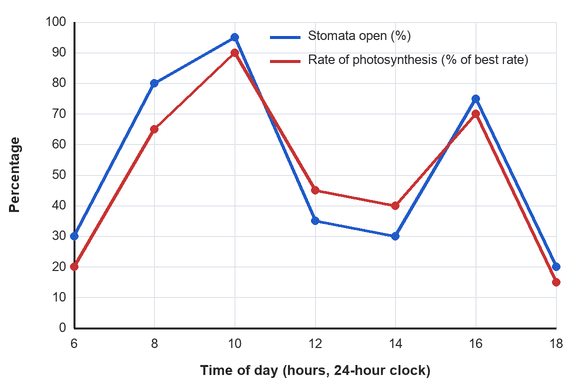
(a) At what time were the stomata most widely open, and what was the rate of photosynthesis then ?
(b) Find the fall in the rate of photosynthesis from a.m. to noon as a fraction of the rate at a.m. Give two reasons why the rate fell although the light was brighter at noon.
(c) Explain why both curves rise again by p.m. and fall at p.m.