Answer: (C) (3) Both A and R are True
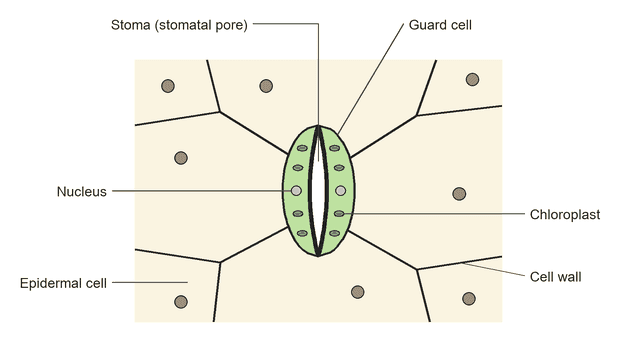
Concept: In an assertion–reason item, judge the Assertion (A) and the Reason (R) separately as true or false; only when both are true do we ask whether R correctly explains A. Each stoma is bounded by two guard cells: turgid guard cells open the stoma and flaccid ones close it.
Step 1 — Judge the Assertion.
Water moving into and out of the guard cells makes them turgid or flaccid, and this opens or closes the stomatal pore. So A is true.
Step 2 — Judge the Reason.
Guard cells contain chloroplasts, stomata are mostly on the lower surface of leaves, and the other cells of the lower epidermis have no chloroplasts. So R is true.
Step 3 — Pick the option.
Both statements are true, and the option that says so is (C).
Watch out: The options here only ask whether A and R are true or false, so (C) is the answer whether or not R explains A.
Why the other options are wrong:
- (A) (1) A is True and R is False: it says R is false, but R is true.
- (B) (2) A is False and R is True: it says A is false, but A is true.
- (D) (4) Both A and R are False: it says both are false, but both are true.
Therefore, both A and R are true, option (C).
