Answer: (B) (2) A is False and R is True
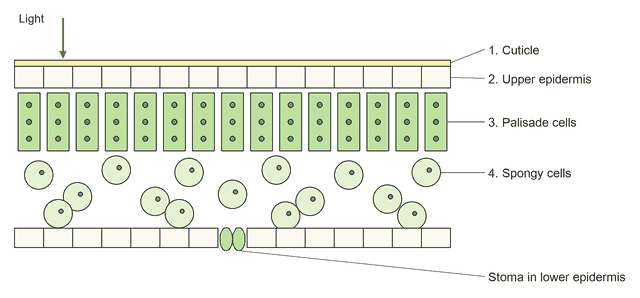
Concept: In an assertion–reason item, judge the Assertion (A) and the Reason (R) separately as true or false; only when both are true do we ask whether R correctly explains A. In a dorsiventral leaf the palisade cells lie just below the upper epidermis and are compactly arranged; the loosely arranged cells near the lower epidermis are the spongy cells.
Step 1 — Judge the Assertion.
Palisade cells are neither loosely arranged nor near the lower epidermis; that description fits the spongy cells. So A is false.
Step 2 — Judge the Reason.
Palisade cells have the most chloroplasts, trap most of the light energy and so help in photosynthesis. So R is true.
Why the other options are wrong:
- (A) (1) A is True and R is False: it says A is true and R is false, the opposite of what we found.
- (C) (3) Both A and R are True: it says both are true, but A is false.
- (D) (4) Both A and R are False: it says both are false, but R is true.
Therefore, A is false and R is true, option (B).
