
Opening your dashboard
Class 10 Biology Chapter 12 The Endocrine System: Previous Year Questions
56 questions on Chapter 12, each solved step by step. Class 10 Biology, ICSE 2026-27.
56 questions with solutions
1–5 marks · Mixed difficulty
- 11 mark
Question 1
Choose the correct answer from the four options given below:
Gigantism and Acromegaly are due to:
Solve with AIAnswer
(A) Hyposecretion of Thyroxine.
(B) Hyposecretion of Growth hormone
(C) Hypersecretion of Thyroxine
- Correct
(D) Hypersecretion of Growth hormone
Answer: (D) Hypersecretion of Growth hormone
Concept: Growth hormone (GH, somatotropin) from the anterior pituitary controls the growth of the body, especially of the bones. Too much or too little of it changes height, and the effect depends on whether the fault starts in childhood or in adult life.
Step 1 — Gigantism.
Gigantism happens when the anterior pituitary makes too much growth hormone in childhood. The long bones are still growing, so they lengthen far beyond normal and the child grows into a giant.
Step 2 — Acromegaly.
Acromegaly happens when too much growth hormone starts in an adult. The long bones can no longer lengthen, so instead the bones of the face (especially the jaws), the hands and the feet grow large.
Step 3 — Find the common cause.
Both disorders come from the same fault, hypersecretion of growth hormone; they differ only in the age at which it starts.

Watch out: Gigantism and acromegaly are both caused by too MUCH growth hormone; too little growth hormone gives dwarfism.
Why the other options are wrong:
- (A) Hyposecretion of Thyroxine: Too little thyroxine causes simple goitre, cretinism (in children) or myxoedema (in adults), not overgrowth of the bones.
- (B) Hyposecretion of Growth hormone: Too little growth hormone in childhood causes dwarfism, the opposite of gigantism.
- (C) Hypersecretion of Thyroxine: Too much thyroxine causes exophthalmic goitre, with bulging eyes and a high metabolic rate, not giant growth.
Therefore, gigantism and acromegaly are due to hypersecretion of growth hormone, option (D).
- 21 mark
Question 2
In each set of terms given below, there is an odd one and cannot be grouped in the same category to which the other three belong. Identify the odd term in each set and name the category to which the remaining three belong.
Example: Ovary, Fallopian tube, Ureter, Uterus. Odd term: Ureter Category: Parts of female reproductive system.
Cortisone, Somatotropin, Adrenocorticotropic hormone, Vasopressin.
Solve with AIWritten solution
Solution:
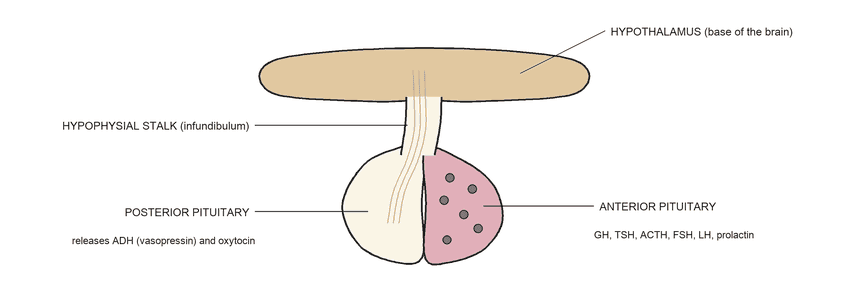
Concept: In an odd-one-out item, find what three of the terms share (the category), and then name the one term that does not share it. The pituitary has two lobes. The anterior lobe makes growth hormone, prolactin and the tropic hormones (TSH, ACTH, FSH, LH). The posterior lobe releases ADH (vasopressin) and oxytocin, which are made in the hypothalamus and stored in the posterior lobe.
Step 1 — Find where each hormone comes from.
We place each of the four hormones in its gland.
- Somatotropin (growth hormone) is made by the anterior pituitary.
- Adrenocorticotropic hormone (ACTH) is made by the anterior pituitary.
- Vasopressin (ADH) is released by the posterior pituitary.
- Cortisone (today called cortisol) is made by the adrenal cortex.
Step 2 — Name the category.
Three of the hormones come from the pituitary gland, one lobe or the other, so the category is hormones of the pituitary gland.
Step 3 — Pick the odd term.
Cortisone alone is made outside the pituitary, in the adrenal cortex. The pituitary only controls it, through ACTH, which tells the adrenal cortex to secrete it.
Watch out: ACTH and cortisone are linked (ACTH stimulates cortisone release), but ACTH is the pituitary hormone and cortisone is the adrenal one.
Therefore, the odd term is Cortisone; the category of the other three is hormones of the pituitary gland.
- 35 marks
Question 3
Complete the following paragraph by filling in the blanks (i) to (v) with appropriate words:
The amount of urine output is under the regulation of a hormone called (i) ............... secreted by the (ii) ............... lobe of the pituitary gland. If this hormone secretion is reduced, there is an increased production of urine. This disorder is called (iii) ............... Sometimes excess glucose is passed with urine due to hyposecretion of another hormone called (iv) ............... leading to the cause of a disease called (v)................
Solve with AIWritten solution
Solution:
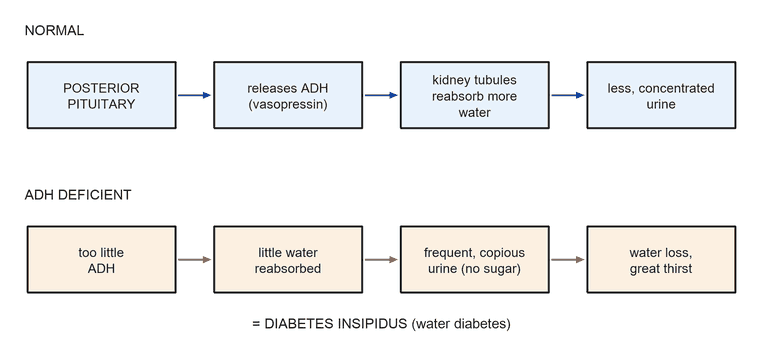
Concept: Two different hormones are linked with the word diabetes (passing a large amount of urine). ADH (antidiuretic hormone, vasopressin) is made in the hypothalamus and released by the posterior pituitary. It makes the kidney tubules take back (reabsorb) more water from the urine being formed, so less, more concentrated urine is passed. Insulin from the beta cells of the pancreas lowers the blood sugar.
Step 1 — Blank (i): the hormone controlling urine output.
The hormone that controls how much water leaves in the urine is antidiuretic hormone (ADH), also called vasopressin. It makes the kidney tubules reabsorb more water, so less urine is formed.
Step 2 — Blank (ii): the lobe that releases it.
ADH is released into the blood by the posterior lobe of the pituitary gland (it is made in the hypothalamus and stored there).
Step 3 — Blank (iii): the disorder when ADH is reduced.
With too little ADH, less water is reabsorbed, so a large amount of dilute urine with no sugar is passed and the person is always thirsty. This is diabetes insipidus.
Step 4 — Blank (iv): the hormone whose lack puts glucose in urine.
Glucose appears in the urine when there is too little insulin, the hormone of the beta cells of the islets of Langerhans that lowers blood sugar.
Step 5 — Blank (v): the disease.
Without enough insulin the blood sugar stays high (hyperglycaemia) and the extra glucose is passed out in the urine. This disease is diabetes mellitus.
Watch out: Insipidus (ADH, no sugar in urine) and mellitus (insulin, sugar in urine) are easy to swap; 'mellitus' means honey-sweet.
Therefore, (i) antidiuretic hormone (ADH or vasopressin), (ii) posterior, (iii) diabetes insipidus, (iv) insulin, (v) diabetes mellitus.
- 41 mark
Question 4
State the exact location of the following structures:
Thyroid gland
Solve with AIWritten solution
Solution:
Concept: "Exact location" means naming the body region and the organs the structure lies next to. The thyroid gland in the neck makes thyroxine, which contains iodine. Thyroxine sets the basal metabolic rate (how fast the cells release energy at rest) and is needed for normal growth and mental development.
Step 1 — Name the body region.
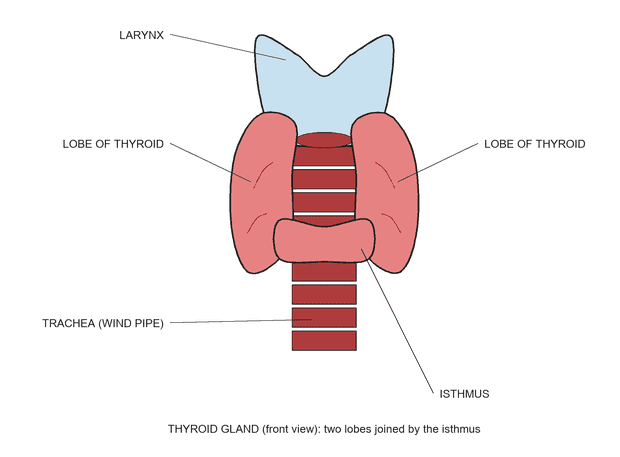
The thyroid gland lies in the neck, in front of the wind pipe, just below the larynx (voice box).
Step 2 — Describe how it sits.
It is a bilobed, butterfly-shaped gland. Its two lobes lie on either side of the trachea (wind pipe) and are joined across the front of the trachea by a narrow band, the isthmus.
Watch out: The thyroid is in the neck below the larynx, not in the brain (that is the pituitary) or on the kidneys (the adrenals).
Therefore, the thyroid gland lies in the front of the neck just below the larynx, its two lobes on either side of the trachea joined by the isthmus.
- 55 marks
Question 5
Given in the box below are a set of 14 biological terms. Of these, 12 can be paired into 6 matching pairs. Out of the six pairs, one has been done for you as an example.
Example: endosmosis – Turgid cell.
Identify the remaining five matching pairs :
Cushing's syndrome, Turgid cell, Iris, Free of rod and cone cells, Colour of eyes, Hypoglycemia, Active transport, Acrosome, Addison's disease, Blind spot, Hyperglycemia, Spermatozoa, Endosmosis, Clotting of blood. Solve with AIWritten solution
Solution:
Concept: Each matching pair is a term and the feature, cause or part that goes with it. Fourteen terms make six pairs (twelve terms), so two terms are left without a partner.
Step 1 — Pair Cushing's syndrome.
Cushing's syndrome is caused by too much cortisol (the book's cortisone) from the adrenal cortex; cortisol raises the blood sugar, so one of its signs is hyperglycaemia. Pair: Cushing's syndrome – Hyperglycemia.
Step 2 — Pair Addison's disease.
Addison's disease is caused by too little of the adrenal cortex hormones, so the blood sugar can fall too low. Pair: Addison's disease – Hypoglycemia.
Step 3 — Pair the iris.
The pigment in the iris gives the eye its colour. Pair: Iris – Colour of eyes.
Step 4 — Pair the blind spot.
The blind spot is where the optic nerve leaves the eyeball; it has no rods or cones, so no image forms there. Pair: Blind spot – Free of rod and cone cells.
Step 5 — Pair the acrosome.
The acrosome is the cap on the head of a sperm (spermatozoon); its enzymes help the sperm to get through the coverings of the egg. Pair: Acrosome – Spermatozoa.
Step 6 — Check the count.
The example and these five pairs use twelve of the fourteen terms. The two left over are Active transport and Clotting of blood, which have no partner in the box.
Watch out: Hyper- means too much and hypo- means too little; Cushing's (too much cortical hormone) goes with hyperglycemia, Addison's (too little) with hypoglycemia.
Therefore, the five pairs are Cushing's syndrome – Hyperglycemia, Addison's disease – Hypoglycemia, Iris – Colour of eyes, Blind spot – Free of rod and cone cells, and Acrosome – Spermatozoa.
- 65 marks
Question 6
Given below is the outline of the human body showing the important glands:
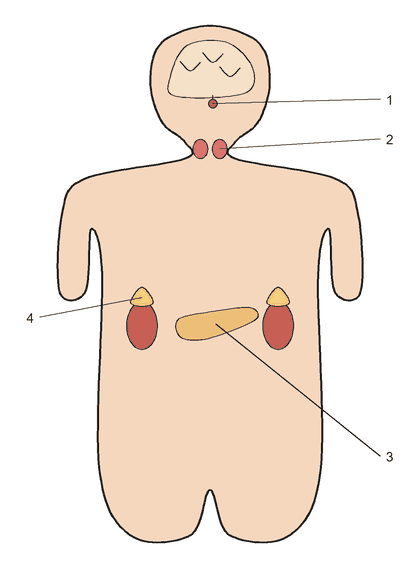
(i) Name the glands marked 1 to 4.
(ii) Name the hormone secreted by part 2. Give one important function of this hormone.
(iii) Name the endocrine part of the part numbered 3.
(iv) Why is the part labelled 1 called the master gland? Which part of the forebrain controls the gland labelled 1?
(v) Name the gland that secretes the 'emergency hormone'.
Solve with AIWritten solution
Solution:
Concept: Read each gland from its position in the outline: the pituitary hangs below the brain, the thyroid is in the neck, the adrenals sit like caps on the kidneys and the pancreas lies across the abdomen below the stomach.

Step 1 — Part (i): name the glands 1 to 4.
We read each number from its position.
- 1 – Pituitary gland (the small gland below the brain)
- 2 – Thyroid gland (in the neck)
- 3 – Pancreas (the long gland across the abdomen)
- 4 – Adrenal gland (the cap on the kidney)
Step 2 — Part (ii): hormone of part 2 and one function.
Part 2, the thyroid, secretes thyroxine. One important function: it regulates the basal metabolic rate, the rate at which the cells release energy (and heat) at rest. It is also needed for normal growth and mental development.
Step 3 — Part (iii): endocrine part of gland 3.
The endocrine part of the pancreas is the islets of Langerhans, small groups of hormone-making cells scattered through it. The rest of the pancreas makes pancreatic juice, which leaves through a duct.
Step 4 — Part (iv): why gland 1 is the master gland.
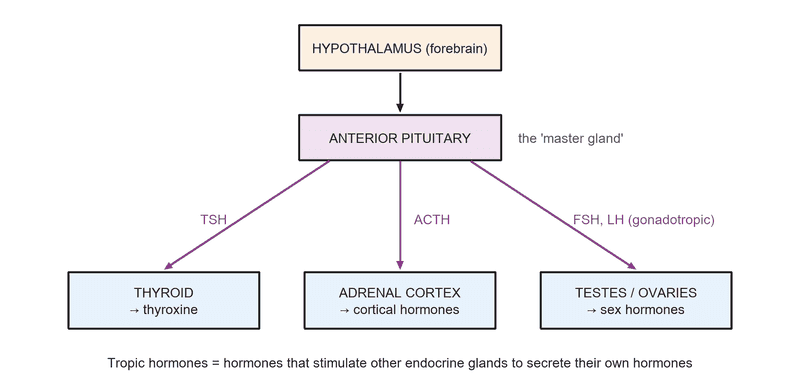
The pituitary is called the master gland because its anterior lobe makes tropic hormones that control several other endocrine glands: TSH controls the thyroid, ACTH the adrenal cortex, and FSH and LH the testes and ovaries. It is itself controlled by the hypothalamus, the part of the forebrain from which it hangs.
Step 5 — Part (v): gland of the emergency hormone.
The adrenal gland secretes the emergency hormone, adrenaline, from its inner part, the medulla. Adrenaline prepares the body to fight or run away.
Watch out: The master gland is the pituitary, but it is not the top controller; the hypothalamus of the forebrain controls it.
Therefore, (i) 1 pituitary, 2 thyroid, 3 pancreas, 4 adrenal gland; (ii) thyroxine, which regulates basal metabolism; (iii) islets of Langerhans; (iv) its tropic hormones control other glands, and the hypothalamus controls it; (v) the adrenal gland (medulla).
- 71 mark
Question 7
Briefly explain the following terms :
Hormone
Solve with AIWritten solution
Solution:
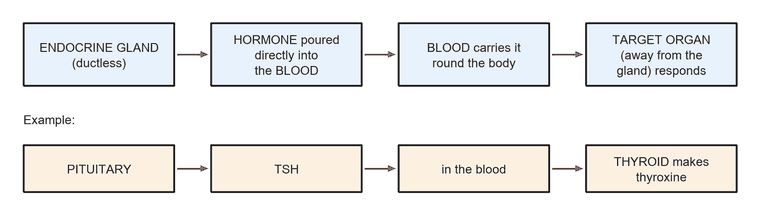
Concept: A hormone is a chemical messenger made by an endocrine (ductless) gland. It is poured straight into the blood, carried round the body, and acts on particular target organs or cells, usually far from the gland that made it.
Step 1 — Say where it is made.
A hormone is made by an endocrine (ductless) gland or glandular tissue.
Step 2 — Say how it travels.
It is poured directly into the blood, not through a duct, and the blood carries it round the body.
Step 3 — Say how it acts.
It acts on particular target organs or cells, usually far from the gland, and so brings about coordination between distant parts of the body. Only a tiny amount is needed.
Step 4 — Give an example.
Insulin from the pancreas travels in the blood to the liver and muscles and makes them take up glucose, which lowers the blood sugar.
Watch out: An enzyme such as pepsin also comes from a gland, but it leaves through a duct and acts where it is poured; a hormone goes into the blood.
Therefore, a hormone is a secretion of a ductless gland poured directly into the blood, which carries it to target organs where it acts.
- 81 mark
Question 8
Name the following:
The pituitary hormone which stimulates contraction of uterus during child birth.
Solve with AIWritten solution
Solution:
Concept: The pituitary has two lobes. The anterior lobe makes growth hormone, prolactin and the tropic hormones (TSH, ACTH, FSH, LH). The posterior lobe releases ADH (vasopressin) and oxytocin, which are made in the hypothalamus and stored in the posterior lobe.
Step 1 — Find what the hormone must do.
The hormone wanted makes the muscles of the uterus contract during childbirth.
Step 2 — Name it.
That hormone is oxytocin (Greek: quick birth). It is released by the posterior pituitary and causes strong contractions of the uterus that push the baby out; after birth it also helps the milk to flow out of the breasts.
Watch out: Prolactin helps make milk; oxytocin contracts the uterus and lets the milk out.
Therefore, the hormone is oxytocin.
- 91 mark
Question 9
Choose the ODD one out of the following terms given and name the CATEGORY to which the others belong:
ACTH, TSH, ADH, FSH
Solve with AIWritten solution
Solution:
Concept: In an odd-one-out item, find what three of the terms share (the category), and then name the one term that does not share it. Tropic hormones are anterior-pituitary hormones that stimulate other endocrine glands.
Step 1 — Place each hormone.
We note the gland and the target of each hormone.
- ACTH (adrenocorticotropic hormone), from the anterior pituitary, stimulates the adrenal cortex.
- TSH (thyroid stimulating hormone), from the anterior pituitary, stimulates the thyroid.
- FSH (follicle stimulating hormone), from the anterior pituitary, stimulates the ovaries and testes.
- ADH (antidiuretic hormone) is released by the posterior pituitary and acts on the kidney tubules.
Step 2 — Name the category and the odd one.
ACTH, TSH and FSH each stimulate another endocrine gland, so they are tropic hormones of the anterior pituitary. ADH acts on the kidney, not on a gland, and comes from the posterior lobe, so it is the odd one.
Watch out: All four are pituitary hormones, so 'pituitary hormones' alone is not a category that leaves one out.
Therefore, the odd one is ADH; the others are tropic hormones of the anterior pituitary.
- 101 mark
Question 10
Match the item given in Column A with the most appropriate one in Column B.
Column A Column B Diabetes mellitus dynamic body balance Hyperglycemia Hypoglycemia Natality static body balance vehicular standards nucleosome Solve with AIWritten solution
Solution:
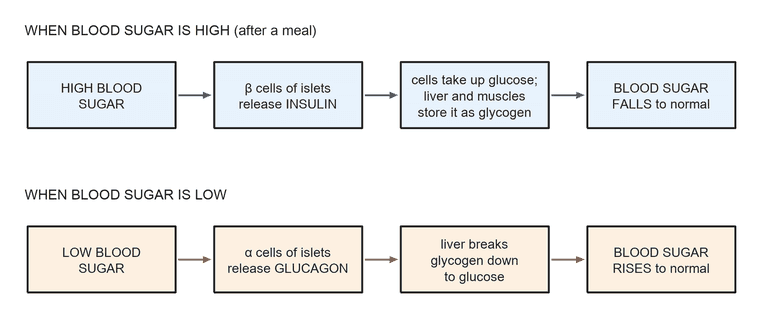
Concept: Diabetes mellitus is the disease in which the body does not have enough insulin, or cannot use it properly, so glucose stays in the blood.
Step 1 — Recall the main sign.
The main sign of diabetes mellitus is a high blood sugar level.
Step 2 — Find the matching term.
Hyperglycemia means too much sugar in the blood (hyper: excess, glyc: sugar, -emia: blood), so it is the match. The other items belong to other chapters.
Watch out: Hypoglycemia is LOW blood sugar, the opposite (for example after an overdose of insulin).
Therefore, Diabetes mellitus – Hyperglycemia.
- 115 marks
Question 11
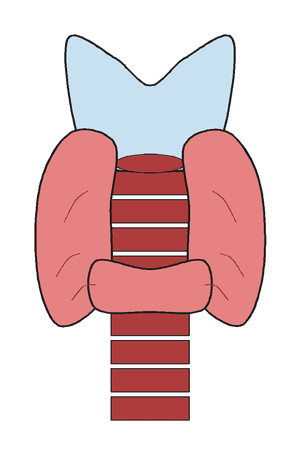
The diagram given below represents the location and structure of an endocrine gland. Study the same and answer the questions that follow:
(i) Name the endocrine gland shown in the diagram.
(ii) Name the secretion of the gland which regulates basal metabolism.
(iii) Name the mineral element required for the synthesis of the above mentioned hormone.
(iv) Name the disease caused due to under secretion of the above mentioned hormone in children.
(v) Name the disease caused due to hypersecretion of the above mentioned hormone.
Solve with AIWritten solution
Solution:
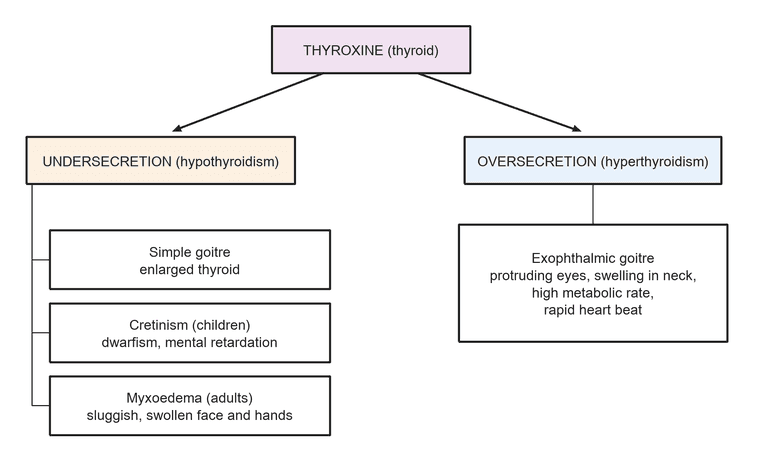
Concept: The thyroid gland in the neck makes thyroxine, which contains iodine. Thyroxine sets the basal metabolic rate (how fast the cells release energy at rest) and is needed for normal growth and mental development.
Step 1 — Part (i): identify the gland.
The figure shows a two-lobed gland lying on the trachea (with its rings) just below the larynx, the lobes joined by a narrow isthmus. This is the thyroid gland.
Step 2 — Part (ii): the secretion that regulates basal metabolism.
The thyroid's hormone thyroxine regulates the basal metabolic rate.
Step 3 — Part (iii): the mineral needed.
Thyroxine contains iodine, so iodine in the diet is needed to make it.
Step 4 — Part (iv): under-secretion in children.
Too little thyroxine in a child causes cretinism: stunted growth (dwarfism) and poor mental development.
Step 5 — Part (v): hypersecretion.
Too much thyroxine causes exophthalmic goitre: bulging eyes, a swelling in the neck, a high metabolic rate, a fast heart beat and loss of weight.
Watch out: Too little thyroxine in an ADULT causes myxoedema, not cretinism; cretinism is the childhood disorder.
Therefore, (i) thyroid gland, (ii) thyroxine, (iii) iodine, (iv) cretinism, (v) exophthalmic goitre.
- 121 mark
Question 12
Mention the exact location of the following:
Islets of Langerhans
Solve with AIWritten solution
Solution:
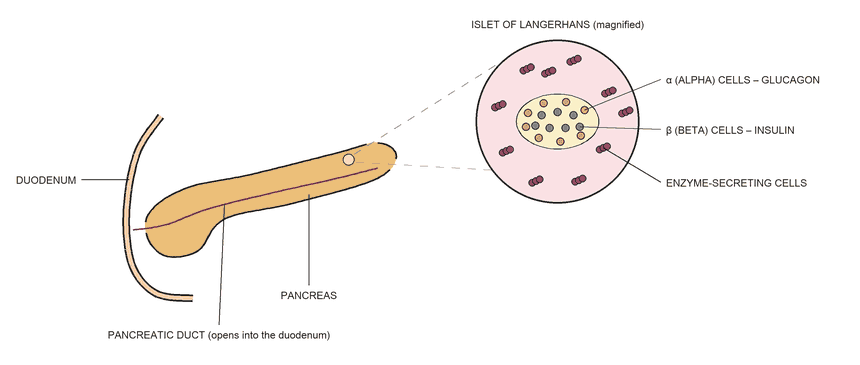
Concept: The pancreas is both a duct gland and a ductless gland. Its endocrine part is the islets of Langerhans: the alpha (α) cells make glucagon (raises blood sugar) and the beta (β) cells make insulin (lowers blood sugar).
Step 1 — Name the organ.
The islets of Langerhans are the endocrine part of the pancreas, small groups of hormone-making cells scattered throughout the pancreas among the cells that make pancreatic juice.
Step 2 — Place the organ in the body.
The pancreas lies in the abdomen, behind and just below the stomach, with its head held in the C-shaped loop of the duodenum.
Watch out: The islets are not a separate gland next to the pancreas; they lie inside it.
Therefore, the islets of Langerhans are scattered throughout the pancreas, which lies below the stomach in the loop of the duodenum.
- 131 mark
Question 13
Give biological reasons for the following statements:
Some women have facial hair like beard and moustache.
Solve with AIWritten solution
Solution:
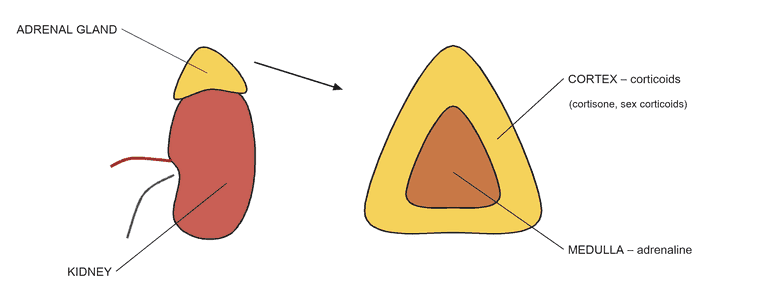
Concept: Each adrenal gland sits like a cap on top of a kidney. Its outer cortex makes the corticoids (cortisol, called cortisone in the book; aldosterone; and the sex corticoids), and its inner medulla makes adrenaline, the emergency hormone. The sex corticoids include male-type hormones (adrenal androgens) in both sexes.
Step 1 — Find the cause.
In some women the adrenal cortex grows too much (for example from a tumour or an inherited enlargement), so it makes too much of the sex corticoids, the male-type hormones.
Step 2 — Trace the effect.
These male-type hormones bring out male features in the woman: a beard and moustache, a deeper voice and more body hair. The condition is called adrenal virilism (Latin virilis: male).
Watch out: The cause is the adrenal cortex, not the medulla; the medulla makes adrenaline.
Therefore, some women grow a beard and moustache because an overactive adrenal cortex secretes too much of the male-type sex corticoids (adrenal virilism).
- 145 marks
Question 14
Match the items given in Column A with the most appropriate ones in Column B and rewrite the correct matching pairs.
Column A Column B (i) Cretinism (a) Hypersecretion of adrenal cortex (ii) Diabetes insipidus (b) Hyposecretion of Thyroxine (iii) Exophthalmic Goitre (c) Hyposecretion of growth hormone (iv) Adrenal virilism (d) Hyposecretion of Vasopressin (v) Dwarfism (e) Hyposecretion of adrenal cortex (f) Hypersecretion of Growth hormone (g) Hypersecretion of Thyroxine Solve with AIWritten solution
Solution:
Concept: Match each disorder to its hormone and decide whether that hormone is too little (hypo-) or too much (hyper-). Column B has seven items for five disorders, so two are left over.
Step 1 — Match (i) Cretinism.
Too little thyroxine in childhood stunts growth and slows mental development. Pair: (i) – (b) Hyposecretion of Thyroxine.
Step 2 — Match (ii) Diabetes insipidus.
Without enough vasopressin (ADH) the kidney tubules reabsorb little water, so a lot of watery urine is passed. Pair: (ii) – (d) Hyposecretion of Vasopressin.
Step 3 — Match (iii) Exophthalmic goitre.
Too much thyroxine gives bulging eyes, a goitre and a high metabolic rate. Pair: (iii) – (g) Hypersecretion of Thyroxine.
Step 4 — Match (iv) Adrenal virilism.
An overactive adrenal cortex in a woman gives male features such as a beard. Pair: (iv) – (a) Hypersecretion of adrenal cortex.
Step 5 — Match (v) Dwarfism.
Too little growth hormone in childhood keeps the person very short. Pair: (v) – (c) Hyposecretion of growth hormone.
Step 6 — Note the items left over.
Two items have no partner: (e) hyposecretion of the adrenal cortex (which causes Addison's disease) and (f) hypersecretion of growth hormone (which causes gigantism or acromegaly).
Watch out: Dwarfism from growth hormone keeps normal intelligence, while cretinism (thyroxine) also slows mental development.
Therefore, (i) – (b), (ii) – (d), (iii) – (g), (iv) – (a), (v) – (c).
- 151 mark
Question 15
Give appropriate biological or technical terms for the following:
Hormones which regulate the secretion of other endocrine glands.
Solve with AIWritten solution
Solution:
Concept: "Tropic" means turning towards or stimulating: a tropic hormone stimulates another endocrine gland.
Step 1 — Read the description.
The hormones wanted regulate the secretion of other endocrine glands.
Step 2 — Name the term.
These are the tropic hormones of the anterior pituitary: TSH (acts on the thyroid), ACTH (adrenal cortex) and the gonadotropic hormones FSH and LH (testes and ovaries).
Therefore, the term is tropic hormones.
- 161 mark
Question 16
Identify the ODD term in each set and name the CATEGORY to which the remaining three belong :
Example: Glucose, starch, cellulose, calcium Odd term: Calcium. Category: Others are different types of carbohydrates
Addison's disease, Cushing's Syndrome, Acromegaly, Leukemia.
Solve with AIWritten solution
Solution:
Concept: In an odd-one-out item, find what three of the terms share (the category), and then name the one term that does not share it. An endocrine (hormonal) disorder is caused by a gland secreting too much or too little of its hormone.
Step 1 — Check each disorder.
We find the cause of each term.
- Addison's disease: too little hormone from the adrenal cortex.
- Cushing's syndrome: too much cortisol (the book's cortisone) from the adrenal cortex.
- Acromegaly: too much growth hormone starting in an adult.
- Leukemia: a cancer of the blood-forming tissue in which white blood cells multiply abnormally.
Step 2 — Pick the odd term.
Three are caused by a hormone imbalance; leukemia is a cancer, not a hormone disorder, so it is the odd term.
Therefore, the odd term is Leukemia; the others are hormonal (endocrine) disorders.
- 171 mark
Question 17
Identify the ODD term in each set and name the CATEGORY to which the remaining three belong :
Example: Glucose, starch, cellulose, calcium Odd term: Calcium. Category: Others are different types of carbohydrates
Insulin, Adrenaline, Pepsin, Thyroxine.
Solve with AIWritten solution
Solution:
Concept: In an odd-one-out item, find what three of the terms share (the category), and then name the one term that does not share it. Hormones go straight into the blood; enzymes of digestive juices go through ducts.
Step 1 — Sort the terms.
We check what each one is.
- Insulin is a hormone of the pancreas (islets of Langerhans).
- Adrenaline is a hormone of the adrenal medulla.
- Thyroxine is a hormone of the thyroid.
- Pepsin is a protein-digesting enzyme of the gastric juice.
Step 2 — Pick the odd term.
Pepsin is poured through ducts into the stomach and acts there, so it is not a hormone.
Therefore, the odd term is Pepsin; the others are hormones.
- 181 mark
Question 18
Expand the following biological abbreviations :
TSH
Solve with AIWritten solution
Solution:
Concept: TSH is one of the tropic hormones of the anterior pituitary.
Step 1 — Expand the letters.
TSH stands for Thyroid Stimulating Hormone.
Step 2 — Say what it does.
It is a tropic hormone of the anterior pituitary that stimulates the thyroid gland to make and release thyroxine.
Watch out: It is thyroid STIMULATING, not 'thyroid secreting', hormone.
Therefore, TSH is Thyroid Stimulating Hormone.
- 195 marks
Question 19
The diagram given below represents an endocrine gland in the human body. Study the diagram and answer the following questions :
(i) Identify the endocrine gland. Where is it located?
(ii) Why is the above gland referred to as the 'Master gland'?
(iii) Name the hormone which in deficiency causes Diabetes Insipidus. How does this disorder differ from Diabetes Mellitus ?
(iv) Explain the term 'Hormone'. What is the role of Tropic hormones in the human body?
(v) Which lobe of the above gland secretes:
(a) Oxytocin
(b) ACTH
(c) Growth hormone
Solve with AIWritten solution
Solution:
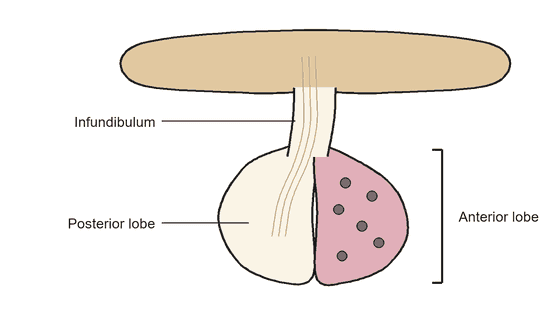
Concept: The pituitary has two lobes. The anterior lobe makes growth hormone, prolactin and the tropic hormones (TSH, ACTH, FSH, LH). The posterior lobe releases ADH (vasopressin) and oxytocin, which are made in the hypothalamus and stored in the posterior lobe.
Step 1 — Part (i): identify and locate the gland.
A small gland hanging by a stalk (the infundibulum) from the base of the brain, with a posterior and an anterior lobe, is the pituitary gland. It is about the size of a pea and hangs from the base of the brain, just below the hypothalamus.
Step 2 — Part (ii): why it is the master gland.
Its anterior lobe makes tropic hormones that control several other endocrine glands (TSH the thyroid, ACTH the adrenal cortex, FSH and LH the gonads), so it seems to control the whole endocrine system.
Step 3 — Part (iii): diabetes insipidus and how it differs.
A deficiency of ADH (vasopressin) causes diabetes insipidus. The table compares it with diabetes mellitus.
Basis Diabetes mellitus Diabetes insipidus Hormone lacking or not working Insulin ADH (vasopressin) Gland concerned Pancreas (beta cells of the islets) Pituitary (posterior lobe) Sugar in urine Present Absent (urine watery) Blood sugar High Normal In both, a large amount of urine is passed and the person feels thirsty.
Step 4 — Part (iv): hormone, and the role of tropic hormones.
A hormone is a secretion of a ductless gland poured directly into the blood, which carries it to target organs where it acts. Tropic hormones stimulate other endocrine glands to make their own hormones, for example TSH makes the thyroid release thyroxine.
Step 5 — Part (v): the lobe for each hormone.
We place each hormone in its lobe.
- (a) Oxytocin: posterior lobe (it is made in the hypothalamus and released here)
- (b) ACTH: anterior lobe
- (c) Growth hormone: anterior lobe
Watch out: The posterior lobe releases only ADH and oxytocin; every other pituitary hormone named in this chapter comes from the anterior lobe.
Therefore, (i) pituitary gland, hanging from the base of the brain below the hypothalamus; (ii) its tropic hormones control other glands; (iii) ADH, and unlike diabetes mellitus there is no sugar in the urine; (iv) a hormone is a blood-borne secretion of a ductless gland, and tropic hormones stimulate other glands; (v) (a) posterior, (b) anterior, (c) anterior.
- 201 mark
Question 20
Given below are certain groups of terms. In each group the first pair indicates a relationship between the two terms. Rewrite and complete the second pair on a similar basis.
Example: Cytoplasm : Cytokinesis :: Nucleus : Karyokinesis.
(i) Widening of hips: Oestrogen :: Deepening of voice in males :
Solve with AIWritten solution
Solution:
Concept: The first pair links a secondary sexual character to the sex hormone that brings it about; the second pair must do the same.
Step 1 — Read the first pair.
Widening of the hips is a female character brought about by the female hormone oestrogen from the ovaries.
Step 2 — Complete the second pair.
Deepening of the voice in males is brought about by the male hormone testosterone, made by the testes; it also brings the growth of the beard and moustache.
Therefore, Widening of hips : Oestrogen :: Deepening of voice in males : Testosterone.
- 211 mark
Question 21
Given below are certain groups of terms. In each group the first pair indicates a relationship between the two terms. Rewrite and complete the second pair on a similar basis.
Example: Cytoplasm : Cytokinesis :: Nucleus : Karyokinesis.
(iii) Insulin : Beta-cells :: Glucagon :
Solve with AIWritten solution
Solution:
Concept: The pancreas is both a duct gland and a ductless gland. Its endocrine part is the islets of Langerhans: the alpha (α) cells make glucagon (raises blood sugar) and the beta (β) cells make insulin (lowers blood sugar).
Step 1 — Read the first pair.
Insulin is made by the beta cells of the islets of Langerhans.
Step 2 — Complete the second pair.
Glucagon is made by the alpha cells of the same islets. It makes the liver break down glycogen into glucose, which raises the blood sugar.
Watch out: Alpha goes with glucagon and beta with insulin; do not swap them.
Therefore, Insulin : Beta-cells :: Glucagon : Alpha-cells.
- 221 mark
Question 22
Identify the ODD term in each set and name the CATEGORY to which the remaining three belong:
(iv) Exophthalmic Goiter, Simple Goitre, Cretinism, Myxoedema
Solve with AIWritten solution
Solution:
Concept: In an odd-one-out item, find what three of the terms share (the category), and then name the one term that does not share it. The thyroid gland in the neck makes thyroxine, which contains iodine. Thyroxine sets the basal metabolic rate (how fast the cells release energy at rest) and is needed for normal growth and mental development.
Step 1 — Find the cause of each disorder.
All four are thyroid disorders, so we ask whether each comes from too little or too much thyroxine.
- Simple goitre: too little thyroxine (lack of iodine), so the thyroid enlarges.
- Cretinism: too little thyroxine in childhood.
- Myxoedema: too little thyroxine in adults.
- Exophthalmic goitre: too much thyroxine (hyperthyroidism).
Step 2 — Pick the odd term.
Three come from hyposecretion; exophthalmic goitre alone comes from hypersecretion.
Watch out: Both kinds of goitre swell the neck, but they have opposite causes.
Therefore, the odd term is Exophthalmic Goiter; the others are disorders due to hyposecretion of thyroxine.
- 231 mark
Question 23
Give appropriate biological technical terms for the following:
(v) Condition when blood sugar level is lowered in the blood.
Solve with AIWritten solution
Solution:
Concept: In medical words, hypo- means below, glyc means sugar and -emia means in the blood.
Step 1 — Build the word.
A lowered blood sugar level is "sugar below normal in the blood", that is hypoglycemia.
Step 2 — Give the context.
It can happen when there is too much insulin, for example an overdose of insulin in a diabetic patient. If the level falls very low the brain is starved of glucose and the person may faint, so eating something sweet at once helps.
Watch out: Hyperglycemia is the opposite, a high blood sugar level.
Therefore, the term is hypoglycemia.
- 245 marks
Question 24
Complete the table:
Name of the Hormone Endocrine Gland Function (i) (ii) Deposits extra glucose of blood as glycogen Growth Hormone (iii) (iv) (v) Thyroid (vi) (vii) (viii) Prepare body for any emergency Oxytocin (ix) (x) Solve with AIWritten solution
Solution:
Concept: Fill each row from what is given: an action names the hormone, a hormone names its gland, and the gland and hormone give the action.
Step 1 — Row 1: deposits extra blood glucose as glycogen.
Storing extra glucose as glycogen in the liver and muscles is the work of (i) insulin, made by (ii) the pancreas (beta cells of the islets of Langerhans).
Step 2 — Row 2: growth hormone.
Growth hormone is made by (iii) the pituitary gland (anterior lobe). (iv) It promotes the growth of the whole body, especially of the bones.
Step 3 — Row 3: thyroid.
The thyroid makes (v) thyroxine. (vi) It regulates the basal metabolic rate (and is needed for growth and mental development).
Step 4 — Row 4: prepares the body for an emergency.
The emergency hormone is (vii) adrenaline, made by (viii) the adrenal gland (adrenal medulla).
Step 5 — Row 5: oxytocin.
Oxytocin is released by (ix) the pituitary gland (posterior lobe). (x) It causes strong contractions of the uterus during childbirth (and helps the milk to flow out).
Step 6 — Write the completed table.
The filled-in table reads:
Name of the Hormone Endocrine Gland Function Insulin Pancreas (islets of Langerhans) Deposits extra glucose of blood as glycogen Growth Hormone Pituitary (anterior lobe) Growth of the body, especially the bones Thyroxine Thyroid Regulates basal metabolism Adrenaline Adrenal gland (medulla) Prepare body for any emergency Oxytocin Pituitary (posterior lobe) Contraction of the uterus during childbirth Watch out: Glucagon does the opposite of row 1: it breaks glycogen down into glucose.
Therefore, (i) insulin, (ii) pancreas, (iii) pituitary (anterior lobe), (iv) growth of the body, (v) thyroxine, (vi) regulates basal metabolism, (vii) adrenaline, (viii) adrenal gland, (ix) pituitary (posterior lobe), (x) contraction of the uterus during childbirth.
- 251 mark
Question 25
Gigantism and Acromegaly are due to:
Solve with AIAnswer
- Correct
(A) Hypersecretion of Growth hormone
(B) Hypersecretion of Thyroxine
(C) Hyposecretion of Growth hormone
(D) Hyposecretion of Thyroxine
Answer: (A) Hypersecretion of Growth hormone
Concept: Growth hormone (GH, somatotropin) from the anterior pituitary controls the growth of the body, especially of the bones. Too much or too little of it changes height, and the effect depends on whether the fault starts in childhood or in adult life.
Step 1 — Gigantism.
Too much growth hormone in childhood makes the long bones lengthen far beyond normal, so the child grows into a giant.
Step 2 — Acromegaly.
Too much growth hormone starting in an adult cannot lengthen the long bones any more, so the bones of the face (especially the jaws), hands and feet grow large instead.
Step 3 — Find the common cause.
Both come from hypersecretion of growth hormone; only the age differs.
Watch out: Gigantism and acromegaly are both caused by too MUCH growth hormone; too little gives dwarfism.
Why the other options are wrong:
- (B) Hypersecretion of Thyroxine: Too much thyroxine causes exophthalmic goitre, not giant growth.
- (C) Hyposecretion of Growth hormone: Too little growth hormone in childhood causes dwarfism, the opposite of gigantism.
- (D) Hyposecretion of Thyroxine: Too little thyroxine causes simple goitre, cretinism or myxoedema, not overgrowth of the bones.
Therefore, gigantism and acromegaly are due to hypersecretion of growth hormone, option (A).
- 261 mark
Question 26
Islets of Langerhans are located in
Solve with AIAnswer
(A) Liver
(B) Pituitary gland
(C) Spleen
- Correct
(D) Pancreas
Answer: (D) Pancreas
Concept: The pancreas is both a duct gland and a ductless gland. Its endocrine part is the islets of Langerhans: the alpha (α) cells make glucagon (raises blood sugar) and the beta (β) cells make insulin (lowers blood sugar).
Step 1 — Recall the pancreas as a duct gland.
As a duct gland, the pancreas pours pancreatic juice through its duct into the duodenum for digestion.
Step 2 — Find its endocrine part.
Scattered inside it are small groups of hormone-making cells, the islets of Langerhans, which pour insulin and glucagon straight into the blood.
Why the other options are wrong:
- (A) Liver: The liver stores glycogen under the control of insulin and glucagon, but it has no islets.
- (B) Pituitary gland: The pituitary is made of an anterior and a posterior lobe; it has no islets.
- (C) Spleen: The spleen is a lymphatic organ that filters the blood; it has no islets of Langerhans.
Therefore, the islets of Langerhans are located in the pancreas, option (D).
- 272 marks
Question 27
Simple goitre is usually seen in people living in the hilly regions. Give two reasons for the statement.
Solve with AIWritten solution
Solution:
Concept: Simple goitre is an enlargement of the thyroid gland. The thyroid needs iodine to make thyroxine; when it cannot make enough, the gland grows larger.
Step 1 — Reason 1: little iodine in the soil, water and food.
In hilly regions, rain and melting snow wash much of the iodine out of the soil, so the soil, the water and the food grown there are poor in iodine; people there also eat little sea food, which is rich in iodine. So their diet lacks iodine.
Step 2 — Reason 2: too little thyroxine, so the thyroid enlarges.
Iodine is a part of the thyroxine molecule. With too little iodine the thyroid cannot make enough thyroxine, so the pituitary keeps sending TSH and the gland enlarges, showing as a swelling in the neck.

Step 3 — Link to prevention.
This is why iodised salt is used in food: it supplies the iodine and prevents simple goitre.
Watch out: Simple goitre is caused by too LITTLE thyroxine (from lack of iodine), not by too much.
Therefore, people in hilly regions get simple goitre because their soil, water and food lack iodine, and without iodine the thyroid cannot make enough thyroxine and enlarges.
- 282 marks
Question 28
What is Adrenal Virilism? What causes this condition?
Solve with AIWritten solution
Solution:
Concept: Each adrenal gland sits like a cap on top of a kidney. Its outer cortex makes the corticoids (cortisol, called cortisone in the book; aldosterone; and the sex corticoids), and its inner medulla makes adrenaline, the emergency hormone. The sex corticoids include male-type hormones (adrenal androgens).
Step 1 — Define adrenal virilism.
Adrenal virilism is a condition in which a woman develops male features, such as a beard, a moustache, more body hair and a deep voice (Latin virilis: male).
Step 2 — State the cause.
It is caused by an overgrowth (overactivity) of the adrenal cortex, which then secretes too much of the sex corticoids, the male-type hormones.
Watch out: The cause is the adrenal cortex, not the adrenal medulla (which makes adrenaline).
Therefore, adrenal virilism is the development of male features in a woman, caused by an overactive adrenal cortex secreting too much of the male-type sex corticoids.
- 292 marks
Question 29
Name the endocrine gland that secretes Thyroxine. Give any one function of Thyroxine.
Solve with AIWritten solution
Solution:
Concept: The thyroid gland in the neck makes thyroxine, which contains iodine. Thyroxine sets the basal metabolic rate (how fast the cells release energy at rest) and is needed for normal growth and mental development.
Step 1 — Name the gland.
Thyroxine is secreted by the thyroid gland, the butterfly-shaped gland in the front of the neck below the larynx.
Step 2 — Give one function.
Thyroxine regulates the basal metabolic rate, the rate at which the cells oxidise food to release energy and heat at rest. (It is also needed for normal growth, development of the bones and mental development; any one function is enough.)
Therefore, thyroxine is secreted by the thyroid gland, and it regulates the basal metabolic rate.
- 302 marks
Question 30
Give the full form of the abbreviation ACTH. Which gland secretes this hormone?
Solve with AIWritten solution
Solution:
Concept: ACTH is a tropic hormone; its name gives its target, the adrenal cortex.
Step 1 — Expand the abbreviation.
ACTH stands for Adrenocorticotropic Hormone (adreno = adrenal, cortico = cortex, tropic = stimulating).
Step 2 — Name the gland that secretes it.
It is secreted by the anterior lobe of the pituitary gland, and it stimulates the adrenal cortex to secrete its hormones.
Watch out: ACTH is made by the pituitary, not by the adrenal gland; the adrenal cortex is only its target.
Therefore, ACTH is Adrenocorticotropic Hormone, secreted by the anterior pituitary.
- 312 marks
Question 31
Name the hormones whose deficiency causes :
(a) Diabetes mellitus
(b) Diabetes insipidus
Solve with AIWritten solution
Solution:
Concept: The two kinds of diabetes are caused by two different hormones. ADH (antidiuretic hormone, vasopressin) is made in the hypothalamus and released by the posterior pituitary. It makes the kidney tubules take back (reabsorb) more water from the urine being formed, so less, more concentrated urine is passed.
Step 1 — Part (a): diabetes mellitus.
Diabetes mellitus is due to a deficiency of insulin, the hormone of the beta cells of the islets of Langerhans. Without enough insulin the blood sugar rises and sugar is passed in the urine.
Step 2 — Part (b): diabetes insipidus.
Diabetes insipidus is due to a deficiency of antidiuretic hormone (ADH), also called vasopressin, released by the posterior pituitary. Without it the kidney tubules reabsorb little water, so a large amount of watery urine with no sugar is passed.
Watch out: Both disorders give a lot of urine, but only diabetes mellitus puts sugar in it.
Therefore, (a) insulin and (b) antidiuretic hormone (ADH, vasopressin).
- 321 mark
Question 32
Alpha cells of Pancreas secrete:
Solve with AIAnswer
(A) Glycogen
(B) Glucose
- Correct
(C) Glucagon
(D) Insulin
Answer: (C) Glucagon
Concept: The pancreas is both a duct gland and a ductless gland. Its endocrine part is the islets of Langerhans: the alpha (α) cells make glucagon (raises blood sugar) and the beta (β) cells make insulin (lowers blood sugar).
Step 1 — Recall the cells of an islet.
An islet of Langerhans has alpha cells and beta cells, and each kind makes its own hormone.
Step 2 — Name the alpha-cell hormone.
The alpha cells secrete glucagon. Glucagon makes the liver break down stored glycogen into glucose, so the blood sugar rises when it has fallen too low.
Watch out: Glucagon (the hormone) and glycogen (the stored carbohydrate) sound alike but are different substances.
Why the other options are wrong:
- (A) Glycogen: Glycogen is the carbohydrate stored in the liver and muscles; it is not a secretion of the alpha cells.
- (B) Glucose: Glucose is the sugar carried in the blood; it comes from food and from glycogen, not from the alpha cells.
- (D) Insulin: Insulin is secreted by the beta cells of the islets, not by the alpha cells.
Therefore, the alpha cells of the pancreas secrete glucagon, option (C).
- 335 marks
Question 33
Match the items given in Column I with most appropriate ones in Column II and rewrite the correct matching pairs:
Column I Column II (a) Hyposecretion of Thyroxine in adults 1. Diabetes insipidus (b) Hyposecretion of Insulin 2. Myxoedema (c) Hypersecretion of Growth hormone in childhood 3. Dwarfism (d) Hyposecretion of ADH 4. Gigantism (e) Hypersecretion of Thyroxine 5. Diabetes mellitus 6. Exophthalmic goitre 7. Cretinism Solve with AIWritten solution
Solution:
Concept: For each disorder ask which hormone is involved, whether it is too little or too much, and at what age. Column II has seven items for five, so two are left over.
Step 1 — Match (a).
Too little thyroxine in an adult makes the person sluggish, with a puffy face and hands. Pair: (a) – 2. Myxoedema.
Step 2 — Match (b).
Too little insulin keeps the blood sugar high and puts sugar in the urine. Pair: (b) – 5. Diabetes mellitus.
Step 3 — Match (c).
Too much growth hormone in childhood makes the long bones grow far beyond normal. Pair: (c) – 4. Gigantism.
Step 4 — Match (d).
Too little ADH makes the kidneys pass a lot of watery urine with no sugar, with great thirst. Pair: (d) – 1. Diabetes insipidus.
Step 5 — Match (e).
Too much thyroxine gives bulging eyes, a goitre and a high metabolic rate. Pair: (e) – 6. Exophthalmic goitre.
Step 6 — Note the items left over.
Two items are not used: 3. Dwarfism (too little growth hormone in childhood) and 7. Cretinism (too little thyroxine in childhood).
Watch out: (a) says 'in adults', so the answer is myxoedema; cretinism is the childhood form.
Therefore, (a) – 2, (b) – 5, (c) – 4, (d) – 1, (e) – 6.
- 341 mark
Question 34
State the exact location of the following structures:
(a) Thyroid gland
Solve with AIWritten solution
Solution:
Concept: "Exact location" means naming the body region and the organs the structure lies next to. The thyroid gland in the neck makes thyroxine, which contains iodine. Thyroxine sets the basal metabolic rate (how fast the cells release energy at rest) and is needed for normal growth and mental development.
Step 1 — Name the body region.
The thyroid gland lies in the neck, in front of the wind pipe, just below the larynx (voice box).
Step 2 — Describe how it sits.
It is a bilobed, butterfly-shaped gland. Its two lobes lie on either side of the trachea (wind pipe) and are joined across the front of the trachea by a narrow band, the isthmus.
Watch out: The thyroid is in the neck below the larynx, not in the brain (that is the pituitary) or on the kidneys (the adrenals).
Therefore, the thyroid gland lies in the front of the neck just below the larynx, its two lobes on either side of the trachea joined by the isthmus.
- 351 mark
Question 35
State the exact location of the following structures:
(e) Islets of Langerhans
Solve with AIWritten solution
Solution:
Concept: The pancreas is both a duct gland and a ductless gland. Its endocrine part is the islets of Langerhans: the alpha (α) cells make glucagon (raises blood sugar) and the beta (β) cells make insulin (lowers blood sugar).
Step 1 — Name the organ.
The islets of Langerhans are the endocrine part of the pancreas, small groups of hormone-making cells scattered throughout the pancreas among the cells that make pancreatic juice.
Step 2 — Place the organ in the body.
The pancreas lies in the abdomen, behind and just below the stomach, with its head held in the C-shaped loop of the duodenum.
Watch out: The islets are not a separate gland next to the pancreas; they lie inside it.
Therefore, the islets of Langerhans are scattered throughout the pancreas, which lies below the stomach in the loop of the duodenum.
- 361 mark
Question 36
The hormone that affects urination is:
Solve with AIAnswer
(A) Adrenaline
- Correct
(B) Vasopressin
(C) Oestrogen
(D) Thyroxine
Answer: (B) Vasopressin
Concept: ADH (antidiuretic hormone, vasopressin) is made in the hypothalamus and released by the posterior pituitary. It makes the kidney tubules take back (reabsorb) more water from the urine being formed, so less, more concentrated urine is passed.
Step 1 — Find the hormone acting on the kidney.
Urination depends on how much water the kidney tubules take back into the blood, and the hormone that controls this is vasopressin (ADH).
Step 2 — See its effect.
More vasopressin means more water is reabsorbed and less urine is passed; too little vasopressin means a lot of dilute urine (diabetes insipidus).
Why the other options are wrong:
- (A) Adrenaline: Adrenaline is the emergency hormone that prepares the body for fight or flight; it does not control the water in urine.
- (C) Oestrogen: Oestrogen is the female sex hormone that brings about the female secondary sexual characters.
- (D) Thyroxine: Thyroxine regulates the basal metabolic rate, not the amount of urine.
Therefore, the hormone that affects urination is vasopressin, option (B).
- 371 mark
Question 37
Match the items given in Column I with most appropriate ones in Column II and rewrite the correct matching pairs:
Column I: (e) Cretinism
Column II: Lack of thyroxine in children; 12 pairs; Testosterone; Diffusion of respiratory gases; Haploid cells; 31 Pairs; Diploid cells
Solve with AIWritten solution
Solution:
Concept: The thyroid gland in the neck makes thyroxine, which contains iodine. Thyroxine sets the basal metabolic rate (how fast the cells release energy at rest) and is needed for normal growth and mental development.
Step 1 — Recall what cretinism is.
Cretinism is a disorder of children in which growth is stunted (dwarfism) and mental development is poor.
Step 2 — Find its cause in Column II.
It is caused by too little thyroxine in childhood, from poor development or early failure of the thyroid, so the match is 'Lack of thyroxine in children'. The other items belong to other chapters.
Therefore, Cretinism – Lack of thyroxine in children.
- 382 marks
Question 38
Distinguish between Diabetes mellitus and Diabetes insipidus (endocrine gland concerned).
Solve with AIWritten solution
Solution:
Concept: Both disorders make a person pass a lot of urine, but different hormones from different glands are involved. Diabetes mellitus is a disorder in which the blood sugar stays high because the pancreas makes too little insulin or the body's cells respond poorly to it; the extra sugar is passed in the urine.
Step 1 — Name the gland and hormone for each.
We compare the two on the basis asked for, the endocrine gland concerned, and add the hormone.
Basis Diabetes mellitus Diabetes insipidus Endocrine gland concerned Pancreas (beta cells of the islets of Langerhans) Pituitary gland (posterior lobe) Hormone involved Insulin ADH (vasopressin) Urine Contains sugar Watery, no sugar Watch out: The question asks for the GLAND; naming only the hormone is not enough.
Therefore, diabetes mellitus concerns the pancreas (islets of Langerhans, insulin), while diabetes insipidus concerns the pituitary gland (posterior lobe, ADH).
- 391 mark
Question 39
Define the term hormone.
Solve with AIWritten solution
Solution:
Concept: A hormone is a chemical messenger made by an endocrine (ductless) gland. It is poured straight into the blood, carried round the body, and acts on particular target organs or cells, usually far from the gland that made it.
Step 1 — Say where it is made.
A hormone is made by an endocrine (ductless) gland or glandular tissue.
Step 2 — Say how it travels.
It is poured directly into the blood, not through a duct, and the blood carries it round the body.
Step 3 — Say how it acts.
It acts on particular target organs or cells, usually far from the gland, and so brings about coordination between distant parts of the body. Only a tiny amount is needed.
Watch out: An enzyme such as pepsin also comes from a gland, but it leaves through a duct and acts where it is poured; a hormone goes into the blood.
Therefore, a hormone is a secretion of a ductless gland poured directly into the blood, which carries it to target organs where it acts.
- 401 mark
Question 40
Name the mineral elements required for:
(b) Synthesis of thyroxine
Solve with AIWritten solution
Solution:
Concept: The thyroid gland in the neck makes thyroxine, which contains iodine. Thyroxine sets the basal metabolic rate (how fast the cells release energy at rest) and is needed for normal growth and mental development.
Step 1 — Name the element.
Thyroxine molecules contain iodine, so the thyroid needs iodine from the diet to make it.
Step 2 — Link to health.
Too little iodine in the diet leads to too little thyroxine and simple goitre; iodised salt is used to prevent it.
Therefore, the mineral element needed for the synthesis of thyroxine is iodine.
- 411 mark
Question 41
The hormone that induces vigorous contractions of the uterus in a pregnant mother is:
Solve with AIAnswer
(A) Oestrogen
(B) Prolactin
- Correct
(C) Oxytocin
(D) Progesterone
Answer: (C) Oxytocin
Concept: The pituitary has two lobes. The anterior lobe makes growth hormone, prolactin and the tropic hormones (TSH, ACTH, FSH, LH). The posterior lobe releases ADH (vasopressin) and oxytocin, which are made in the hypothalamus and stored in the posterior lobe.
Step 1 — Identify the action.
The hormone wanted makes the muscles of the uterus contract strongly at the end of pregnancy, which pushes the baby out.
Step 2 — Name the hormone.
This is oxytocin (Greek: quick birth), released by the posterior pituitary. After birth it also helps the milk to flow out of the breasts.
Watch out: Prolactin helps MAKE milk; oxytocin contracts the uterus and lets the milk flow out.
Why the other options are wrong:
- (A) Oestrogen: Oestrogen is the female sex hormone from the ovaries; it builds up the uterus lining and brings about the female secondary sexual characters.
- (B) Prolactin: Prolactin from the anterior pituitary stimulates milk production in the breasts.
- (D) Progesterone: Progesterone (from the corpus luteum, and later from the placenta) keeps the uterus lining in place and keeps the uterus quiet during pregnancy.
Therefore, the hormone that induces vigorous contractions of the uterus is oxytocin, option (C).
- 421 mark
Question 42
Assertion (A): Deficiency of Antidiuretic hormone causes an increase in urination.
Reason (R): Antidiuretic hormone acts on the kidney to reabsorb water from the kidney tubules.
Solve with AIAnswer
(A) A is True and R is False
(B) A is False and R is True
- Correct
(C) Both A and R are True
(D) Both A and R are False
Answer: (C) Both A and R are True
Concept: In an assertion-reason item, judge the Assertion and the Reason separately as true or false, and then decide whether the Reason explains the Assertion. ADH (antidiuretic hormone, vasopressin) is made in the hypothalamus and released by the posterior pituitary. It makes the kidney tubules take back (reabsorb) more water from the urine being formed, so less, more concentrated urine is passed.
Step 1 — Judge the Assertion.
A lack of ADH means the kidney tubules reabsorb little water, so a large amount of urine is passed (diabetes insipidus). The Assertion is true.
Step 2 — Judge the Reason.
ADH does act on the kidney and makes the tubules reabsorb water. The Reason is true.
Step 3 — Choose the option.
Both statements are true, so the answer is option (C). (The Reason also explains the Assertion: with less ADH, less water is taken back and more urine is passed.)
Why the other options are wrong:
- (A) A is True and R is False: The Reason is a correct statement of what ADH does, so it is not false.
- (B) A is False and R is True: The Assertion is true: a lack of ADH does increase urination.
- (D) Both A and R are False: Both statements are true, so 'both false' cannot be right.
Therefore, both A and R are true, option (C).
- 431 mark
Question 43
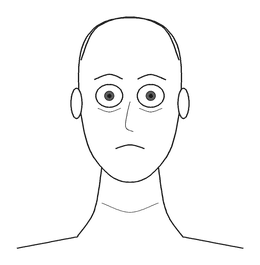
Observe the following picture, identify the defect and the cause of the defect.
 Solve with AI
Answer
(A) Simple goitre, under secretion of thyroxine.
- Correct
(B) Ex-ophthalmic goitre, over secretion of thyroxine.
(C) Simple goitre, over secretion of thyroxine.
(D) Ex-ophthalmic goitre, under secretion of thyroxine.
Answer: (B) Ex-ophthalmic goitre, over secretion of thyroxine.
Concept: The thyroid gland in the neck makes thyroxine, which contains iodine. Thyroxine sets the basal metabolic rate (how fast the cells release energy at rest) and is needed for normal growth and mental development.
Step 1 — Look at the picture.
The face in the picture has bulging (protruding), staring eyes.
Step 2 — Identify the defect.
Protruding eyes are the mark of exophthalmic goitre (exo: outward, ophthalmos: eye), which also brings a swelling in the neck, a high metabolic rate, a fast heart beat and loss of weight.
Step 3 — Find the cause.
Exophthalmic goitre is due to over secretion of thyroxine (hyperthyroidism).
Watch out: The word 'goitre' alone does not tell the cause; bulging eyes point to too MUCH thyroxine.
Why the other options are wrong:
- (A) Simple goitre, under secretion of thyroxine: Simple goitre (from too little thyroxine) swells the neck but does not make the eyes bulge.
- (C) Simple goitre, over secretion of thyroxine: Simple goitre is due to under secretion of thyroxine, not over secretion, and it gives no bulging eyes.
- (D) Ex-ophthalmic goitre, under secretion of thyroxine: Exophthalmic goitre is caused by over secretion of thyroxine, not under secretion.
Therefore, the defect is exophthalmic goitre, due to over secretion of thyroxine, option (B).
- 441 mark
Question 44
Arrange the terms in each group in the correct order. Write them in a logical sequence beginning with the term that is underlined.
(d) Insulin release, , Lowers blood sugar, Stimulates glucose uptake from blood.
Solve with AIWritten solution
Solution:
Concept: Insulin is released when the blood sugar rises, and it brings the level back down by making the body cells take up glucose.
Step 1 — Start: High blood sugar.
After a meal, glucose absorbed from the food raises the blood sugar level.
Step 2 — Next: Insulin release.
The beta cells of the islets of Langerhans sense the high sugar and release insulin into the blood.
Step 3 — Next: Stimulates glucose uptake from blood.
Insulin makes the body cells take up and use glucose, and makes the liver and muscles store the extra as glycogen.
Step 4 — Last: Lowers blood sugar.
As glucose leaves the blood, the blood sugar falls back to normal.
Watch out: Insulin release comes after the rise in blood sugar, because the rise is what triggers it.
Therefore, the sequence is High blood sugar → Insulin release → Stimulates glucose uptake from blood → Lowers blood sugar.
- 455 marks
Question 45
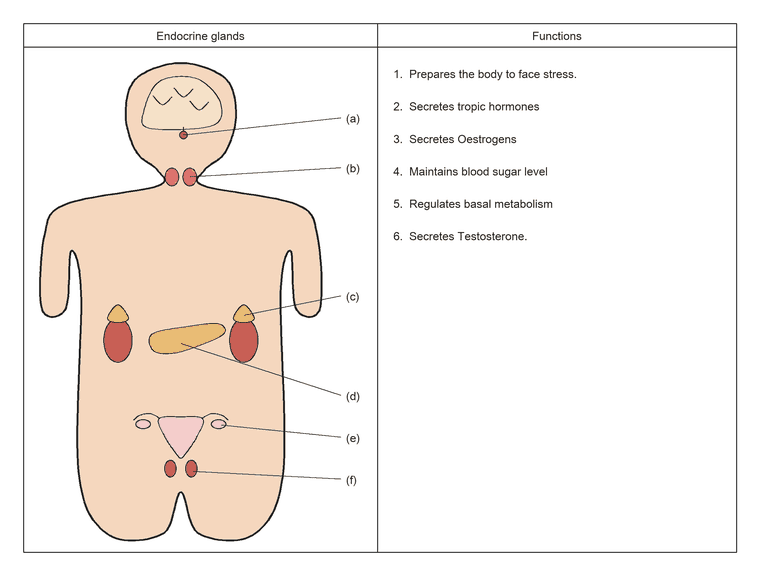
Given below is an outline of the human body showing the important endocrine glands. Match the glands marked (a) to (e) with their correct functions:
Example: (f) – 6. Secretes Testosterone.
 Solve with AI
Written solution
Solution:
Concept: First identify each marked gland from its position, then pick the function of its hormone. The example (f) is the testis.

Step 1 — Gland (a).
(a) hangs below the brain, so it is the pituitary gland; its anterior lobe makes the tropic hormones. Pair: (a) – 2. Secretes tropic hormones.
Step 2 — Gland (b).
(b) is in the neck, so it is the thyroid gland; its thyroxine regulates basal metabolism. Pair: (b) – 5. Regulates basal metabolism.
Step 3 — Gland (c).
(c) sits on top of the kidney, so it is the adrenal gland; its adrenaline prepares the body to face stress. Pair: (c) – 1. Prepares the body to face stress.
Step 4 — Gland (d).
(d) lies across the abdomen between the kidneys, so it is the pancreas; insulin and glucagon from its islets keep the blood sugar level steady. Pair: (d) – 4. Maintains blood sugar level.
Step 5 — Gland (e).
(e) lies beside the uterus, so it is the ovary, which secretes the female hormones (oestrogens, and also progesterone). Pair: (e) – 3. Secretes Oestrogens.
Watch out: (c) and (d) are close together: the adrenal is the small cap ON the kidney, the pancreas is the long gland between the kidneys.
Therefore, (a) – 2, (b) – 5, (c) – 1, (d) – 4, (e) – 3.
- 461 mark
Question 46
Read the explanations given below and name the structures:
Example: A cord that connects the placenta with the foetus.
Answer: Umbilical cord
(b) The cells of the islets of Langerhans that secrete the hormone glucagon.
Solve with AIWritten solution
Solution:
Concept: The pancreas is both a duct gland and a ductless gland. Its endocrine part is the islets of Langerhans: the alpha (α) cells make glucagon (raises blood sugar) and the beta (β) cells make insulin (lowers blood sugar).
Step 1 — Read the description.
We need the cells of the islets of Langerhans that make glucagon.
Step 2 — Name them.
Glucagon is made by the alpha (α) cells; it makes the liver turn glycogen into glucose, raising the blood sugar. (The beta cells make insulin.)
Watch out: Alpha goes with glucagon and beta with insulin; do not swap them.
Therefore, the structures are the alpha (α) cells.
- 471 mark
Question 47
Ram has protruding eyes and a high metabolic rate. Name the hormone responsible for this condition.
Solve with AIWritten solution
Solution:
Concept: The thyroid gland in the neck makes thyroxine, which contains iodine. Thyroxine sets the basal metabolic rate (how fast the cells release energy at rest) and is needed for normal growth and mental development.
Step 1 — Identify the condition.
Protruding eyes together with a high metabolic rate are the signs of exophthalmic goitre.
Step 2 — Name the hormone.
Exophthalmic goitre is caused by too much thyroxine (hyperthyroidism) from the thyroid gland; the extra thyroxine also speeds up the heart beat and causes loss of weight.
Watch out: The hormone is thyroxine; the problem is too MUCH of it, not too little.
Therefore, the hormone responsible is thyroxine (its over secretion).
- 481 mark
Question 48
Expand the following abbreviations:
(a) ACTH
Solve with AIWritten solution
Solution:
Concept: ACTH is one of the tropic hormones of the anterior pituitary.
Step 1 — Expand the letters.
ACTH stands for Adrenocorticotropic Hormone.
Step 2 — Say what it does.
It is made by the anterior pituitary and stimulates the adrenal cortex to secrete its hormones.
Therefore, ACTH is Adrenocorticotropic Hormone.
- 492 marks
Question 49
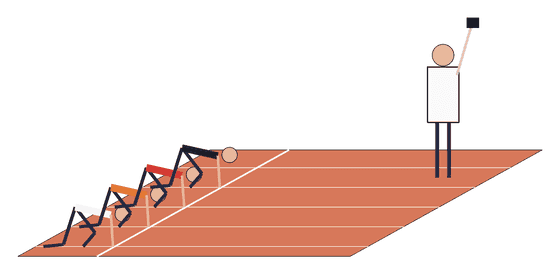
The picture given below shows the athletes lined up at the starting line. The countdown begins and all are focused and alert waiting for the gunshot.
(a) Which hormone prepares the body in such a situation given above?
(b) Name the endocrine gland that secretes the hormone mentioned in (a).
Solve with AIWritten solution
Solution:
Concept: Adrenaline is the emergency hormone, made by the adrenal medulla. In fear, excitement or stress it gets the body ready for sudden action ("fight or flight").
Step 1 — Read the situation.
The athletes at the start line are excited, alert and waiting for the gun, which is a moment of stress that needs sudden, strong action.
Step 2 — Part (a): the hormone.
Adrenaline prepares the body for this. It makes the heart beat faster, breathing faster and deeper, sends more blood to the muscles and makes the liver release glucose, so the muscles are ready for a burst of effort.
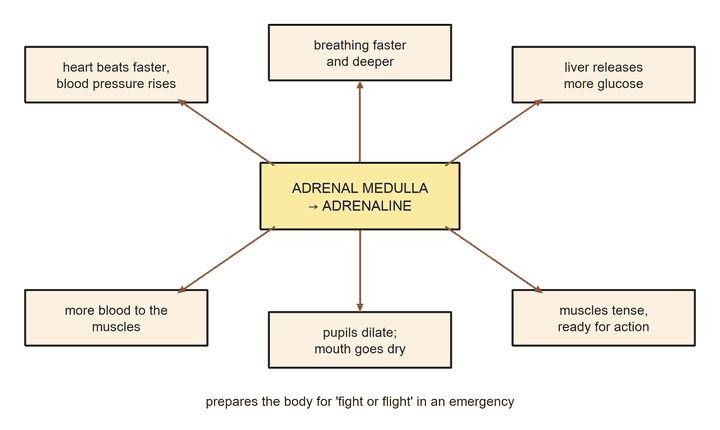
Step 3 — Part (b): the gland.
Adrenaline is secreted by the adrenal gland, from its inner part, the adrenal medulla.
Watch out: The adrenal CORTEX makes the corticoids; adrenaline comes from the MEDULLA.
Therefore, (a) adrenaline prepares the body, and (b) it is secreted by the adrenal gland (adrenal medulla).
- 501 mark
Question 50
Choose the odd one out from the following terms and name the category to which the others belong:
(b) Growth Hormone, Vasopressin, Thyroid Stimulating Hormone, Gonadotropic Hormone
Solve with AIWritten solution
Solution:
Concept: In an odd-one-out item, find what three of the terms share (the category), and then name the one term that does not share it. The pituitary has two lobes. The anterior lobe makes growth hormone, prolactin and the tropic hormones (TSH, ACTH, FSH, LH). The posterior lobe releases ADH (vasopressin) and oxytocin, which are made in the hypothalamus and stored in the posterior lobe.
Step 1 — Place each hormone in its lobe.
We note which lobe of the pituitary each hormone comes from.
- Growth hormone: anterior lobe.
- Thyroid stimulating hormone: anterior lobe.
- Gonadotropic hormone (FSH, LH): anterior lobe.
- Vasopressin (ADH): released by the posterior lobe.
Step 2 — Pick the odd one.
Three come from the anterior lobe; vasopressin alone comes from the posterior lobe and acts on the kidney tubules.
Watch out: Growth hormone is not a tropic hormone (it acts on the body directly), so the safe category is 'hormones of the anterior pituitary'.
Therefore, the odd one is Vasopressin; the others are hormones of the anterior pituitary.
- 515 marks
Question 51
Mohit, a 30-year-old man was a software professional leading a sedentary life. He showed signs of high blood sugar during a routine health check-up despite having a normal body weight.

Answer the following :
(a) The hormonal disorder he is suffering from.
(b) The hormone responsible for this disorder.
(c) The organ that secretes this hormone.
(d) One symptom experienced by Mohit due to this disorder.
(e) One change in lifestyle to lower the blood sugar level.
Solve with AIWritten solution
Solution:
Concept: Diabetes mellitus is a disorder in which the blood sugar stays high because the pancreas makes too little insulin or the body's cells respond poorly to it; the extra sugar is passed in the urine.
Step 1 — Part (a): the disorder.
A high blood sugar found at a check-up points to diabetes mellitus.
Step 2 — Part (b): the hormone.
The hormone concerned is insulin, which normally lowers the blood sugar.
Note: in an adult like Mohit, the usual form (type 2) comes mainly from the body's cells responding poorly to insulin, helped by an inactive life; the hormone involved is still insulin.
Step 3 — Part (c): the organ.
Insulin is made by the pancreas, in the beta cells of its islets of Langerhans.
Step 4 — Part (d): one symptom.
Any one of these: passing a lot of urine often (with sugar in it); great thirst from the water lost in urine; tiredness and weakness, with loss of weight.
Step 5 — Part (e): one lifestyle change.
Regular physical exercise (a daily walk, yoga or a sport) instead of a sedentary routine helps, because working muscles use up glucose and respond better to insulin. A balanced diet with less sugar and refined food also helps.
Watch out: Hyperglycaemia is a SIGN (high blood sugar), not the name of the disorder; the disorder is diabetes mellitus.
Therefore, (a) diabetes mellitus, (b) insulin, (c) pancreas, (d) frequent urination, (e) regular exercise.
- 522 marks
Question 52
A 17-year-old girl was having irregular menstrual cycle. Her mother took her to their family physician. She was diagnosed with adrenal virilism. Study the picture given below and answer the following question:
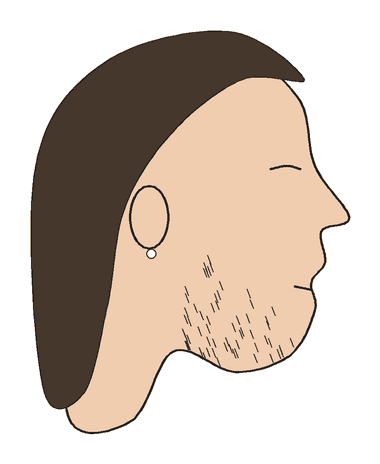
(a) Hypersecretion of which hormone results in Adrenal Virilism in human females?
(b) Mention one symptom of this disorder.
Solve with AIWritten solution
Solution:
Concept: Each adrenal gland sits like a cap on top of a kidney. Its outer cortex makes the corticoids (cortisol, called cortisone in the book; aldosterone; and the sex corticoids), and its inner medulla makes adrenaline, the emergency hormone. The sex corticoids include male-type hormones (adrenal androgens).
Step 1 — Part (a): the hormone.
Adrenal virilism is caused by hypersecretion of the sex corticoids (the male-type adrenal androgens) by an overactive adrenal cortex.
Step 2 — Part (b): one symptom.
Any one of these: growth of facial hair like a beard and moustache, as seen in the picture; a deep, male-like voice; irregular menstrual cycles, as in this girl.
Watch out: The hormone comes from the adrenal cortex, not from the adrenal medulla.
Therefore, (a) hypersecretion of the sex corticoids of the adrenal cortex, and (b) growth of a beard and moustache.
- 531 mark
Question 53
A gland which is both endocrine and exocrine in function is:
Solve with AIAnswer
(A) Pituitary
(B) Thyroid
- Correct
(C) Pancreas
(D) Adrenal
Answer: (C) Pancreas
Concept: A gland that sends one secretion out through a duct (exocrine) and another straight into the blood (endocrine) works both ways. The pancreas is both a duct gland and a ductless gland. Its endocrine part is the islets of Langerhans: the alpha (α) cells make glucagon (raises blood sugar) and the beta (β) cells make insulin (lowers blood sugar).
Step 1 — Exocrine part.
The pancreas pours pancreatic juice, with its digestive enzymes, through the pancreatic duct into the duodenum.
Step 2 — Endocrine part.
Its islets of Langerhans pour insulin and glucagon directly into the blood.
Why the other options are wrong:
- (A) Pituitary: The pituitary is a ductless (endocrine) gland only; its hormones go straight into the blood.
- (B) Thyroid: The thyroid is a ductless gland that pours thyroxine into the blood; it has no duct.
- (D) Adrenal: The adrenal is a ductless gland that pours adrenaline and the corticoids into the blood.
Therefore, the gland which is both endocrine and exocrine is the pancreas, option (C).
- 541 mark
Question 54
Surya’s father was diagnosed with Diabetes Insipidus. What are the primary symptoms of Diabetes Insipidus that Surya’s father must have experienced?
P: Weight gain
Q: More-urine formation
R: Joint pain
S: Excessive thirst
Solve with AIAnswer
(A) P and Q
(B) Q and R
- Correct
(C) Q and S
(D) P and R
Answer: (C) Q and S
Concept: ADH (antidiuretic hormone, vasopressin) is made in the hypothalamus and released by the posterior pituitary. It makes the kidney tubules take back (reabsorb) more water from the urine being formed, so less, more concentrated urine is passed.
Step 1 — Test Q: more urine formation.
With too little ADH the tubules reabsorb little water, so a lot of urine is formed. Q is a symptom.
Step 2 — Test S: excessive thirst.
So much water is lost in urine that the person feels very thirsty. S is a symptom.
Step 3 — Test P and R.
Weight gain (P) and joint pain (R) are not caused by a lack of ADH, so neither is a symptom.
Why the other options are wrong:
- (A) P and Q: Weight gain (P) is not a symptom of diabetes insipidus; the water loss tends to lower the weight.
- (B) Q and R: Joint pain (R) is not a symptom of diabetes insipidus.
- (D) P and R: Neither weight gain (P) nor joint pain (R) is a symptom of diabetes insipidus.
Therefore, the primary symptoms are more urine formation and excessive thirst, Q and S, option (C).
- 555 marks
Question 55
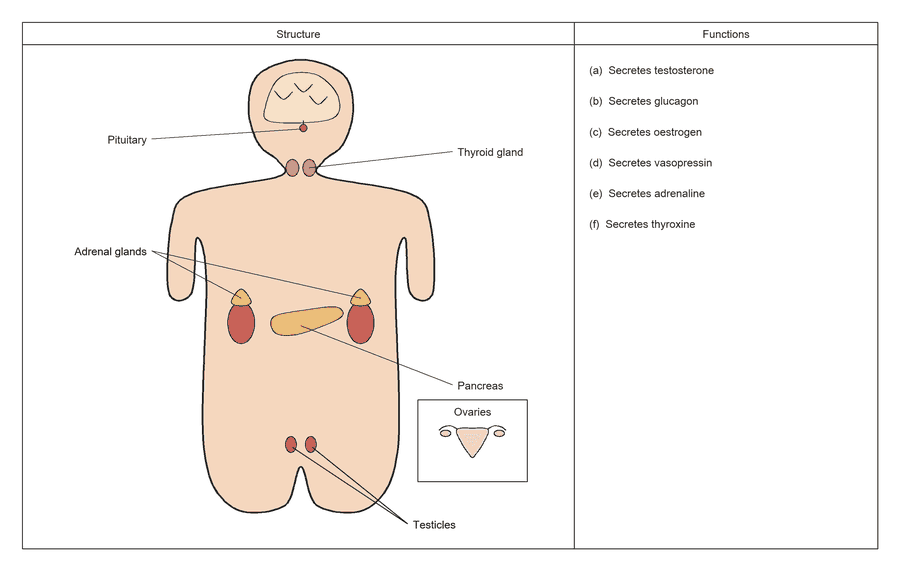
Study the diagram given below and match the gland with its functions:
Example: Thyroid gland – (f) secretes thyroxine
 Solve with AI
Written solution
Solution:
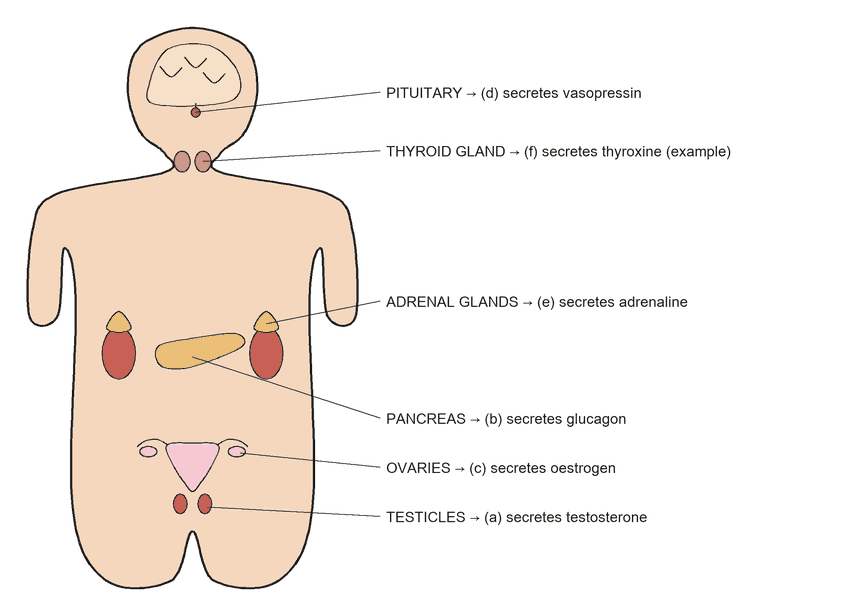
Concept: Name the hormone each gland makes, then find that hormone in the list of functions. The thyroid – (f) pair is the example.
Step 1 — Pituitary.
The posterior pituitary releases vasopressin (ADH). Pair: Pituitary – (d) Secretes vasopressin.
Step 2 — Adrenal glands.
The adrenal medulla secretes adrenaline, the emergency hormone. Pair: Adrenal glands – (e) Secretes adrenaline.
Step 3 — Pancreas.
The alpha cells of the islets of Langerhans secrete glucagon. Pair: Pancreas – (b) Secretes glucagon.
Step 4 — Ovaries.
The ovaries secrete oestrogen, the female sex hormone. Pair: Ovaries – (c) Secretes oestrogen.
Step 5 — Testicles.
The testes secrete testosterone, the male sex hormone. Pair: Testicles – (a) Secretes testosterone.
Watch out: The pancreas also makes insulin, but insulin is not in the list; glucagon is.
Therefore, Pituitary – (d), Adrenal glands – (e), Pancreas – (b), Ovaries – (c), Testicles – (a).
- 561 mark
Question 56
Expand the biological abbreviations:
(a) TSH
Solve with AIWritten solution
Solution:
Concept: TSH is one of the tropic hormones of the anterior pituitary.
Step 1 — Expand the letters.
TSH stands for Thyroid Stimulating Hormone.
Step 2 — Say what it does.
It is a tropic hormone of the anterior pituitary that stimulates the thyroid gland to make and release thyroxine.
Watch out: It is thyroid STIMULATING, not 'thyroid secreting', hormone.
Therefore, TSH is Thyroid Stimulating Hormone.