Solution:
Concept: The thyroid gland in the neck makes thyroxine, which contains iodine. Thyroxine sets the basal metabolic rate (how fast the cells release energy at rest) and is needed for normal growth and mental development.
Step 1 — Part (i): identify the gland.
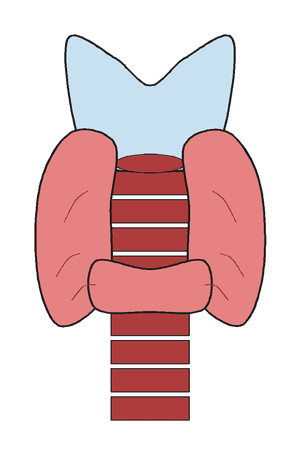
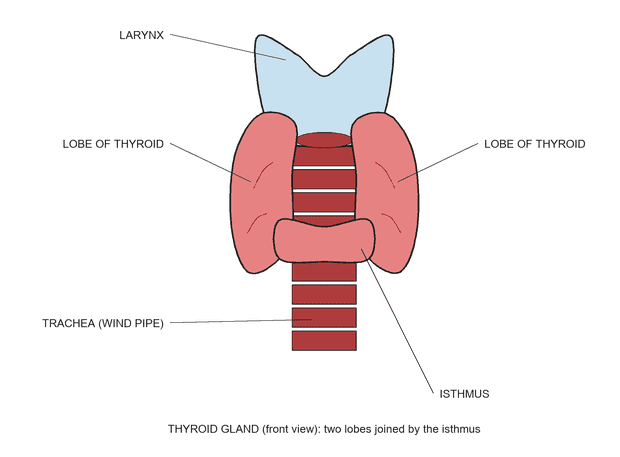
The figure shows a two-lobed gland lying on the trachea (with its rings) just below the larynx, the lobes joined by a narrow isthmus. This is the thyroid gland.
Step 2 — Part (ii): the secretion that regulates basal metabolism.
The thyroid's hormone thyroxine regulates the basal metabolic rate.
Step 3 — Part (iii): the mineral needed.
Thyroxine contains iodine, so iodine in the diet is needed to make it.
Step 4 — Part (iv): under-secretion in children.
Too little thyroxine in a child causes cretinism: stunted growth (dwarfism) and poor mental development.
Step 5 — Part (v): hypersecretion.
Too much thyroxine causes exophthalmic goitre: bulging eyes, a swelling in the neck, a high metabolic rate, a fast heart beat and loss of weight.
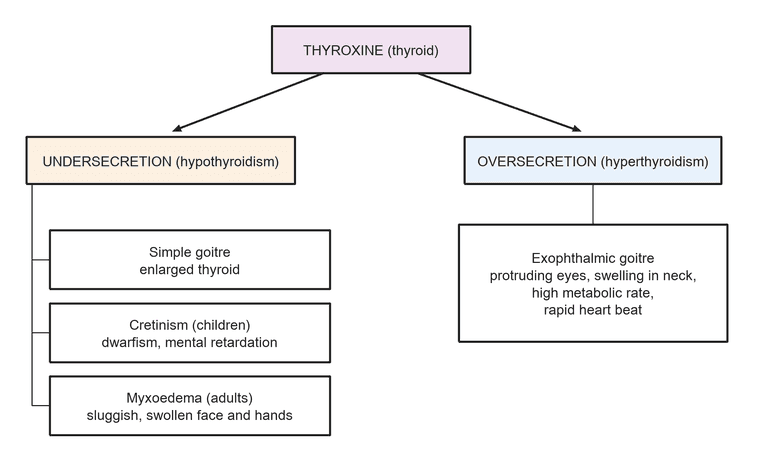
Watch out: Too little thyroxine in an ADULT causes myxoedema, not cretinism; cretinism is the childhood disorder.
Therefore, (i) thyroid gland, (ii) thyroxine, (iii) iodine, (iv) cretinism, (v) exophthalmic goitre.