Solution:
Concept: For each disorder ask which hormone is involved, whether it is too little or too much, and at what age. Column II has seven items for five, so two are left over.
Step 1 — Match (a).
Too little thyroxine in an adult makes the person sluggish, with a puffy face and hands. Pair: (a) – 2. Myxoedema.
Step 2 — Match (b).
Too little insulin keeps the blood sugar high and puts sugar in the urine. Pair: (b) – 5. Diabetes mellitus.
Step 3 — Match (c).
Too much growth hormone in childhood makes the long bones grow far beyond normal. Pair: (c) – 4. Gigantism.
Step 4 — Match (d).
Too little ADH makes the kidneys pass a lot of watery urine with no sugar, with great thirst. Pair: (d) – 1. Diabetes insipidus.
Step 5 — Match (e).
Too much thyroxine gives bulging eyes, a goitre and a high metabolic rate. Pair: (e) – 6. Exophthalmic goitre.
Step 6 — Note the items left over.
Two items are not used: 3. Dwarfism (too little growth hormone in childhood) and 7. Cretinism (too little thyroxine in childhood).
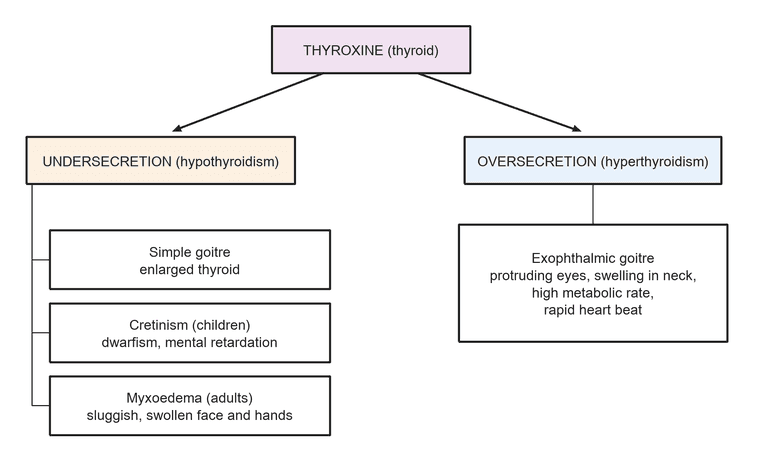
Watch out: (a) says 'in adults', so the answer is myxoedema; cretinism is the childhood form.
Therefore, (a) – 2, (b) – 5, (c) – 4, (d) – 1, (e) – 6.
