
Question 421 markMCQAsked 2025Easy
Assertion (A): Deficiency of Antidiuretic hormone causes an increase in urination.
Reason (R): Antidiuretic hormone acts on the kidney to reabsorb water from the kidney tubules.
Confirming your payment
Sign up now and get 250 free tokens.
Previous Year Questions · Question 42 of 56
Assertion (A): Deficiency of Antidiuretic hormone causes an increase in urination.
Reason (R): Antidiuretic hormone acts on the kidney to reabsorb water from the kidney tubules.
(A) A is True and R is False
(B) A is False and R is True
(C) Both A and R are True
(D) Both A and R are False
Answer: (C) Both A and R are True
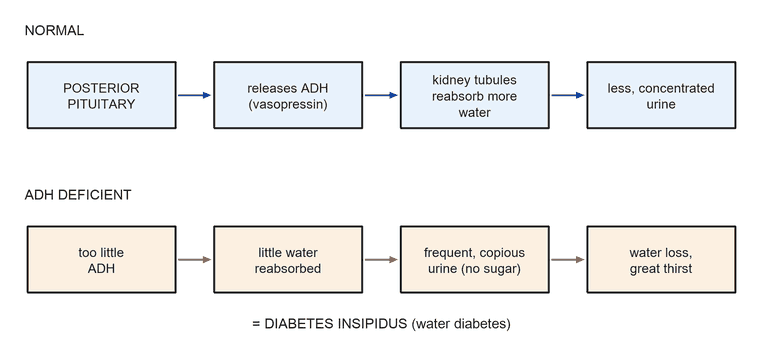
Concept: In an assertion-reason item, judge the Assertion and the Reason separately as true or false, and then decide whether the Reason explains the Assertion. ADH (antidiuretic hormone, vasopressin) is made in the hypothalamus and released by the posterior pituitary. It makes the kidney tubules take back (reabsorb) more water from the urine being formed, so less, more concentrated urine is passed.
Step 1 — Judge the Assertion.
A lack of ADH means the kidney tubules reabsorb little water, so a large amount of urine is passed (diabetes insipidus). The Assertion is true.
Step 2 — Judge the Reason.
ADH does act on the kidney and makes the tubules reabsorb water. The Reason is true.
Step 3 — Choose the option.
Both statements are true, so the answer is option (C). (The Reason also explains the Assertion: with less ADH, less water is taken back and more urine is passed.)
Why the other options are wrong:
Therefore, both A and R are true, option (C).