
Question 531 markMCQAsked 2026Easy
A gland which is both endocrine and exocrine in function is:
Confirming your payment
Sign up now and get 250 free tokens.
Previous Year Questions · Question 53 of 56
A gland which is both endocrine and exocrine in function is:
(A) Pituitary
(B) Thyroid
(C) Pancreas
(D) Adrenal
Answer: (C) Pancreas
Concept: A gland that sends one secretion out through a duct (exocrine) and another straight into the blood (endocrine) works both ways. The pancreas is both a duct gland and a ductless gland. Its endocrine part is the islets of Langerhans: the alpha (α) cells make glucagon (raises blood sugar) and the beta (β) cells make insulin (lowers blood sugar).
Step 1 — Exocrine part.
The pancreas pours pancreatic juice, with its digestive enzymes, through the pancreatic duct into the duodenum.
Step 2 — Endocrine part.
Its islets of Langerhans pour insulin and glucagon directly into the blood.
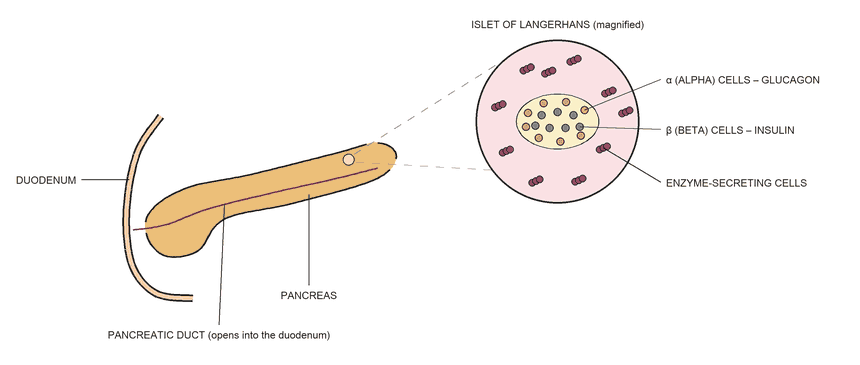
Why the other options are wrong:
Therefore, the gland which is both endocrine and exocrine is the pancreas, option (C).