Solution:
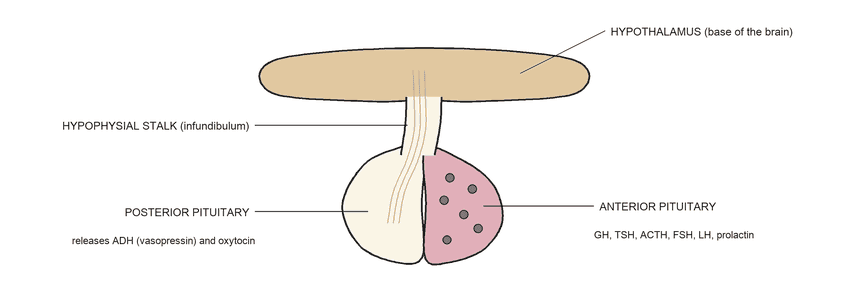
Concept: The pituitary has two lobes. The anterior lobe makes growth hormone, prolactin and the tropic hormones (TSH, ACTH, FSH, LH). The posterior lobe releases ADH (vasopressin) and oxytocin, which are made in the hypothalamus and stored in the posterior lobe.
Step 1 — Part (i): identify and locate the gland.
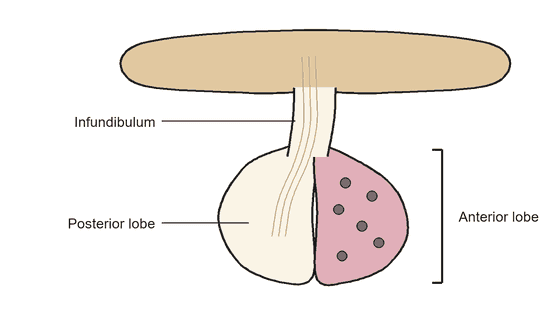
A small gland hanging by a stalk (the infundibulum) from the base of the brain, with a posterior and an anterior lobe, is the pituitary gland. It is about the size of a pea and hangs from the base of the brain, just below the hypothalamus.
Step 2 — Part (ii): why it is the master gland.
Its anterior lobe makes tropic hormones that control several other endocrine glands (TSH the thyroid, ACTH the adrenal cortex, FSH and LH the gonads), so it seems to control the whole endocrine system.
Step 3 — Part (iii): diabetes insipidus and how it differs.
A deficiency of ADH (vasopressin) causes diabetes insipidus. The table compares it with diabetes mellitus.
| Basis | Diabetes mellitus | Diabetes insipidus |
|---|
| Hormone lacking or not working | Insulin | ADH (vasopressin) |
| Gland concerned | Pancreas (beta cells of the islets) | Pituitary (posterior lobe) |
| Sugar in urine | Present | Absent (urine watery) |
| Blood sugar | High | Normal |
In both, a large amount of urine is passed and the person feels thirsty.
Step 4 — Part (iv): hormone, and the role of tropic hormones.
A hormone is a secretion of a ductless gland poured directly into the blood, which carries it to target organs where it acts. Tropic hormones stimulate other endocrine glands to make their own hormones, for example TSH makes the thyroid release thyroxine.
Step 5 — Part (v): the lobe for each hormone.
We place each hormone in its lobe.
- (a) Oxytocin: posterior lobe (it is made in the hypothalamus and released here)
- (b) ACTH: anterior lobe
- (c) Growth hormone: anterior lobe
Watch out: The posterior lobe releases only ADH and oxytocin; every other pituitary hormone named in this chapter comes from the anterior lobe.
Therefore, (i) pituitary gland, hanging from the base of the brain below the hypothalamus; (ii) its tropic hormones control other glands; (iii) ADH, and unlike diabetes mellitus there is no sugar in the urine; (iv) a hormone is a blood-borne secretion of a ductless gland, and tropic hormones stimulate other glands; (v) (a) posterior, (b) anterior, (c) anterior.