Solution:
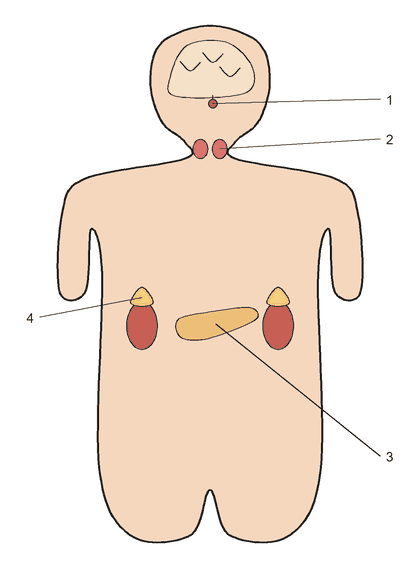
Concept: Read each gland from its position in the outline: the pituitary hangs below the brain, the thyroid is in the neck, the adrenals sit like caps on the kidneys and the pancreas lies across the abdomen below the stomach.

Step 1 — Part (i): name the glands 1 to 4.
We read each number from its position.
- 1 – Pituitary gland (the small gland below the brain)
- 2 – Thyroid gland (in the neck)
- 3 – Pancreas (the long gland across the abdomen)
- 4 – Adrenal gland (the cap on the kidney)
Step 2 — Part (ii): hormone of part 2 and one function.
Part 2, the thyroid, secretes thyroxine. One important function: it regulates the basal metabolic rate, the rate at which the cells release energy (and heat) at rest. It is also needed for normal growth and mental development.
Step 3 — Part (iii): endocrine part of gland 3.
The endocrine part of the pancreas is the islets of Langerhans, small groups of hormone-making cells scattered through it. The rest of the pancreas makes pancreatic juice, which leaves through a duct.
Step 4 — Part (iv): why gland 1 is the master gland.
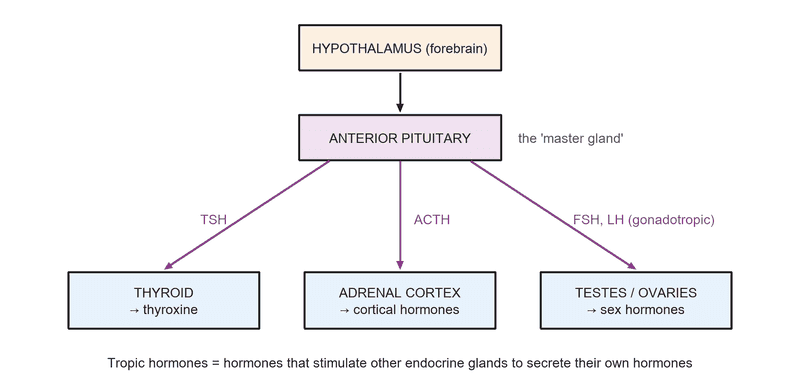
The pituitary is called the master gland because its anterior lobe makes tropic hormones that control several other endocrine glands: TSH controls the thyroid, ACTH the adrenal cortex, and FSH and LH the testes and ovaries. It is itself controlled by the hypothalamus, the part of the forebrain from which it hangs.
Step 5 — Part (v): gland of the emergency hormone.
The adrenal gland secretes the emergency hormone, adrenaline, from its inner part, the medulla. Adrenaline prepares the body to fight or run away.
Watch out: The master gland is the pituitary, but it is not the top controller; the hypothalamus of the forebrain controls it.
Therefore, (i) 1 pituitary, 2 thyroid, 3 pancreas, 4 adrenal gland; (ii) thyroxine, which regulates basal metabolism; (iii) islets of Langerhans; (iv) its tropic hormones control other glands, and the hypothalamus controls it; (v) the adrenal gland (medulla).