Solution:
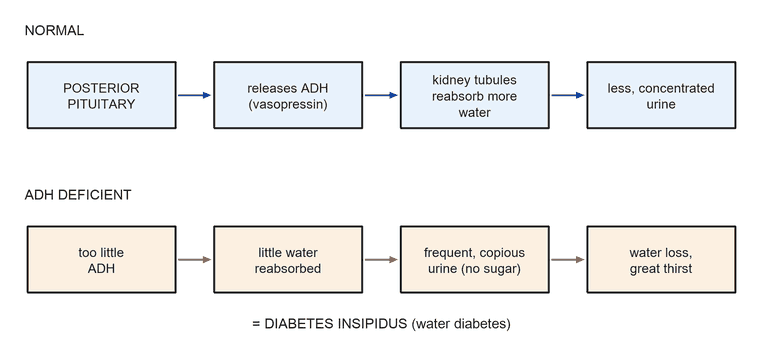
Concept: Two different hormones are linked with the word diabetes (passing a large amount of urine). ADH (antidiuretic hormone, vasopressin) is made in the hypothalamus and released by the posterior pituitary. It makes the kidney tubules take back (reabsorb) more water from the urine being formed, so less, more concentrated urine is passed. Insulin from the beta cells of the pancreas lowers the blood sugar.
Step 1 — Blank (i): the hormone controlling urine output.
The hormone that controls how much water leaves in the urine is antidiuretic hormone (ADH), also called vasopressin. It makes the kidney tubules reabsorb more water, so less urine is formed.
Step 2 — Blank (ii): the lobe that releases it.
ADH is released into the blood by the posterior lobe of the pituitary gland (it is made in the hypothalamus and stored there).
Step 3 — Blank (iii): the disorder when ADH is reduced.
With too little ADH, less water is reabsorbed, so a large amount of dilute urine with no sugar is passed and the person is always thirsty. This is diabetes insipidus.
Step 4 — Blank (iv): the hormone whose lack puts glucose in urine.
Glucose appears in the urine when there is too little insulin, the hormone of the beta cells of the islets of Langerhans that lowers blood sugar.
Step 5 — Blank (v): the disease.
Without enough insulin the blood sugar stays high (hyperglycaemia) and the extra glucose is passed out in the urine. This disease is diabetes mellitus.
Watch out: Insipidus (ADH, no sugar in urine) and mellitus (insulin, sugar in urine) are easy to swap; 'mellitus' means honey-sweet.
Therefore, (i) antidiuretic hormone (ADH or vasopressin), (ii) posterior, (iii) diabetes insipidus, (iv) insulin, (v) diabetes mellitus.
