Solution:
Concept: Match each disorder to its hormone and decide whether that hormone is too little (hypo-) or too much (hyper-). Column B has seven items for five disorders, so two are left over.
Step 1 — Match (i) Cretinism.
Too little thyroxine in childhood stunts growth and slows mental development. Pair: (i) – (b) Hyposecretion of Thyroxine.
Step 2 — Match (ii) Diabetes insipidus.
Without enough vasopressin (ADH) the kidney tubules reabsorb little water, so a lot of watery urine is passed. Pair: (ii) – (d) Hyposecretion of Vasopressin.
Step 3 — Match (iii) Exophthalmic goitre.
Too much thyroxine gives bulging eyes, a goitre and a high metabolic rate. Pair: (iii) – (g) Hypersecretion of Thyroxine.
Step 4 — Match (iv) Adrenal virilism.
An overactive adrenal cortex in a woman gives male features such as a beard. Pair: (iv) – (a) Hypersecretion of adrenal cortex.
Step 5 — Match (v) Dwarfism.
Too little growth hormone in childhood keeps the person very short. Pair: (v) – (c) Hyposecretion of growth hormone.
Step 6 — Note the items left over.
Two items have no partner: (e) hyposecretion of the adrenal cortex (which causes Addison's disease) and (f) hypersecretion of growth hormone (which causes gigantism or acromegaly).
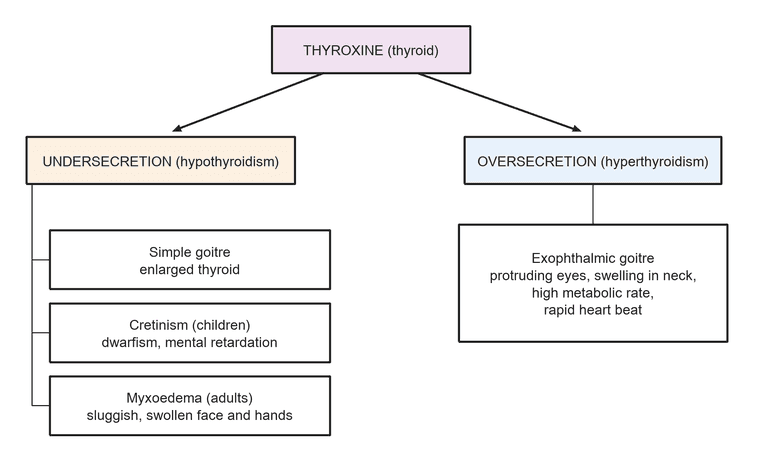
Watch out: Dwarfism from growth hormone keeps normal intelligence, while cretinism (thyroxine) also slows mental development.
Therefore, (i) – (b), (ii) – (d), (iii) – (g), (iv) – (a), (v) – (c).
