
Opening your dashboard
Class 9 Physics Chapter 2: Motion in One Dimension Solutions
143 textbook questions with step-by-step answers, free to read, for ICSE 2026-27.
Get talked through Ch 2, not just shown the answer
Reading a finished solution is not the same as being able to do it. The AI tutor takes one question at a time and works it with you, in your own words, until you can.
- Ask it out loud, in your own words
- It gives you the next step, not the answer
- Stuck on part (ii)? Start there
143 questions with solutions
1–5 marks · Mixed difficulty
The first 58 solutions are on this page. This chapter is a long one, so the rest open on their own page to keep this one quick to load.
- 11 mark
Question 1
Physical quantities which are expressed only by their magnitude are :
Solve with AIAnswer
- Correct
(A) Scalar quantities
(B) Vector quantities
(C) Tensor quantities
(D) None of these
Answer: (A) Scalar quantities
Concept: A scalar quantity is fully described by its magnitude alone, that is a number with its unit (for example, a mass of 5 kg). A vector quantity needs both a magnitude and a direction (for example, a displacement of 5 m due north).
Step 1 — See what the stem describes.
The stem asks for quantities that are expressed only by their magnitude, that is by a number with a unit and with no direction.
Step 2 — Match it with the definition.
A quantity that needs only a magnitude is, by definition, a scalar quantity. Mass, time, distance and speed are examples: saying "5 kg" or "10 s" tells us everything about them.
Why the other options are wrong:
- (B) Vector quantities: A vector quantity needs a direction as well as a magnitude, so it cannot be expressed by its magnitude alone.
- (C) Tensor quantities: Tensors are not part of the Class 9 course, and a tensor also needs more than a single magnitude to describe it.
- (D) None of these: This cannot be right, because scalar quantities are exactly the ones described by magnitude only.
Therefore, physical quantities expressed only by their magnitude are scalar quantities, option (A).
- 21 mark
Question 2
Which of the following is a scalar quantity ?
Solve with AIAnswer
(A) Force
- Correct
(B) Time
(C) Acceleration
(D) Displacement
Answer: (B) Time
Concept: A scalar quantity is fully described by its magnitude alone, that is a number with its unit (for example, a mass of 5 kg). A vector quantity needs both a magnitude and a direction (for example, a displacement of 5 m due north).
Step 1 — Ask whether each quantity needs a direction.
For each option we check whether saying its size alone describes it completely, or whether we must also say which way it acts.
Step 2 — Pick the one with no direction.
Time is given fully by a number with a unit, such as 5 s; it does not point anywhere. So time is a scalar, while force, acceleration and displacement all act in a direction.
Why the other options are wrong:
- (A) Force: A force is a push or pull in a definite direction, so it is a vector.
- (C) Acceleration: Acceleration is the rate of change of velocity, and it has a direction (for example, acts vertically downwards), so it is a vector.
- (D) Displacement: Displacement is the shortest distance from the initial to the final position in a given direction, so it is a vector.
Therefore, the scalar quantity is time, option (B).
- 31 mark
Question 3
A vector quantity possesses :
Solve with AIAnswer
(A) Direction
(B) Magnitude
- Correct
(C) Both (a) and (b)
(D) None of these
Answer: (C) Both (a) and (b)
Concept: A scalar quantity is fully described by its magnitude alone, that is a number with its unit (for example, a mass of 5 kg). A vector quantity needs both a magnitude and a direction (for example, a displacement of 5 m due north).
Step 1 — Recall what describes a vector.
A vector is described fully only when we give how much (its magnitude, a number with a unit) and which way (its direction).
Step 2 — Check with an example.
"A velocity of 10 m s" is incomplete; "10 m s due east" describes the velocity fully. So a vector possesses both magnitude and direction.
Why the other options are wrong:
- (A) Direction: Direction alone is not enough; without the magnitude we do not know how large the quantity is.
- (B) Magnitude: Magnitude alone describes a scalar, not a vector.
- (D) None of these: This cannot be right, because a vector does possess both magnitude and direction.
Therefore, a vector quantity possesses both direction and magnitude, option (C).
- 41 mark
Question 4
A vector quantity is :
Solve with AIAnswer
(A) work
(B) pressure
(C) distance
- Correct
(D) velocity
Answer: (D) velocity
Concept: A scalar quantity is fully described by its magnitude alone, that is a number with its unit (for example, a mass of 5 kg). A vector quantity needs both a magnitude and a direction (for example, a displacement of 5 m due north). Speed is the distance travelled per unit time; it is a scalar. Velocity is the displacement per unit time, that is the distance travelled per second in a given direction; it is a vector. Both have the S.I. unit metre per second (m s).
Step 1 — Check each quantity for a direction.
Work, pressure and distance are each described fully by a number with a unit. Velocity is not: we must also say in which direction the body moves.
Step 2 — Name the vector.
Velocity is speed in a given direction, so it has both magnitude and direction; it is a vector.
Why the other options are wrong:
- (A) work: Work is the product of force and displacement along the force; it has only magnitude, so it is a scalar.
- (B) pressure: Pressure at a point acts equally in all directions, so it has no single direction; it is a scalar.
- (C) distance: Distance is the length of the path travelled, with no direction, so it is a scalar.
Therefore, the vector quantity is velocity, option (D).
- 51 mark
Question 5
The motion of a train on a straight track is an example of ............ motion :
Solve with AIAnswer
(A) Two-dimensional
(B) Three-dimensional
- Correct
(C) One-dimensional
(D) All of these
Answer: (C) One-dimensional
Concept: Motion along a single straight line is called one-dimensional (linear) motion, because the position of the body can be given by just one coordinate measured along that line.
Step 1 — Look at the path.
On a straight track the train can move only forwards or backwards along one straight line.
Step 2 — Count the coordinates needed.
One number, the distance along the track from a fixed point, tells us where the train is. So its motion is one-dimensional.
Why the other options are wrong:
- (A) Two-dimensional: Two-dimensional motion takes place in a plane and needs two coordinates, for example a car turning on a flat road.
- (B) Three-dimensional: Three-dimensional motion takes place in space and needs three coordinates, for example a flying bird.
- (D) All of these: This cannot be right, because the train's motion is only one-dimensional.
Therefore, the motion of a train on a straight track is one-dimensional motion, option (C).
- 61 mark
Question 6
The S.I. unit of displacement is :
Solve with AIAnswer
(A) Centimetre
(B) Millimeter
(C) Decimetre
- Correct
(D) Metre
Answer: (D) Metre
Concept: Displacement is a length measured in a given direction, so it has the unit of length. The S.I. unit of length is the metre (m).
Step 1 — Identify the kind of quantity.
Displacement is the shortest distance between the initial and final positions, so it is a length.
Step 2 — Write its S.I. unit.
The S.I. unit of length, and so of displacement, is the metre.
Why the other options are wrong:
- (A) Centimetre: The centimetre is one-hundredth of a metre; it is a unit of length, but not the S.I. unit.
- (B) Millimeter: The millimetre is one-thousandth of a metre; it is not the S.I. unit.
- (C) Decimetre: The decimetre is one-tenth of a metre; it is not the S.I. unit.
Therefore, the S.I. unit of displacement is the metre, option (D).
- 71 mark
Question 7
If a body starts its motion from point A to B and comes back to the same point after a certain time interval, the displacement is :
 Solve with AI
Answer
(A) 10
(B) 20
- Correct
(C) 0
(D) 15
Answer: (C) 0
Concept: Distance is the length of the actual path travelled by a body; it is a scalar. Displacement is the shortest (straight-line) distance from the initial position to the final position, in the direction from the initial to the final position; it is a vector.
Step 1 — Find the initial and final positions.
The body starts at A, goes to B (10 m away, as the figure shows) and comes back to A. So both its initial and its final position are the point A.
Step 2 — Find the displacement.
Displacement depends only on the initial and final positions, not on the path. Since they are the same point, the shortest distance between them, from A to A, is zero.
Step 3 — Compare with the distance.
The distance travelled is the length of the whole path, A to B and back.
This is not zero, but the question asks for the displacement.
Watch out: Do not confuse the 20 m distance (the whole path) with the displacement (start to finish).
Why the other options are wrong:
- (A) 10: 10 m is only the distance from A to B, which is the displacement half-way through, not at the end.
- (B) 20: 20 m is the distance travelled (A to B and back), not the displacement.
- (D) 15: 15 m does not come from the figure at all: no path or position in it is 15 m from A.
Therefore, the displacement is zero, option (C).
- 81 mark
Question 8
Motion of a car in a crowded street is an example of:
Solve with AIAnswer
(A) Uniform speed
(B) Uniform velocity
- Correct
(C) Variable acceleration
(D) Uniform acceleration
Answer: (C) Variable acceleration
Concept: Acceleration is uniform when the velocity changes by equal amounts in equal intervals of time, and variable when it changes by unequal amounts in equal intervals of time.
Step 1 — Picture the motion.
In a crowded street the car keeps speeding up, slowing down and stopping at irregular moments, depending on the traffic.
Step 2 — Decide what kind of acceleration it has.
So its velocity changes by unequal amounts in equal intervals of time. Its acceleration keeps changing, so it is a variable acceleration.
Why the other options are wrong:
- (A) Uniform speed: Its speed keeps changing, so its speed is not uniform.
- (B) Uniform velocity: Its speed and direction keep changing, so its velocity is not uniform.
- (D) Uniform acceleration: Its velocity does not change at a steady rate, so its acceleration is not uniform.
Therefore, the motion of a car in a crowded street is an example of variable acceleration, option (C).
- 91 mark
Question 9
The distance travelled by a body in 10 s when it travels with a uniform speed of 10 ms is :
Solve with AIAnswer
- Correct
(A) 100 m
(B) 1 m
(C) 20 m
(D) 50 m
Answer: (A) 100 m
Concept: For a body moving with uniform speed, the distance travelled is the speed multiplied by the time: distance = speed × time.
Step 1 — Write the data.
The speed is 10 m s and the time is 10 s.
Step 2 — Multiply speed by time.
Since the speed is uniform, the body covers 10 m in every second, so in 10 s it covers
Why the other options are wrong:
- (B) 1 m: 1 m comes from dividing the speed by the time instead of multiplying.
- (C) 20 m: 20 m comes from adding the speed and the time, which has no meaning.
- (D) 50 m: 50 m is half the correct value; there is no factor ½ for uniform speed.
Therefore, the distance travelled is 100 m, option (A).
- 101 mark
Question 10
For a particle in motion, which of the following quantity can be zero at any given instant ?
Solve with AIAnswer
- Correct
(A) Displacement
(B) Distance
(C) Speed
(D) None of these
Answer: (A) Displacement
Concept: Distance is the length of the actual path travelled by a body; it is a scalar. Displacement is the shortest (straight-line) distance from the initial position to the final position, in the direction from the initial to the final position; it is a vector.
Step 1 — Think of a moving particle that returns.
A particle can keep moving and still come back to its starting point, for example a runner who completes one full lap of a circular track.
Step 2 — Find its displacement at that instant.
At the instant it is back at the start, its initial and final positions are the same, so its displacement is zero, even though the particle is still moving.
Step 3 — Check the other quantities.
The distance travelled only grows once the particle has moved, so it cannot be zero again. Speed is different: it can be zero for an instant, for example at the highest point of a ball thrown straight up.
Note: Option (C) is arguable, since a particle's speed can be zero for an instant (at the top of a vertical throw). The printed key (A) is kept, because only displacement can be zero while the particle is actually moving.
Why the other options are wrong:
- (B) Distance: The distance travelled by a particle that has moved keeps adding up and never goes back to zero.
- (C) Speed: Speed can be zero for an instant (at the top of a vertical throw), but at that instant the particle has stopped, so it is not "in motion" then; the book wants displacement, which can be zero while the particle keeps moving.
- (D) None of these: This cannot be right, because displacement can be zero for a moving particle.
Therefore, the quantity that can be zero for a particle in motion is its displacement, option (A).
- 111 mark
Question 11
The S.I. unit of velocity is :
Solve with AIAnswer
(A) km h
(B) m min
(C) km min
- Correct
(D) m s
Answer: (D) m s
Concept: Speed is the distance travelled per unit time; it is a scalar. Velocity is the displacement per unit time, that is the distance travelled per second in a given direction; it is a vector. Both have the S.I. unit metre per second (m s).
Step 1 — Write the unit from the definition.
Velocity is displacement divided by time, so its unit is the unit of length divided by the unit of time.
Step 2 — Use S.I. base units.
In S.I. the unit of length is the metre and the unit of time is the second, so the S.I. unit of velocity is the metre per second, m s.
Why the other options are wrong:
- (A) km h: km h is a unit of velocity, but the kilometre and the hour are not S.I. base units.
- (B) m min: m min uses the minute, which is not the S.I. unit of time.
- (C) km min: km min uses neither the metre nor the second, so it is not the S.I. unit.
Therefore, the S.I. unit of velocity is m s, option (D).
- 121 mark
Question 12
The unit of retardation is :
Solve with AIAnswer
(A) m s
- Correct
(B) m s
(C) m
(D) m s
Answer: (B) m s
Concept: Acceleration is the rate of change of velocity, , where is the initial velocity, the final velocity and the time taken. Its S.I. unit is m s. When the velocity decreases, the acceleration is negative and is called retardation.
Step 1 — Write the definition.
Retardation is the rate of decrease of velocity, that is the decrease in velocity divided by the time taken. It is a kind of acceleration, so it has the same unit.
Step 2 — Work out the unit.
We divide a velocity unit by a time unit.
Why the other options are wrong:
- (A) m s: m s is the unit of velocity, not of the rate of change of velocity.
- (C) m: The metre is the unit of length or displacement.
- (D) m s: m s would mean metre × second², which is not the unit of any quantity in this chapter.
Therefore, the unit of retardation is m s, option (B).
- 131 mark
Question 13
18 km h is equal to :
Solve with AIAnswer
(A) 10 m s
- Correct
(B) 5 m s
(C) 18 m s
(D) 1.8 m s
Answer: (B) 5 m s
Concept: To change km h into m s, change kilometres into metres (1 km is 1000 m) and hours into seconds (1 h is 3600 s). This is the same as multiplying by . To change m s back into km h, multiply by .
Step 1 — Find the conversion factor.
One kilometre per hour is 1000 m covered in 3600 s.
Step 2 — Convert 18 km h.
Multiply the given speed by .
Watch out: Multiply by to go from km h to m s, not by .
Why the other options are wrong:
- (A) 10 m s: 10 m s is 36 km h, twice the given speed.
- (C) 18 m s: 18 m s just copies the number without converting the units.
- (D) 1.8 m s: 1.8 m s comes from dividing by 10, which is not the conversion factor.
Therefore, 18 km h is equal to 5 m s, option (B).
- 141 mark
Question 14
The value of does not depend on the :
Solve with AIAnswer
(A) Height of the body
(B) Mass of the body
(C) Shape of the body
- Correct
(D) All of the above
Answer: (D) All of the above
Concept: The acceleration due to gravity () is the uniform acceleration of a body falling freely under the pull of the earth alone. Near the earth's surface its average value is 9.8 m s, and at a given place it is the same for every body when air resistance is neglected.
Step 1 — Recall what g depends on.
At a given place, every body falls with the same acceleration when air resistance is neglected: a heavy stone and a light coin speed up at the same rate.
Step 2 — Apply it to the options.
So does not depend on the mass of the falling body, nor on its shape, nor on its size (how tall the body itself is). All three properties of the body leave unchanged, so the answer is "all of the above".
Watch out: does change with the height (altitude) of the place above the earth's surface: it becomes smaller as we go higher. Only a property of the falling body itself leaves unchanged.
Note: The printed key (D) is kept, reading "height of the body" as the body's own size, like its mass and shape. If "height" is read as the altitude of the body above the earth, option (A) is false, because decreases with altitude; then only (B) and (C) would be true.
Why the other options are wrong:
- (A) Height of the body: This is true when "height" means the body's own size, but it is only one of the three correct statements, so it is not the complete answer.
- (B) Mass of the body: This is true (a heavy and a light body fall with the same ), but it is only one of the three correct statements.
- (C) Shape of the body: This is true (a round and a flat body fall with the same in vacuum), but it is only one of the three correct statements.
Therefore, the value of does not depend on the height (size), mass or shape of the body, option (D).
- 151 mark
Question 15
Free fall of a body near earth's surface is an example of :
Solve with AIAnswer
- Correct
(A) Uniform acceleration
(B) Uniform velocity
(C) Variable acceleration
(D) None of the above
Answer: (A) Uniform acceleration
Concept: The acceleration due to gravity () is the uniform acceleration of a body falling freely under the pull of the earth alone. Near the earth's surface its average value is 9.8 m s, and at a given place it is the same for every body when air resistance is neglected.
Step 1 — See how the velocity changes.
A freely falling body near the earth's surface gains about 9.8 m s of velocity in every second.
Step 2 — Name the kind of motion.
Equal changes of velocity in equal intervals of time mean the acceleration is constant. So free fall is an example of uniform acceleration.
Why the other options are wrong:
- (B) Uniform velocity: The velocity of a falling body keeps increasing, so its velocity is not uniform.
- (C) Variable acceleration: Near the earth's surface the acceleration stays the same, so it is not variable.
- (D) None of the above: This cannot be right, because free fall is an example of uniform acceleration.
Therefore, free fall of a body near the earth's surface is an example of uniform acceleration, option (A).
- 161 mark
Question 16
The value of is maximum at :
Solve with AIAnswer
(A) Tropic of Capricorn
(B) Equator
(C) Tropic of Cancer
- Correct
(D) Poles
Answer: (D) Poles
Concept: The value of at a place is larger when the place is nearer to the centre of the earth. The earth is not a perfect sphere: it is slightly flattened at the poles and bulges at the equator, and its rotation also lowers a little at the equator.
Step 1 — Compare the distances from the centre.
Because of the flattening, the poles are the places on the surface nearest to the centre of the earth, and the equator is the farthest.
Step 2 — Find where g is largest.
So is maximum at the poles (about 9.83 m s) and minimum at the equator (about 9.78 m s).
Why the other options are wrong:
- (A) Tropic of Capricorn: The Tropic of Capricorn lies between the equator and the South Pole, so there is between its smallest and largest values.
- (B) Equator: At the equator is the minimum, not the maximum.
- (C) Tropic of Cancer: The Tropic of Cancer lies between the equator and the North Pole, so there is between its smallest and largest values.
Therefore, the value of is maximum at the poles, option (D).
- 171 mark
Question 17
A body when projected up with an initial velocity goes to a maximum height in time and then comes back at the point of projection. The correct statement is:
Solve with AIAnswer
(A) the average velocity is
(B) the acceleration is zero
(C) the final velocity on reaching the point of projection is .
- Correct
(D) the displacement is zero.
Answer: (D) the displacement is zero
Concept: Distance is the length of the actual path travelled by a body; it is a scalar. Displacement is the shortest (straight-line) distance from the initial position to the final position, in the direction from the initial to the final position; it is a vector. Average speed is the total distance travelled divided by the total time taken. Average velocity is the total displacement divided by the total time taken.
Step 1 — Find the displacement.
The body comes back to the point of projection, so its initial and final positions are the same. Its displacement is therefore zero.
Step 2 — Check the average velocity.
Average velocity is displacement divided by time. With zero displacement the average velocity for the whole trip is also zero.
Step 3 — Check the average speed too.
Going up takes time and, with no air resistance, coming down takes another . The total distance is in time .
Why the other options are wrong:
- (A) the average velocity is : The average velocity is zero, since the displacement is zero; and even the average speed is , not .
- (B) the acceleration is zero: The acceleration is , acting downwards, during the whole motion (even at the highest point); it is never zero.
- (C) the final velocity on reaching the point of projection is : Neglecting air resistance, the body comes back with the same speed (now downwards), not .
Therefore, the correct statement is that the displacement is zero, option (D).
- 182 marks
Question 18
State whether the following quantity is a scalar or vector ?
(a) pressure (b) force (c) momentum (d) energy (e) weight (f) speed.
Solve with AIWritten solution
Solution:
Concept: A scalar quantity is fully described by its magnitude alone, that is a number with its unit (for example, a mass of 5 kg). A vector quantity needs both a magnitude and a direction (for example, a displacement of 5 m due north).
Step 1 — Decide the test.
For each quantity we ask: is a number with a unit enough, or must we also say which way it acts? If a direction is needed, it is a vector; if not, it is a scalar.
Step 2 — Apply the test to each quantity.
The table gives the result and the reason for each.
Quantity Scalar or vector Reason (a) pressure scalar pressure at a point acts equally in all directions, so it has no single direction (b) force vector a force always acts in a definite direction (c) momentum vector momentum is mass × velocity, and velocity has a direction (d) energy scalar energy has only magnitude (e) weight vector weight is the force of gravity on the body, acting vertically downwards (f) speed scalar speed tells only how fast a body moves, not in which direction Watch out: Pressure is produced by a force, but pressure itself is a scalar, because at a point in a fluid it acts equally in all directions.
Therefore, the scalars are (a) pressure, (d) energy and (f) speed, and the vectors are (b) force, (c) momentum and (e) weight.
- 191 mark
Question 19
Write the parameters required to express a scalar quantity.
Solve with AIWritten solution
Solution:
Concept: A scalar quantity is fully described by its magnitude alone, that is a number with its unit (for example, a mass of 5 kg). A vector quantity needs both a magnitude and a direction (for example, a displacement of 5 m due north).
Step 1 — Recall what a scalar needs.
A scalar has no direction, so only its size has to be stated.
Step 2 — Name the parameters.
Its size is given by a numerical value together with a unit. For example, in "mass 5 kg", 5 is the numerical value and kg is the unit.
Therefore, a scalar quantity is expressed by its magnitude alone, that is a numerical value with its unit.
- 201 mark
Question 20
Name the parameters required to express a vector quantity.
Solve with AIWritten solution
Solution:
Concept: A scalar quantity is fully described by its magnitude alone, that is a number with its unit (for example, a mass of 5 kg). A vector quantity needs both a magnitude and a direction (for example, a displacement of 5 m due north).
Step 1 — Recall what a vector needs.
A vector acts in a particular direction, so its size alone does not describe it fully.
Step 2 — Name the parameters.
We need its magnitude (a numerical value with a unit) and its direction. For example, "displacement 5 m due north" gives both.
Therefore, a vector quantity is expressed by its magnitude (numerical value with unit) and its direction.
- 211 mark
Question 21
What does the negative sign with a vector quantity indicates ?
Solve with AIWritten solution
Solution:
Concept: For motion along a straight line, one direction is chosen as positive; the opposite direction is then negative.
Step 1 — Say what the sign shows.
A negative sign with a vector quantity shows that the vector points opposite to the direction chosen as positive. It does not mean the quantity is "less than nothing".
Step 2 — Give an example.
If velocity towards the east is taken as positive, a velocity of m s means 5 m s towards the west. Likewise, a negative acceleration of a body moving in the positive direction means it is slowing down (retardation).
Watch out: The size of the vector is the number without its sign; the sign only gives the direction.
Therefore, a negative sign with a vector quantity indicates that its direction is opposite to the direction taken as positive.
- 221 mark
Question 22
When is a body said to be at rest ?
Solve with AIWritten solution
Solution:
Concept: Rest and motion are always judged with respect to the surroundings. A body is at rest if its position does not change with time with respect to its surroundings, and in motion if its position does change.
Step 1 — State the condition.
A body is at rest when its position does not change with time with respect to its surroundings.
Step 2 — Give an example.
A book lying on a table stays at the same place relative to the table and the room, so it is at rest with respect to them.
Therefore, a body is said to be at rest when it does not change its position with respect to its surroundings with time.
- 231 mark
Question 23
When is a body said to be in motion ?
Solve with AIWritten solution
Solution:
Concept: Rest and motion are always judged with respect to the surroundings. A body is at rest if its position does not change with time with respect to its surroundings, and in motion if its position does change.
Step 1 — State the condition.
A body is in motion when its position changes with time with respect to its surroundings.
Step 2 — Give an example.
A car moving on a road keeps changing its position relative to the trees and buildings beside the road, so it is in motion with respect to them.
Therefore, a body is said to be in motion when it changes its position with respect to its surroundings with time.
- 241 mark
Question 24
What do you mean by motion in one direction ?
Solve with AIWritten solution
Solution:
Concept: Motion along a single straight line is called motion in one direction, one-dimensional motion or linear motion.
Step 1 — Describe the path.
In this motion the body moves along a straight line only, forwards or backwards along it.
Step 2 — Say why it is called one-dimensional.
Its position at any instant is given by just one coordinate, its distance along that line from a fixed point.
Step 3 — Give examples.
A train on a straight track and a stone dropped from a height both move in one direction.
Therefore, motion in one direction means the motion of a body along a straight line path.
- 252 marks
Question 25
Define displacement. State its unit.
Solve with AIWritten solution
Solution:
Concept: Distance is the length of the actual path travelled by a body; it is a scalar. Displacement is the shortest (straight-line) distance from the initial position to the final position, in the direction from the initial to the final position; it is a vector.
Step 1 — Define displacement.
Displacement is the shortest distance from the initial position to the final position of a body, in the direction from the initial to the final position. Because it has a direction, it is a vector quantity.
Step 2 — State its unit.
Displacement is a length, so its S.I. unit is the metre (m).
Therefore, displacement is the shortest distance from the initial to the final position in that direction, and its S.I. unit is the metre (m).
- 261 mark
Question 26
When is the magnitude of displacement equal to the distance ?
Solve with AIWritten solution
Solution:
Concept: Distance is the length of the actual path travelled by a body; it is a scalar. Displacement is the shortest (straight-line) distance from the initial position to the final position, in the direction from the initial to the final position; it is a vector.
Step 1 — Compare the two lengths.
The distance is the length of the actual path, while the magnitude of the displacement is the straight-line length from start to finish. In general the path is longer than or equal to that straight line.
Step 2 — Find when they are equal.
They are equal only when the path itself is that straight line, that is when the body moves along a straight line in one fixed direction without turning back.
Therefore, the magnitude of displacement equals the distance when the body moves along a straight line in a fixed direction.
- 272 marks
Question 27
Define velocity. State its unit.
Solve with AIWritten solution
Solution:
Concept: Speed is the distance travelled per unit time; it is a scalar. Velocity is the displacement per unit time, that is the distance travelled per second in a given direction; it is a vector. Both have the S.I. unit metre per second (m s).
Step 1 — Define velocity.
The velocity of a body is the distance travelled by it per second in a given direction, that is the rate of change of its displacement.
Step 2 — State its unit.
Displacement is in metres and time in seconds, so the S.I. unit of velocity is the metre per second (m s).
Therefore, velocity is the rate of change of displacement (distance per second in a given direction), and its S.I. unit is m s.
- 282 marks
Question 28
Define speed. What is its S.I. unit ?
Solve with AIWritten solution
Solution:
Concept: Speed is the distance travelled per unit time; it is a scalar. Velocity is the displacement per unit time, that is the distance travelled per second in a given direction; it is a vector. Both have the S.I. unit metre per second (m s).
Step 1 — Define speed.
The speed of a body is the distance travelled by it per unit time, in whatever direction it moves.
Step 2 — State its unit.
Distance is in metres and time in seconds, so the S.I. unit of speed is the metre per second (m s).
Therefore, speed is the distance travelled per unit time, and its S.I. unit is m s.
- 291 mark
Question 29
Which quantity, speed or velocity gives the direction of motion of a body ?
Solve with AIWritten solution
Solution:
Concept: Speed is the distance travelled per unit time; it is a scalar. Velocity is the displacement per unit time, that is the distance travelled per second in a given direction; it is a vector. Both have the S.I. unit metre per second (m s).
Step 1 — Ask which one is a vector.
Only a vector quantity carries a direction. Speed is a scalar; velocity is a vector.
Step 2 — Answer.
So velocity gives the direction of motion, while speed tells only how fast the body moves.
Therefore, velocity gives the direction of motion of a body.
- 301 mark
Question 30
When is the instantaneous speed same as the average speed ?
Solve with AIWritten solution
Solution:
Concept: Instantaneous speed is the speed at a particular instant; average speed is the total distance divided by the total time.
Step 1 — Think about when they can differ.
If the body speeds up or slows down, its speed at some instants is more than the average and at others less.
Step 2 — Find when they are the same.
If the speed never changes, the speed at every instant equals the average speed. This is uniform speed: equal distances in equal intervals of time, however small the intervals.
Therefore, the instantaneous speed is the same as the average speed when the body moves with a uniform speed.
- 312 marks
Question 31
Define acceleration. State its S.I. unit.
Solve with AIWritten solution
Solution:
Concept: Acceleration is the rate of change of velocity, , where is the initial velocity, the final velocity and the time taken. Its S.I. unit is m s. When the velocity decreases, the acceleration is negative and is called retardation.
Step 1 — Define acceleration.
Acceleration is the rate of change of velocity with time.
Step 2 — State its unit.
Velocity is in m s and time in s, so the S.I. unit of acceleration is metre per second squared (m s).
Therefore, acceleration is the rate of change of velocity, and its S.I. unit is m s.
- 322 marks
Question 32
What is meant by the term retardation ? Name its S.I. unit.
Solve with AIWritten solution
Solution:
Concept: Acceleration is the rate of change of velocity, , where is the initial velocity, the final velocity and the time taken. Its S.I. unit is m s. When the velocity decreases, the acceleration is negative and is called retardation.
Step 1 — Define retardation.
Retardation is the rate of decrease of velocity with time. It is a negative acceleration: the body slows down.
Step 2 — State its unit.
Like acceleration, it is a change of velocity per second, so its S.I. unit is m s.
Therefore, retardation is the rate of decrease of velocity, and its S.I. unit is m s.
- 331 mark
Question 33
Which of the quantity, velocity or acceleration determines the direction of motion ?
Solve with AIWritten solution
Solution:
Concept: A body always moves in the direction of its velocity at that instant. Acceleration tells how the velocity is changing, not where the body is going.
Step 1 — Look at the velocity.
The velocity of a body points the way it is moving at each instant.
Step 2 — Look at the acceleration.
The acceleration can be along the motion (speeding up), opposite to it (slowing down) or at an angle to it (turning). For example, a ball thrown upwards moves up while its acceleration points down.
Therefore, velocity determines the direction of motion.
- 342 marks
Question 34
Define the term acceleration due to gravity. State its average value.
Solve with AIWritten solution
Solution:
Concept: The acceleration due to gravity () is the uniform acceleration of a body falling freely under the pull of the earth alone. Near the earth's surface its average value is 9.8 m s, and at a given place it is the same for every body when air resistance is neglected.
Step 1 — Define it.
The acceleration due to gravity () is the uniform acceleration produced in a freely falling body by the gravitational pull of the earth.
Step 2 — State its average value.
Near the earth's surface its average value is
Therefore, acceleration due to gravity is the acceleration of a freely falling body due to the earth's pull, with average value 9.8 m s.
- 353 marks
Question 35
Differentiate between scalar and vector quantities and give two examples of each.
Solve with AIWritten solution
Solution:
Concept: A scalar quantity is fully described by its magnitude alone, that is a number with its unit (for example, a mass of 5 kg). A vector quantity needs both a magnitude and a direction (for example, a displacement of 5 m due north).
Step 1 — Compare the two kinds of quantity.
The table sets out the differences point by point.
Scalar quantity Vector quantity It has only magnitude. It has both magnitude and direction. It is fully described by a number with a unit. It is described by a number with a unit and a direction. Scalars are added by simple arithmetic. Vectors are added by the rules of vector (geometric) addition. Step 2 — Give two examples of each.
Scalars: mass and time (also distance, speed, work, energy). Vectors: displacement and velocity (also acceleration, force, weight).
Therefore, a scalar has only magnitude (e.g. mass, time), while a vector has magnitude and direction (e.g. displacement, velocity).
- 362 marks
Question 36
Both scalar and vector quantities can be added, subtracted, multiplied and divided by simple arithmetic methods. Is this statement correct ? Give a reason for your answer.
Solve with AIWritten solution
Solution:
Concept: Scalars have only magnitude, so they combine by simple arithmetic. Vectors also have a direction, so the result of combining them depends on their directions too.
Step 1 — Decide whether the statement holds.
No, the statement is not correct. It is true for scalars (for example, 2 kg + 3 kg gives 5 kg), but not for vectors.
Step 2 — Show it with an example.
A body moves 3 m due east and then 4 m due north. Its total distance, a scalar, is found by simple addition.
Its displacement, a vector, is the straight line from the start to the end. The two parts are at right angles, so by Pythagoras' theorem
Step 3 — Draw the conclusion.
Adding the vectors by simple arithmetic would give 7 m, which is wrong. Vectors must be added by the rules of vector addition, which take their directions into account.
Therefore, the statement is not correct: scalars follow simple arithmetic, but vectors must be combined by vector addition because their directions matter.
- 375 marks
Question 37
Differentiate between the following :
(a) distance and displacement.
(b) speed and velocity.
(c) uniform velocity and variable velocity.
(d) average speed and average velocity.
(e) acceleration and retardation.
(f) uniform acceleration and variable acceleration.
Solve with AIWritten solution
Solution:
Concept: Each pair differs either in whether direction matters (scalar or vector) or in whether a quantity changes evenly with time.
Step 1 — Distance and displacement.
Distance looks at the whole path; displacement looks only at the start and end points.
Distance Displacement Length of the actual path travelled. Shortest distance from the initial to the final position, in that direction. Scalar. Vector. Always positive; never decreases. Can be positive, negative or zero. Step 2 — Speed and velocity.
Speed uses the distance; velocity uses the displacement.
Speed Velocity Distance travelled per second. Displacement per second (distance per second in a given direction). Scalar. Vector. Always positive or zero. Can be positive, negative or zero. Step 3 — Uniform velocity and variable velocity.
The difference is whether equal displacements are covered in equal times.
Uniform velocity Variable velocity Equal displacements in equal intervals of time, in the same direction. Unequal displacements in equal intervals of time, or a change of direction. Example: a car moving at a steady 60 km h on a straight road. Example: a car in traffic; a body moving in a circle. Step 4 — Average speed and average velocity.
Average speed uses the total distance; average velocity uses the total displacement.
Average speed Average velocity Total distance travelled ÷ total time taken. Total displacement ÷ total time taken. Scalar; never zero for a body that has moved. Vector; zero if the body comes back to its start. Step 5 — Acceleration and retardation.
Both are rates of change of velocity, but in opposite senses.
Acceleration Retardation Rate of increase of velocity. Rate of decrease of velocity. Acts along the direction of motion. Acts opposite to the direction of motion (negative acceleration). Step 6 — Uniform and variable acceleration.
The difference is whether the velocity changes evenly.
Uniform acceleration Variable acceleration Velocity changes by equal amounts in equal intervals of time. Velocity changes by unequal amounts in equal intervals of time. Example: a freely falling body. Example: a car moving in a crowded street. Therefore, distance, speed and average speed are scalars, while displacement, velocity and average velocity are vectors; and "uniform" always means equal changes in equal intervals of time.
- 382 marks
Question 38
Can displacement be zero even if distance is not zero ? Give one example to explain your answer.
Solve with AIWritten solution
Solution:
Concept: Distance is the length of the actual path travelled by a body; it is a scalar. Displacement is the shortest (straight-line) distance from the initial position to the final position, in the direction from the initial to the final position; it is a vector.
Step 1 — Answer the question.
Yes. Displacement depends only on the initial and final positions, so if a body comes back to its starting point its displacement is zero, although it has travelled some distance.
Step 2 — Give an example.
An athlete runs one complete round of a circular track of circumference 400 m. The distance travelled is 400 m. But he finishes exactly where he started, so his displacement is zero.
Therefore, displacement can be zero even when the distance is not zero, as for one full round of a circular track.
- 393 marks
Question 39
Give an example of motion of a body moving with a constant speed, but with a variable velocity. Draw a diagram to represent such a motion.
Solve with AIWritten solution
Solution:
Concept: Velocity has both magnitude and direction, so the velocity changes if either the speed or the direction of motion changes.
Step 1 — Give the example.
The uniform circular motion of a body, such as the tip of the second hand of a clock, or a stone whirled in a circle at a steady rate.
Step 2 — Explain why the speed is constant.
The body covers equal lengths of the circle in equal intervals of time, so its speed does not change.
Step 3 — Explain why the velocity changes.
At every point the body moves along the tangent to the circle there, and the tangent points a different way at each point. So the direction of motion, and hence the velocity, keeps changing.
The figure shows the body going anticlockwise round a circle with centre O; the velocity arrows at A, B, C and D have the same length (same speed) but point in different directions.
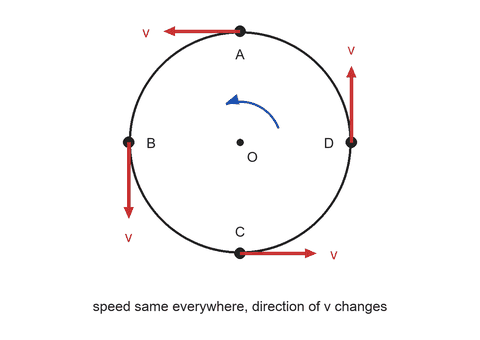
Therefore, a body in uniform circular motion moves with constant speed but variable velocity.
- 402 marks
Question 40
Give an example of motion in which average speed is not zero, but average velocity is zero.
Solve with AIWritten solution
Solution:
Concept: Average speed is the total distance travelled divided by the total time taken. Average velocity is the total displacement divided by the total time taken.
Step 1 — Give the example.
A car goes from a town A to a town B and comes back to A (or a ball is thrown vertically upwards and caught again at the point of projection).
Step 2 — Explain why the average speed is not zero.
The car travels a real distance, AB and back, in some time, so the total distance divided by the total time is not zero.
Step 3 — Explain why the average velocity is zero.
The car ends where it started, so its displacement is zero. The total displacement divided by the total time is therefore zero.
Therefore, any motion that returns to its starting point, like a round trip from A to B and back, has a non-zero average speed but zero average velocity.
- 412 marks
Question 41
Give one example of each of the following :
(a) uniform velocity (b) variable velocity (c) variable acceleration (d) uniform retardation.
Solve with AIWritten solution
Solution:
Concept: Look at how the size and direction of the velocity change with time: uniform means equal changes in equal intervals of time; variable means unequal changes.
Step 1 — Uniform velocity.
A car moving at a steady speed on a straight, empty highway covers equal distances in equal times in the same direction, so its velocity is uniform.
Step 2 — Variable velocity.
A body moving in a circle at steady speed keeps changing its direction, so its velocity is variable (a car on a busy road is another example).
Step 3 — Variable acceleration.
A car in a crowded street speeds up and slows down by different amounts at irregular times, so its acceleration is variable.
Step 4 — Uniform retardation.
A ball thrown vertically upwards, while it is going up, loses 9.8 m s of velocity every second, so it has a uniform retardation (a car braked steadily to rest is another example).
Therefore, (a) a car on a straight empty highway at steady speed, (b) a body moving in a circle, (c) a car in a crowded street and (d) a ball going up after being thrown vertically are suitable examples.
- 423 marks
Question 42
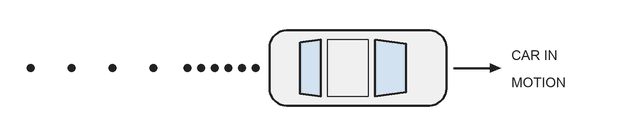
The diagram below shows the pattern of the oil on the road, dripping at a constant rate from a moving car. What informations do you get from it about the motion of the car ?
 Solve with AI
Written solution
Solution:
Concept: The oil drips at a constant rate, so the drops fall at equal intervals of time. The gap between two neighbouring drops is the distance the car moves in one such interval.
Step 1 — Find which drops fell first.
The car moves to the right, so the drops farthest behind it (on the left) fell first and those just behind the car fell last.
Step 2 — Read the first part of the trail.
On the left the gaps are large and equal. The car covered equal distances in equal times, so at first it moved with a uniform speed.
Step 3 — Read the last part of the trail.
Just behind the car the gaps are small (and nearly equal). In the same time interval the car now covers a much smaller distance, so it has slowed down and is moving at a lower speed.
Step 4 — Put the two parts together.
The change from large gaps to small gaps shows that between the two parts the car was retarded (its speed decreased).
Watch out: The drops nearest the car are the most recent ones, so read the trail from left to right, in the order the drops fell.
Therefore, the car first moved with a uniform (higher) speed and then slowed down, moving more slowly towards the end.
- 432 marks
Question 43
What is the direction of velocity of an object moving in a circular path ?
Solve with AIWritten solution
Solution:
Concept: At every instant a body moves straight ahead in the direction it is going at that moment; on a curved path this direction is along the tangent to the path.
Step 1 — Give the direction.
For an object moving in a circular path, the velocity at any point is directed along the tangent to the circle at that point.
Step 2 — See what this means.
The tangent points a different way at every point of the circle, so the direction of velocity keeps changing (see the figure in Short 5).
Step 3 — Check with an everyday case.
This is why a stone whirled in a circle flies off along the tangent when the string breaks.
Therefore, the velocity of an object moving in a circular path is along the tangent to the circle at each point.
- 442 marks
Question 44
'The value of remains same at all places on the earth surface'. Is this statement true ? Give reason for your answer.
Solve with AIWritten solution
Solution:
Concept: The value of at a place depends on its distance from the centre of the earth: the nearer the place is to the centre, the larger is .
Step 1 — Decide whether the statement is true.
No, the statement is not true.
Step 2 — Give the reason.
The earth is not a perfect sphere: it is flattened at the poles and bulges at the equator. So a place at a pole is nearer to the centre of the earth than a place on the equator.
Step 3 — State the result.
Hence is maximum at the poles (about 9.83 m s) and minimum at the equator (about 9.78 m s). The rotation of the earth also lowers a little at the equator.
Therefore, the statement is false: is greatest at the poles and least at the equator, because the earth is flattened at the poles.
- 452 marks
Question 45
If a stone and a pencil are dropped simultaneously in vacuum from the top of a tower, which of the two will reach the ground first ? Give reason.
Solve with AIWritten solution
Solution:
Concept: The acceleration due to gravity () is the uniform acceleration of a body falling freely under the pull of the earth alone. Near the earth's surface its average value is 9.8 m s, and at a given place it is the same for every body when air resistance is neglected.
Step 1 — Look at the forces in vacuum.
In vacuum there is no air, so there is no air resistance. The only force on each body is the pull of gravity.
Step 2 — Compare the accelerations.
Gravity gives every body the same acceleration , whatever its mass, shape or size. So the stone and the pencil have equal accelerations.
Step 3 — Compare the times.
Both start from rest at the same moment and fall the same height with the same acceleration, so they take the same time.
Watch out: In air a light, flat object falls more slowly because of air resistance; in vacuum this difference disappears.
Therefore, the stone and the pencil reach the ground at the same time.
- 463 marks
Question 46
The speed of a car is 72 km h. Express it in m s.
Solve with AIWritten solution
Solution:
Concept: To change km h into m s, change kilometres into metres (1 km is 1000 m) and hours into seconds (1 h is 3600 s). This is the same as multiplying by . To change m s back into km h, multiply by .
Given: Speed of the car = 72 km h
Step 1 — Write the conversion factor.
One kilometre per hour is 1000 m in 3600 s.
Step 2 — Convert 72 km h.
Multiply the speed by .
Therefore, 72 km h is 20 m s.
- 473 marks
Question 47
Express 15 m s in km h.
Solve with AIWritten solution
Solution:
Concept: To change km h into m s, change kilometres into metres (1 km is 1000 m) and hours into seconds (1 h is 3600 s). This is the same as multiplying by . To change m s back into km h, multiply by .
Given: Speed = 15 m s
Step 1 — Write the conversion factor.
One metre per second is 3600 m in one hour, that is 3.6 km in one hour.
Step 2 — Convert 15 m s.
Multiply the speed by .
Therefore, 15 m s is 54 km h.
- 484 marks
Question 48
Express each of the following in m s :
(a) 10 km h (b) 18 km min
Solve with AIWritten solution
Solution:
Concept: Change kilometres into metres (× 1000) and hours or minutes into seconds (1 h is 3600 s, 1 min is 60 s).
Step 1 — Convert 10 km h.
In one hour the body covers 10 km, that is 10 × 1000 m, in 3600 s.
Step 2 — Convert 18 km min.
In one minute the body covers 18 km, that is 18 × 1000 m, in 60 s.
Watch out: Divide by 60 (not 3600) when the time unit is the minute.
Note: The book's printed answer for (a), 0.278 m s, is a misprint (ten times too small); the correct value is 2.78 m s.
Therefore, (a) 10 km h ≈ 2.78 m s and (b) 18 km min is 300 m s.
- 493 marks
Question 49
Arrange the following speeds in increasing order: 10 m s, 1 km min, 18 km h.
Solve with AIWritten solution
Solution:
Concept: Speeds can be compared only when they are in the same unit, so first change every speed into m s.
Step 1 — Convert 1 km min.
One kilometre per minute is 1000 m in 60 s.
Step 2 — Convert 18 km h.
Multiply by to change km h into m s.
Step 3 — Compare.
The three speeds are now 10 m s, 16.67 m s and 5 m s, so from smallest to largest:
Therefore, the increasing order is 18 km h, 10 m s, 1 km min.
- 503 marks
Question 50
A train takes 3 h to travel from Agra to Delhi with a uniform speed of 65 km h. Find the distance between the two cities.
Solve with AIWritten solution
Solution:
Concept: For a body moving with uniform speed, distance = speed × time.
Given: Speed = 65 km h, time = 3 h
Step 1 — Write the formula.
The train moves with a uniform speed, so it covers 65 km in every hour.
Step 2 — Substitute the values.
Multiply the speed by the time taken.
Therefore, the distance between Agra and Delhi is 195 km.
- 514 marks
Question 51
A car travels first 30 km with a uniform speed of 60 km h and then next 30 km with a uniform speed of 40 km h. Calculate : (i) the total time of journey, (ii) the average speed of the car.
Solve with AIWritten solution
Solution:
Concept: Average speed is the total distance travelled divided by the total time taken. Average velocity is the total displacement divided by the total time taken. Time for each part = distance ÷ speed.
Given: 30 km at 60 km h, then 30 km at 40 km h
Step 1 — Time for the first 30 km.
The car covers 30 km at 60 km h.
Step 2 — Time for the next 30 km.
The car covers 30 km at 40 km h.
Step 3 — Total time of the journey.
Add the two times and change hours into minutes.
Step 4 — Average speed.
Divide the total distance, 30 + 30 = 60 km, by the total time.
Watch out: The average speed is not the mean of the two speeds, (60 + 40) ÷ 2 = 50 km h, because the car spends more time at the lower speed.
Therefore, (i) the total time is 1.25 h (75 min) and (ii) the average speed is 48 km h.
- 524 marks
Question 52
A train takes 2 h to reach station from station , and then 3 h to return from station to station . The distance between the two stations is 200 km. Find : (i) the average speed, (ii) the average velocity of the train.
Solve with AIWritten solution
Solution:
Concept: Average speed is the total distance travelled divided by the total time taken. Average velocity is the total displacement divided by the total time taken.
Given: AB = 200 km, time A to B = 2 h, time B to A = 3 h
Step 1 — Total distance and time.
The train goes 200 km from A to B and 200 km back, so the total distance is 400 km. The total time is 2 h + 3 h, that is 5 h.
Step 2 — Average speed.
Divide the total distance by the total time.
Step 3 — Average velocity.
The train starts at A and ends at A, so its total displacement is zero.
Therefore, (i) the average speed is 80 km h and (ii) the average velocity is zero.
- 533 marks
Question 53
A car moving on a straight path covers a distance of 1 km due east in 100 s. What is (i) the speed and (ii) the velocity, of car ?
Solve with AIWritten solution
Solution:
Concept: Speed is the distance travelled per unit time; it is a scalar. Velocity is the displacement per unit time, that is the distance travelled per second in a given direction; it is a vector. Both have the S.I. unit metre per second (m s).
Given: Distance = 1 km (1000 m) due east, time = 100 s
Step 1 — Change into S.I. units.
The distance is 1 km, that is 1000 m, covered in 100 s along a straight path due east.
Step 2 — Find the speed.
Speed is distance divided by time.
Step 3 — Find the velocity.
The path is straight and in one direction, so the displacement is also 1000 m, due east. The velocity therefore has the same size as the speed and the direction due east.
Therefore, (i) the speed is 10 m s and (ii) the velocity is 10 m s due east.
- 543 marks
Question 54
A body starts from rest and acquires a velocity 10 m s in 2 s. Find the acceleration.
Solve with AIWritten solution
Solution:
Concept: Acceleration is the rate of change of velocity, , where is the initial velocity, the final velocity and the time taken. Its S.I. unit is m s. When the velocity decreases, the acceleration is negative and is called retardation.
Given: , m s, s
Step 1 — Write the formula.
Acceleration is the change in velocity divided by the time taken; the body starts from rest, so .
Step 2 — Substitute the values.
Put the values into the formula.
Therefore, the acceleration is 5 m s.
- 553 marks
Question 55
A car starting from rest acquires a velocity 180 m s in 0.05 h. Find the acceleration.
Solve with AIWritten solution
Solution:
Concept: Acceleration is the rate of change of velocity, , where is the initial velocity, the final velocity and the time taken. Its S.I. unit is m s. When the velocity decreases, the acceleration is negative and is called retardation.
Given: , m s, h
Step 1 — Change the time into seconds.
The velocity is in m s, so the time must be in seconds.
Step 2 — Find the acceleration.
The car starts from rest, so .
Watch out: Do not divide by 0.05 directly; mixing hours with m s gives a wrong unit.
Therefore, the acceleration is 1 m s.
- 563 marks
Question 56
A body is moving vertically upwards. Its velocity changes at a constant rate from 50 m s to 20 m s in 3 s. What is its acceleration ?
Solve with AIWritten solution
Solution:
Concept: Acceleration is the rate of change of velocity, , where is the initial velocity, the final velocity and the time taken. Its S.I. unit is m s. When the velocity decreases, the acceleration is negative and is called retardation.
Given: m s, m s, s
Step 1 — Write the data.
The velocity changes at a constant rate. The initial velocity is m s, the final velocity is m s, and the time taken is s.
Step 2 — Find the acceleration.
Use the definition of acceleration.
Step 3 — Explain the sign.
The negative sign shows the velocity is decreasing: the body has a retardation of 10 m s, directed downwards, opposite to its upward motion.
Therefore, the acceleration is −10 m s, that is a retardation of 10 m s.
- 573 marks
Question 57
A toy car initially moving with a uniform velocity of 18 km h comes to a stop in 2 s. Find the retardation of the car in S.I. units.
Solve with AIWritten solution
Solution:
Concept: Acceleration is the rate of change of velocity, , where is the initial velocity, the final velocity and the time taken. Its S.I. unit is m s. When the velocity decreases, the acceleration is negative and is called retardation.
Given: km h, , s
Step 1 — Change the speed into m s.
Multiply by .
Step 2 — Find the acceleration.
The car stops, so , in s.
Step 3 — State the retardation.
The negative acceleration is a retardation of 2.5 m s.
Therefore, the retardation of the toy car is 2.5 m s.
- 583 marks
Question 58
A car accelerates at a rate of 5 m s. Find the increase in its velocity in 2 s.
Solve with AIWritten solution
Solution:
Concept: Acceleration is the rate of change of velocity, , where is the initial velocity, the final velocity and the time taken. Its S.I. unit is m s. When the velocity decreases, the acceleration is negative and is called retardation.
Given: m s, s
Step 1 — Rearrange the definition.
Since , the increase in velocity is the acceleration multiplied by the time.
Step 2 — Substitute the values.
Put m s and s.
Therefore, the velocity increases by 10 m s in 2 s.
- 593 marks
Question 59
A car is moving with a velocity 20 m s. The brakes are applied to retard it at a rate of 2 m s. What will be the velocity after 5 s of applying the brakes ?.
- 603 marks
Question 60
A bicycle initially moving with a velocity 5.0 m s accelerates for 5 s at a rate of 2 m s. What will be its final velocity ?
- 614 marks
Question 61
A car is moving in a straight line with speed 18 km h. It is stopped in 5 s by applying the brakes. Find : (i) the speed of car in m s, (ii) the retardation and (iii) the speed of car after 2 s of applying the brakes.
- 621 mark
Question 62
The slope of displacement-time graph gives :
- 631 mark
Question 63
From the given displacement-time graph, answer the following questions :
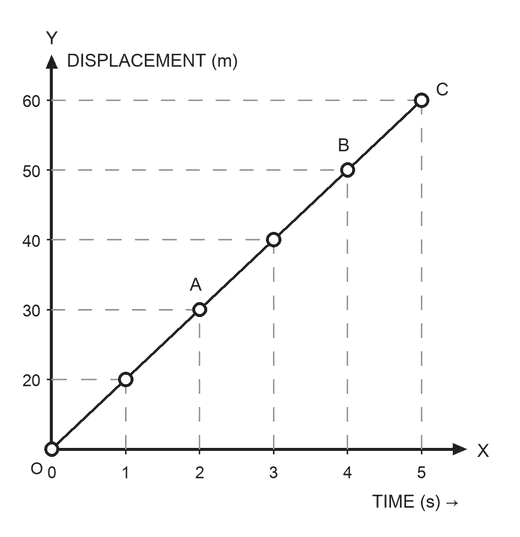
Displacement-time graph with a uniform velocity
(i)The kind of motion depicted in this graph is :
- 641 mark
Question 64
From the given displacement-time graph, answer the following questions :
Displacement-time graph with a uniform velocity
(ii) The velocity between point A and C is :
- 651 mark
Question 65
From the given displacement-time graph, answer the following questions :
Displacement-time graph with a uniform velocity
(iii) The displacement at is :
- 661 mark
Question 66
Out of the following, the correct displacement-time graph for uniform motion is :
- 671 mark
Question 67
From the velocity-time graph, we can determine :
- 681 mark
Question 68
Velocity × time = :
- 691 mark
Question 69
The velocity-time graph of a body in motion is a straight line inclined to the time axis. The correct statement is :
- 701 mark
Question 70
For a uniformly retarded motion, the velocity-time graph is :
- 711 mark
Question 71
Study the velocity-time graph shown below and answer the questions that follow :

(i) The distance travelled in 5 s :
- 721 mark
Question 72
Study the velocity-time graph shown below and answer the questions that follow :
(ii) The retardation of the body as calculated from the graph is :
- 731 mark
Question 73
The graph representing the state of rest of an object is :
- 741 mark
Question 74
Which of the following graphs shown below represents the uniform motion of an object ?
- 751 mark
Question 75
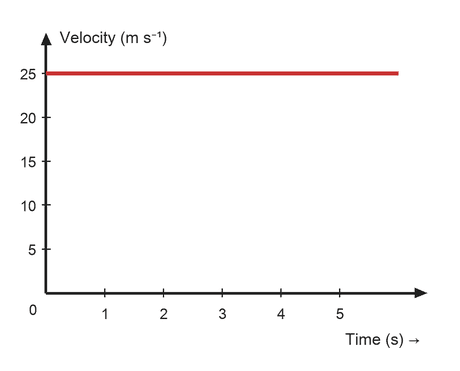
The velocity-time graph given below shows :
- 761 mark
Question 76
The slope of the velocity-time graph gives :
- 771 mark
Question 77
In the velocity-time graph shown below, the ratio of the distance travelled by the object in the last 2 s and the distance travelled in 7 s is :

- 781 mark
Question 78
The velocity-time graph given below shows an object moving in a straight line. The displacement and distance travelled by the object in 6 s will respectively be :

- 791 mark
Question 79
For the motion with uniform velocity, how is the distance travelled related to the time ?
- 801 mark
Question 80
What does the slope of a displacement–time graph represent ?
- 811 mark
Question 81
When can the distance-time and displacement-time graph be the same ?
- 821 mark
Question 82
What information do we get by a greater slope of displacement-time graph ?
- 831 mark
Question 83
What information is conveyed about motion by the negative slope of a displacement–time graph ?
- 841 mark
Question 84
What does the slope of velocity–time graph represent?
- 851 mark
Question 85
What information do we get by a higher slope of velocity-time graph ?
- 861 mark
Question 86
What information do we get about motion by the negative slope of a velocity-time graph ?
- 872 marks
Question 87
What information about the motion of a body are obtained from the displacement–time graph ?
- 882 marks
Question 88
Can displacement–time sketch be parallel to the displacement axis ? Give reason to your answer.
- 893 marks
Question 89
Draw a displacement–time graph for a boy going to school with a uniform velocity.
- 903 marks
Question 90
State how the velocity–time graph can be used to find (i) the acceleration of a body, (ii) the distance travelled by the body in a given time, and (iii) the displacement of the body in a given time.
- 913 marks
Question 91
What can you say about the nature of motion of a body if its displacement–time graph is
(a) a straight line parallel to time axis ?
(b) a straight line inclined to the time axis with an acute angle ?
(c) a straight line inclined to the time axis with an obtuse angle ?
(d) a curve.
- 922 marks
Question 92
The figure given below shows displacement–time graph of two vehicles A and B moving along a straight road. Which vehicle is moving faster ? Give reason.

- 933 marks
Question 93
How is the velocity obtained from the displacement-time graph for a body moving with a varying speed in a fixed direction ?
- 943 marks
Question 94
Draw a velocity–time graph for a body moving with an initial velocity and uniform acceleration . Use this graph to find the distance travelled by the body in time .
- 953 marks
Question 95
State the type of motion represented by the following sketches in (a) and (b). Give example of each type of motion.

- 962 marks
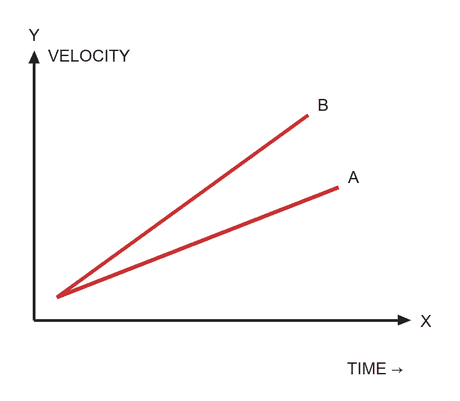
Question 96
The figure given below shows the velocity-time graph for two cars A and B moving in same direction. Which car has the greater acceleration ? Give reason for your answer.
- 973 marks
Question 97
Draw a velocity–time graph for a body moving with (a) uniform velocity, (b) uniform acceleration.
- 982 marks
Question 98
The velocity-time graph for a uniformly retarded body is a straight line inclined to the time axis with an obtuse angle. How is retardation calculated from the velocity-time graph ?
- 993 marks
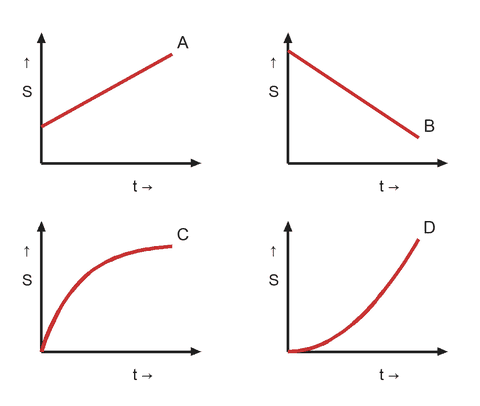
Question 99
The figure given below shows the displacement–time graph for four bodies A, B, C and D. In each case state what information do you get about the acceleration (zero, positive or negative).
- 1003 marks
Question 100
Draw a graph for acceleration against time for a uniformly accelerated motion. How can it be used to find the change in speed in a certain interval of time?
- 1013 marks
Question 101
Draw a velocity–time graph for the free fall of a body under gravity, starting from rest. Take = 10 m s.
- 1022 marks
Question 102
How is the distance related with time for the motion under uniform acceleration such as the motion of a freely falling body ?
- 1033 marks
Question 103
A body falls freely from a certain height. Show graphically the relation between the distance fallen and square of time. How will you determine g from this graph ?
- 1045 marks
Question 104
Draw the velocity-time graph for a body moving with :
(a) Uniform velocity
(b) Uniform acceleration
and give one example of each and also calculate the displacement and acceleration.
- 1054 marks
Question 105
Draw the acceleration-time graph for a body moving with :
(a) Uniform velocity (b) Free falling body
and give an example of each.
- 1064 marks
Question 106
The fig. 2.33 (a) given below shows the displacement–time graph for the motion of a body. Use it to calculate the velocity of body at = 1 s, 2 s and 3 s, then draw the velocity–time graph for it in Fig. (b).

Fig. 2.33 (a)
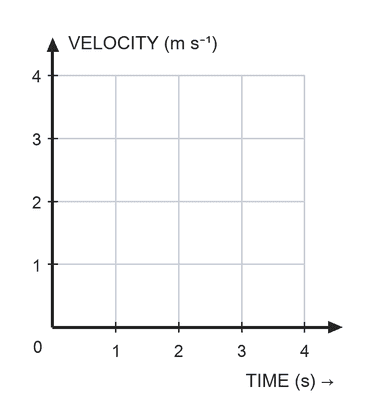
Fig. 2.33 (b)
- 1074 marks
Question 107
Following table gives the displacement of a car at different instants of time.
Time (s) 0 1 2 3 4 Displacement (m) 0 5 10 15 20 (a) Draw the displacement–time sketch and find the average velocity of car.
(b) What will be the displacement of car at (i) 2.5 s and (ii) 4.5 s ?
- 1084 marks
Question 108
A body is moving in a straight line and its displacement at various instants of time is given in the following table :
Time (s) 0 1 2 3 4 5 6 7 Displacement (m) 2 6 12 12 12 18 22 24 Plot displacement–time graph and calculate :
(i) total distance travelled in interval 1 s to 5 s,
(ii) average velocity in time interval 1 s to 5 s.
- 1094 marks
Question 109
The Fig. 2.34 given below shows the displacement of a body at different times.

Fig. 2.34
(a) Calculate the velocity of the body as it moves for time interval (i) 0 to 5 s, (ii) 5 s to 7 s and (iii) 7 s to 9 s.
(b) Calculate the average velocity during the time interval 5 s to 9 s.
[Hint : From 5 s to 9 s, displacement = 7 m − 3 m = 4 m]
- 1104 marks
Question 110
From the displacement–time graph of a cyclist, given in Fig. 2.35, find :
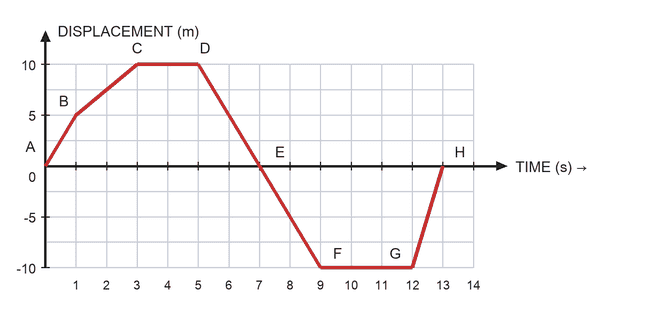
Fig. 2.35
(i) the average velocity in the first 4 s,
(ii) the displacement from the initial position at the end of 10 s,
(iii) the time after which he reaches the starting point.
- 1114 marks
Question 111
The figure given below represents the displacement–time sketch of motion of two cars A and B. Find :
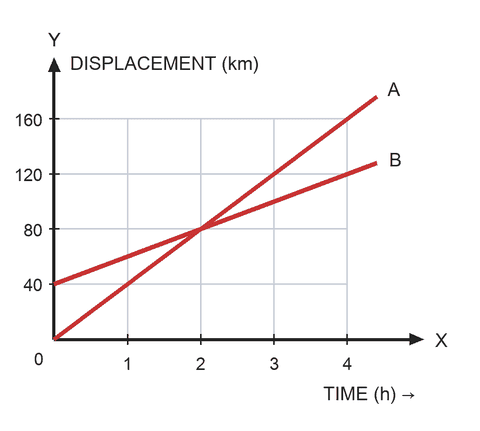
Fig. 2.36
(i) the distance by which the car B was initially ahead of car A.
(ii) the velocities of car A and car B.
(iii) the time in which car A catches car B.
(iv) the distance from start when the car A will catch the car B.
- 1124 marks
Question 112
A body at rest is made to fall from the top of a tower. Its displacement at different instants is given in the following table :
Time (in s) 0.1 0.2 0.3 0.4 0.5 0.6 Displacement (in m) 0.05 0.20 0.45 0.80 1.25 1.80 Draw a displacement–time graph and state whether the motion is uniform or non-uniform ?
- 1134 marks
Question 113
The Fig. 2.37 (a) below shows the velocity–time graph for the motion of a body. Use it to find the displacement of the body at = 1 s, 2 s, 3 s and 4 s, then draw the displacement–time graph for it in fig. (b).
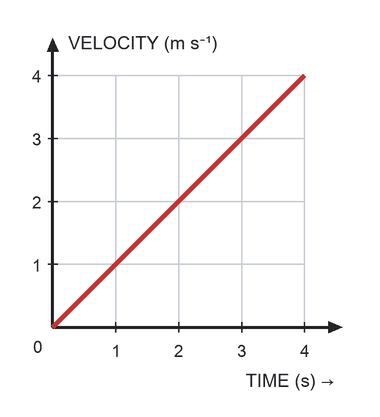
Fig. 2.37 (a)

Fig. 2.37 (b)
- 1145 marks
Question 114
The Fig. 2.38 given below shows a velocity–time graph for a car starting from rest. The graph has three parts , and .

Fig. 2.38
(i) State how is the distance travelled in any part determined from this graph.
(ii) Compare the distance travelled in part with the distance travelled in part .
(iii) Which part of the graph shows motion with (a) uniform velocity (b) acceleration (c) retardation ?
(iv) (a) Is the magnitude of acceleration higher or lower than that of retardation ? Give a reason.
(b) Compare the magnitude of acceleration and retardation.
- 1155 marks
Question 115
The velocity–time graph of a moving body is shown below in Fig. 2.39.
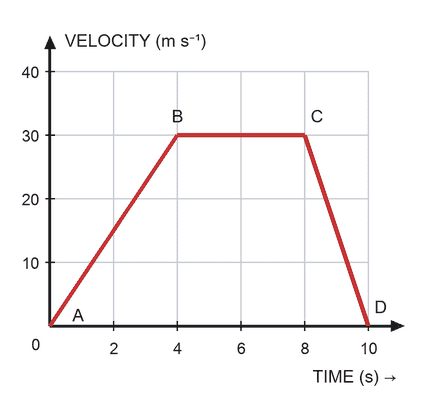
Fig. 2.39
Find :
(i) the acceleration in parts , and .
(ii) displacement in each part , , , and
(iii) total displacement.
- 1164 marks
Question 116
A ball moves on a smooth floor in a straight line with a uniform velocity 10 m s for 6 s. At = 6 s, the ball hits a wall and comes back along the same line to the starting point with same speed. Draw the velocity-time graph and use it to find the total distance travelled by the ball and its displacement.
- 1175 marks
Question 117
The figure below shows the velocity-time graph of a particle moving in a straight line.
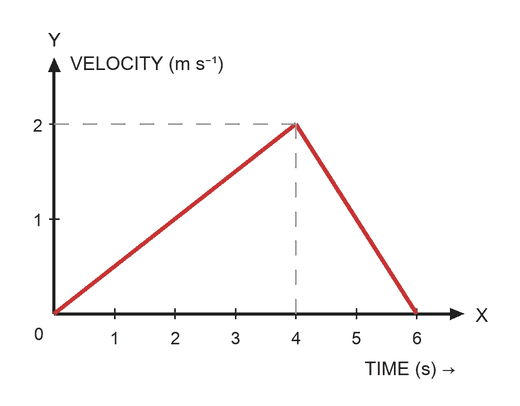
Fig. 2.40
(i) State the nature of motion of particle.
(ii) Find the displacement of particle at = 6 s.
(iii) Does the particle change its direction of motion ?
(iv) Compare the distance travelled by the particle from 0 to 4 s and from 4 s to 6 s.
(v) Find the acceleration from 0 to 4 s and retardation from 4 s to 6 s.
- 1181 mark
Question 118
The correct equation of motion is :
- 1191 mark
Question 119
When a body starts from rest, the equation of motion takes the form :
- 1201 mark
Question 120
If a body is moving with a uniform retardation, then its acceleration will be :
- 1211 mark
Question 121
A car acquires a velocity of 54 ms in 20 s starting from rest, then its acceleration is :
- 1221 mark
Question 122
A particle starts to move in a straight line from a point with velocity 10 ms and acceleration 2.0 ms. Its position at t = 5s will be :
- 1231 mark
Question 123
A body initially at rest, starts moving with a constant acceleration of 0.5 ms and travels a distance 25 m, then its final velocity is :
- 1241 mark
Question 124
A body starts from rest with a uniform acceleration of 8 ms, then the distance covered by the body in 2 s is :
- 1251 mark
Question 125
A car starting from rest accelerates uniformly to acquire a speed 20 km h in 30 min. The distance travelled by car in this time interval will be :
- 1262 marks
Question 126
Write three equations of uniformly accelerated motion relating the initial velocity (), final velocity (), time (), acceleration () and displacement ().
- 1271 mark
Question 127
Write an expression for the distance covered in time by a body which is initially at rest and starts moving with a constant acceleration .
- 1285 marks
Question 128
Derive the following equations for a uniformly accelerated motion :
(i) (ii) (iii)
where the symbols have their usual meanings.
- 1293 marks
Question 129
A body starts from rest with a uniform acceleration of 2 m s. Find the distance covered by the body in 2 s.
- 1303 marks
Question 130
A body starts with an initial velocity of 10 m s and acceleration 5 m s. Find the distance covered by it in 5 s.
- 1314 marks
Question 131
A vehicle is accelerating on a straight road. Its velocity at any instant is 30 km h, after 2 s, it is 33.6 km h and after further 2 s, it is 37.2 km h. Find the acceleration of vehicle in m s. Is the acceleration uniform ?
- 1324 marks
Question 132
A body, initially at rest, starts moving with a constant acceleration 2 m s. Calculate : (i) the velocity acquired and (ii) the distance travelled in 5 s.
- 1333 marks
Question 133
A bullet initially moving with a velocity 20 m s strikes a target and comes to rest after penetrating a distance 10 cm in the target. Calculate the retardation caused by the target.
- 1343 marks
Question 134
A train moving with a velocity of 20 m s is brought to rest by applying brakes in 5 s. Calculate the retardation.
- 1354 marks
Question 135
A train travels with a speed of 60 km h from station A to station B and then comes back with a speed 80 km h from station B to station A. Find : (i) the average speed, and (ii) the average velocity of train.
- 1364 marks
Question 136
A train is moving with a velocity of 90 km h. It is brought to stop by applying the brakes which produce a retardation of 0.5 m s. Find : (i) the velocity after 10 s, and (ii) the time taken by the train to come to rest.
- 1374 marks
Question 137
A car travels a distance 100 m with a constant acceleration and average velocity of 20 m s. The final velocity acquired by the car is 25 m s. Find : (i) the initial velocity and (ii) acceleration of car.
- 1384 marks
Question 138
When brakes are applied to a bus, the retardation produced is 25 cm s and the bus takes 20 s to stop. Calculate : (i) the initial velocity of bus, and (ii) the distance travelled by bus during this time.
- 1394 marks
Question 139
A body moves from rest with a uniform acceleration and travels 270 m in 3 s. Find the velocity of the body at 10 s after the start.
- 1404 marks
Question 140
A body moving with a constant acceleration travels the distances 3 m and 8 m respectively in 1 s and 2 s. Calculate : (i) the initial velocity, and (ii) the acceleration of body.
- 1414 marks
Question 141
A car travels with a uniform velocity of 25 m s for 5 s. The brakes are then applied and the car is uniformly retarded and comes to rest in further 10 s. Find : (i) the distance which the car travels before the brakes are applied, (ii) the retardation, and (iii) the distance travelled by the car after applying the brakes.
- 1424 marks
Question 142
A space craft flying in a straight course with a velocity of 75 km s fires its rocket motors for 6.0 s. At the end of this time, its speed is 120 km s in the same direction. Find : (i) the space craft's average acceleration while the motors were firing, (ii) the distance travelled by the space craft in the first 10 s after the rocket motors were started, the motors having been in action for only 6.0 s.
- 1434 marks
Question 143
A train starts from rest and accelerates uniformly at a rate of 2 m s for 10 s. It then maintains a constant speed for 200 s. The brakes are then applied and the train is uniformly retarded and comes to rest in 50 s. Find : (i) the maximum velocity reached, (ii) the retardation in the last 50 s, (iii) the total distance travelled, and (iv) the average velocity of the train.
What Class 9 Physics Ch 2 covers
The sections of the chapter, in the order the book takes them. Every question above comes from one of these.
- 01Scalar and Vector Quantities
- 02Rest and Motion
- 03Distance and Displacement
- 04Speed and Velocity
- 05Acceleration and Retardation
- 06Displacement-Time Graph
More ways to study this chapter
The same chapter asked three other ways. Practise it, revise it, and see what the board has set on Ch 2 before.
Class 9 Physics Ch 2 questions students ask
How many questions are there in Class 9 Physics Ch 2?
143 questions. Every one is solved step by step on this page.
Are these Class 9 Physics solutions free?
Yes. Every question and its full working is free to read, with no account needed.
Can I download the Class 9 Physics Ch 2 solutions as a PDF?
There is no PDF to download. Every solution is on this page instead, which means it is searchable, always the current syllabus, and readable on a phone. Use your browser's print option if you want it on paper.