
Question 943 marksMedium
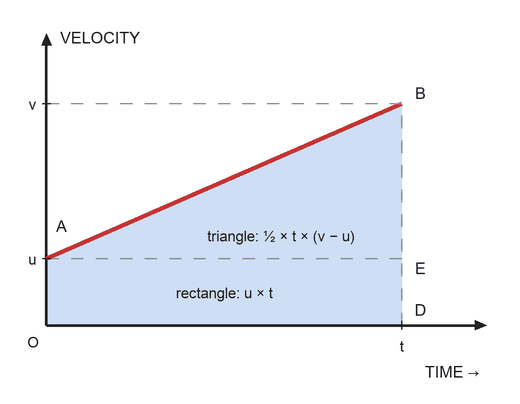
Draw a velocity–time graph for a body moving with an initial velocity and uniform acceleration . Use this graph to find the distance travelled by the body in time .
Confirming your payment
Sign up now and get 250 free tokens.
Motion in One Dimension · Question 94 of 143
Draw a velocity–time graph for a body moving with an initial velocity and uniform acceleration . Use this graph to find the distance travelled by the body in time .
Solution:
Concept: In a velocity-time graph the slope (change in velocity ÷ change in time) gives the acceleration, and the area enclosed between the graph and the time axis gives the displacement. Area above the time axis counts as positive and area below it as negative; for the distance travelled, every area counts as positive.
Step 1 — Draw the graph.
At t = 0 the velocity is (point A). With uniform acceleration the velocity rises steadily and becomes at time (point B). So the graph is the straight line AB.
Step 2 — Split the area under AB.
The distance travelled is the area of the trapezium OABD. It is the rectangle OAED (height , width ) plus the triangle ABE (base , height ).
Step 3 — Use the slope.
The slope of AB is the acceleration, so the rise BE is the acceleration multiplied by the time.
Step 4 — Substitute.
Put into the expression for the area.
Therefore, the distance travelled in time is .