
Opening your dashboard
Class 9 Physics Chapter 2 Motion in One Dimension: Practice Questions
43 questions on Chapter 2, each worked through on its own page with the AI tutor. Class 9 Physics, ICSE 2026-27.
43 questions
1–5 marks · Mixed difficulty
- 11 mark
Question 1
Bloom's level: Remember
Four students were each asked to name two physical quantities that have direction as well as magnitude. Whose pair is correct ?
- 21 mark
Question 2
Bloom's level: Understand
Aditi is sitting in a moving bus. Which statement about her is correct ?
- 31 mark
Question 3
Bloom's level: Remember
Which description fits a body moving in one dimension ?
- 41 mark
Question 4
Bloom's level: Apply
A boy walks 40 m due east along a straight road and then 15 m due west along the same road. The distance travelled and the displacement of the boy are :
- 51 mark
Question 5
Bloom's level: Apply
An athlete runs one complete round of a 400 m circular track in 50 s and stops at the starting point. Her average speed and average velocity are :
- 61 mark
Question 6
Bloom's level: Apply
A scooter speeds up uniformly from 36 km h to 54 km h in 5 s. Its acceleration is :
- 71 mark
Question 7
Bloom's level: Analyse
A car moves along a straight road, and the graph of its velocity against time is given below.

How far does the car go in the first 4 s ?
- 81 mark
Question 8
Bloom's level: Understand
A ball is thrown vertically upwards. At the highest point of its path, the velocity and the acceleration of the ball are :
- 91 mark
Question 9
Bloom's level: Apply
A body starts from rest. Its acceleration plotted against time is a horizontal line at 2 m s from = 0 to = 5 s. What is the body's velocity at the end of 5 s ?
- 101 mark
Question 10
Bloom's level: Understand
Read the Assertion (A) and the Reason (R) and choose the correct option.
Assertion (A): The displacement-time graph of a body at rest is a straight line parallel to the time axis.
Reason (R): For a body moving in a fixed direction, the displacement-time graph and the distance-time graph are the same.
- 111 mark
Question 11
Bloom's level: Analyse
Read the Assertion (A) and the Reason (R) and choose the correct option.
Assertion (A): A body moving with uniform speed in a circular path has no acceleration.
Reason (R): The velocity of a body changes when the direction of its motion changes, even if its speed stays the same.
- 121 mark
Question 12
Bloom's level: Analyse
Read the Assertion (A) and the Reason (R) and choose the correct option.
Assertion (A): A body starting from rest and moving with uniform acceleration covers distances in the ratio 1 : 3 : 5 in its 1st, 2nd and 3rd seconds.
Reason (R): The velocity of such a body increases by equal amounts in equal distances.
- 131 mark
Question 13
Bloom's level: Remember
Write the equation of uniformly accelerated motion which does not contain time . State what each symbol stands for.
- 142 marks
Question 14
Bloom's level: Understand
To a person standing on a platform, a tree beside the railway line is at rest. To a passenger in a passing train, the same tree appears to be moving backwards. Explain why both are right, and what this tells us about rest and motion.
- 152 marks
Question 15
Bloom's level: Understand
State, with a reason, whether each of the following is a motion in one dimension :
(a) a lift going up from the ground floor to the fifth floor
(b) a car turning around a bend in the road
(c) a coconut falling from a tree
(d) the earth going around the sun
- 162 marks
Question 16
Bloom's level: Understand
A teacher tells a new student, "Walk 5 m and you will reach the library door." The student walks 5 m but does not reach the door. Explain, using the idea of scalar and vector quantities, what was missing from the instruction, and rewrite the instruction correctly.
- 172 marks
Question 17
Bloom's level: Apply
An athlete runs one and a half rounds of a circular track of radius 35 m.
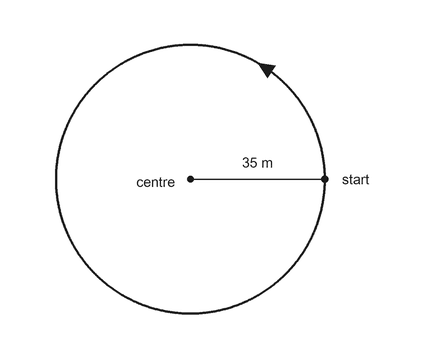
Find (a) the distance covered and (b) the magnitude of the displacement. (Take .)
- 182 marks
Question 18
Bloom's level: Apply
During a thunderstorm, Rohan hears the thunder 3 s after he sees the flash of lightning. The speed of sound in air is 340 m s. How far away is the lightning ? (Light takes almost no time to reach him.)
- 192 marks
Question 19
Bloom's level: Apply
A cricket ball moving at 30 m s is stopped by a fielder in 0.06 s. Find the acceleration of the ball. What is its retardation ?
- 202 marks
Question 20
Bloom's level: Analyse
Two cars A and B move along a straight road in the same direction. Car A starts from rest and its velocity rises uniformly to 20 m s in 10 s. Car B has a velocity of 10 m s at = 0, which rises uniformly to 20 m s in the same 10 s. Which car has the greater acceleration, and which travels farther in these 10 s ? Show your working.
- 212 marks
Question 21
Bloom's level: Evaluate
A stone is dropped from the top of a building 45 m high. A student says, "It will take 4.5 s to reach the ground, because ." Check the student's answer, point out the mistake, and find the correct time. (Take = 10 m s and neglect air resistance.)
- 221 mark
Question 22
Bloom's level: Remember
What is the shape of the displacement-time graph of a body which starts from rest and moves with uniform acceleration ?
- 234 marks
Question 23
Bloom's level: Apply
A lift starts from rest at the ground floor. It speeds up at 1.5 m s for 2 s, then moves with a constant velocity for 6 s, and then slows down at 1 m s for 3 s.
(a) Draw the acceleration-time graph of the lift.
(b) What does the area under an acceleration-time graph give ?
(c) Use the graph to find the greatest velocity of the lift and show that it comes to rest at the end.
(d) Find the total distance the lift moves.
- 244 marks
Question 24
Bloom's level: Apply
Case study: A car is moving at 20 m s when the driver sees a traffic signal turn red at a crossing 45 m ahead. He takes 0.5 s to react (the car keeps moving at 20 m s during this time) and then applies the brakes, which produce a uniform retardation of 5 m s.
(a) How far does the car travel during the reaction time ?
(b) How far does it travel after the brakes are applied, before it stops ?
(c) Does the car stop before the crossing ? If the driver had been talking on his phone and taken 1.5 s to react, how far past the crossing would the car have stopped ?
- 255 marks
Question 25
Bloom's level: Analyse
The velocity-time graph of a bus moving between two bus stops on a straight road is shown.
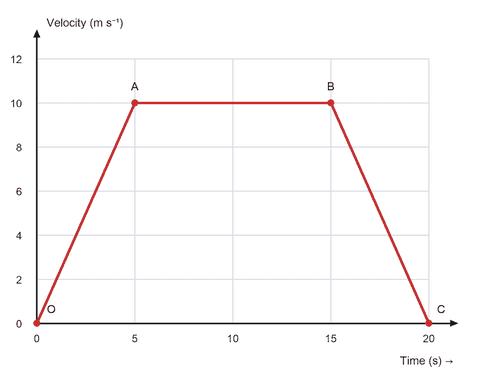
(a) Describe the motion of the bus in the parts OA, AB and BC.
(b) Find the acceleration in each part.
(c) Find the distance between the two bus stops.
(d) Find the average speed of the bus for the whole journey.
(e) Sketch the acceleration-time graph for the journey.
- 264 marks
Question 26
Bloom's level: Evaluate
Rahul wrote these statements while revising this chapter. Check each one, state whether it is correct, and correct the wrong ones with a reason or an example.
(a) A body moving with a constant speed can have no acceleration.
(b) The distance travelled by a body can be less than the magnitude of its displacement.
(c) The area under a velocity-time graph gives the displacement.
(d) The slope of a displacement-time graph gives the acceleration.
(e) A body can have a non-zero average speed but zero average velocity.
- 274 marks
Question 27
Bloom's level: Evaluate
Case study: Priya drives from her home to her aunt's house 120 km away. She drives the first 60 km at 40 km h and the remaining 60 km at 60 km h. She tells her brother, "My average speed was km h."
(a) Find the time she took for each half of the distance.
(b) Find her actual average speed.
(c) Is Priya's method correct ? Explain why not, and state when taking the simple average of two speeds would give the right answer.
- 283 marks
Question 28
Bloom's level: Understand
A ball is thrown vertically upwards and is caught back by the thrower at the same height. Describe how (a) its velocity, (b) its acceleration and (c) its displacement change during the upward and the downward journey. Also state the shape of its velocity-time graph. (Neglect air resistance.)
- 295 marks
Question 29
Bloom's level: Create
Frame a word problem about a real situation (for example a sprinter, a train or an aeroplane on a runway) in which a body starts from rest and moves with uniform acceleration, such that
(a) the equation is needed to find the final velocity, and
(b) the equation is needed to find the time taken.
(c) Solve your problem completely, and check your answers using the third equation of motion.
- 305 marks
Question 30
Bloom's level: Create
A metro train runs between two stations 1.2 km apart on a straight track. Plan its journey as follows: it starts from rest and speeds up at 1 m s until it reaches 20 m s, then runs at this speed, and finally slows down at 1 m s to stop exactly at the next station.
(a) Find the time and the distance for speeding up and for slowing down.
(b) Find the time for which the train runs at constant speed.
(c) Draw the velocity-time graph of the whole journey with the values marked on it, and find the total time.
(d) The metro company wants to shorten the journey. Suggest one change in the plan and work out the new journey time.
- 312 marks
Question 31
What is the average velocity of a particle when it returns to its initial position ?
- 322 marks
Question 32
A cycle moving with an initial velocity of 10 m s accelerates at the rate of 4 m s for 10 s. Find its final velocity.
- 332 marks
Question 33
A car covers the first 30 km in 0.5 h and the next 30 km in h. Find the average speed of the car for the whole trip.
- 341 mark
Question 34
In which of the following groups are all three physical quantities vectors ?
- 351 mark
Question 35
A cyclist rides 6 km due east along a straight road in 20 minutes. He then turns back and rides 2 km due west along the same road in 10 minutes. For the whole journey, his average speed and the magnitude of his average velocity are respectively :
- 361 mark
Question 36
Assertion (A): The acceleration-time graph of a freely falling body is a straight line parallel to the time axis.
Reason (R): A freely falling body moves with a uniform acceleration, equal to the acceleration due to gravity.
- 372 marks
Question 37
(i) When is a body said to be at rest, and when is it said to be in motion ?
(ii) A water bottle is kept on the seat of a moving school bus. State whether the bottle is at rest or in motion with respect to (a) the seat, and (b) a tree by the side of the road. What does this show about rest and motion ?
- 382 marks
Question 38
An ant crawling along the edge of a metre rule starts from the 10 cm mark, goes straight up to the 85 cm mark, turns round and comes back to the 40 cm mark. The whole trip takes 25 s.
(i) Find the distance travelled by the ant and its displacement.
(ii) Calculate the average speed and the average velocity of the ant.
- 392 marks
Question 39
A ball is rolled up a smooth sloping plank. It starts from the bottom of the plank with a velocity of 12 m s and comes to rest for a moment after 4 s. Its velocity decreases at a uniform rate.
(i) Calculate the acceleration of the ball.
(ii) State the retardation of the ball. What does the negative sign of the acceleration tell us ?
- 402 marks
Question 40
The graph shows the displacement of a body moving along a straight line, plotted against time.
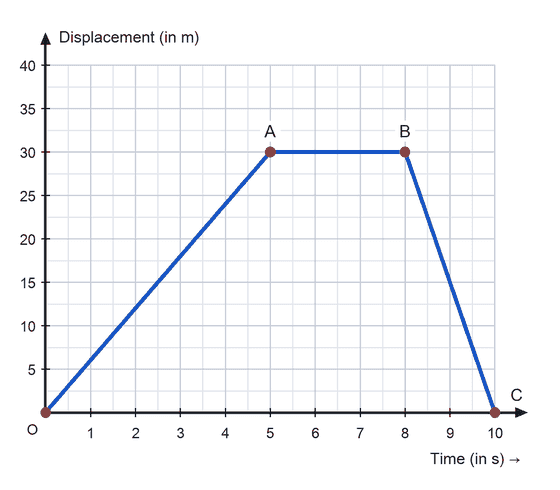
(i) Find the velocity of the body in the part OA, and state what the part AB tells about the body.
(ii) Find the velocity of the body in the part BC. What does its sign show ?
- 414 marks
Question 41
The graph shows how the velocity of a car moving on a straight road changes with time.
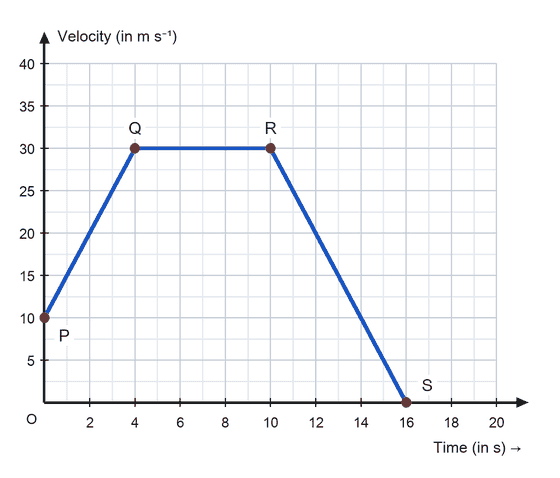
(i) Calculate the acceleration of the car in the part PQ.
(ii) Calculate the retardation of the car in the part RS.
(iii) Calculate the total distance travelled by the car in 16 s.
- 424 marks
Question 42
A car starts from rest and moves along a straight road with a uniform acceleration of 1.5 m s for 12 s. The brakes are then applied, and the car comes to rest with a uniform retardation after travelling a further 54 m.
(i) Calculate the velocity of the car at the end of 12 s.
(ii) Calculate the distance travelled by the car in these 12 s.
(iii) Calculate the retardation of the car after the brakes are applied.
- 433 marks
Question 43
A ball is thrown vertically upwards from the ground with an initial velocity of 25 m s. Neglect the resistance of air and take m s.
(i) Calculate the time taken by the ball to reach its highest point.
(ii) Calculate the maximum height reached by the ball.
(iii) Calculate the speed of the ball when it is 20 m above the ground.