
Question 1045 marksMedium
Draw the velocity-time graph for a body moving with :
(a) Uniform velocity
(b) Uniform acceleration
and give one example of each and also calculate the displacement and acceleration.
Confirming your payment
Sign up now and get 250 free tokens.
Motion in One Dimension · Question 104 of 143
Draw the velocity-time graph for a body moving with :
(a) Uniform velocity
(b) Uniform acceleration
and give one example of each and also calculate the displacement and acceleration.
Solution:
Concept: In a velocity-time graph the slope (change in velocity ÷ change in time) gives the acceleration, and the area enclosed between the graph and the time axis gives the displacement. Area above the time axis counts as positive and area below it as negative; for the distance travelled, every area counts as positive.
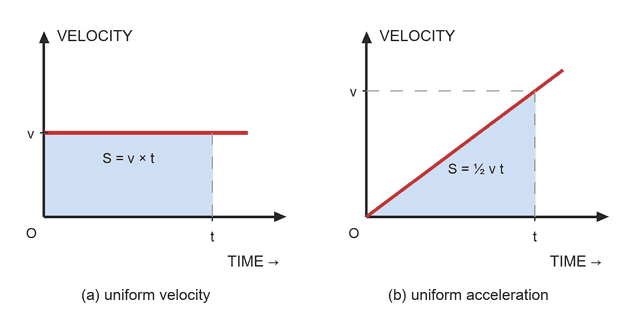
Step 1 — Draw the graphs.
The figure shows both graphs: (a) a horizontal line at velocity , and (b) a straight line rising from the origin to velocity at time .
Step 2 — Uniform velocity: example and acceleration.
Example: a car moving at a steady 60 km h on a straight road. The line is horizontal, so its slope, the acceleration, is zero.
Step 3 — Uniform velocity: displacement.
The area under the line up to time is a rectangle of height and width .
Step 4 — Uniform acceleration: example and acceleration.
Example: a stone falling freely from rest. The acceleration is the slope of the line.
Step 5 — Uniform acceleration: displacement.
The area under the line up to time is a triangle of base and height ; since it can also be written in terms of .
Therefore, (a) for uniform velocity the acceleration is zero and ; (b) for uniform acceleration from rest and .