
Question 1285 marksMedium
Derive the following equations for a uniformly accelerated motion :
(i) (ii) (iii)
where the symbols have their usual meanings.
Confirming your payment
Sign up now and get 250 free tokens.
Motion in One Dimension · Question 128 of 143
Derive the following equations for a uniformly accelerated motion :
(i) (ii) (iii)
where the symbols have their usual meanings.
Solution:
Concept: For uniform acceleration the velocity-time graph is a straight line. Its slope is the acceleration , and the area under it is the displacement .
Step 1 — Set up the graph.
A body has initial velocity and uniform acceleration ; after time its velocity is . Its velocity-time graph is the straight line AB.
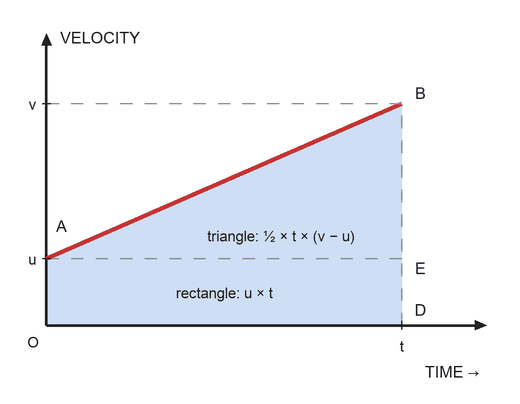
Here OA stands for , DB for , and both OD and AE for . The rise of the line, BE, is DB − DE; this rise is .
Step 2 — Derive v = u + at.
The acceleration is the slope of AB, the rise BE divided by the run AE.
Multiply both sides by and add .
Step 3 — Derive S = ut + ½at².
The displacement is the area under AB, which is the rectangle OAED plus the triangle ABE.
From Step 2, , so
Step 4 — Derive v² = u² + 2aS.
The same area is the trapezium OABD, whose parallel sides are OA and DB and whose width is OD.
From Step 2, . Substitute this time.
Multiply both sides by and rearrange.
Watch out: The area under the graph is a trapezium, so do not use the area of the triangle alone.
Therefore, (i) , (ii) and (iii) .