Solution:
Concept: In a velocity-time graph the slope (change in velocity ÷ change in time) gives the acceleration, and the area enclosed between the graph and the time axis gives the displacement. Area above the time axis counts as positive and area below it as negative; for the distance travelled, every area counts as positive.
Step 1 — Nature of the motion.
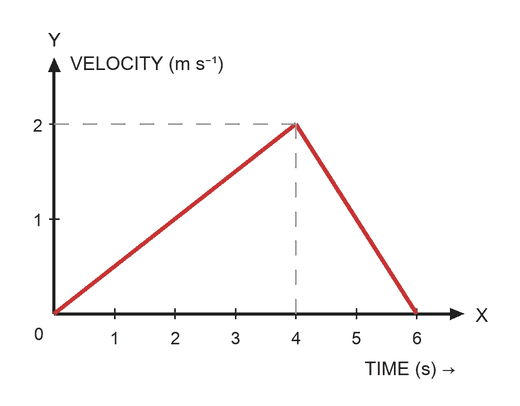
From 0 to 4 s the velocity rises uniformly from 0 to 2 m s−1: uniformly accelerated. From 4 s to 6 s it falls uniformly to zero: uniformly retarded.
Step 2 — Displacement at 6 s.
The area under the whole graph is a triangle of base 6 s and height 2 m s−1.
S=21×6×2=6 m
Step 3 — Change of direction.
No. The velocity stays positive (the graph never goes below the time axis), so the particle keeps moving the same way.
Step 4 — Compare the distances.
Find the area of each triangle.
S0−4=21×4×2=4 m
S4−6=21×2×2=2 m
So the ratio is 4 : 2, that is 2 : 1.
Step 5 — Acceleration and retardation.
Find the slopes of the two parts.
a=42−0=0.5 m s−2
retardation=6−42−0=1 m s−2
Therefore, (i) uniform acceleration then uniform retardation; (ii) 6 m; (iii) no; (iv) 2 : 1; (v) acceleration 0.5 m s−2 and retardation 1 m s−2.