Solution:
Concept: In a velocity-time graph the slope (change in velocity ÷ change in time) gives the acceleration, and the area enclosed between the graph and the time axis gives the displacement. Area above the time axis counts as positive and area below it as negative; for the distance travelled, every area counts as positive.
Step 1 — Work out the motion.
The ball moves at +10 m s−1 for 6 s, so it is 60 m from the start when it hits the wall. It comes back the same 60 m at the same speed, so the return also takes
t=1060=6 s
Step 2 — Draw the graph.
The velocity is +10 m s−1 from 0 to 6 s and −10 m s−1 (moving back) from 6 s to 12 s.
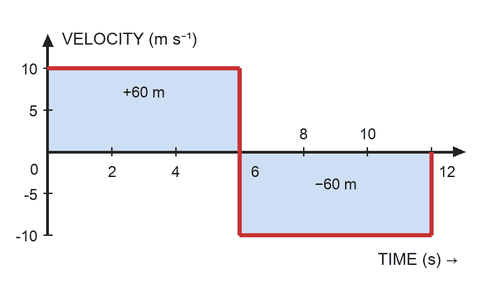
Step 3 — Total distance.
Add the two areas, both taken as positive.
distance=10×6+10×6=120 m
Step 4 — Displacement.
Add the areas with their signs; the area below the time axis is negative.
displacement=60+(−60)=0
Therefore, the ball travels a total distance of 120 m and its displacement is zero.
