
Opening your dashboard
Class 9 Physics Chapter 2 Motion in One Dimension: Competency-Based Questions (CBQ)
40 questions on Chapter 2, each worked through on its own page with the AI tutor. Class 9 Physics, ICSE 2026-27.
40 questions
1–5 marks · Mixed difficulty
- 11 mark
Question 1
Competency: Application
In a practice session, a swimmer dives in at one end of a straight 50 m pool and swims 5 lengths of the pool without stopping, finishing at the far end. She takes 250 s in all. Her average speed and the magnitude of her average velocity for the session are :
- 21 mark
Question 2
Competency: Analysis
Meera is sitting in train X at a station. Through the window on her left she sees the coaches of train Y, on the next track, sliding steadily towards the back of her own train. Through the window on her right she sees that a bench fixed on the platform stays exactly opposite her window. What can she correctly conclude ?
- 31 mark
Question 3
Competency: Analysis
A remote-controlled toy car is run along a straight corridor. The graph shows its displacement from the starting line against time.

Which statement about the motion of the toy car is correct ?
- 41 mark
Question 4
Competency: Application & Analysis
The dashboard of an electric car moving on a straight road shows these speeds at intervals of 2 s.
Time (s) 0 2 4 6 Speed (km h) 18 27 36 45 Which statement about the motion of the car during these 6 s is correct ?
- 51 mark
Question 5
Competency: Understanding
Assertion (A): On the Moon, where there is no air, an astronaut lets go of a hammer and a feather from the same height at the same instant, and they reach the ground together.
Reason (R): In the absence of air, all bodies at a place fall with the same acceleration, whatever their masses.
- 61 mark
Question 6
Competency: Understanding & Application
Assertion (A): A hiker who walks 3 km and then a further 4 km must be 7 km away from her starting point.
Reason (R): Distance is a scalar quantity, so two distances are added by simple arithmetic.
- 72 marks
Question 7
Competency: Application
A window-cleaning cradle hangs by steel cables on the outside wall of a tall building. Each floor of the building is 3.5 m above the one below it, and the ground floor is at ground level. One morning the cradle goes straight up from the ground floor to the 8th floor and then comes down to the 3rd floor, where it stops.
(a) Find the distance moved by the cradle and its displacement.
(b) A meter on the cradle is used to decide when the cables are worn and must be replaced. Should it record the distance or the displacement ? Give a reason.
- 82 marks
Question 8
Competency: Analysis & Evaluation
A lift starts from rest at the ground floor and moves upwards. The graph shows how its acceleration changes with time.
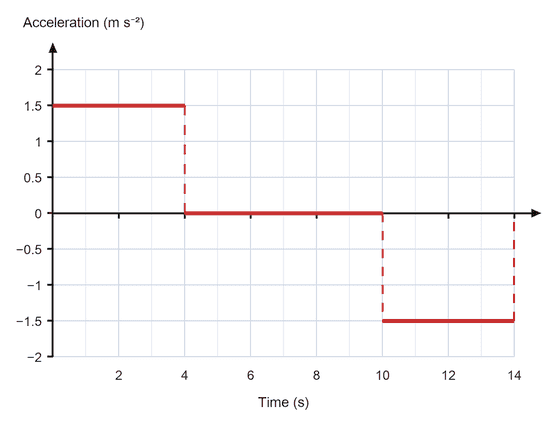
(a) Use the graph to find the velocity of the lift at = 4 s.
(b) A student says, "From 4 s to 10 s the acceleration is zero, so the lift is standing still, and at 14 s it is moving downwards." Judge both parts of this statement.
- 92 marks
Question 9
Competency: Application & Analysis
To compare their reaction times, Anu and Bala use a metre rule. A friend holds the rule vertically with its zero mark level with the open fingers of the catcher and lets it go without warning. The catcher grips the rule as quickly as possible, and the mark at the fingers shows how far the rule has fallen. (Take = 10 m s and neglect air resistance.)
Catcher Distance fallen by the rule Anu 20 cm Bala 45 cm (a) Find the reaction time of each of them.
(b) Bala says, "My rule fell 2.25 times as far as Anu's, so my reaction time is 2.25 times hers." Is he right ? Give a reason.
- 102 marks
Question 10
Competency: Application & Evaluation
On a straight highway with a speed limit of 90 km h, two cameras are fixed 3 km apart. They record that a car passes the first camera at 10 : 15 : 00 and the second camera at 10 : 16 : 40 (hours : minutes : seconds). The driver argues, "My speedometer showed only 80 km h at each camera, so I did not break the speed limit."
(a) Find the average speed of the car between the cameras in km h.
(b) Is the driver's argument acceptable ? Give a reason.
- 114 marks
Question 11
Competency: Application & Analysis
Case study: A metro train runs on a straight track from one station to the next. The graph shows its velocity against time for the whole run.

(a) Find the acceleration of the train while it speeds up and its retardation while it slows down.
(b) Use the graph to find the distance between the two stations.
(c) During repair work the train is not allowed to go faster than 10 m s anywhere between these stations. It speeds up and slows down at the same rates as before. How much longer does the run now take ?
- 124 marks
Question 12
Competency: Application & Evaluation
Case study: A small passenger aircraft must reach a speed of 60 m s to lift off the ground. Starting from rest at one end of a runway, it speeds up with a uniform acceleration of 2.5 m s. An airfield has three straight runways.
Runway X Y Z Length 600 m 800 m 900 m For safety, the airfield allows a take-off only if the runway is at least 1.2 times as long as the distance the aircraft needs to lift off.
(a) Find the time the aircraft takes to reach its lift-off speed and the distance it covers in doing so.
(b) On which runways can the aircraft lift off at all ? Which of them does the safety rule allow it to use ? Show your working.
(c) The aircraft is to be fitted with more powerful engines. What is the least uniform acceleration that would let it use runway X under the same safety rule ?
- 134 marks
Question 13
Competency: Analysis & Evaluation
Case study: Two cyclists A and B ride along the same straight track from the same starting line. A sports teacher records their displacement from the starting line and plots the graph below. Time is counted from the moment A starts.

(a) Find the velocity of each cyclist.
(b) How far ahead is A at the moment B starts ? When, and how far from the starting line, does B draw level with A ?
(c) The finishing line is 120 m from the starting line and both cyclists keep the same velocities. Who finishes first, and by how many seconds ? A spectator says, "B must have kept on speeding up to catch A." Judge this remark from the graph.
- 144 marks
Question 14
Competency: Application & Creation
Your class wants to find the height of the school terrace above the playground. You are given only a small stone and a stopwatch, and a teacher will keep the ground below clear.
(a) Plan the measurement: write the steps you would follow and the readings you would take.
(b) State the relation you would use to calculate the height, and what you assume in using it.
(c) Name two sources of error in your method and say how you would reduce each.
(d) In a trial, three timings were 1.5 s, 1.7 s and 1.6 s. Find the height of the terrace. (Take = 10 m s.)
- 154 marks
Question 15
Competency: Analysis & Evaluation
Case study: Two athletes P and Q run a 100 m race on a straight track. Both start from rest at the same instant. Each speeds up uniformly to a top speed and then keeps that speed up to the finishing line. Their coach notes the following.
Athlete Time taken to reach top speed Top speed P 4 s 10 m s Q 2 s 8 m s (a) Find the acceleration of each athlete and the distance each covers while speeding up.
(b) Who is ahead 4 s after the start, and by how much ?
(c) Who wins the race, and by how many seconds ? The coach says, "The athlete with the greater acceleration always wins a sprint." Judge this statement using your results.
- 161 mark
Question 16
Competency: Analysis
Four cars W, X, Y and Z are moving along a straight north-south highway. A traffic camera records the speedometer reading and the direction of each car. (Hypothetical data.)
Car W X Y Z Speedometer reading (km h) 60 60 60 80 Direction of motion north south north north Which statement about the cars is correct ?
- 171 mark
Question 17
Competency: Analysis
Four objects A, B, C and D are on a straight road. Their positions are measured, in metres east of a fixed lamp-post, at intervals of 1 s. (Hypothetical data.) The objects do not turn back during these 3 s.
Time (s) 0 1 2 3 Position of A (m) 12 12 12 12 Position of B (m) 4 7 10 13 Position of C (m) 20 17 14 11 Position of D (m) 5 8 12 17 Which statement about the objects, with respect to the lamp-post, is correct ?
- 181 mark
Question 18
Competency: Application
In a game, a rubber ball is dropped from a height of 2.0 m above the floor. It hits the floor once, bounces up, and a player catches it when it has risen to a height of 1.2 m above the floor.
What are the distance moved by the ball and its displacement, from the moment it is dropped until it is caught ?
- 191 mark
Question 19
Competency: Analysis
A cyclist rides forward along a straight road and never turns back. An observer records her position from a marker post at intervals of 10 s. (Hypothetical data.)
Time (s) 0 10 20 30 40 Position (m) 0 80 190 320 380 Which statement about her motion is correct ?
- 201 mark
Question 20
Competency: Analysis
On a straight east-west road, the direction towards the east is taken as positive. A car moving towards the west at 20 m s is braked uniformly, and 5 s later it is still moving towards the west but at 5 m s. (Hypothetical data.)
What is the acceleration of the car ?
- 211 mark
Question 21
Competency: Analysis
A heavy cart is released from rest on a long sloping track. The graph shows its displacement down the slope, measured from the release point, at intervals of 1 s. (Hypothetical data.)
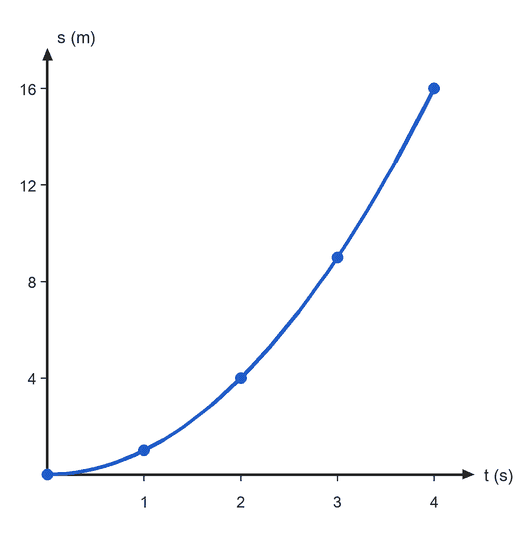
Which statement about the motion of the cart is correct ?
- 221 mark
Question 22
Competency: Understanding & Analysis
A skydiver jumps from a hovering helicopter and falls for 20 s before she opens her parachute. A device she carries records her velocity, and the graph below is plotted. (Hypothetical data.)
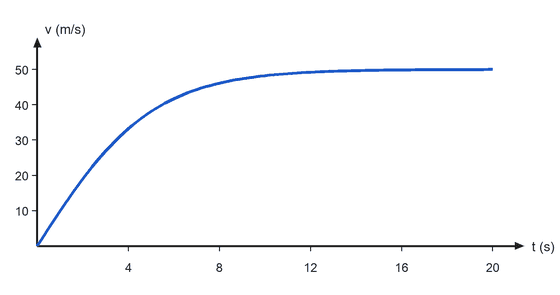
Which statement describes her motion during the 20 s correctly ?
- 231 mark
Question 23
Competency: Application
A motorbike is moving along a straight road with a velocity of 4 m s when its rider begins to change its speed. The graph shows how its acceleration changes with time during the next 13 s. (Hypothetical data.)

What is the velocity of the motorbike at = 13 s ?
- 241 mark
Question 24
Competency: Understanding & Analysis
Assertion (A): For a body moving in a straight line, the magnitude of its average velocity is never greater than its average speed over the same time.
Reason (R): The average velocity of a body is the total distance travelled by it divided by the total time taken.
- 251 mark
Question 25
Competency: Understanding
Assertion (A): In the absence of air, a stone thrown vertically upwards takes the same time to rise to its highest point as it takes to fall back to the point from which it was thrown.
Reason (R): In the absence of air, the magnitude of the acceleration of the stone is the same, , during its rise and during its fall.
- 262 marks
Question 26
Competency: Application
A boy sits on a small cart at the top of a long, gentle slope in a park and is released from rest. The cart moves down the slope with a uniform acceleration and covers the first 2.0 m in the first 2.0 s. (Hypothetical data.)
(a) Find the acceleration of the cart.
(b) Find the distance the cart covers during the fifth second alone, that is, from = 4 s to = 5 s.
- 272 marks
Question 27
Competency: Application
Standing on a bridge 15 m above a river, Kabir throws a stone vertically downwards with a speed of 10 m s. Neglect the resistance of air and take = 10 m s.
Find (a) the speed with which the stone hits the water, and (b) the time the stone takes to reach the water.
- 282 marks
Question 28
Competency: Application & Analysis
A rubber ball rolling along a smooth floor towards a wall on its east side has a velocity of 6 m s. It hits the wall and rebounds along the same line with a speed of 4 m s. The ball is in contact with the wall for 0.05 s. Take the direction towards the east as positive. (Hypothetical data.)
Find the change in the velocity of the ball and its average acceleration during the contact, with the direction of each.
- 292 marks
Question 29
Competency: Application
A cyclist moving at 6 m s along a straight lane sees a stray dog and applies her brakes. Her speed falls uniformly to zero, and she stops 18 m from the point where she began to brake. (Hypothetical data.)
Using the area under her velocity-time graph, find (a) the time she takes to stop, and (b) her retardation.
- 302 marks
Question 30
Competency: Application
A train 150 m long moves along a straight track with a uniform speed. It takes 10 s to pass a signal post completely, from the moment its engine reaches the post to the moment its last coach leaves it. (Hypothetical data.)
(a) Find the speed of the train in m s and in km h.
(b) How long does the train take to cross completely a bridge 450 m long, from the moment its engine reaches the bridge to the moment its last coach leaves it ?
- 312 marks
Question 31
Competency: Application & Evaluation
On a lake, the speed limit for boats is 10 km h. The GPS display of a motor boat shows its speed as 3.0 m s. (Hypothetical data.)
(a) Is the boat within the speed limit ? Show your working.
(b) What is the highest speed, in m s correct to two decimal places, that the boat may have ?
- 323 marks
Question 32
Competency: Application & Analysis
Meera rides a kick-scooter down a straight, gentle slope that has lamp posts along it. She starts from rest at the top of the slope and speeds up uniformly. She passes lamp post A with a speed of 4 m s, and she passes the next lamp post B, 24 m further down, with a speed of 8 m s. (Hypothetical data.)
(a) Find her acceleration.
(b) Find the time she takes to go from A to B.
(c) How far above lamp post A is the point where she started from rest ?
- 333 marks
Question 33
Competency: Analysis
A hot-air balloon is rising steadily at 5 m s. When it is 30 m above the ground, a crew member lets a sandbag go from the basket. At that instant the sandbag has the same velocity as the balloon. Neglect the resistance of air and take = 10 m s. (Hypothetical data.)
(a) How high above the point of release does the sandbag rise before it starts to fall ?
(b) How long after the release does the sandbag reach the ground ?
(c) With what speed does it hit the ground ?
- 343 marks
Question 34
Competency: Analysis & Application
Towns P and Q are 100 km apart on a straight highway. Bus A leaves P for Q, and bus B leaves Q for P, at the same instant. The graph shows the displacement of each bus from P at different times. (Hypothetical data.)
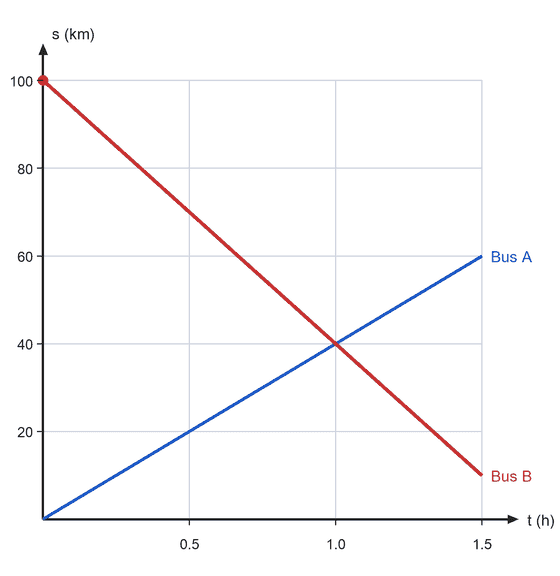
(a) Find the velocity of each bus. Give the sign of each velocity, taking the direction from P to Q as positive.
(b) After what time, and at what distance from P, do the two buses meet ?
(c) How far apart are the buses 0.5 h after they start ?
- 353 marks
Question 35
Competency: Evaluation
Outside a school the speed limit is 20 km h. After a minor accident, a driver says, "I was within the limit." The skid marks show that the car skidded 6.0 m before it stopped. On this road a skidding car slows down uniformly at about 5 m s. (Hypothetical data.)
(a) Express the speed limit in m s.
(b) Find the speed of the car at the moment its wheels began to skid.
(c) Is the driver's statement acceptable ? Give a reason.
- 363 marks
Question 36
Competency: Creation & Analysis
A student noted the displacement of her friend Aman from the school gate, along a straight lane, every 2 min. The table shows the readings. (Hypothetical data.)
Time (min) 0 2 4 6 8 Displacement from the gate (m) 0 120 120 40 40 (a) Write a short, realistic story of what Aman could have been doing that fits all the readings.
(b) Find Aman's velocity in each 2 min interval, in m per min, with its sign. Take the direction away from the gate as positive.
(c) Find the total distance Aman travelled in the 8 min, and his displacement from the gate at the end.
- 374 marks
Question 37
Competency: Analysis & Evaluation
Case study: An express train runs on a long straight railway line from station P to station S, and stops at stations Q and R on the way. A student travelling by the train copies the printed timetable below. She wants to know how fast the train really goes between the stations. Assume that the line is straight and that the train never moves backwards. (Hypothetical data.)
Station Distance from P (km) Arrives Departs P 0 – 08 : 00 Q 40 08 : 30 08 : 35 R 130 09 : 35 09 : 40 S 150 10 : 00 – (a) Find the average speed of the train in km h for each of the three sections P to Q, Q to R and R to S.
(b) Find the average speed for the whole journey from P to S, including the stops. Then find the average speed while the train is actually moving.
(c) The student says, "The train never ran faster than 90 km h, because 90 km h is the highest average speed in the table." Is she right ? Give a reason.
- 384 marks
Question 38
Competency: Application & Analysis
Case study: A small battery-driven test cart is placed on a long, straight sloping test track, and a sensor records its velocity. The motor drives the cart up the slope for the first 5 s and is then switched off. After this the cart keeps going up the slope for a while, comes to rest for an instant, and then rolls back down. The sensor counts a velocity up the slope as positive. The graph shows the result. (Hypothetical data.)
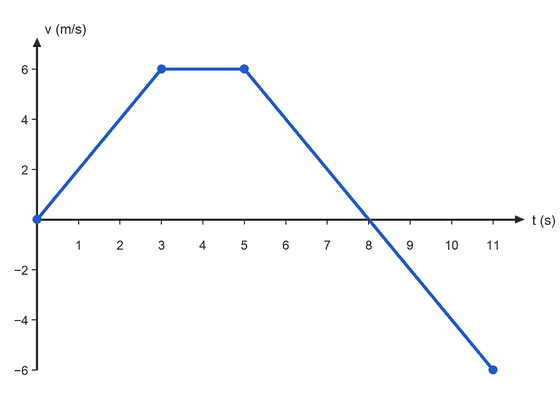
(a) Find the acceleration of the cart from 0 to 3 s and from 5 s to 11 s.
(b) At what time does the cart come to rest for an instant, and how far is it then from its starting point ?
(c) Find the distance travelled by the cart and its displacement at the end of 11 s.
- 395 marks
Question 39
Competency: Application & Evaluation
Case study: A phone slips from a table and falls 1.25 m onto a floor. A maker of phone covers tests how well a cover protects the glass. In the test the phone lands flat, and the cover squashes uniformly while it brings the phone to rest. The glass is known to crack when the retardation is more than 3000 m s. The maker tests three covers, X, Y and Z, which have different thicknesses of cushion. Neglect the resistance of air and take = 10 m s. (Hypothetical data.)
Cover X Y Z Thickness of cushion that gets squashed (mm) 2 5 10 (a) Find the speed of the phone just before it touches the floor, and the time it takes to fall.
(b) Find the retardation of the phone with cover Y, while the cushion is squashed.
(c) Find the retardation with covers X and Z, and decide which of the three covers keep the retardation within the limit. What is the least thickness of cushion that is safe ?
- 404 marks
Question 40
Competency: Analysis & Evaluation
Case study: Ravi delivers parcels on a scooter for a shop on a long, straight east-west road. One morning he rides east from the shop to a house H, hands over a parcel, then turns back towards the west and stops at a café C, where his trip ends. He never turns back at any other point. The trip meter of the scooter, which adds up every metre the scooter rides, shows 7.2 km for the trip. A map app on his phone shows that the café is 3.0 km east of the shop. (Hypothetical data.)
(a) Which of the two readings is the distance travelled by Ravi, and which is the magnitude of his displacement ? Give a reason for each.
(b) How far east of the shop is house H, and how far did Ravi ride towards the west after leaving H ?
(c) The shop owner plans to pay riders according to the displacement shown by the map app at the end of each trip. Using this trip, explain whether this is a fair way to pay them.