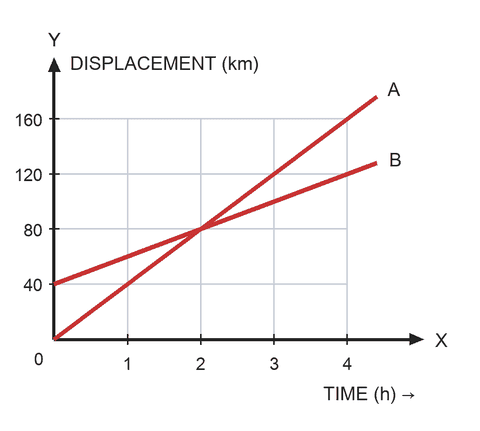
Solution:
Concept: In a displacement-time graph the slope (change in displacement ÷ change in time) gives the velocity. A line parallel to the time axis means rest, a straight inclined line means uniform velocity, and a curve means the velocity is changing.
Step 1 — Initial positions.
At t = 0, car A is at 0 km and car B is at 40 km, so B is 40 km ahead.
Step 2 — Velocity of A.
Line A goes from (0, 0) to (4 h, 160 km).
vA=4160−0=40 km h−1
Step 3 — Velocity of B.
Line B goes from (0, 40 km) to (4 h, 120 km).
vB=4120−40=20 km h−1
Step 4 — When A catches B.
The two lines meet at t = 2 h. As a check, A gains 40 − 20 = 20 km on B every hour, so it makes up the 40 km gap in
t=2040=2 h
Step 5 — Where A catches B.
At the meeting point the displacement is read as 80 km; for car A,
S=40×2=80 km
Therefore, (i) B was 40 km ahead, (ii) A moves at 40 km h−1 and B at 20 km h−1, (iii) A catches B after 2 h, (iv) 80 km from the start.