
Question 731 markMCQEasy
The graph representing the state of rest of an object is :
Confirming your payment
Sign up now and get 250 free tokens.
Motion in One Dimension · Question 73 of 143
The graph representing the state of rest of an object is :
(A) 
(B) 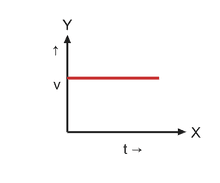
(C) 
(D) 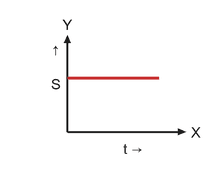
Answer: (D) S-t line parallel to the time axis
Concept: In a displacement-time graph the slope (change in displacement ÷ change in time) gives the velocity. A line parallel to the time axis means rest, a straight inclined line means uniform velocity, and a curve means the velocity is changing.
Step 1 — Describe rest.
At rest the position of the object does not change, so its displacement stays the same at all times.
Step 2 — Find the graph.
A displacement that stays constant gives an - graph parallel to the time axis. Graph (D) shows this.
Watch out: A horizontal line means rest only on a displacement-time graph; on a velocity-time graph it means uniform velocity.
Why the other options are wrong:
Therefore, the graph for the state of rest is the displacement-time line parallel to the time axis, option (D).