
Opening your dashboard
Class 9 Maths Chapter 9: Triangles Solutions
42 textbook questions with step-by-step answers, free to read, for ICSE 2026-27.
Get talked through Ch 9, not just shown the answer
Reading a finished solution is not the same as being able to do it. The AI tutor takes one question at a time and works it with you, in your own words, until you can.
- Ask it out loud, in your own words
- It gives you the next step, not the answer
- Stuck on part (ii)? Start there
42 questions with solutions
1–3 marks · Mixed difficulty
- 11 mark
Question 1
If ΔABC ≅ ΔPQR, then
Solve with AIAnswer
- Correct
(A) AC = PR
(B) AC = PQ
(C) BC = PR
(D) BC = PQ
Answer: (A) AC = PR
Concept: Two triangles are congruent when one of the tests S.S.S., S.A.S., A.S.A. (or A.A.S.) or R.H.S. holds; then all their corresponding parts are equal (C.P.C.T.C. = corresponding parts of congruent triangles are congruent).
Step 1 — Match the vertices.
In the statement ΔABC ≅ ΔPQR the letters are written in matching order, so A matches P, B matches Q and C matches R.
Step 2 — List the corresponding sides.
A side joins two vertices, so it matches the side joining the two matching vertices.
AB matches PQ.
BC matches QR.
AC matches PR.
Step 3 — Pick the true statement.
Corresponding sides of congruent triangles are equal, so AC = PR.
Watch out: In a congruence statement the letters match in order, so read the equal parts from the order of the letters.
Why the other options are wrong:
- (B): PQ is the side that matches AB (A ↔ P, B ↔ Q), not AC.
- (C): PR matches AC; the side that matches BC is QR.
- (D): PQ matches AB; the side that matches BC is QR.
Therefore, AC = PR, option (A).
- 21 mark
Question 2
In quadrilateral ABCD, AB = AC and BD = CD, does AD bisect :
 Solve with AI
Answer
(A) angle ADC
(B) angle BAD
- Correct
(C) angle BAC
(D) angle ABC
Answer: (C) angle BAC
Concept: S.S.S. test: if all three sides of one triangle equal the three sides of another, the triangles are congruent.
Step 1 — Name the triangles.
The diagonal AD splits the quadrilateral into ΔABD and ΔACD.
Step 2 — Compare ΔABD and ΔACD.
AB = AC (given)
BD = CD (given)
AD = AD (common side)
So ΔABD ≅ ΔACD by S.S.S.
Step 3 — Read off the angles at A.
By C.P.C.T.C., ∠BAD = ∠CAD. These are the two parts into which AD divides ∠BAC, so AD bisects ∠BAC.
Watch out: AD can only bisect an angle whose vertex is on AD and whose two arms lie on either side of it.
Why the other options are wrong:
- (A): AD is one of the arms of ∠ADC, so it cannot divide that angle into two parts (at D it bisects ∠BDC instead).
- (B): AD is one of the arms of ∠BAD, so it cannot divide that angle.
- (D): A bisector of ∠ABC must start at its vertex B, and AD does not pass through B.
Therefore, AD bisects angle BAC, option (C).
- 31 mark
Question 3
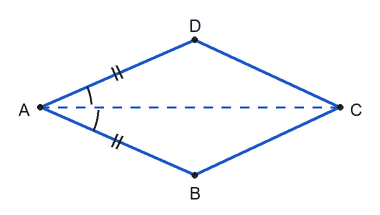
Which of the following will hold true for the given figure :
 Solve with AI
Answer
(A) AD = DC
- Correct
(B) CD = CB
(C) ∠ACD ≠ ∠ACB
(D) ∠B ≠ ∠D
Answer: (B) CD = CB
Concept: S.A.S. test: two sides and the angle BETWEEN them in one triangle equal two sides and the included angle in the other, so the triangles are congruent.
Step 1 — Read the figure.
The figure marks AD = AB (double ticks) and ∠DAC = ∠BAC (one arc each). AC is a side of both triangles ADC and ABC.
Step 2 — Compare ΔADC and ΔABC.
AD = AB (marked)
∠DAC = ∠BAC (marked)
AC = AC (common)
The equal angles lie between the equal sides, so ΔADC ≅ ΔABC by S.A.S.
Step 3 — Use C.P.C.T.C.
The matching parts are now equal: CD = CB, ∠ACD = ∠ACB and ∠D = ∠B.
Watch out: For S.A.S. the equal angle must lie BETWEEN the two equal sides; an angle outside them does not give S.A.S.
Why the other options are wrong:
- (A): Nothing in the figure makes AD equal to DC; the marked equal side is AB, not DC.
- (C): Step 3 gives ∠ACD = ∠ACB, so they are equal, not unequal.
- (D): Step 3 gives ∠B = ∠D, so they are equal, not unequal.
Therefore, CD = CB, option (B).
- 41 mark
Question 4
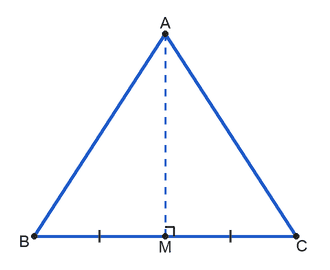
In the given figure, AM is the perpendicular bisector of BC. Then :
 Solve with AI
Answer
(A) AB = AM
(B) AC = BM
(C) AB ≠ AC
- Correct
(D) AM bisects ∠BAC
Answer: (D) AM bisects ∠BAC
Concept: S.A.S. test: two sides and the angle BETWEEN them in one triangle equal two sides and the included angle in the other, so the triangles are congruent.
Step 1 — Read what a perpendicular bisector gives.
AM is the perpendicular bisector of BC, so M is the mid-point of BC and AM meets BC at right angles.
BM = CM
∠AMB and ∠AMC are both 90°.
Step 2 — Compare ΔAMB and ΔAMC.
BM = CM (M is the mid-point)
∠AMB = ∠AMC (both 90°)
AM = AM (common)
So ΔAMB ≅ ΔAMC by S.A.S.
Step 3 — Use C.P.C.T.C.
∠BAM = ∠CAM, so AM bisects ∠BAC. The congruence also gives AB = AC.
Watch out: AM is a side of both triangles, so it is the common side; it is not equal to AB.
Why the other options are wrong:
- (A): AB is the hypotenuse of the right triangle AMB, so AB is longer than AM.
- (B): AC is the hypotenuse of the right triangle AMC, so AC is longer than MC, and MC = BM; so AC ≠ BM.
- (C): Step 3 shows AB = AC, so they are not unequal.
Therefore, AM bisects ∠BAC, option (D).
- 51 mark
Question 5
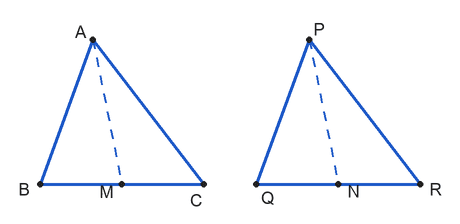
In the given figure, AB = PQ, BC = QR and median AM = median PN, then :
 Solve with AI
Answer
(A) AC ≠ PR
(B) BM ≠ QN
(C) ΔABM ≇ ΔPQN
- Correct
(D) ΔABC ≅ ΔPQR
Answer: (D) ΔABC ≅ ΔPQR
Concept: Two triangles are congruent when one of the tests S.S.S., S.A.S., A.S.A. (or A.A.S.) or R.H.S. holds; then all their corresponding parts are equal (C.P.C.T.C. = corresponding parts of congruent triangles are congruent).
Step 1 — Compare the halves of the bases.
AM is a median, so M is the mid-point of BC and BM is half of BC. In the same way QN is half of QR. Halves of equal lengths are equal, so BM = QN.
Step 2 — Show ΔABM ≅ ΔPQN.
AB = PQ (given)
BM = QN (Step 1)
AM = PN (given medians)
So ΔABM ≅ ΔPQN by S.S.S., and by C.P.C.T.C. ∠B = ∠Q.
Step 3 — Show ΔABC ≅ ΔPQR.
AB = PQ (given)
∠B = ∠Q (Step 2)
BC = QR (given)
∠B lies between AB and BC, and ∠Q between PQ and QR, so ΔABC ≅ ΔPQR by S.A.S.
Watch out: The given parts do not fit any test for the big triangles straight away; the smaller triangles ABM and PQN come first.
Why the other options are wrong:
- (A): The congruence in Step 3 gives AC = PR, so they are equal.
- (B): BM and QN are halves of the equal sides BC and QR, so BM = QN.
- (C): Step 2 proves ΔABM ≅ ΔPQN.
Therefore, ΔABC ≅ ΔPQR, option (D).
- 63 marks
Question 6
Which of the following pairs of triangles are congruent ? In each case, state the condition of congruency :
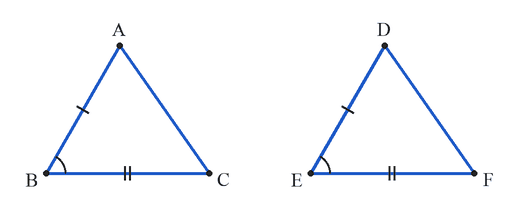
(a) In Δ ABC and Δ DEF, AB = DE, BC = EF and ∠B = ∠E.
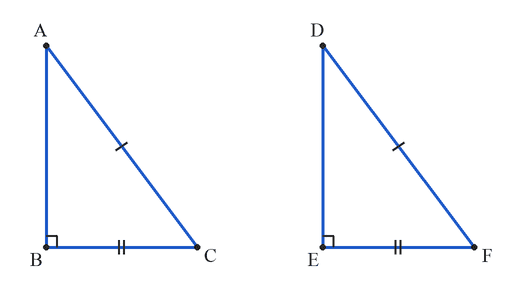
(b) In Δ ABC and Δ DEF, ∠B = ∠E = 90°; AC = DF and BC = EF.
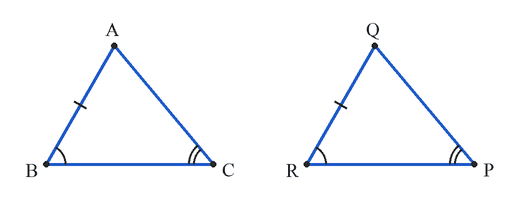
(c) In Δ ABC and Δ QRP, AB = QR, ∠B = ∠R and ∠C = ∠P.
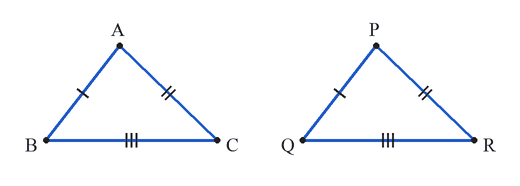
(d) In Δ ABC and Δ PQR, AB = PQ, AC = PR and BC = QR.
(e) In Δ ABC and Δ PQR, BC = QR, ∠A = 90°, ∠C = ∠R = 40° and ∠Q = 50°.
 Solve with AI
Written solution
Solution:
Concept: Two triangles are congruent when one of the tests S.S.S., S.A.S., A.S.A. (or A.A.S.) or R.H.S. holds; then all their corresponding parts are equal (C.P.C.T.C. = corresponding parts of congruent triangles are congruent).
Given: Five pairs of triangles with some equal sides and angles.
Step 1 — Pair (a).
We have AB = DE, BC = EF and ∠B = ∠E. ∠B lies between AB and BC, and ∠E lies between DE and EF, so the equal angle is the included angle.
ΔABC ≅ ΔDEF by S.A.S.
Step 2 — Pair (b).
Both triangles have a right angle (at B and at E). AC and DF are opposite the right angles, so they are the hypotenuses, and they are equal. One more pair of sides is equal: BC = EF.
ΔABC ≅ ΔDEF by R.H.S.
Step 3 — Pair (c).
Two angles are equal, ∠B = ∠R and ∠C = ∠P, so the vertices match as A ↔ Q, B ↔ R, C ↔ P. The side AB matches QR, and AB = QR is given. AB is not between ∠B and ∠C, so this is two angles and a non-included side.
ΔABC ≅ ΔQRP by A.A.S. (the third angles ∠A and ∠Q are then equal too, so A.S.A. also applies)
Step 4 — Pair (d).
All three pairs of sides are equal: AB = PQ, AC = PR and BC = QR.
ΔABC ≅ ΔPQR by S.S.S.
Step 5 — Pair (e): find ∠B.
The angles of ΔABC add up to 180°, and we know ∠A = 90° and ∠C = 40°.
Step 6 — Pair (e): match the parts.
So ∠B = ∠Q, since both are 50°. We also have ∠C = ∠R (both 40°) and BC = QR. BC lies between ∠B and ∠C, and QR lies between ∠Q and ∠R, so the equal side is the included side.
ΔABC ≅ ΔPQR by A.S.A.
Watch out: Check WHERE the equal angle sits: between the two equal sides for S.A.S., between the two equal angles for the side in A.S.A.
Therefore, all five pairs are congruent: (a) S.A.S., (b) R.H.S., (c) A.A.S. (or A.S.A.), (d) S.S.S., (e) A.S.A.
- 73 marks
Question 7
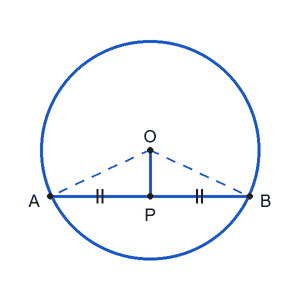
The given figure shows a circle with centre O. P is mid-point of chord AB. Show that OP is perpendicular to AB.
 Solve with AI
Written solution
Solution:
Concept: S.S.S. test: if all three sides of one triangle equal the three sides of another, the triangles are congruent. Angles on a straight line (a linear pair) add up to 180°, and vertically opposite angles are equal.
Given: O is the centre of the circle and P is the mid-point of the chord AB. To prove: OP ⊥ AB.
Step 1 — Join the radii.
Join OA and OB. They are radii of the same circle, so OA = OB.
Step 2 — Compare ΔOAP and ΔOBP.
OA = OB (radii)
AP = BP (P is the mid-point of AB)
OP = OP (common)
So ΔOAP ≅ ΔOBP by S.S.S., and by C.P.C.T.C. ∠OPA = ∠OPB.
Step 3 — Use the straight line APB.
∠OPA and ∠OPB form a linear pair on the chord, so they add up to 180°. They are equal, so each is half of 180°.
Watch out: OA and OB are not drawn in the question; join them first, because the proof needs two triangles.
Therefore, ∠OPA = 90°, so OP is perpendicular to AB. Hence shown.
- 83 marks
Question 8
The following figure shows a circle with centre O.
If OP is perpendicular to AB, prove that AP = BP.
 Solve with AI
Written solution
Solution:
Concept: R.H.S. test: two right-angled triangles are congruent when their hypotenuses are equal and one other pair of sides is equal.
Given: O is the centre of the circle and OP ⊥ AB. To prove: AP = BP.
Step 1 — Join the radii.
Join OA and OB. They are radii of the same circle, so OA = OB.
Step 2 — Compare the right triangles OPA and OPB.
OP ⊥ AB, so ∠OPA and ∠OPB are both 90°.
OA = OB (radii, the hypotenuses)
OP = OP (common)
So ΔOPA ≅ ΔOPB by R.H.S.
Step 3 — Use C.P.C.T.C.
The sides AP and BP match, so AP = BP.
Watch out: In R.H.S. one equal pair must be the hypotenuses (the sides opposite the right angles).
Therefore, AP = BP. Hence proved.
- 93 marks
Question 9
In a triangle ABC, D is mid-point of BC; AD is produced upto E so that DE = AD.

Prove that :
(i) Δ ABD and Δ ECD are congruent.
(ii) AB = EC.
(iii) AB is parallel to EC.
Solve with AIWritten solution
Solution:
Concept: S.A.S. test: two sides and the angle BETWEEN them in one triangle equal two sides and the included angle in the other, so the triangles are congruent. When a line crosses two parallel lines, alternate angles are equal and corresponding angles are equal.
Given: D is the mid-point of BC, and AD is produced to E with DE = AD.
Step 1 — Compare ΔABD and ΔECD.
BD = CD (D is the mid-point of BC)
∠ADB = ∠EDC (vertically opposite angles)
AD = ED (given)
The equal angles at D lie between the equal sides, so ΔABD ≅ ΔECD by S.A.S. This is part (i).
Step 2 — Part (ii).
AB and EC are matching sides of the congruent triangles, so AB = EC by C.P.C.T.C.
Step 3 — Part (iii).
By C.P.C.T.C., ∠BAD = ∠CED, that is ∠BAE = ∠CEA.
These two angles are alternate angles made by the line AE with the lines AB and EC. Equal alternate angles mean the lines are parallel, so AB ∥ EC.
Watch out: For (iii) name the angles at A and at E (∠BAE and ∠CEA); they are the alternate angles on the line AE.
Therefore, (i) ΔABD ≅ ΔECD, (ii) AB = EC and (iii) AB ∥ EC. Hence proved.
- 103 marks
Question 10
A triangle ABC has ∠B = ∠C.
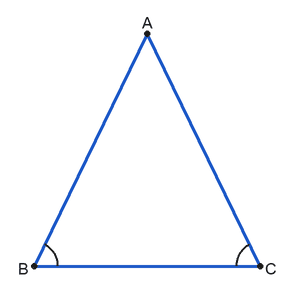
Prove that :
(i) the perpendiculars from the mid-point of BC to AB and AC are equal.
(ii) the perpendiculars from B and C to the opposite sides are equal.
Solve with AIWritten solution
Solution:
Concept: A.S.A. test: two angles and the side between them in one triangle equal the matching parts of the other, so the triangles are congruent. A.A.S. (two angles and a side not between them) works too, because the third angles are then equal as well.
Given: In ΔABC, ∠B = ∠C.
Step 1 — Part (i): set up.
Let D be the mid-point of BC, and draw DE ⊥ AB and DF ⊥ AC.
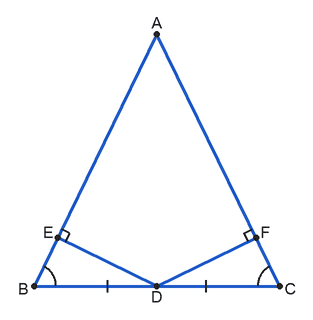
Step 2 — Part (i): compare ΔBED and ΔCFD.
∠BED = ∠CFD (both 90°)
∠EBD = ∠FCD (the given equal angles B and C)
BD = CD (D is the mid-point)
So ΔBED ≅ ΔCFD by A.A.S., and by C.P.C.T.C. DE = DF.
Step 3 — Part (ii): set up.
Draw BL ⊥ AC and CM ⊥ AB.
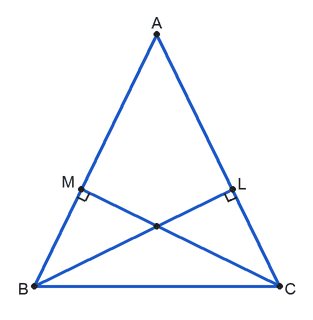
Step 4 — Part (ii): compare ΔBLC and ΔCMB.
∠BLC = ∠CMB (both 90°)
∠LCB = ∠MBC (the given equal angles C and B)
BC = CB (common)
So ΔBLC ≅ ΔCMB by A.A.S., and by C.P.C.T.C. BL = CM.
Watch out: In (ii) the common side BC is the hypotenuse of both right triangles; match it with itself.
Therefore, (i) the perpendiculars DE and DF are equal and (ii) the perpendiculars BL and CM are equal. Hence proved.
- 113 marks
Question 11
The perpendicular bisectors of the sides of a triangle ABC meet at I.
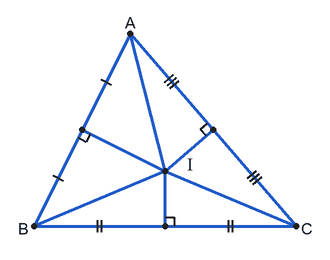
Prove that : IA = IB = IC.
Solve with AIWritten solution
Solution:
Concept: S.A.S. test: two sides and the angle BETWEEN them in one triangle equal two sides and the included angle in the other, so the triangles are congruent. So every point on the perpendicular bisector of a segment is equally far from its two ends.
Given: The perpendicular bisectors of the sides of ΔABC meet at I.
Step 1 — Set up.
Let the perpendicular bisector of AB meet AB at D, and the perpendicular bisector of BC meet BC at E. Both pass through I.
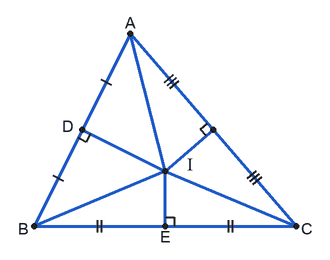
Step 2 — Show IA = IB.
AD = BD (D is the mid-point of AB)
∠IDA = ∠IDB (both 90°)
ID = ID (common)
So ΔIDA ≅ ΔIDB by S.A.S., and by C.P.C.T.C. IA = IB.
Step 3 — Show IB = IC.
BE = CE (E is the mid-point of BC)
∠IEB = ∠IEC (both 90°)
IE = IE (common)
So ΔIEB ≅ ΔIEC by S.A.S., and by C.P.C.T.C. IB = IC.
Step 4 — Put the results together.
IA equals IB, and IB equals IC, so all three lengths are the same.
Watch out: Two of the three perpendicular bisectors are enough; the third gives nothing new.
Therefore, IA, IB and IC are all equal. Hence proved.
- 123 marks
Question 12
A line segment AB is bisected at point P and through point P another line segment PQ, which is perpendicular to AB, is drawn.
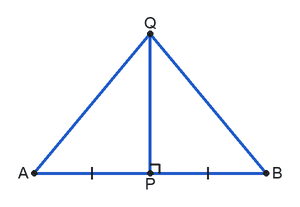
Show that : QA = QB.
Solve with AIWritten solution
Solution:
Concept: S.A.S. test: two sides and the angle BETWEEN them in one triangle equal two sides and the included angle in the other, so the triangles are congruent.
Given: P is the mid-point of AB and PQ ⊥ AB.
Step 1 — Compare ΔQPA and ΔQPB.
AP = BP (P bisects AB)
∠QPA = ∠QPB (both 90°, as PQ ⊥ AB)
QP = QP (common)
So ΔQPA ≅ ΔQPB by S.A.S.
Step 2 — Use C.P.C.T.C.
QA and QB are matching sides, so QA = QB.
Watch out: For S.A.S. the equal angle must lie BETWEEN the two equal sides; an angle outside them does not give S.A.S.
Therefore, QA = QB. Hence shown.
- 133 marks
Question 13
If AP bisects angle BAC and M is any point on AP, prove that the perpendiculars drawn from M to AB and AC are equal.
 Solve with AI
Written solution
Solution:
Concept: A.S.A. test: two angles and the side between them in one triangle equal the matching parts of the other, so the triangles are congruent. A.A.S. (two angles and a side not between them) works too, because the third angles are then equal as well.
Given: AP bisects ∠BAC and M is any point on AP.
Step 1 — Set up.
Draw ML ⊥ AB and MN ⊥ AC; we must show ML = MN.
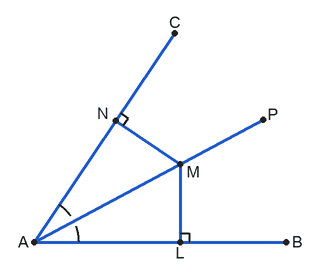
Step 2 — Compare ΔALM and ΔANM.
∠ALM = ∠ANM (both 90°)
∠LAM = ∠NAM (AP bisects ∠BAC)
AM = AM (common hypotenuse)
So ΔALM ≅ ΔANM by A.A.S.
Step 3 — Use C.P.C.T.C.
ML and MN are matching sides, so ML = MN.
Watch out: The perpendiculars are the SHORTEST distances to the arms, so draw them at right angles, not just any segments.
Therefore, the perpendiculars from M to AB and AC are equal. Hence proved.
- 143 marks
Question 14
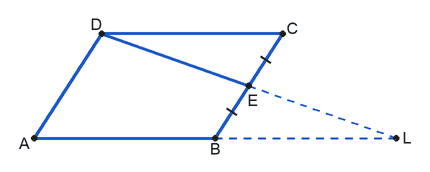
From the given diagram, in which ABCD is a parallelogram, ABL is a line segment and E is mid point of BC.
Prove that :
(i) Δ DCE ≅ Δ LBE
(ii) AB = BL.
(iii) AL = 2DC
 Solve with AI
Written solution
Solution:
Concept: A.S.A. test: two angles and the side between them in one triangle equal the matching parts of the other, so the triangles are congruent. A.A.S. (two angles and a side not between them) works too, because the third angles are then equal as well. When a line crosses two parallel lines, alternate angles are equal and corresponding angles are equal.
Given: ABCD is a parallelogram, ABL is a straight line and E is the mid-point of BC.
Step 1 — Part (i): compare ΔDCE and ΔLBE.
DC ∥ AB, and ABL is a straight line, so DC ∥ AL.
∠DCE = ∠LBE (alternate angles, DC ∥ AL with BC as transversal)
CE = BE (E is the mid-point of BC)
∠DEC = ∠LEB (vertically opposite angles)
The side CE lies between the two angles at C and E, so ΔDCE ≅ ΔLBE by A.S.A.
Step 2 — Part (ii).
From (i), DC = BL by C.P.C.T.C.
Also DC = AB, because opposite sides of a parallelogram are equal.
So AB = BL.
Step 3 — Part (iii).
AL is made of AB and BL, and each of these equals DC.
Watch out: The alternate angles come from DC ∥ AL; AL is the side AB produced, so it is parallel to DC as well.
Therefore, (i) ΔDCE ≅ ΔLBE, (ii) AB = BL and (iii) AL = 2DC. Hence proved.
- 151 mark
Question 15
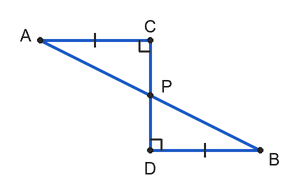
Which of the following is true for the given figure :
 Solve with AI
Answer
(A) ∠A = ∠B
(B) CP ≠ DP
- Correct
(C) AB and CD bisect each other
(D) ΔAPC ≇ ΔBPD
Answer: (C) AB and CD bisect each other
Concept: A.S.A. test: two angles and the side between them in one triangle equal the matching parts of the other, so the triangles are congruent. A.A.S. (two angles and a side not between them) works too, because the third angles are then equal as well.
Step 1 — Read the figure.
The figure marks AC = BD (single ticks) and right angles at C and D. AB and CD cross at P.
Step 2 — Compare ΔAPC and ΔBPD.
∠ACP = ∠BDP (both 90°)
∠APC = ∠BPD (vertically opposite angles)
AC = BD (marked)
So ΔAPC ≅ ΔBPD by A.A.S.
Step 3 — Use C.P.C.T.C.
AP = BP and CP = DP, so P is the mid-point of both AB and CD. AB and CD bisect each other.
Watch out: The equal sides AC and BD are not between the two equal angles, so the test is A.A.S.
Note: Two options are true for this figure, (A) and (C). (C) is the result the congruence is built for, so the printed key (C) is kept.
Why the other options are wrong:
- (A): This statement is also true: AC and BD are both perpendicular to CD, so AC ∥ BD and ∠A, ∠B are alternate angles. It does not need the congruence; the printed key is that AB and CD bisect each other (see the note).
- (B): Step 3 gives CP = DP, so they are equal.
- (D): Step 2 proves the triangles ARE congruent.
Therefore, AB and CD bisect each other, option (C).
- 161 mark
Question 16
In the following figure, ∠BAD = ∠EAC, BD = EC and ∠B = ∠E, then :
 Solve with AI
Answer
(A) ΔABD ≇ ΔAEC
- Correct
(B) ΔABC ≅ ΔAED
(C) ΔABC ≇ ΔAED
(D) ΔABD ≅ ΔADE
Answer: (B) ΔABC ≅ ΔAED
Concept: A.S.A. test: two angles and the side between them in one triangle equal the matching parts of the other, so the triangles are congruent. A.A.S. (two angles and a side not between them) works too, because the third angles are then equal as well. S.A.S. test: two sides and the angle BETWEEN them in one triangle equal two sides and the included angle in the other, so the triangles are congruent.
Step 1 — Show ΔABD ≅ ΔAEC.
∠BAD = ∠EAC (given)
∠B = ∠E (given)
BD = EC (given)
So ΔABD ≅ ΔAEC by A.A.S., and by C.P.C.T.C. AB = AE.
Step 2 — Show BC = ED.
B, D, C, E lie on one line in that order. Add the common piece DC to the equal lengths BD and EC.
Step 3 — Show ΔABC ≅ ΔAED.
AB = AE (Step 1)
∠B = ∠E (given)
BC = ED (Step 2)
∠B lies between AB and BC, and ∠E between AE and ED, so ΔABC ≅ ΔAED by S.A.S.
Watch out: Adding the shared piece DC to the equal lengths BD and EC is what gives BC = ED.
Why the other options are wrong:
- (A): Step 1 proves ΔABD ≅ ΔAEC.
- (C): Step 3 proves ΔABC ≅ ΔAED.
- (D): The name ΔABD ≅ ΔADE needs BD = DE, but DE is DC + CE, which is longer than CE = BD, so these triangles are not congruent in that order.
Therefore, ΔABC ≅ ΔAED, option (B).
- 171 mark
Question 17
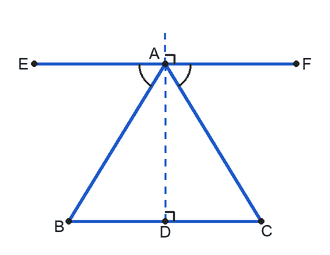
Which of the following is true for the given figure :
 Solve with AI
Answer
- Correct
(A) ΔABD ≅ ΔACD
(B) angle BAD ≠ angle CAD
(C) ΔABD ≇ ΔACD
(D) ∠EAB = ∠BAD
Answer: (A) ΔABD ≅ ΔACD
Concept: A.S.A. test: two angles and the side between them in one triangle equal the matching parts of the other, so the triangles are congruent. A.A.S. (two angles and a side not between them) works too, because the third angles are then equal as well.
Step 1 — Read the figure.
The figure marks AD ⊥ BC, EF ⊥ AD at A (AD produced above A), and ∠EAB = ∠FAC (one arc each).
Step 2 — Find the angles at A on either side of AD.
∠EAD = 90°, and AB splits it into ∠EAB and ∠BAD. In the same way ∠FAD = 90° is split into ∠FAC and ∠CAD.
∠BAD = 90° − ∠EAB
∠CAD = 90° − ∠FAC
∠EAB = ∠FAC, so ∠BAD = ∠CAD.
Step 3 — Compare ΔABD and ΔACD.
∠BAD = ∠CAD (Step 2)
AD = AD (common)
∠ADB = ∠ADC (both 90°)
The side AD lies between the two angles, so ΔABD ≅ ΔACD by A.S.A.
Watch out: Subtract each marked angle from its OWN right angle (∠EAD or ∠FAD) to reach the angles inside the triangle.
Why the other options are wrong:
- (B): Step 2 shows ∠BAD = ∠CAD.
- (C): Step 3 proves the triangles are congruent.
- (D): ∠EAB and ∠BAD add up to 90°, so they are equal only when each is 45°, which is not given (and not drawn).
Therefore, ΔABD ≅ ΔACD, option (A).
- 181 mark
Question 18
In the given figure, ∠x = ∠y and PO = RO, then :
 Solve with AI
Answer
(A) RB = AO
(B) BO = PA
- Correct
(C) BP = AR
(D) RB = OB
Answer: (C) BP = AR
Concept: A.S.A. test: two angles and the side between them in one triangle equal the matching parts of the other, so the triangles are congruent. A.A.S. (two angles and a side not between them) works too, because the third angles are then equal as well. Angles on a straight line (a linear pair) add up to 180°, and vertically opposite angles are equal.
Step 1 — Read the figure.
P, A, O lie on one line and R, B, O lie on another. The angle x is ∠PAR and the angle y is ∠RBP.
Step 2 — Turn x = y into equal angles inside the triangles.
∠OAR is the linear pair of x, and ∠OBP is the linear pair of y.
∠OAR = 180° − x
∠OBP = 180° − y
x = y, so ∠OAR = ∠OBP.
Step 3 — Compare ΔOAR and ΔOBP.
∠AOR = ∠BOP (the same angle at O)
∠OAR = ∠OBP (Step 2)
OR = OP (given)
So ΔOAR ≅ ΔOBP by A.A.S., and by C.P.C.T.C. AR = BP (and OA = OB).
Watch out: X and y are OUTSIDE the triangles OAR and OBP; use their supplements.
Why the other options are wrong:
- (A): RB = OR − OB and AO = OB, so RB = AO only if OR is twice OB, which is not given.
- (B): PA is OP − OA, and OA = OB, so BO = PA only if OP is twice OB, which is not given.
- (D): RB = OB would make B the mid-point of OR, which nothing in the question says.
Therefore, BP = AR, option (C).
- 191 mark
Question 19
In the given figure, BC//DA and BC = DA, then :
 Solve with AI
Answer
- Correct
(A) AB and CD bisect each other
(B) AB ≠ CD
(C) OA = OC
(D) OA = OD
Answer: (A) AB and CD bisect each other
Concept: A.S.A. test: two angles and the side between them in one triangle equal the matching parts of the other, so the triangles are congruent. A.A.S. (two angles and a side not between them) works too, because the third angles are then equal as well. When a line crosses two parallel lines, alternate angles are equal and corresponding angles are equal.
Step 1 — Find two pairs of equal angles.
BC ∥ DA, and AB, CD are two transversals.
∠OBC = ∠OAD (alternate angles, transversal AB)
∠OCB = ∠ODA (alternate angles, transversal CD)
Step 2 — Compare ΔOBC and ΔOAD.
∠OBC = ∠OAD
BC = AD (given)
∠OCB = ∠ODA
The side BC lies between the angles at B and C, so ΔOBC ≅ ΔOAD by A.S.A.
Step 3 — Use C.P.C.T.C.
OB = OA and OC = OD, so O is the mid-point of AB and of CD: AB and CD bisect each other.
Watch out: Match the vertices through the parallel lines: B with A and C with D.
Why the other options are wrong:
- (B): AB and CD are the diagonals of the parallelogram ACBD (opposite sides BC, AD equal and parallel); its diagonals are equal when it is a rectangle, so they need not be unequal.
- (C): OA is half of AB and OC is half of CD, so OA and OC are equal only when AB and CD are equal, which is not given.
- (D): OD = OC, so OA and OD are equal only when AB and CD are equal, which is not given.
Therefore, AB and CD bisect each other, option (A).
- 203 marks
Question 20
On the sides AB and AC of triangle ABC, equilateral triangles ABD and ACE are drawn.

Prove that: (i) ∠CAD =∠BAE (ii) CD = BE.
Solve with AIWritten solution
Solution:
Concept: S.A.S. test: two sides and the angle BETWEEN them in one triangle equal two sides and the included angle in the other, so the triangles are congruent.
Given: Equilateral triangles ABD and ACE are drawn outwards on AB and AC.
Step 1 — Part (i): build the two angles.
Each angle of an equilateral triangle is 60°. The angle ∠CAD is made of ∠BAC and ∠BAD, and ∠BAE is made of ∠BAC and ∠CAE.
∠CAD = ∠BAC + 60°
∠BAE = ∠BAC + 60°
The right-hand sides are the same, so ∠CAD = ∠BAE.
Step 2 — Part (ii): compare ΔCAD and ΔEAB.
AC = AE (sides of the equilateral triangle ACE)
∠CAD = ∠EAB (part (i))
AD = AB (sides of the equilateral triangle ABD)
The equal angles lie between the equal sides, so ΔCAD ≅ ΔEAB by S.A.S.
Step 3 — Part (ii): use C.P.C.T.C.
CD and EB are matching sides, so CD = BE.
Watch out: Pair the triangles so that each contains one side of EACH equilateral triangle: ΔCAD (sides AC, AD) with ΔEAB (sides AE, AB).
Therefore, (i) ∠CAD = ∠BAE and (ii) CD = BE. Hence proved.
- 213 marks
Question 21
In the following diagrams, ABCD is a square and APB is an equilateral triangle.
In each case,
(i) Prove that : Δ APD ≅ Δ BPC
(ii) Find the angles of Δ DPC.

 Solve with AI
Written solution
Solution:
Concept: S.A.S. test: two sides and the angle BETWEEN them in one triangle equal two sides and the included angle in the other, so the triangles are congruent. Angles opposite equal sides of a triangle are equal, and the angles of a triangle add up to 180°.
Given: ABCD is a square and APB is an equilateral triangle (P inside the square in the first diagram, outside it in the second).
Step 1 — Part (i): the equal angles at A and B.
∠DAB and ∠CBA are both 90° (square), and ∠PAB and ∠PBA are both 60° (equilateral triangle). In the first diagram P is inside the square, so the 60° is taken away; in the second P is outside, so the 60° is added.
In the second diagram ∠PAD is the sum instead.
In each diagram ∠PBC is found in exactly the same way, so ∠PAD = ∠PBC.
Step 2 — Part (i): compare ΔAPD and ΔBPC.
AP = BP (sides of the equilateral triangle)
∠PAD = ∠PBC (Step 1)
AD = BC (sides of the square)
So ΔAPD ≅ ΔBPC by S.A.S., and by C.P.C.T.C. PD = PC.
Step 3 — Part (ii), first diagram: the angles at D.
AP and AD both equal AB, so ΔAPD is isosceles and its base angles ∠ADP and ∠APD are equal. They share 180° − 30°.
Seen from D, the line DP runs between DA and DC, so ∠PDC is what is left of the square's 90° at D.
Step 4 — Part (ii), first diagram: the other angles.
PD = PC, so ΔDPC is isosceles and ∠PCD equals ∠PDC, which is 15°. The angles of ΔDPC add up to 180°.
Step 5 — Part (ii), second diagram: the angles at D.
Again AP = AD, so ∠ADP = ∠APD, and now ∠PAD = 150°.
Seen from D, the line DP again runs between DA and DC, so ∠PDC is the square's 90° minus ∠ADP.
Step 6 — Part (ii), second diagram: the other angles.
PD = PC, so ∠PCD equals ∠PDC, which is 75°.
Watch out: AP = AD because both equal AB; that isosceles triangle APD is the key to the angles at D.
Therefore, in the first diagram ∠DPC = 150°, ∠PDC = 15°, ∠PCD = 15°; in the second ∠DPC = 30°, ∠PDC = 75°, ∠PCD = 75°.
- 223 marks
Question 22
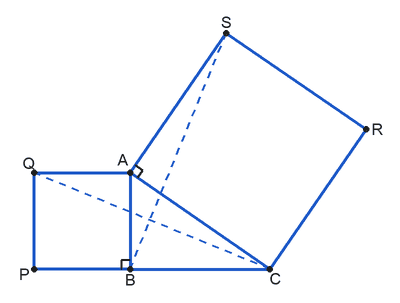
In the figure, given below, triangle ABC is right-angled at B. ABPQ and ACRS are squares. Prove that :
(i) Δ ACQ and Δ ASB are congruent.
(ii) CQ = BS.
 Solve with AI
Written solution
Solution:
Concept: S.A.S. test: two sides and the angle BETWEEN them in one triangle equal two sides and the included angle in the other, so the triangles are congruent.
Given: ΔABC is right-angled at B; ABPQ and ACRS are squares.
Step 1 — Part (i): build the equal angles at A.
Each angle of a square is 90°. ∠QAC is made of ∠QAB and ∠BAC; ∠SAB is made of ∠SAC and ∠CAB.
∠QAC = 90° + ∠BAC
∠SAB = 90° + ∠BAC
The right-hand sides are the same, so ∠QAC = ∠SAB.
Step 2 — Part (i): compare ΔACQ and ΔASB.
AQ = AB (sides of the square ABPQ)
∠QAC = ∠BAS (Step 1)
AC = AS (sides of the square ACRS)
The equal angles lie between the equal sides, so ΔACQ ≅ ΔASB by S.A.S.
Step 3 — Part (ii).
CQ and BS are matching sides of the congruent triangles, so CQ = BS by C.P.C.T.C.
Watch out: Match the letters in order: A ↔ A, C ↔ S, Q ↔ B, so CQ matches SB.
Therefore, (i) ΔACQ ≅ ΔASB and (ii) CQ = BS. Hence proved.
- 233 marks
Question 23
In a Δ ABC, BD is the median to the side AC, BD is produced to E such that BD = DE.
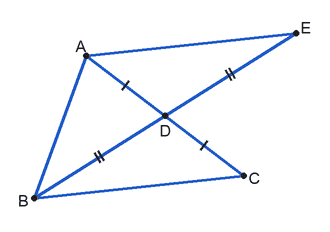
Prove that : AE is parallel to BC.
Solve with AIWritten solution
Solution:
Concept: S.A.S. test: two sides and the angle BETWEEN them in one triangle equal two sides and the included angle in the other, so the triangles are congruent. When a line crosses two parallel lines, alternate angles are equal and corresponding angles are equal.
Given: BD is the median to AC, and BD is produced to E with DE = BD.
Step 1 — Compare ΔADE and ΔCDB.
AD = CD (BD is the median, so D is the mid-point of AC)
∠ADE = ∠CDB (vertically opposite angles)
DE = DB (given)
So ΔADE ≅ ΔCDB by S.A.S., and by C.P.C.T.C. ∠DAE = ∠DCB.
Step 2 — Use the alternate angles.
∠DAE and ∠DCB are alternate angles made by the transversal AC with the lines AE and BC. They are equal, so the lines are parallel: AE ∥ BC.
Watch out: A median joins a vertex to the MID-POINT of the opposite side; that is where AD = CD comes from.
Therefore, AE ∥ BC. Hence proved.
- 243 marks
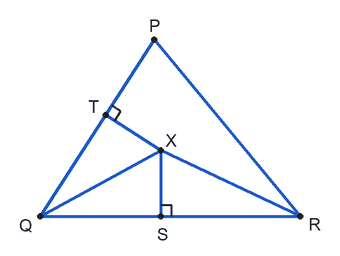
Question 24
In the adjoining figure, QX and RX are the bisectors of the angles Q and R respectively of the triangle PQR.
If XS ⊥ QR and XT ⊥ PQ; prove that :
(i) Δ XTQ ≅ Δ XSQ
(ii) PX bisects angle P.
 Solve with AI
Written solution
Solution:
Concept: A.S.A. test: two angles and the side between them in one triangle equal the matching parts of the other, so the triangles are congruent. A.A.S. (two angles and a side not between them) works too, because the third angles are then equal as well. R.H.S. test: two right-angled triangles are congruent when their hypotenuses are equal and one other pair of sides is equal.
Given: QX and RX bisect ∠Q and ∠R of ΔPQR; XS ⊥ QR and XT ⊥ PQ.
Step 1 — Part (i): compare ΔXTQ and ΔXSQ.
∠XTQ = ∠XSQ (both 90°)
∠XQT = ∠XQS (QX bisects ∠Q)
XQ = XQ (common)
So ΔXTQ ≅ ΔXSQ by A.A.S., and by C.P.C.T.C. XT = XS.
Step 2 — Part (ii): one more perpendicular.
Draw XU ⊥ PR.
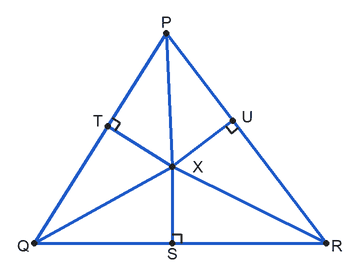
RX bisects ∠R, so in the same way ΔXSR ≅ ΔXUR by A.A.S., and XS = XU.
Step 3 — Part (ii): X is equally far from PQ and PR.
XT equals XS, and XS equals XU, so XT = XU.
Step 4 — Part (ii): compare ΔXTP and ΔXUP.
∠XTP = ∠XUP (both 90°)
XP = XP (common hypotenuse)
XT = XU (Step 3)
So ΔXTP ≅ ΔXUP by R.H.S., and by C.P.C.T.C. ∠XPT = ∠XPU. So PX bisects ∠P.
Watch out: XU ⊥ PR is not in the figure; draw it, because part (ii) needs the distance from X to PR.
Therefore, (i) ΔXTQ ≅ ΔXSQ and (ii) PX bisects ∠P. Hence proved.
- 253 marks
Question 25
In the parallelogram ABCD, the angles A and C are obtuse. Points X and Y are taken on the diagonal BD such that the angles XAD and YCB are right angles.
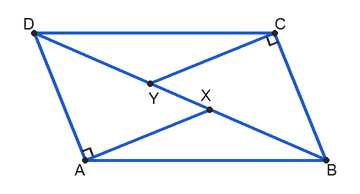
Prove that : XA = YC.
Solve with AIWritten solution
Solution:
Concept: A.S.A. test: two angles and the side between them in one triangle equal the matching parts of the other, so the triangles are congruent. A.A.S. (two angles and a side not between them) works too, because the third angles are then equal as well. When a line crosses two parallel lines, alternate angles are equal and corresponding angles are equal.
Given: ABCD is a parallelogram; X and Y are on BD with ∠XAD and ∠YCB both 90°.
Step 1 — Compare ΔXAD and ΔYCB.
∠XAD = ∠YCB (both 90°, given)
AD = CB (opposite sides of a parallelogram)
∠ADX = ∠CBY (alternate angles, AD ∥ BC with BD as transversal)
The side AD lies between the angles at A and D, and CB between the angles at C and B, so ΔXAD ≅ ΔYCB by A.S.A.
Step 2 — Use C.P.C.T.C.
XA and YC are matching sides, so XA = YC.
Watch out: The angles at D and B are ∠ADB and ∠CBD, the angles the diagonal makes with the parallel sides AD and BC.
Therefore, XA = YC. Hence proved.
- 263 marks
Question 26
ABCD is a parallelogram. The sides AB and AD are produced to E and F respectively, such that AB = BE and AD = DF.
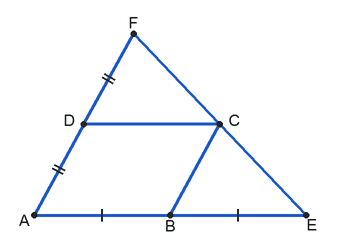
Prove that : Δ BEC ≅ Δ DCF.
Solve with AIWritten solution
Solution:
Concept: S.A.S. test: two sides and the angle BETWEEN them in one triangle equal two sides and the included angle in the other, so the triangles are congruent. When a line crosses two parallel lines, alternate angles are equal and corresponding angles are equal.
Given: ABCD is a parallelogram; AB is produced to E and AD to F with AB = BE and AD = DF.
Step 1 — Find equal sides.
Opposite sides of a parallelogram are equal, so AB = DC and AD = BC.
BE = AB (given), and AB = DC, so BE = DC.
DF = AD (given), and AD = BC, so DF = BC.
Step 2 — Find equal angles.
∠CBE = ∠DAB (corresponding angles, BC ∥ AD with AE as transversal)
∠FDC = ∠DAB (corresponding angles, DC ∥ AB with AF as transversal)
Both equal ∠DAB, so ∠CBE = ∠FDC.
Step 3 — Compare ΔBEC and ΔDCF.
BE = DC (Step 1)
∠EBC = ∠CDF (Step 2)
BC = DF (Step 1)
The angle at B lies between BE and BC, and the angle at D between DC and DF, so ΔBEC ≅ ΔDCF by S.A.S.
Watch out: Match the vertices in the order of the statement: B ↔ D, E ↔ C, C ↔ F.
Therefore, ΔBEC ≅ ΔDCF. Hence proved.
- 273 marks
Question 27
In the following figures, the sides AB and BC and the median AD of triangle ABC are respectively equal to the sides PQ and QR and median PS of the triangle PQR. Prove that Δ ABC and Δ PQR are congruent.
 Solve with AI
Written solution
Solution:
Concept: S.S.S. test: if all three sides of one triangle equal the three sides of another, the triangles are congruent. S.A.S. test: two sides and the angle BETWEEN them in one triangle equal two sides and the included angle in the other, so the triangles are congruent.
Given: AB = PQ, BC = QR and the medians AD = PS.
Step 1 — Compare half the bases.
D and S are mid-points (AD and PS are medians), so BD is half of BC and QS is half of QR. BC = QR, so BD = QS.
Step 2 — Show ΔABD ≅ ΔPQS.
AB = PQ (given)
BD = QS (Step 1)
AD = PS (given medians)
So ΔABD ≅ ΔPQS by S.S.S., and by C.P.C.T.C. ∠B = ∠Q.
Step 3 — Show ΔABC ≅ ΔPQR.
AB = PQ (given)
∠B = ∠Q (Step 2)
BC = QR (given)
So ΔABC ≅ ΔPQR by S.A.S.
Watch out: The given parts do not fit a test for the whole triangles at once; prove the half-triangles congruent first.
Therefore, ΔABC ≅ ΔPQR. Hence proved.
- 283 marks
Question 28
In the following diagram, AP and BQ are equal and parallel to each other.
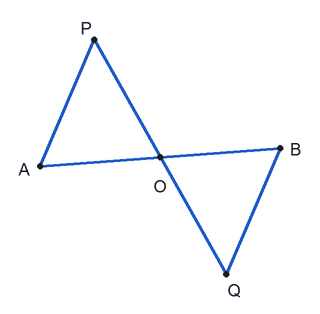
Prove that :
(i) Δ AOP ≅ Δ BOQ.
(ii) AB and PQ bisect each other.
Solve with AIWritten solution
Solution:
Concept: A.S.A. test: two angles and the side between them in one triangle equal the matching parts of the other, so the triangles are congruent. A.A.S. (two angles and a side not between them) works too, because the third angles are then equal as well. When a line crosses two parallel lines, alternate angles are equal and corresponding angles are equal.
Given: AP and BQ are equal and parallel.
Step 1 — Part (i): compare ΔAOP and ΔBOQ.
∠OAP = ∠OBQ (alternate angles, AP ∥ BQ with AB as transversal)
AP = BQ (given)
∠OPA = ∠OQB (alternate angles, AP ∥ BQ with PQ as transversal)
The side AP lies between the angles at A and P, so ΔAOP ≅ ΔBOQ by A.S.A.
Step 2 — Part (ii).
By C.P.C.T.C., OA = OB and OP = OQ. So O is the mid-point of both AB and PQ: AB and PQ bisect each other.
Watch out: Each pair of alternate angles uses a different transversal: AB for the angles at A and B, PQ for those at P and Q.
Therefore, (i) ΔAOP ≅ ΔBOQ and (ii) AB and PQ bisect each other. Hence proved.
- 293 marks
Question 29
In the following figure, OA = OC and AB = BC.
Prove that :
(i) ∠AOB = 90°
(ii) Δ AOD ≅ Δ COD
(iii) AD = CD
 Solve with AI
Written solution
Solution:
Concept: S.S.S. test: if all three sides of one triangle equal the three sides of another, the triangles are congruent. S.A.S. test: two sides and the angle BETWEEN them in one triangle equal two sides and the included angle in the other, so the triangles are congruent. Angles on a straight line (a linear pair) add up to 180°, and vertically opposite angles are equal.
Given: OA = OC and AB = BC, with AOC and BOD straight lines.
Step 1 — Part (i): compare ΔAOB and ΔCOB.
OA = OC (given)
AB = CB (given)
OB = OB (common)
So ΔAOB ≅ ΔCOB by S.S.S., and by C.P.C.T.C. ∠AOB = ∠COB.
Step 2 — Part (i): use the straight line AOC.
∠AOB and ∠COB form a linear pair, so they add up to 180°. They are equal, so each is half of 180°.
Step 3 — Part (ii): the angles at O on the other side.
∠AOD and ∠COB are vertically opposite, and ∠COD and ∠AOB are vertically opposite, so both are 90°.
Step 4 — Part (ii): compare ΔAOD and ΔCOD.
OA = OC (given)
∠AOD = ∠COD (both 90°)
OD = OD (common)
So ΔAOD ≅ ΔCOD by S.A.S.
Step 5 — Part (iii).
AD and CD are matching sides of these triangles, so AD = CD by C.P.C.T.C.
Watch out: ∠AOB = 90° comes from the linear pair; congruence alone only says the two angles are equal.
Therefore, (i) ∠AOB = 90°, (ii) ΔAOD ≅ ΔCOD and (iii) AD = CD. Hence proved.
- 303 marks
Question 30
The following figure shows a triangle ABC in which AB = AC. M is a point on AB and N is a point on AC such that BM = CN.
Prove that :
(i) AM = AN
(ii) Δ AMC ≅ Δ ANB
(iii) BN = CM
(iv) Δ BMC ≅ Δ CNB
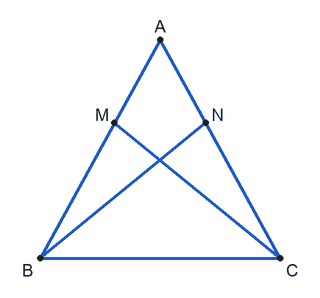 Solve with AI
Written solution
Solution:
Concept: S.A.S. test: two sides and the angle BETWEEN them in one triangle equal two sides and the included angle in the other, so the triangles are congruent. S.S.S. test: if all three sides of one triangle equal the three sides of another, the triangles are congruent.
Given: AB = AC, M on AB and N on AC with BM = CN.
Step 1 — Part (i).
M is on AB and N is on AC, so AM is what is left of AB after BM, and AN is what is left of AC after CN.
AM = AB − BM
AN = AC − CN
AB = AC and BM = CN, so the right-hand sides are equal and AM = AN.
Step 2 — Part (ii).
AM = AN (part (i))
∠MAC = ∠NAB (the same angle A)
AC = AB (given)
So ΔAMC ≅ ΔANB by S.A.S.
Step 3 — Part (iii).
CM and BN are matching sides of the triangles in (ii), so BN = CM by C.P.C.T.C.
Step 4 — Part (iv).
BM = CN (given)
MC = NB (part (iii))
BC = CB (common)
So ΔBMC ≅ ΔCNB by S.S.S.
Watch out: Each part uses the one before it, so prove them in order.
Therefore, (i) AM = AN, (ii) ΔAMC ≅ ΔANB, (iii) BN = CM and (iv) ΔBMC ≅ ΔCNB. Hence proved.
- 313 marks
Question 31
In a triangle ABC, AB = BC, AD is perpendicular to side BC and CE is perpendicular to side AB.
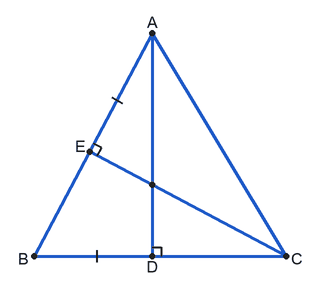
Prove that : AD = CE.
Solve with AIWritten solution
Solution:
Concept: A.S.A. test: two angles and the side between them in one triangle equal the matching parts of the other, so the triangles are congruent. A.A.S. (two angles and a side not between them) works too, because the third angles are then equal as well.
Given: AB = BC, AD ⊥ BC and CE ⊥ AB.
Step 1 — Compare ΔADB and ΔCEB.
∠ADB = ∠CEB (both 90°)
∠ABD = ∠CBE (the same angle B)
AB = CB (given)
So ΔADB ≅ ΔCEB by A.A.S.
Step 2 — Use C.P.C.T.C.
AD and CE are matching sides, so AD = CE.
Watch out: AB and CB are the hypotenuses here; the common part is the ANGLE B, not a side.
Therefore, AD = CE. Hence proved.
- 323 marks
Question 32
PQRS is a parallelogram. L and M are points on PQ and SR respectively such that PL = MR.
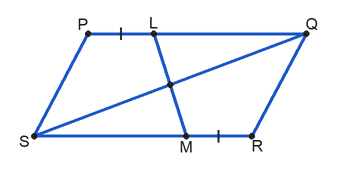
Show that LM and QS bisect each other.
Solve with AIWritten solution
Solution:
Concept: A.S.A. test: two angles and the side between them in one triangle equal the matching parts of the other, so the triangles are congruent. A.A.S. (two angles and a side not between them) works too, because the third angles are then equal as well. When a line crosses two parallel lines, alternate angles are equal and corresponding angles are equal.
Given: PQRS is a parallelogram, L on PQ and M on SR with PL = MR.
Step 1 — Set up.
Let LM and QS meet at O.
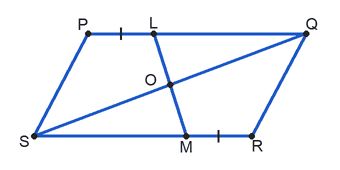
We show ΔOLQ ≅ ΔOMS.
Step 2 — Show LQ = MS.
L is on PQ and M is on SR, so LQ is what is left of PQ after PL, and MS is what is left of SR after MR.
LQ = PQ − PL
MS = SR − MR
PQ = SR (opposite sides of a parallelogram) and PL = MR, so LQ = MS.
Step 3 — Compare ΔOLQ and ΔOMS.
∠OQL = ∠OSM (alternate angles, PQ ∥ SR with QS as transversal)
LQ = MS (Step 2)
∠OLQ = ∠OMS (alternate angles, PQ ∥ SR with LM as transversal)
So ΔOLQ ≅ ΔOMS by A.S.A., and by C.P.C.T.C. OL = OM and OQ = OS.
Watch out: The equal pieces are LQ and MS (what is LEFT of the sides), not PL and MR themselves.
Therefore, O is the mid-point of both LM and QS, so LM and QS bisect each other. Hence shown.
- 333 marks
Question 33
In the following figure, ABC is an equilateral triangle in which QP is parallel to AC. Side AC is produced upto point R so that CR = BP.
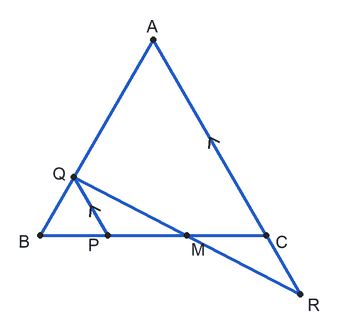
Prove that QR bisects PC.
Solve with AIWritten solution
Solution:
Concept: A.S.A. test: two angles and the side between them in one triangle equal the matching parts of the other, so the triangles are congruent. A.A.S. (two angles and a side not between them) works too, because the third angles are then equal as well. When a line crosses two parallel lines, alternate angles are equal and corresponding angles are equal. Each angle of an equilateral triangle is 60°.
Given: ABC is equilateral, QP ∥ AC, and AC is produced to R with CR = BP.
Step 1 — ΔQBP is equilateral.
QP ∥ AC, so the angles at P and Q equal the angles of ΔABC (corresponding angles).
∠QPB = ∠ACB (each 60°)
∠BQP = ∠BAC (each 60°)
All three angles of ΔQBP are 60°, so it is equilateral and PQ = BP.
Also CR = BP, so PQ = CR.
Step 2 — Find the angles at P and C.
∠QPM is the linear pair of ∠QPB, and ∠RCM is the linear pair of ∠ACB (R is on AC produced).
Step 3 — Compare ΔQPM and ΔRCM.
Let QR meet BC at M.
∠QMP = ∠RMC (vertically opposite angles)
∠QPM = ∠RCM (both 120°)
PQ = CR (Step 1)
So ΔQPM ≅ ΔRCM by A.A.S., and by C.P.C.T.C. PM = CM.
Watch out: PQ = CR is the key length; it comes from ΔQBP being equilateral, so prove that first.
Therefore, M is the mid-point of PC, so QR bisects PC. Hence proved.
- 343 marks
Question 34
In the given figure, AB = DB and AC = DC.
If ∠ABD = 58°, ∠DBC = (2x – 4)°, ∠ACB = y + 15° and ∠DCB = 63°; find the values of x and y.
 Solve with AI
Written solution
Solution:
Concept: S.S.S. test: if all three sides of one triangle equal the three sides of another, the triangles are congruent.
Given: AB = DB, AC = DC, ∠ABD = 58°, ∠DBC = (2x − 4)°, ∠ACB = y + 15° and ∠DCB = 63°.
Step 1 — Show ΔABC ≅ ΔDBC.
AB = DB (given)
AC = DC (given)
BC = BC (common)
So ΔABC ≅ ΔDBC by S.S.S., and by C.P.C.T.C. ∠ABC = ∠DBC and ∠ACB = ∠DCB.
Step 2 — Find ∠DBC.
BC splits ∠ABD into the two equal angles ∠ABC and ∠DBC, so ∠DBC is half of 58°.
Step 3 — Solve for x.
∠DBC = (2x − 4)°, so 2x − 4 = 29.
Step 4 — Solve for y.
∠ACB equals ∠DCB, which is 63°. Also ∠ACB = y + 15°, so y + 15° = 63°.
Watch out: ∠ABD = 58° is the WHOLE angle at B; ∠DBC is only half of it.
Therefore, x = 16.5 and y = 48°.
- 353 marks
Question 35
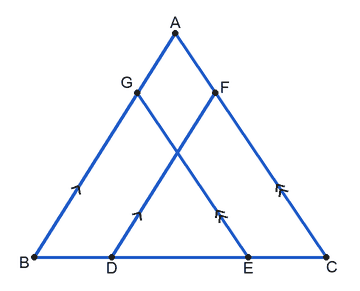
In the given figure : AB//FD, AC//GE and BD = CE; prove that :
(i) BG = DF
(ii) CF = EG.
 Solve with AI
Written solution
Solution:
Concept: A.S.A. test: two angles and the side between them in one triangle equal the matching parts of the other, so the triangles are congruent. A.A.S. (two angles and a side not between them) works too, because the third angles are then equal as well. When a line crosses two parallel lines, alternate angles are equal and corresponding angles are equal.
Given: AB ∥ FD, AC ∥ GE and BD = CE.
Step 1 — Show BE = DC.
B, D, E, C lie on BC in that order. Add the common piece DE to the equal lengths BD and CE.
Step 2 — Find equal angles.
∠GBE = ∠FDC (corresponding angles, AB ∥ FD with BC as transversal)
∠GEB = ∠FCD (corresponding angles, GE ∥ AC with BC as transversal)
Step 3 — Compare ΔGBE and ΔFDC.
∠GBE = ∠FDC
BE = DC (Step 1)
∠GEB = ∠FCD
The side BE lies between the angles at B and E, so ΔGBE ≅ ΔFDC by A.S.A.
Step 4 — Use C.P.C.T.C.
The vertices match as G ↔ F, B ↔ D, E ↔ C, so BG = DF (part (i)) and EG = CF (part (ii)).
Watch out: BD and CE are not sides of the triangles; add DE to both to reach BE and DC.
Therefore, (i) BG = DF and (ii) CF = EG. Hence proved.
- 363 marks
Question 36
In a triangle ABC, AB = AC. Show that the altitude AD is median also.
 Solve with AI
Written solution
Solution:
Concept: R.H.S. test: two right-angled triangles are congruent when their hypotenuses are equal and one other pair of sides is equal.
Given: AB = AC and AD ⊥ BC with D on BC. To prove: BD = CD.
Step 1 — Compare ΔADB and ΔADC.
∠ADB = ∠ADC (both 90°, as AD ⊥ BC)
AB = AC (given; these are the hypotenuses)
AD = AD (common)
So ΔADB ≅ ΔADC by R.H.S.
Step 2 — Use C.P.C.T.C.
BD = CD, so D is the mid-point of BC. A segment from a vertex to the mid-point of the opposite side is a median.
Watch out: In R.H.S. one equal pair must be the hypotenuses (the sides opposite the right angles).
Therefore, the altitude AD is also the median from A. Hence proved.
- 373 marks
Question 37
In the following figure, BL = CM. Prove that AD is a median of triangle ABC.
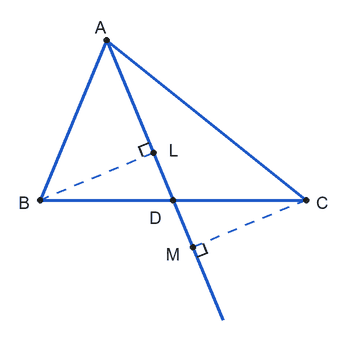 Solve with AI
Written solution
Solution:
Concept: A.S.A. test: two angles and the side between them in one triangle equal the matching parts of the other, so the triangles are congruent. A.A.S. (two angles and a side not between them) works too, because the third angles are then equal as well.
Given: BL ⊥ AD, CM ⊥ AD produced, and BL = CM. To prove: AD is a median.
Step 1 — Compare ΔBLD and ΔCMD.
∠BLD = ∠CMD (both 90°, as BL ⊥ AD and CM ⊥ AD produced)
∠BDL = ∠CDM (vertically opposite angles)
BL = CM (given)
So ΔBLD ≅ ΔCMD by A.A.S.
Step 2 — Use C.P.C.T.C.
BD = CD, so D is the mid-point of BC.
Watch out: The equal sides BL and CM are opposite the vertically opposite angles, not between two equal angles: the test is A.A.S.
Therefore, AD joins A to the mid-point of BC, so AD is a median of ΔABC. Hence proved.
- 383 marks
Question 38
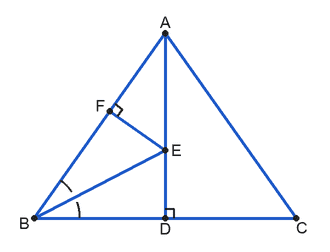
In the following figure, AB = AC and AD is perpendicular to BC. BE bisects angle B and EF is perpendicular to AB. Prove that :
(i) BD = CD
(ii) ED = EF
 Solve with AI
Written solution
Solution:
Concept: R.H.S. test: two right-angled triangles are congruent when their hypotenuses are equal and one other pair of sides is equal. A.S.A. test: two angles and the side between them in one triangle equal the matching parts of the other, so the triangles are congruent. A.A.S. (two angles and a side not between them) works too, because the third angles are then equal as well.
Given: AB = AC, AD ⊥ BC, BE bisects ∠B and EF ⊥ AB.
Step 1 — Part (i): compare ΔADB and ΔADC.
∠ADB = ∠ADC (both 90°, as AD ⊥ BC)
AB = AC (given hypotenuses)
AD = AD (common)
So ΔADB ≅ ΔADC by R.H.S., and by C.P.C.T.C. BD = CD.
Step 2 — Part (ii): compare ΔEBD and ΔEBF.
∠EBD = ∠EBF (BE bisects ∠B)
∠EDB = ∠EFB (both 90°, as AD ⊥ BC and EF ⊥ AB)
BE = BE (common)
So ΔEBD ≅ ΔEBF by A.A.S., and by C.P.C.T.C. ED = EF.
Watch out: E lies on AD, so ED is a part of AD and is perpendicular to BC; that gives the right angle at D.
Therefore, (i) BD = CD and (ii) ED = EF. Hence proved.
- 393 marks
Question 39
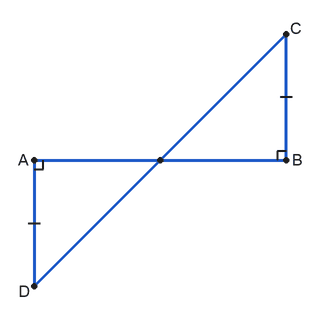
AD and BC are equal perpendiculars to a line segment AB. If AD and BC are on different sides of AB prove that CD bisects AB.
 Solve with AI
Written solution
Solution:
Concept: A.S.A. test: two angles and the side between them in one triangle equal the matching parts of the other, so the triangles are congruent. A.A.S. (two angles and a side not between them) works too, because the third angles are then equal as well.
Given: AD and BC are equal perpendiculars to AB on opposite sides of it. To prove: CD bisects AB.
Step 1 — Set up.
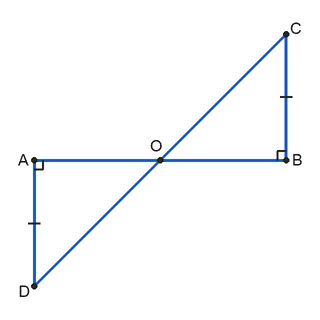
AD ⊥ AB, BC ⊥ AB, AD = BC, and D and C lie on opposite sides of AB. Let CD meet AB at O.
Step 2 — Compare ΔAOD and ΔBOC.
∠OAD = ∠OBC (both 90°)
∠AOD = ∠BOC (vertically opposite angles)
AD = BC (given)
So ΔAOD ≅ ΔBOC by A.A.S.
Step 3 — Use C.P.C.T.C.
AO = BO, so O is the mid-point of AB.
Watch out: Because D and C are on OPPOSITE sides, CD crosses AB; that crossing point O is where the angles are vertically opposite.
Therefore, O is the mid-point of AB, so CD bisects AB. Hence proved.
- 403 marks
Question 40
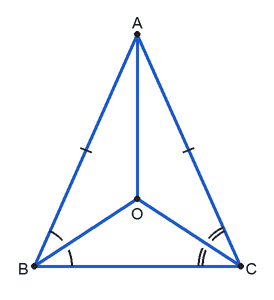
In △ ABC, AB = AC and the bisectors of angles B and C intersect at point O.
Prove that :
(i) BO = CO
(ii) AO bisects angle BAC.
Solve with AIWritten solution
Solution:
Concept: S.S.S. test: if all three sides of one triangle equal the three sides of another, the triangles are congruent. Angles opposite equal sides of a triangle are equal, and sides opposite equal angles are equal.
Given: AB = AC, and the bisectors of ∠B and ∠C meet at O.
Step 1 — Part (i): equal half-angles.
AB = AC, so the angles opposite them are equal: ∠ABC = ∠ACB. OB and OC bisect these angles, and halves of equal angles are equal, so ∠OBC = ∠OCB.
Step 2 — Part (i): equal sides.
In ΔOBC the sides opposite the equal angles are equal, so BO = CO.
Step 3 — Part (ii): compare ΔAOB and ΔAOC.
AB = AC (given)
BO = CO (part (i))
AO = AO (common)
So ΔAOB ≅ ΔAOC by S.S.S., and by C.P.C.T.C. ∠BAO = ∠CAO.
Watch out: ∠OBC and ∠OCB are HALF the base angles, so their equality needs AB = AC first.
Therefore, (i) BO = CO and (ii) AO bisects ∠BAC. Hence proved.
- 413 marks
Question 41
In the following figure, AB = EF, BC = DE and ∠B = ∠E = 90°. Prove that AD = FC.
 Solve with AI
Written solution
Solution:
Concept: S.A.S. test: two sides and the angle BETWEEN them in one triangle equal two sides and the included angle in the other, so the triangles are congruent.
Given: AB = EF, BC = DE, and ∠B and ∠E are both 90°.
Step 1 — Show BD = EC.
B, C, D, E lie on one line in that order. Add the common piece CD to the equal lengths BC and DE.
Step 2 — Compare ΔABD and ΔFEC.
AB = FE (given)
∠ABD = ∠FEC (both 90°)
BD = EC (Step 1)
The right angles lie between the equal sides, so ΔABD ≅ ΔFEC by S.A.S.
Step 3 — Use C.P.C.T.C.
AD and FC are matching sides, so AD = FC.
Watch out: BC and DE are not sides of the triangles that contain AD and FC; add CD to reach BD and EC.
Therefore, AD = FC. Hence proved.
- 423 marks
Question 42
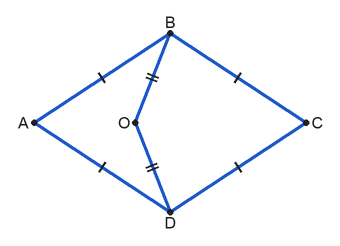
A point O is taken inside a rhombus ABCD such that its distances from the vertices B and D are equal. Show that AOC is a straight line.
 Solve with AI
Written solution
Solution:
Concept: S.S.S. test: if all three sides of one triangle equal the three sides of another, the triangles are congruent. Two adjacent angles that add up to 180° have their outer arms in one straight line.
Given: ABCD is a rhombus and O is a point inside it with OB = OD.
Step 1 — Show ΔAOB ≅ ΔAOD.
Join OA, OB, OC and OD.

AB = AD (sides of a rhombus)
OB = OD (given)
AO = AO (common)
So ΔAOB ≅ ΔAOD by S.S.S., and by C.P.C.T.C. ∠AOB = ∠AOD. Call this (1).
Step 2 — Show ΔCOB ≅ ΔCOD.
CB = CD (sides of a rhombus)
OB = OD (given)
CO = CO (common)
So ΔCOB ≅ ΔCOD by S.S.S., and by C.P.C.T.C. ∠COB = ∠COD. Call this (2).
Step 3 — Add the angles round O.
The four angles round the point O add up to 360°.
Replace ∠DOA by ∠AOB (from (1)) and ∠COD by ∠BOC (from (2)).
Halve both sides.
Step 4 — Conclude.
∠AOB and ∠BOC are adjacent angles with the common arm OB, and they add up to 180°. So the other arms OA and OC lie on one straight line.
Watch out: Do not assume O is on AC; that is what has to be proved. Use only the angles round O.
Therefore, AOC is a straight line. Hence shown.
What Class 9 Maths Ch 9 covers
The sections of the chapter, in the order the book takes them. Every question above comes from one of these.
- 01Relation Between Sides and Angles of Triangles
- 02Some Important Terms
- 03Congruent Triangles
- 04Conditions for Congruency of Triangles
More ways to study this chapter
The same chapter asked three other ways. Practise it, revise it, and see what the board has set on Ch 9 before.
Class 9 Maths Ch 9 questions students ask
How many questions are there in Class 9 Maths Ch 9?
42 questions. Every one is solved step by step on this page.
Are these Class 9 Maths solutions free?
Yes. Every question and its full working is free to read, with no account needed.
Can I download the Class 9 Maths Ch 9 solutions as a PDF?
There is no PDF to download. Every solution is on this page instead, which means it is searchable, always the current syllabus, and readable on a phone. Use your browser's print option if you want it on paper.